
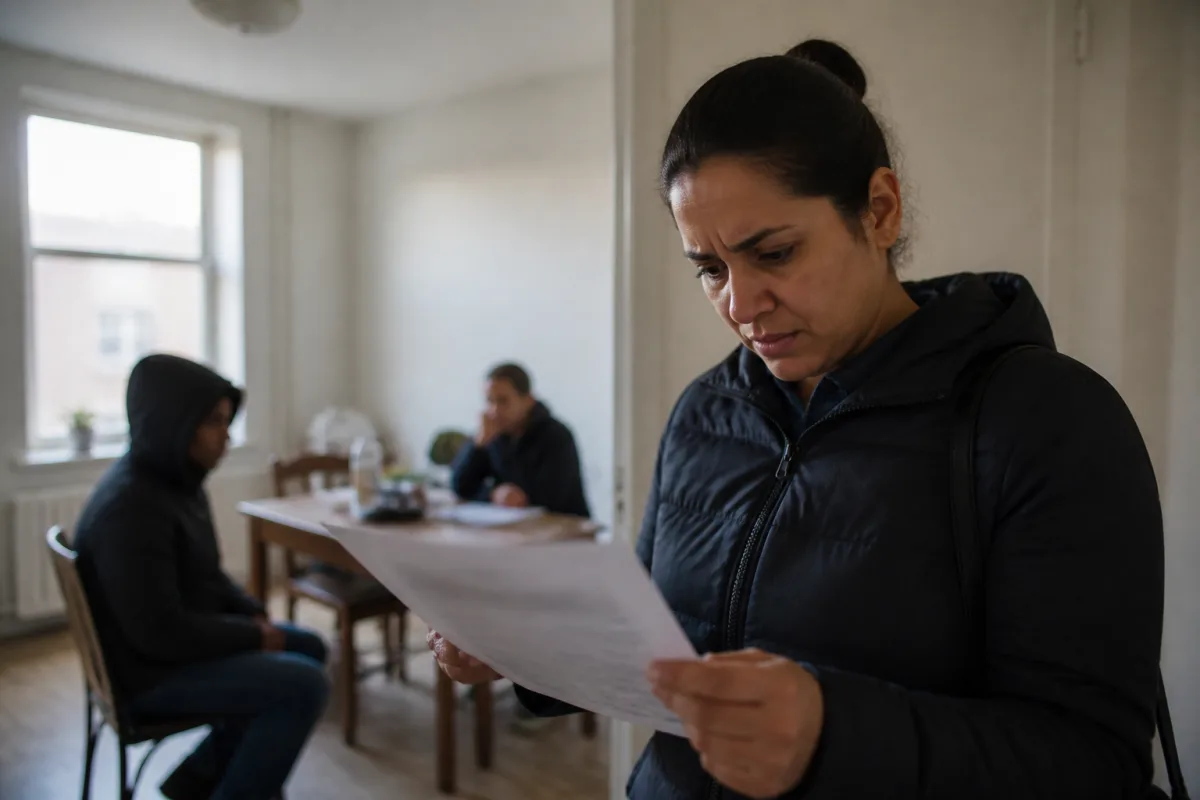

In 2026, US authorities are denying asylum more often through procedural tactics — short interview notices, tight document deadlines, hearings rescheduled without warning, and new grounds for removal to third countries introduced this summer.
In short
- The interview notice is mailed to the first address on file — if you’ve moved, it may never reach you, so check the case status yourself once a week.
- “Short notice” gives applicants 3 to 14 days to prepare, regardless of how many years they’ve waited for the interview.
- Since August 21, 2026, all case documents must be submitted no later than 14 days before the interview.
- Asylum offices can refer a case straight to court, skipping the interview entirely, based on criteria that aren’t publicly disclosed.
- Since August 2026, a missing lawyer at a hearing no longer guarantees an automatic continuance — exceptional circumstances must be proven.
Interview Notices Go to Your Old Address
The notice to appear for an asylum interview is mailed to the first address the applicant listed on the form — the one that was current at the time of filing. By the time an interview is scheduled, applicants have often moved once or more, and the letter to the old address simply never arrives. As a result, the applicant never learns the interview date, fails to appear, and the case gets referred to court — even though the applicant still believes they’re waiting to be called.
Relying on a paper notice alone is risky — it’s worth checking the case status in the online system yourself at least once a week, ideally more often. That’s the only reliable way to catch that an interview has been scheduled, or already happened, in your absence.
The notice is mailed to the first address you listed. Moved since filing? The letter won’t find you, and the case can go to court without your knowledge.
Don’t rely on a paper letter — log into the online case status system at least once a week.
Short Notice: An Interview in 3 to 14 Days
The second tactic is known as “short notice,” and it’s been in use for about a year. An applicant checks their mailbox after filing for asylum and finds a call to interview — with a date that leaves very little time: sometimes around two weeks, sometimes only a few days.
In that window, building a case from scratch, gathering evidence, and preparing answers for the officer’s questions is nearly impossible. The problem is widespread: applicants get a short notice regardless of how long they’ve waited for their interview — one year, two, five, or seven.
The only way to avoid being caught off guard is to treat the case as ready today, without waiting for the actual notice to arrive. It can come at any moment, and the applicant will need to show up at the office within days of receiving it.
The only way to avoid being caught off guard is to treat the case as ready today, without waiting for the actual notice to arrive.
All Evidence Due No Later Than 14 Days Before the Interview
As of August 21, 2026, a new administrative rule requires asylum applicants to submit all case documents no later than 14 days before the interview date. The rule compounds the short-notice problem described above — an applicant can learn of the call and simultaneously find themselves required to assemble a complete evidence package within days.
The measure appears to serve two goals at once: pushing more cases into immigration court to lighten the load on asylum officers, and prompting some applicants to give up the fight for status and leave the country on their own.
Evidence Submission Deadline Before the Interview
As of August 21, 2026, applicants must submit all documents ahead of time rather than by the interview date itself.
- Deadline to submit case documents
All case evidence must be submitted no later than 14 days before the interview — even if you learned of the interview only days before that deadline.
A Case Can Go to Court Without an Interview at All
Asylum offices now have the authority to refer a case to court, skipping the interview entirely. For the applicant, this means the interview they’ve been waiting months for may simply never happen — the case goes straight to immigration court. Authorities have defined a set of characteristics that trigger this referral, but the list of criteria itself isn’t part of the public rule. What’s worth remembering: waiting for an interview is no guarantee that one will ever be scheduled.
Hearings Get Rescheduled Without Written Notice, and a Missing Lawyer No Longer Guarantees a Delay
In 2026, authorities have been moving individual asylum hearings from distant dates to much closer ones — without written notice to the applicant. There’s only one way to learn of the new date: check the case status in the court system yourself. Missing a hearing means a decision issued in the applicant’s absence, so checking status regularly, several times a week, is recommended.
The second tactic concerns those who show up to a hearing without a lawyer and expect the date to be pushed back. Previously, lacking a lawyer was itself a legally sufficient reason for a continuance, and the judge was required to grant one. As of August 2026, the standard for rescheduling has tightened: where the absence of a lawyer alone used to be enough, applicants now need to demonstrate exceptional circumstances rather than just good cause. In the first 45 days after a missed interview the standard is more lenient; after that, the requirements get stricter.
Missing a Lawyer at the Hearing
Since August 2026, the standard for rescheduling due to a missing lawyer has become stricter.
- Grounds for a hearing continuanceFirst 45 days after a missed hearing — the standard is more lenient
In 2026, hearings are being moved to earlier dates without written notice. Miss it, and a decision will be issued in your absence.
Pretermission: Cases Closed and Removal Ordered Without Any Hearing
A separate tactic from hearing reschedules is pretermission: authorities can close an asylum seeker’s case and issue a removal order without holding any court hearings at all. The applicant isn’t called to court and doesn’t learn of the pretermission in advance — they simply receive an already-final in-absentia decision denying asylum and ordering removal. Practitioners estimate that the number of people affected by cases closed this way could run into the tens of thousands, though no official statistics on this figure exist.
The applicant isn’t called to court and doesn’t learn of the pretermission in advance — they simply receive an already-final in-absentia decision denying asylum and ordering removal.
Removal to Third Countries Under a New Precedent
Since 2025, authorities have had the power to remove a certain category of asylum seekers to third countries — not to their home country, but to another state entirely. The basis is a new Board of Immigration precedent: it’s what opened the door to closing a case without full review and sending a person to a third country.
For a period in 2026, this practice was applied broadly: cases were closed without a hearing specifically to enable such removals. Later, the intensity eased, and now, even with the precedent in place, removal to third countries can’t be called a mass phenomenon — authorities apply it selectively, without much publicity.
But the authority to carry out this kind of removal exists, and it is used. Applicants with weak, underdeveloped cases are most at risk — those are the cases most likely to become grounds for removal to a third country rather than a hearing on the merits.
Future-Persecution Claims Are Being Rejected More Harshly
In 2026, claims based on future persecution are being scrutinized especially closely. If the applicant hasn’t proven that, upon return home — as of the time the case is being reviewed, whether at interview or in court — they face a firm, serious threat, the case gets denied.
Authorities treat anonymous threats and summonses as weak evidence — they simply don’t work. Political claims also tend to fare poorly: authorities rely on a standing BIA (Board of Immigration Appeals) precedent under which persecution doesn’t have to be discriminatory in nature. In other words, an applicant may be persecuted not because of their political views but as part of ordinary criminal enforcement practice in their country — and in that case, the basis for asylum falls away.
Evidence Nitpicking: Too Little and Too Much Are Both a Problem
A separate cluster of objections concerns the quality and volume of evidence in an asylum case:
- Medical records lacking the necessary detail. If a record documenting detention at a protest doesn’t explicitly state that the applicant was beaten, authorities use that as grounds to deny the case.
- Copies instead of originals. Not having original documents on hand is, by itself, grounds for denial if the applicant only has copies.
- Originals without a clear account of how they were obtained. Even when originals exist, a denial can follow if the applicant can’t clearly and coherently explain how they got them, or if the account itself raises doubts for the reviewer.
- Too little evidence. A case is denied if the facts and supporting materials fall short.
- Too much evidence. Paradoxically, excessive detail — where every phrase and every episode is backed by a separate document — also becomes grounds for denial.
Paradoxically, excessive detail — where every phrase and every episode is backed by a separate document — also becomes grounds for denial.
The practical takeaway: building a winning case in 2026 under the current administration takes maximum effort — a single, calibrated volume of evidence that looks sufficient without looking excessive. There’s an additional condition: the case must remain current as of the date it’s actually reviewed, not the date it was filed.
Aim for exactly the right volume of evidence: both too little and excessive detail on every episode can equally become grounds for denial.
Common Evidence Nitpicks in Asylum Cases

Comments
Reader experience is useful, but it is not advice: check the rules on the official site.
No account needed: click Sign in, type any name, and you are done.