
In the 2026 Italia OGI quality-of-life rankings, the northern province of Bolzano took first place, Milan slipped to second, Rome came in thirtieth, and Naples ranked ninety-eighth.
In short
- Bolzano scored the maximum 1.000 points, overtaking Milan, which had led in 2024 and 2025.
- Of 107 provinces, only 60 are rated as having good or acceptable quality of life; all 21 of the worst-ranked provinces are in the south or on the islands.
- Bolzano leads in five categories, but rents there are high and German is widely spoken in the region.
- Potenza is named the safest province and Ancona the best for healthcare — a province’s overall rank doesn’t reflect how it performs in individual categories.
- Belluno posted the biggest jump of the year, climbing 29 spots from 60th to 31st.
What the Italia OGI ranking measures and how it’s calculated
The annual quality-of-life ranking from the Italian outlet Italia OGI came out on November 15 — the 28th edition of the study. It’s published jointly with Ital Communications and Rome’s La Sapienza University.
Despite the familiar headlines about “cities,” the ranking actually covers provinces: Milan’s result includes not just the city itself but its entire surrounding province — the same goes for every other entry on the list. In total, 107 provinces were assessed across 92 indicators, grouped into nine categories: business and employment, environment, education, demographics, crime, income, social welfare, healthcare, and tourism and culture.
That’s exactly why the ranking doesn’t match tourist lists of “Italy’s best places.” A beautiful coastline, mild climate, and historic architecture don’t on their own earn a high score — researchers aren’t measuring tourist appeal, but everyday living conditions: how easy it is to find work, how safe the streets are, how accessible healthcare is, and what local income levels look like.
Italia OGI scores 107 provinces on 92 indicators across 9 categories — not tourist appeal, but everyday living conditions: jobs, safety, healthcare, income.
Top 10 provinces in the 2026 ranking
| Rank | Province | Year-over-year change | Notable detail |
|---|---|---|---|
| 10 | Verona | — | makes the top 10 |
| 9 | Monza and Brianza | — | makes the top 10 |
| 8 | Parma | — | makes the top 10 |
| 7 | Florence | — | the only Central Italy province in the top 10 |
| 6 | Rimini | — | often seen as a summer resort town, but it climbed on the strength of its tourism economy, jobs, infrastructure, and services |
| 5 | Trento | — | makes the top 10 |
| 4 | Padua | — | notable rise this year |
| 3 | Bologna | unchanged | held last year’s result; ranked first in Italy for education |
| 2 | Milan | topped the ranking in 2024 and 2025, now ceded the lead | strengths: income, jobs, business, universities, transport; weaknesses: expensive housing, the pace of city life, crime issues |
| 1 | Bolzano | — | the winner is broken down in the next section |
Of the top 10, only Florence represents Central Italy — the rest of the spots are split between the north and Rimini, the sole southern resort town to make the cut. Rimini moved up the rankings this year: what secured its spot wasn’t beach infrastructure but jobs and services for year-round residents. Padua rose this year, while Bologna held third place for a second year running, leading the country on education.
Milan sits in second place — a city with a mixed scorecard: high income, strong employment and transport, weighed down by expensive housing and crime problems. Before 2026, Milan had led the ranking for two consecutive years, in 2024 and 2025.
Top 10 provinces in the Italia OGI 2026 ranking
Table scrolls sideways
| Rank | Province | Year-over-year change | Notable detail |
|---|---|---|---|
| 1 | Bolzano | — | Maximum score of 1.000, leads in five categories |
| 2 | Milan | Ceded the lead after 2024–2025 | Strengths: income, jobs, transport; weaknesses: housing, crime |
| 3 | Bologna | Unchanged | Ranked first in Italy for education |
| 4 | Padua | Rose this year | — |
| 5 | Trento | — | Makes the top 10 |
| 6 | Rimini | Rose this year | Climbed on jobs and services, not beaches |
| 7 | Florence | — | Only Central Italy province in the top 10 |
| 8 | Parma | — | Makes the top 10 |
Why Bolzano came out on top
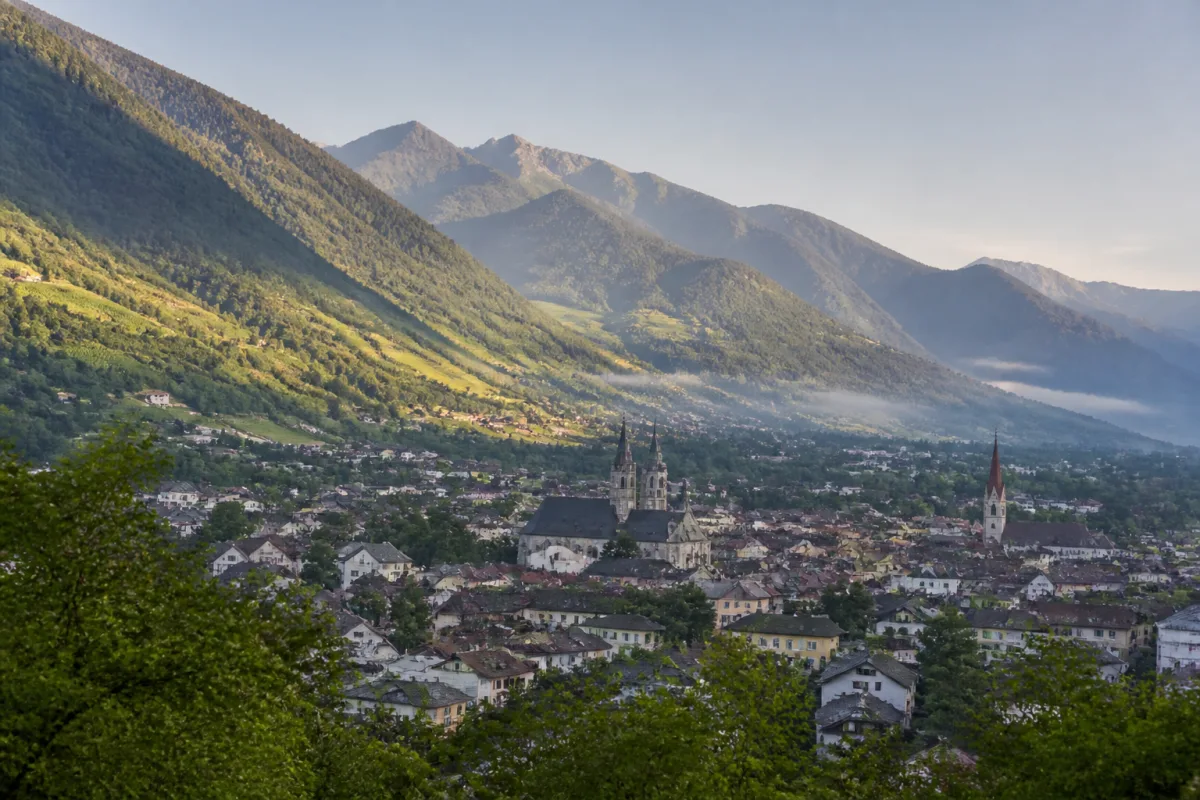
The winner of the 2026 ranking is the province of Bolzano (Bozen) in South Tyrol — it earned the maximum possible score of 1.000 points. Bolzano leads in five categories at once: business and employment, environment, demographics, income and wealth, and tourism and culture. This isn’t a one-off: the province has topped the ranking before, prior to Milan taking the lead in 2024 and 2025.
There’s a nuance worth knowing for anyone actually considering a move here. South Tyrol is a distinct territory where German is widely spoken, and that’s worth factoring in when job-hunting in the region.
Housing in Bolzano is expensive: in 2026, rental cost per square meter became a new negative indicator in the methodology specifically because of how high prices have climbed in the province. Topping the ranking doesn’t mean Bolzano will be an equally good fit for every newcomer: strong scores on the economy and environment come alongside a language barrier and steep rents.
Bolzano took first place, but housing there is expensive and German is widely spoken in the region — worth factoring in if you’re job-hunting there.
Safety and healthcare: separate rankings within the ranking
The study’s safest province is Potenza in Basilicata, with Enna in Sicily — a town often described as one with mafia ties — in second place. Third place for safety went to Cuneo in Piedmont, in the north.
with Enna in Sicily — a town often described as one with mafia ties — in second place
Meanwhile, Milan, Rome, Florence, Bologna, and Turin all landed among the provinces with the lowest scores for crime and safety, with Trieste coming in last on that measure. That’s just a statistic, not a claim that Trieste’s streets are dangerous — but it shows how sharply individual indicators can diverge from a province’s overall reputation.
A similar pattern shows up in healthcare. Ancona ranks first for healthcare quality, Siena second, and Catanzaro in Calabria third. Yet Catanzaro itself sits only around 8th–9th in the overall ranking — proof that a province with a middling overall position can still lead an individual category.
Benevento came out on top for social welfare. Even in the south, despite the region’s broader economic struggles, individual provinces still have standout strengths in specific areas.
How regional standings shifted this year: Piedmont, Liguria, and a record climb
In Piedmont, Turin sits 26th in the overall ranking, Cuneo 43rd, Asti 69th, and Alessandria 72nd. Yet Cuneo, which doesn’t even crack the top 40 overall, ranks 5th in Italy for business and employment conditions and 3rd for safety. For someone looking for work or planning to start a business, Cuneo could turn out to be more appealing than cities that sit well above it in the overall table — the final rank is built from many categories combined and doesn’t capture a province’s individual strengths.
Cuneo could turn out to be more appealing than cities that sit well above it in the overall table
Neighboring Liguria didn’t make the leaders’ circle: Genoa is 52nd, La Spezia 53rd, Savona 62nd, and Imperia 65th.
| Province | Region | Year-over-year change |
|---|---|---|
| Belluno | Veneto | +29 (from 60th to 31st) |
| Pistoia | Tuscany | +18 |
| Venice | Veneto | +16 |
| Lucca | Tuscany | −18 |
| Cremona | Lombardy | −16 |
| Potenza | Basilicata | −12 |
| Sassari | Sardinia | −12 |
The biggest riser this year was Belluno in Veneto — it jumped 29 spots, from 60th to 31st. The opposite happened with Lucca, down 18 places, and with Cremona, Potenza, and Sassari, which fell 16 and 12 places respectively. Moving a few spots up or down a ranking doesn’t by itself mean conditions in a province suddenly got worse — a province’s position also depends on how its neighbors in the ranking performed and on the study’s methodology.
Cuneo is only 43rd overall, but 5th for business conditions and 3rd for safety. For a job search, category scores matter more than the final number.
The gap between northern and southern Italy
Of the 107 provinces in the ranking, only 60 are rated as having good or acceptable quality of life. The rest fall into groups with middling or poor results, and here the ranking traces a clear geographic line.
All 22 provinces of northeastern Italy land in the two top-rated groups — not a single one falls below. The picture is reversed in the south: all 21 provinces with the lowest scores are located in the south of the country or on the islands.
all 21 provinces with the lowest scores are located in the south of the country or on the islands
Among major southern cities, the standings look like this:
- Bari — 68th place;
- Naples — 98th place;
- Palermo — 102nd place;
- Foggia, Crotone, and Taranto occupy the bottom three, with Taranto dead last at 107th overall.
Sardinia shows a similar split: Cagliari ranks 63rd, Nuoro 87th, and Sassari 88th. Yet in a separate, more prestige-focused ranking, Cagliari is one of the few southern cities to score highly — not the most impressive showing for an island with some of the most beautiful beaches in the Mediterranean. Tourist appeal and the conditions of everyday living are two different things, and a low spot in a quality-of-life ranking doesn’t mean life in the south can’t be good. It reflects differences in economic opportunity, services, and social infrastructure between regions.
The gap between northern and southern Italy
Of 107 provinces, only 60 have good or acceptable quality of life.
- Northeastern provinces in the top two groups22 of 22
- Southern and island provinces among the worst21 of 21
- Total provinces with good or acceptable quality of life60 of 107
Why a ranking isn’t a personal recommendation
A province moving a few spots up or down doesn’t by itself signal a real change in quality of life: its position also depends on how neighboring provinces performed and on the study’s methodology. A sharp jump or drop for a given province in a single year shouldn’t be read as proof that life there suddenly got better or worse.
Choosing where to move based purely on table position isn’t a good idea. It all depends on who’s moving, what they do for work, how much they earn, and what they expect from Italy: a young professional cares about the job market, a family with kids about schools, healthcare, and safety, a retiree cares about entirely different things, and a remote worker might not need a big city at all.
Bolzano’s first-place finish is the result of a statistical study, not a universal recommendation to move there specifically. A high ranking reflects averaged indicators across the economy, services, and infrastructure — it doesn’t account for any one person’s actual circumstances.
A ranking reflects averaged economic and service indicators. The right city depends on who’s moving: a professional needs a job market, a family needs schools and healthcare, a retiree needs something else entirely.
Frequently asked questions
Can you move to Bolzano without knowing German?
The ranking doesn’t assess this, but there’s an important nuance: South Tyrol is a distinct territory where German is widely spoken. That’s worth factoring in when job-hunting in the region, even if the province leads the country on most other measures.
Why might a highly ranked city not be the right fit for me personally?
The final position reflects averaged indicators across the economy, services, and infrastructure — not a recommendation tailored to any one person. The right choice depends on what you do, how much you earn, and what you expect from the move: a young professional cares about the job market, a family about schools and healthcare, a retiree about something else entirely.
Can the overall ranking tell you how easy it is to find a job or affordable housing there?
No: the final rank is built from nine categories combined, and a province with a middling overall position can still lead an individual category. Cuneo, for example, is only 43rd overall but 5th for business and employment conditions and 3rd for safety — on those measures it beats cities ranked well above it.
Does a low ranking for a southern Italian province mean you can’t live comfortably there?
No. A low position reflects differences in economic opportunity, services, and social infrastructure between regions — it doesn’t mean life there is bad. Tourist appeal and everyday living conditions are different things: Cagliari, for instance, ranks highly in a separate, more prestige-focused ranking among southern cities.
Roughly how much does it cost to rent an apartment in Bolzano?
As of October, the average asking rent in the city of Bolzano itself exceeded €16 per square meter, putting a 60 sq m apartment at roughly €1,000 a month. That’s one reason the province’s win in the ranking doesn’t mean it will be an equally good fit for every newcomer.
Can this year’s results be compared directly with past years?
Partly, but with caution: a province’s position depends both on how its neighbors in the ranking performed and on the study’s methodology. A sharp rise or fall in a single year isn’t direct proof that life there suddenly got better or worse.
Comments
Reader experience is useful, but it is not advice: check the rules on the official site.
No account needed: click Sign in, type any name, and you are done.