
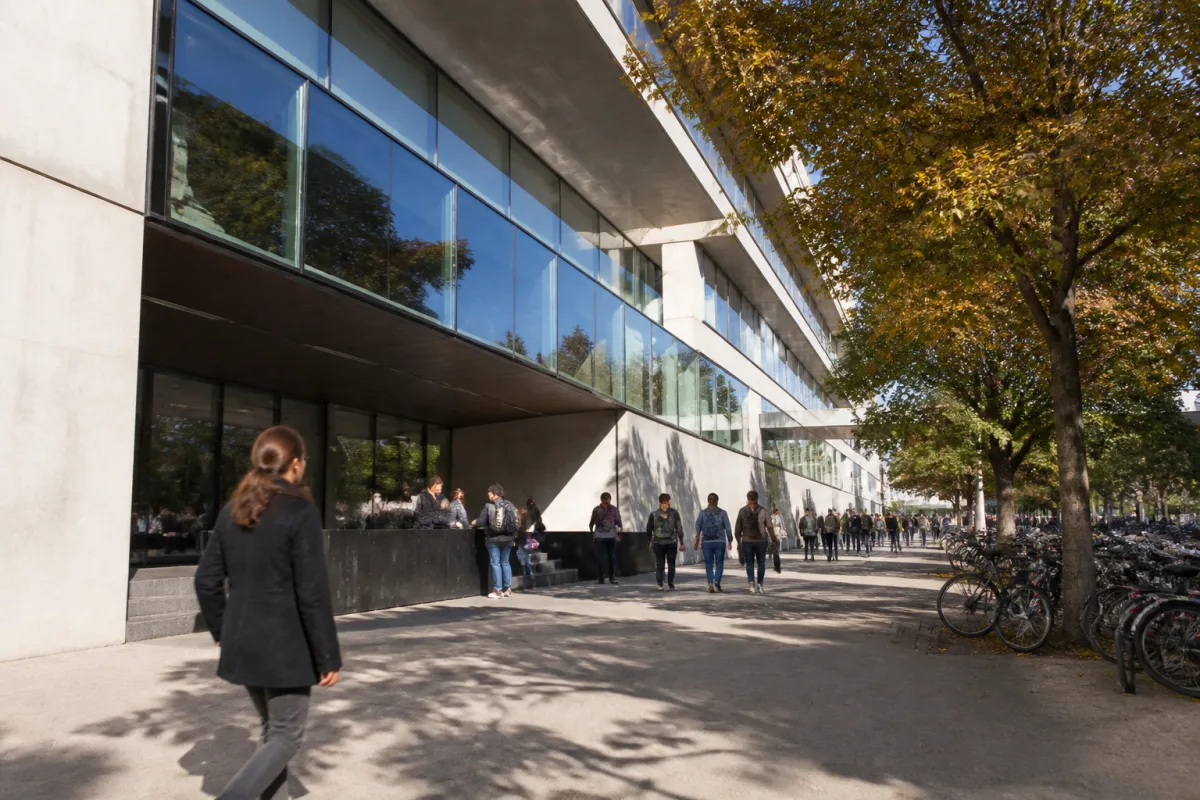

Russian school graduates can start a bachelor’s degree in five countries without a mandatory preparatory year. Spain and France require additional procedures for diploma recognition, Hungary offers access to fully funded programs, China has a comprehensive scholarship system for foreigners, and Austria allows each university to evaluate documents independently.
Spain: accessible state universities in Spanish
After finishing Russian school, you can enrol in a Spanish university, but your Russian diploma requires official recognition. First, diplomas are authenticated and submitted for recognition to the Spanish Ministry of Education. After this, the UNAES system is used for admission, which helps universities evaluate documents from international applicants. Depending on the programme, additional exams in subject-specific areas may be required.
The procedure takes time, so it’s best to start the application process during 11th grade. State universities are affordable — for example, at the University of Granada, one year of bachelor’s study costs around 758 euros with a standard workload of 60 academic credits.
Spain is suitable for those willing to learn Spanish, looking for a state European university, and wanting affordable tuition costs.
Hungary: full government funding in English
One of the most interesting options for 11th-grade graduates. If you want to study in English and receive full government funding, Hungary offers complete bachelor’s programmes without a preparatory year. The choice of programmes in English is really extensive: business, economics, engineering, information technology, natural sciences. For example, Debrecen University offers more than 80 programmes in English.
The basis of your application consists of your diploma, transcript of grades and confirmation of English proficiency. Conditions vary depending on the programme: some universities conduct their own exam or interview.
Hungary’s main advantage is the Hungaricum scholarship. Russia officially participates in the programme, and Russian students have access to full bachelor’s programmes. The scholarship covers 100% of tuition costs, students receive a monthly allowance of approximately 50,000 forints, accommodation in a dormitory or housing compensation of 40,000 forints per month, as well as health insurance. For the 2027 intake, the deadline for applications was 15 January 2026, so documents should be prepared in autumn 2026.
Hungary is suitable for those who want to study in English and are considering the opportunity to receive full government funding for their studies.
China: systematic funding for international students
China is interesting for three reasons at once: you can enrol in a bachelor’s programme directly after school, there are programmes in English and there is a powerful scholarship system for international students.
To enrol, you need a secondary education diploma and to meet the requirements of your chosen university. You can study in Chinese or English. For Chinese-language programmes you’ll need the HSK exam; for English programmes the university will set its own language requirements.
China’s main advantage is scholarships. The most well-known is the Chinese Government Scholarship, China’s state scholarship. Full funding can include tuition payment, dormitory or housing assistance, health insurance and a monthly allowance. For a bachelor’s degree, this is 2,500 yuan per month. In addition to this, there are university, provincial and city scholarships.
It’s best to start preparation well in advance, while simultaneously checking the university’s requirements, exams and deadlines for suitable scholarships.
China is worth considering if you’re open to a new experience and want to minimise education costs through funding.
Austria: quality education at an affordable price
Austria is an option for those seeking quality European education at a very affordable cost. It has strong state universities with a familiar system: bachelor’s, master’s and doctoral programmes.
In Austria, there is no general rule that all students must complete a preparatory year after 11th grade. The university itself evaluates the documents. For example, Vienna University of Technology directly includes the Russian USE (Unified State Exam) in its list of documents confirming the right to enrol. If a university sees a difference between Russian education and its requirements, it may assign additional exams or a preparatory course. This is no longer a mandatory stage for each graduate, but rather a decision based on your individual application.
The main language of bachelor’s programmes is German. Depending on the university, a B2 or C1 level is required. There are also programmes in English, but the choice at bachelor’s level is smaller.
The main advantage for students from outside the EU: state universities cost around 750 euros per semester plus a mandatory student fee of around 25 euros. Total is roughly 1,500 euros per academic year.
Austria is particularly good for those seeking a strong education at a state European university without enormous tuition fees.
France: enrolment in the first year directly after school
France allows Russian graduates to enrol in university immediately after school without a mandatory preparatory year. The official source Campusfrance directly states that Russian school students can enrol in the first year of a French university on equal terms.
For the first year of a state university, the Parcoursup procedure is used. You need to create an electronic file, select programmes and submit documents to universities through this system. For the 2026 intake, Russian applicants for the first year submitted applications from 1 November to 15 December 2025. This is an important point: to enrol in autumn 2027, you need to start with France in autumn 2026, not after receiving your diploma in summer.
At bachelor’s level, most programmes are taught in French. For the first year, a B2 level is usually required. English-language programmes exist, but a wider range appears at master’s level.
For the 2026–27 academic year, the standard cost of a French bachelor’s degree for students from outside the EU is around 3,000 euros per year. Some universities may fully or partially exempt foreign students from the increased fee, so it’s worth checking the specific university’s rules.
France is suitable for those willing to learn French and wanting to enrol in university right after school.
How to choose: four main criteria
Completing 11 grades of Russian school doesn’t necessarily mean spending an extra year on foundation. But the ability to enrol after school doesn’t mean the conditions are the same everywhere.
In Spain, you need to have your diploma recognised. In China, an exam appears. In Austria, documents are evaluated by the specific university. And in France, applications for the first year open very early.
It’s better to choose a country not based on attractive description or rankings, but by immediately looking at four things: your education, language, budget and field of study. Then a list of dozens of countries quickly becomes just a few truly suitable options.

Comments
Reader experience is useful, but it is not advice: check the rules on the official site.
No account needed: click Sign in, type any name, and you are done.