
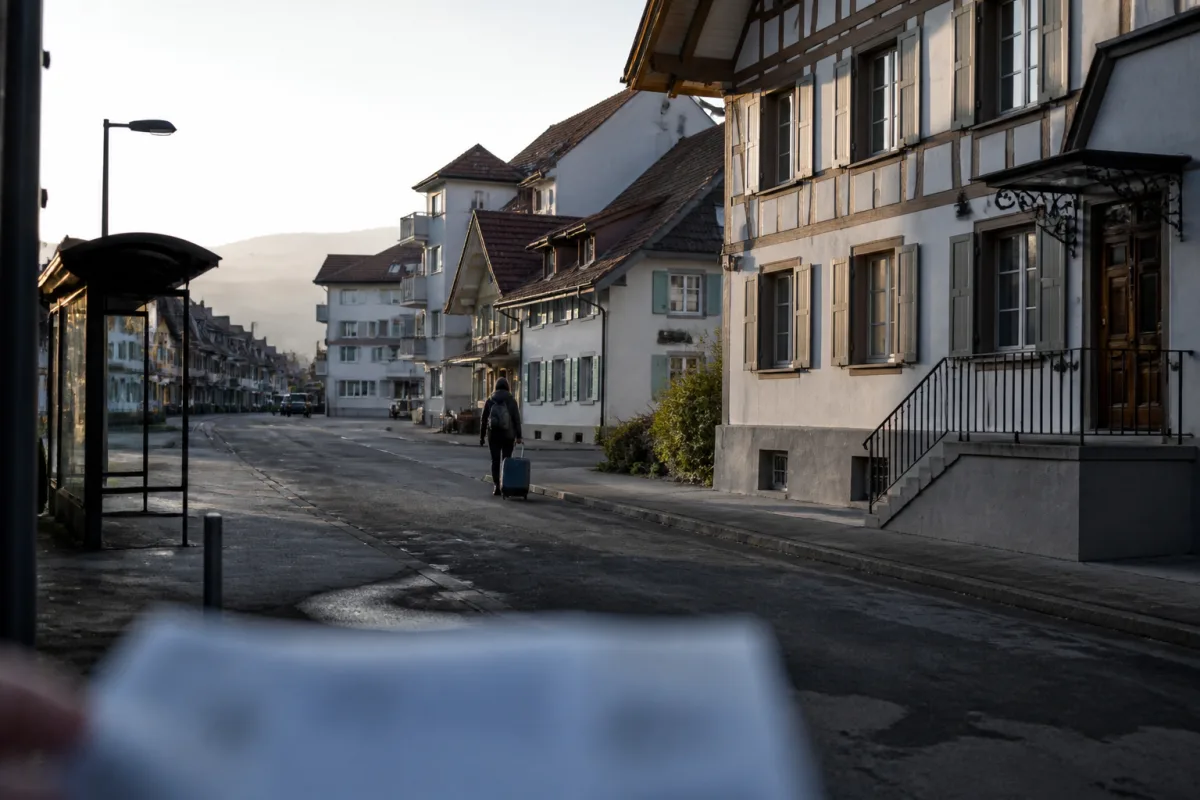

An EU citizen can move to Switzerland under the right of free movement as long as they have housing and a source of income, but for the first five years after leaving Germany, part of their income is still taxed there under a rule called überdachende Besteuerung.
In short
- An EU citizen has a legal entitlement to a B-Bewilligung given an employment contract, or sufficient financial means plus insurance.
- Registering a place of residence must happen within 14 days of arrival, and health insurance must be taken out no later than 3 months after the move.
- In marriage, one spouse automatically gets a B-Bewilligung from the other, but a joint tax filing is taxed at a higher rate — the Heiratstrafe.
- For the first 5 years after the move, Germany keeps the right to tax a German pension, shares, interest, and dividends — überdachende Besteuerung.
- A move typically pays off at an income from 250,000 francs a year — and even 350,000 francs isn’t a guaranteed win once expenses are factored in.
Who can move to Switzerland, and how much of a salary actually survives the move
Every EU citizen has a legal entitlement to a B-Bewilligung — a Swiss residence permit. This is not a discretionary approval granted at the authorities’ convenience but a right guaranteed once the conditions are met: an employment contract for those who will work, or sufficient financial means plus health insurance (including accident coverage) for those who won’t, so as not to become a burden on the state.
The move doesn’t have to be tied to employment. A person can relocate to Switzerland as a rentier, a retiree, or an entrepreneur — the entitlement to a B-Bewilligung still applies.
Spiegel’s first tip sounds simple: work out in advance, precisely, what will actually be left of a Swiss salary. The advice is sound, but the final number depends on several factors at once. Income from selling shares, securities, cryptocurrency, and gold is, in principle, not taxed at all in Switzerland — while entrepreneurs and the self-employed are still required to pay social security contributions. The tax system itself isn’t uniform either: rates differ from municipality to municipality and from canton to canton.
The cost of living adds another layer of complexity — it’s noticeably higher in Switzerland, especially when it comes to rent and childcare. In the end, how much actually stays in hand after the move depends heavily on individual circumstances: the type of income, the canton, and the size of the family. That’s exactly why the net balance needs to be calculated in advance and as precisely as possible — otherwise it can turn out that less is left over in Switzerland than would have remained in Germany or Austria on the same income.
How much stays in hand after the move depends on the type of income, the canton, and family size — there’s no single tax rate in Switzerland, and it’s easy to miscalculate without doing the math first.
Finding housing: where the move actually begins
Spiegel’s second tip is to find housing within budget, and this isn’t a formality — it’s the first practical step of the move. Housing is searched for before the residence permit, not the other way around: an apartment is secured first, and only then does the application for an Aufenthaltstitel go in. Without a place to live, there’s no way to plan the move in concrete terms anyway.
The cost of living in Switzerland is in places noticeably higher than in Germany and Austria, and rent is the main driver of that gap. In low-tax cantons, housing is expensive: in canton Zug, known precisely for its low taxes, rent for many apartments easily reaches 4,000–5,000 francs a month. It’s not just about price — in cantons like this, supply simply falls short, apartments are scarce, and affordable options get snapped up fast.
in canton Zug, known precisely for its low taxes, rent for many apartments easily reaches 4,000–5,000 francs a month
Large cities like Zurich can also be expensive, but affordable housing does turn up there. Smaller towns in cantons with less favorable tax rates rent out apartments at more moderate prices — but taxes there are correspondingly higher. Which option is better in a given case has to be worked out separately.
A foreigner with no Swiss credit history has a harder time finding housing: they have no local Bonität for landlords to rely on, and some landlords treat such applications warily. This is worth factoring in ahead of time, not discovering on arrival.
An apartment is found first, and only then does the application for an Aufenthaltstitel go in. Without an address, there’s no way to plan the move in concrete terms.
Registration deadlines, health insurance, and daycare: what the move actually costs
Spiegel’s third tip is to stick to the deadlines and formal rules of the move. Switzerland isn’t an EU member, but it’s part of the Schengen area and, through bilateral treaties, has adopted most EU rules, including the free movement of persons. So an EU citizen can move to Switzerland much like to any other EU country — but the order of steps matters. The 14-day deadline for registering a place of residence runs from the date of arrival in Switzerland, and for those taking up employment it must be completed before the job starts — which is why housing should be lined up ahead of time, not after arrival. Once registered, the residence permit application is reviewed against the conditions — an employment contract, or financial means plus insurance — so supporting documents are worth preparing in advance.
A separate obligation is to take out health insurance no later than three months after the move; as long as this deadline is met, the policy applies retroactively from the date of the move. Switzerland has no state insurance system: coverage is purely private, and every family member is insured separately — there’s no such thing as a family policy, although children get lower rates. The minimum cost of insurance per person is around 300 francs.
All insurers are required to offer a basic plan, including to people with chronic conditions: the scope of basic coverage is set by law and is the same for everyone. Beyond the basic plan, extra options can be added — homeopathic remedies, say, or direct access to a specialist without a referral — but those come at extra cost. The premium also depends on the deductible (the amount paid out of pocket before coverage kicks in): the higher the deductible, the cheaper the insurance. For example, agreeing to cover the first 2,500 francs of treatment yourself noticeably lowers the premium. Dental care isn’t part of basic coverage. That said, for people who were paying for voluntary or private insurance in Germany, the Swiss system often ends up cheaper and delivers better service on average.
Spiegel’s fifth tip concerns daycare: in financial terms, it really can hit the budget hard. Caring for one child in Switzerland often costs 2,000 francs a month or more, because the state doesn’t subsidize it. This is worth building into the relocation budget in advance for anyone planning to put children in daycare after the move. Switzerland isn’t unusual here: a similar picture exists in the UK and the US, where the state likewise offers little support for childcare — unlike Germany and Austria.
Formal deadlines and minimum amounts after the move
What needs to be done, by when, and roughly how much to budget after moving to Switzerland.
- Registering a place of residence14 days from date of arrival
- Taking out health insuranceno later than 3 months after the movepolicy applies retroactively
- Minimum insurance cost per personaround 300 francs
- Lower premium with a deductiblefrom 2,500 francsif willing to cover initial costs out of pocket
- Daycarefrom 2,000 francs a monthnot subsidized by the state
Caring for one child often costs 2,000 francs a month or more — the state doesn’t subsidize it, so this is worth budgeting for in advance.
What to do in the first months after the move
Marriage, partnership, and taxes: what changes when moving as a couple
Switzerland has no German-style joint taxation of spouses: Ehegattensplitting doesn’t apply here. Instead, what’s known as the Heiratstrafe (marriage penalty) kicks in — when a married couple files jointly, their income is combined and taxed at a higher progressive rate. For couples where both partners earn comparably well, this means a noticeably higher tax bill than the same two people would pay unmarried, without a stamp in their passports. The issue is contentious enough that Switzerland is heading toward a referendum on reworking this rule — by the time of a move, the vote may already be behind us.
when a married couple files jointly, their income is combined and taxed at a higher progressive rate
With residence permits, the situation runs the other way: marriage makes things easier. If one spouse holds a B-Bewilligung, the other gets the same permit automatically. An unregistered partner doesn’t get this privilege — a Lebenspartner doesn’t count as a spouse for immigration purposes. There’s one way around it: if both partners have jobs in Switzerland, each applies for a B-Bewilligung separately, as an independent applicant. The process ends up longer than an automatic extension to a spouse, but for couples who deliberately don’t marry — including for tax reasons — this is, in practice, the only route to get both partners a permit.
Language, local mentality, and everyday habits: Spiegel’s tips 7 through 12
Spiegel’s seventh tip is to understand Swiss German, even without planning to speak it. This points to a common mistake Germans make: arriving in Switzerland, they decide Swiss German isn’t that hard and that they understand it fine — in reality, the person they’re talking to has simply switched to standard German. The gap between Hochdeutsch and Schweizerdeutsch can be very wide and varies by region: the best-known example is the standard German word for Kuchenkasten (a pastry cupboard), which in dialect comes out as something like “Hucheli.” There’s no need to worry too much about it: within a couple of years of living in Switzerland at the latest, understanding the dialect by ear stops being a problem, and it’s perfectly fine to answer in standard German. Living in the country without any German at all is also possible — plenty of Brits and Americans do exactly that — but knowing the language clearly makes everyday life easier.
Spiegel’s eighth tip is to master the subjunctive mood, illustrated with a line from a bakery: “Wenn Sie so gut sein wollten, ich hätte gerne noch zwei Gipfeli.” This tip can be considered beside the point for a successful move: a grammatical form of speech has no bearing on whether the relocation itself succeeds.
The ninth tip is to find common ground with locals and keep in mind that the Swiss carry certain preconceptions, not always positive, shaped by experience with the large numbers of Germans who have moved there. It’s a universal recipe for any country, not just Switzerland: behave like a good guest — no arrogance, no insisting on your own assumptions, more listening and observing, adapting where it’s called for. In practice, relationships with Swiss colleagues, service providers, and clients don’t necessarily turn out as difficult as sometimes described — but the cultural differences are real and worth respecting.
The tenth tip concerns online shopping: Switzerland isn’t in the EU, so ordering from online stores in EU countries means budgeting for extra customs duties, taxes, and shipping costs. The same issue comes up with cross-border shopping at German supermarkets near the border — Lidl, Aldi, EDEKA — where groceries are noticeably cheaper. German VAT can be reclaimed on purchases made in Germany, but goods brought into Switzerland must be declared, and the duty-free thresholds for such imports are relatively low.
The eleventh tip is to install Twint, a payment app popular in Switzerland: as in many other countries, QR-code payments work almost everywhere here, and Twint is well suited for it. The twelfth tip is almost self-evident — carry a reusable water bottle instead of buying water in a shop: drinking fountains are widespread across Switzerland, and bottles can be refilled there for free.

Überdachende Besteuerung: the five-year tax trap Spiegel left out
Moving from Germany to Switzerland triggers a special rule under the German-Swiss double taxation treaty — überdachende Besteuerung. It keeps broad German taxing rights in place for the first 5 years after the move to Switzerland. The exact way the rule applies depends on the specific situation and needs individual review, but a few examples show the underlying logic.
A German retiree who moves to Switzerland keeps paying German tax on their German pension for the first 5 years, not only Swiss tax. Only once that period is over does the right to tax the pension pass fully to Switzerland.
The same logic extends to income that would normally stop being taxed in Germany once unlimited tax liability there ends. One example is income from selling German shares. For a Swiss resident, selling shares is generally tax-free — but if the shares are German, that income is still taxed in Germany for the first 5 years after the move: the Abgeltungssteuer applies, 25% plus a solidarity surcharge. The same rule applies to other German-sourced income — interest and dividends.
Income from renting out German real estate is a separate matter. It stays taxable in Germany regardless of the move, and is taxed there no matter how many years someone has already lived in Switzerland — this is limited tax liability, which has nothing to do with überdachende Besteuerung: it’s a separate provision of the same double taxation treaty.
For entrepreneurs there’s an extra layer of complexity: a move also triggers the Wegzugsteuer (exit tax) and Entstrickungsbesteuerung — taxation triggered by moving assets out of German tax jurisdiction.
Überdachende Besteuerung: the 5-year window after the move
How long Germany keeps the right to tax certain types of income after a move to Switzerland.
- German pension5 yearsthen the right passes to Switzerland
- Income from selling German shares5 yearsAbgeltungssteuer 25% plus solidarity surcharge
- Interest and dividends from Germany5 years
- Income from renting out German real estateindefinitelylimited tax liability, unrelated to the 5-year rule
After the move, Germany keeps the right to tax a pension, income from German shares, interest, and dividends for 5 more years — this isn’t a formality, it’s überdachende Besteuerung under the double taxation treaty.
Who actually benefits from moving to Switzerland
A move to Switzerland only pays off at a fairly high income level — this is a practical observation, not a formal rule. One client used 250,000 francs a year as a rough benchmark: below that, in his experience, staying in Germany works out better. The consultant himself stresses this isn’t a precise threshold, just a rough figure for general orientation.
A high salary on its own guarantees nothing. One client — an executive with a job offer in Switzerland worth 350,000 francs a year — ultimately turned the move down: once the cost of living and other financial consequences were factored in, it simply didn’t pay off for him and his family. In Germany he earned less, but after all expenses were deducted, he was left with more in hand.
In Germany he earned less, but after all expenses were deducted, he was left with more in hand
This is a single case, and it can’t be turned into a general rule — Switzerland doesn’t suit everyone. The takeaway from both examples is the same: if the point of the move is to genuinely save on taxes, the math needs to be done in detail and in advance, factoring in the specific salary, the cost of living, and the five-year trap described above — not based on the country’s general reputation as a tax haven.
Frequently asked questions
Can you move to Switzerland without an employment contract, for example as a retiree or rentier
Yes, a B-Bewilligung isn’t tied to employment: a move is possible as a rentier, a retiree, or an entrepreneur. The main condition for those not working is sufficient financial means plus health insurance, so as not to become a burden on the state.
Can one insurance policy cover the whole family in Switzerland to save money
No, there’s no such thing as a family policy in Switzerland: coverage is purely private, and every family member, including children, is insured separately. Children do get lower rates than adults, though.
What happens once the five years of überdachende Besteuerung are up
Once the five years are over, the right to tax passes fully to Switzerland — this is shown clearly with a German pension: it’s taxed in Germany for the first five years, after which Germany loses the right to tax it. The same logic applies to other types of income, unless a separate rule applies instead, as with rental income from German real estate.
Can a couple file taxes separately if both want to live in Switzerland and avoid the Heiratstrafe
The material describes the Heiratstrafe as a consequence specifically of filing a joint tax return — income is combined and taxed at a higher progressive rate. For couples who don’t want to marry for tax reasons, the separate route is to stay unmarried and apply for residence permits individually, as independent applicants, provided both already have jobs in Switzerland.
Comments
Reader experience is useful, but it is not advice: check the rules on the official site.
No account needed: click Sign in, type any name, and you are done.