

If squatters have entered your property in Spain, the first 48 hours after entry are decisive — call the police for immediate eviction without a court order, and if that window is missed, prepare for a court process that has become significantly faster since 2025 thanks to Law 1/2025 and a new Supreme Court ruling on cutting off utilities.
In short
- Law 1/2025 requires a squatter to be summoned before a judge no later than 15 days after a complaint is filed, with a ruling issued within 3 days of the hearing.
- On June 24, 2026, the Supreme Court allowed cutting off electricity, water, and gas to those living in a property with no legal basis whatsoever.
- Immediate eviction without a court order is only possible within the first 48 hours and only for invasion of an occupied home (allanamiento de morada).
- The key mafia sells access to vacant properties for €1,000–2,000, and payoffs to squatters can reach 10% of a property’s value.
- The main risk factor is not the neighborhood or the class of the property, but the fact that it sits empty for long stretches without the owner living there.
What changed in 2025–2026: Law 1/2025 and the Supreme Court ruling
In April 2025, Organic Law 1/2025 came into force in Spain. It moved cases of home takeover and unlawful occupation onto a fast-track criminal procedure — replacing a process that used to take around two years on average.
The new law removed courts’ obligation to check squatters’ vulnerability before eviction in criminal cases: previously, a ruling had to wait for a social services report, which slowed the case down. Protection for families with children, victims of violence, and people with no alternative housing has been kept in place, though — for this category, immediate eviction may still not happen.
On June 24, 2026, Spain’s Supreme Court settled a separate dispute: whether electricity, water, and gas can be cut off to squatters. Courts across the country had previously ruled inconsistently — acquitting owners in some regions, convicting them of coercion in others. The Supreme Court ruled that if a person is in a property with absolutely no legal basis — no contract, no permission — the owner is entitled to disconnect utilities or simply stop paying for them, and this will not count as criminal coercion. The court’s logic is simple: the law cannot force the victim of a takeover to fund the lifestyle of the person who robbed them.
The court’s logic is simple: the law cannot force the victim of a takeover to fund the lifestyle of the person who robbed them.
Law 1/2025 sped up criminal cases over home takeovers and removed the mandatory check of squatters’ vulnerability. The Supreme Court allowed cutting off utilities to those living in someone else’s property with no legal basis at all.
Where the squatting problem came from: from the 2008 crisis to today
Spain’s first squatters appeared in the 1980s: amid unemployment, people began moving into vacant buildings without permission. Back then it was a spontaneous response to a housing shortage, but over time the movement took on an ideological edge — a protest against high housing prices and property speculation.
The real catalyst was the 2008 crisis. Before the crisis, Spanish banks handed out mortgages easily — an employment contract and proof of ability to pay were usually enough. When the crisis hit, banks began seizing properties en masse and demanding repayment: thousands of families lost their homes within months.
In response, the state passed a social protection law: people who could not afford rent were allowed to stay in their homes, and evicting such a protected tenant became possible only by court order. The law was meant as a humane measure, but it created a legal loophole that was later exploited for entirely different purposes.
Three forms of home takeover: usurpación, allanamiento de morada, and inquilinismo
In Spain, the word “okupas” gets applied to three different situations, and which one an owner is dealing with determines both the speed of eviction and the tools available.
Usurpación — taking over a vacant property. Someone breaks the lock, fits their own, and moves into a property where nobody currently lives. In practice, this is one of the most common scenarios.
Allanamiento de morada — invasion of an occupied home. Here the victim is a property where someone is actually living. This is a criminal offense, and if the police are called during entry or right after it, they are entitled to act immediately — which is exactly why such cases are noticeably rarer, and the fear of “stepping out for bread and coming back to strangers in your flat” is closer to an urban legend than a typical situation.
Inquilinismo — a tenant who stops paying. A person moves in under a rental contract, pays for the first month, then stops paying and refuses to leave. In practice, this is no longer a takeover but a civil dispute over unpaid rent (desahucio por impago) — and resolving it can take even longer than the first two forms.
Three forms of home takeover in Spain
Table scrolls sideways
| Feature | Usurpación | Allanamiento de morada | Inquilinismo |
|---|---|---|---|
| What happens | Taking over a vacant property, breaking a lock | Invasion of a home where someone actually lives | Moving in under a rental contract, then not paying |
| Immediate police eviction | No, only through court | Yes, within the first 48 hours after entry | No |
| Type of procedure | Fast-track criminal (Law 1/2025) | Criminal, crime caught in the act | Civil dispute over unpaid rent (desahucio por impago) |
| Length of proceedings | Sped up under Law 1/2025 | Faster when caught on the spot | Longer than the first two forms |
Why squatters end up with rights over someone else’s home: constitutional protection
The paradox rests on two articles of the Spanish Constitution. Article 47 guarantees everyone the right to decent housing — squatters and their advocates cite it to justify taking over vacant property. Article 18.2 guarantees the inviolability of the home: at some point it began to be interpreted broadly, and this protection started shielding not the owner, but whoever had entered the property without permission.
The mechanism works like this: an intruder turns into an occupant as soon as they cross the threshold and stay in the property long enough. From that moment, constitutional home inviolability extends to them too — and the police lose the right to simply break down the door and remove them without a court order. Such a case must go through court, not be handled by a local officer on the spot.
The court process used to take months at best — before the reform, cases dragged on for two years on average. The whole time, the owner cannot enter their own property, sell it, or rent it out.
The whole time, the owner cannot enter their own property, sell it, or rent it out.
How long eviction now takes under Law 1/2025
Law 1/2025 set strict procedural deadlines: a squatter must appear before a judge no later than 15 days after a complaint is filed, and the court must issue a ruling within 3 days of the hearing. Before the reform, such cases used to drag on for around two years on average — an order-of-magnitude difference.
The speed-up isn’t limited to hearing deadlines. The law scrapped the mandatory vulnerability assessment for squatters before eviction in criminal cases — previously, the process was held up while waiting for a social services report, and that pause alone stretched cases out by months.
Some protective mechanisms remain in place, though. Special safeguards still apply to families with children, victims of violence, and people with no alternative housing — for this category, immediate eviction may not happen even under the new deadlines.
Timelines under Law 1/2025
| Stage | Deadline |
|---|---|
| Squatter summoned before a judge after complaint | maximum 15 days |
| Ruling issued after hearing | 3 days |
| Average case length before the reform | about 2 years |
Eviction timelines under Law 1/2025
New procedural deadlines compared with the former average case length
- Squatter summoned before a judge after complaintmaximum 15 days
- Ruling issued after hearing3 days
- Average case length before the reformabout 2 years
The first 48 hours: when police can evict without a court order
If police catch a squatter within the first 48 hours after entry, they are entitled to evict them immediately, without a court order. This is treated as a crime caught in the act — a separate category that allows action without going to court.
But the rule applies to only one form of takeover — allanamiento de morada, meaning invasion of a property where someone actually lives. If the property was vacant and it’s usurpación — the takeover of an empty property — there is no immediate police response: even in this case a court process is required, though a considerably faster one under Law 1/2025.
If the 48-hour window is missed, the case goes to court regardless of which form of takeover is involved.
Immediate eviction without a court order is only possible when someone invades a home where a person actually lives (allanamiento de morada), and only if police catch the squatter within the first 48 hours. There is no such rule for taking over a vacant property (usurpación).
Cutting off electricity, water, and gas to squatters: the Supreme Court ruling of June 24, 2026
The Supreme Court has allowed cutting off electricity, water, and gas to a person living in someone else’s property with no legal basis whatsoever — no contract and no permission from the owner. Such a disconnection does not count as criminal coercion against the squatter, even though courts in different regions of Spain had previously classified it exactly that way.
The rule applies only in one scenario: the person in the property has no right to it at all. If it’s a legal tenant, a spouse with a temporary right to stay during a divorce, or someone with any other legal title, cutting off utilities remains a crime — and the owner risks becoming the one facing charges.
The ruling does not grant the right to break down doors, change locks while people are still inside, or otherwise use force against squatters. That remains a criminal offense regardless of the property’s status or the circumstances of the takeover.
Utilities can only be cut off to someone with absolutely no right to the property. If a legal tenant or a spouse with a temporary right to stay is inside, disconnection remains a crime — and the owner could become the one facing charges.
Who is at risk and how to protect a property in advance
If the owner lives in the home full-time, the risk of encountering squatters is minimal: cases where a property is taken over while the owner is simply at work or the shop are extremely rare. The main risk group is owners who visit their property irregularly, with long gaps in between, or don’t live there at all. Squatters track such properties through direct or indirect signs, or hear about them from informants. If a property in Spain is bought as a second home or an investment and is expected to sit empty for long stretches, that is the main risk factor — regardless of the neighborhood or the class of the property.
What reduces the risk in practice:
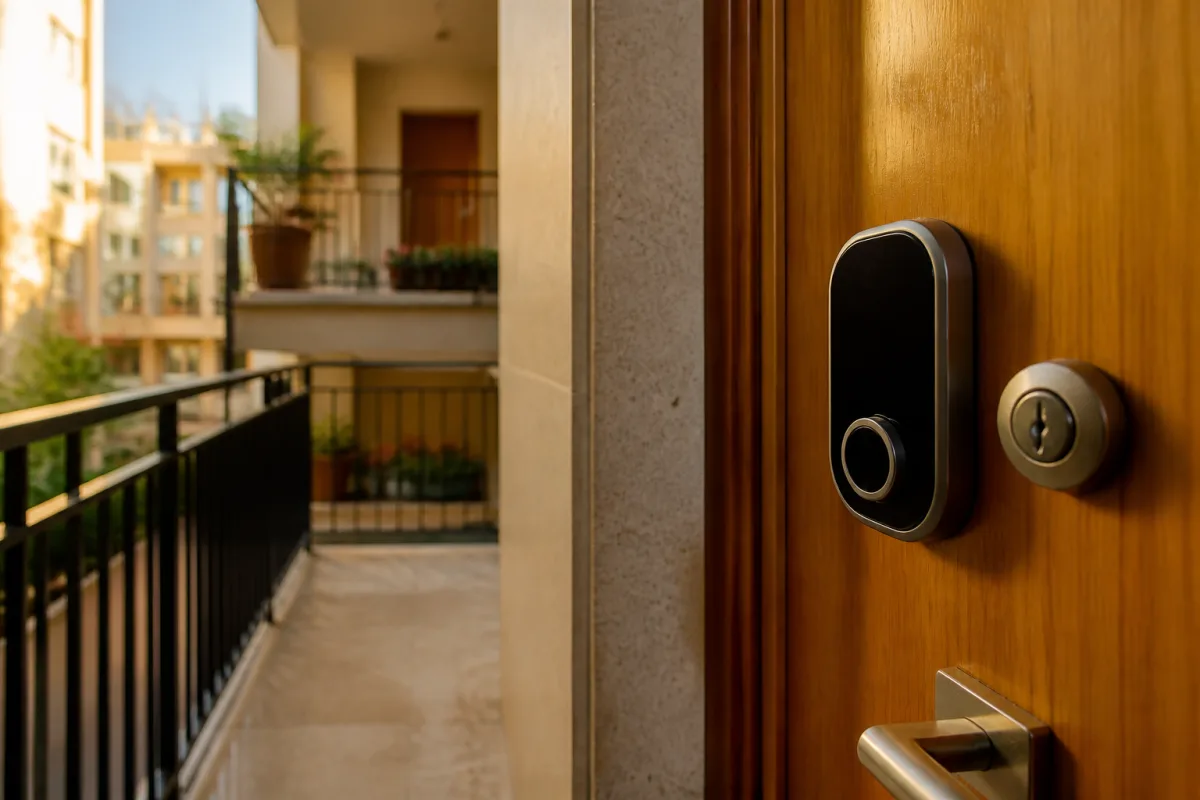
- Install an alarm with phone alerts and a smart lock — the difference between finding out about entry within an hour versus a week determines whether eviction takes a couple of weeks or drags on for years in court.
- Hire a property manager for regular visual checks — especially if the property was bought as an investment or a second home without permanent residence.
- Take out squatter insurance (seguro antiokupas): it typically covers legal costs of eviction and often lost rental income during the process.
- If the property is in a complex with an owners’ association, keep in mind that such associations recently gained the right to file eviction lawsuits themselves against squatters disrupting order in the building — an extra lever alongside the owner’s own actions.
A phone-alert alarm system, a smart lock, regular visual checks by a property manager, and squatter insurance sharply cut down reaction and process time.
How to protect a vacant property from squatters
The key mafia and paying off squatters: what it costs
Criminal groups sell keys to vacant properties for €1,000–2,000, essentially organizing takeovers to order. What started as a spontaneous social protest has turned into a criminal business with a price list.
Criminal groups sell keys to vacant properties for €1,000–2,000, essentially organizing takeovers to order.
The most cynical money-making scheme is blackmailing the owner. After taking over a property, squatters demand a payoff from the owner to vacate it, and the sum can reach 10% of the property’s value. For a desperate owner who would otherwise have to wait years for a court ruling, paying such a sum can look like a quick way out, but it does not guarantee the property will actually be vacated and does not replace the legal eviction procedure — lawyers warn that this route is risky and unprotected by law.
Paying squatters up to 10% of a property’s value does not guarantee the flat will actually be vacated and does not replace the legal eviction procedure — lawyers call this route risky.
Frequently asked questions
What if the owner bought the property specifically to rent it out and the squatter already moved in — can they be evicted as a squatter if there was technically a rental agreement, but the person later stopped paying?
No, this is no longer a takeover but a civil dispute over unpaid rent (inquilinismo). Such a case goes through the desahucio por impago procedure, not the fast-track criminal process under Law 1/2025, and resolving it can take even longer than a classic home takeover.
What should be done if a court has already ordered an eviction but the squatters refuse to leave voluntarily?
Breaking down the door, changing the locks, or using force against people inside the property is not allowed — that remains a criminal offense regardless of the property’s status or the court’s ruling. Forced enforcement of an eviction is carried out only by authorized bodies, not by the owner personally.
Do the accelerated deadlines under Law 1/2025 apply equally to all forms of home takeover?
No, the fast-track procedure and the 48-hour rule apply primarily to allanamiento de morada — invasion of a property where someone actually lives. For usurpación, meaning the takeover of a vacant property, there is no immediate police response, and even under the new law a court process is still required, though a considerably faster one.
Can an owners’ association file an eviction lawsuit against squatters on its own if the property owner does nothing?
Yes, owners’ associations recently gained the right to file eviction lawsuits themselves against squatters who disrupt order in the building. This is an extra lever besides the owner’s own actions, particularly useful if the neighboring owner doesn’t start the process for some reason.
Is it worth paying squatters a payoff to vacate the property instead of waiting for a court ruling?
Lawyers warn this route is risky and unprotected by law: paying a sum that can reach 10% of the property’s value does not guarantee the property will actually be vacated. Such a payment does not replace the legal eviction procedure and leaves the owner with no legal protection if they are cheated.
Does the Supreme Court ruling on cutting off utilities apply retroactively if an owner already disconnected electricity to a squatter before June 24, 2026?
The Supreme Court’s ruling concerns the legal classification of a disconnection as such, not a specific date of action — before this, courts across the country ruled on the issue inconsistently, acquitting owners in some cases and convicting them of coercion in others. The key condition for a disconnection to be lawful is that the person in the property has no legal basis to be there at all, not the moment when it was done.
Does squatter insurance actually speed up eviction, or does it only cover financial losses?
Squatter insurance (antiokupas) covers legal costs of eviction and often lost rental income during the process, but it does not by itself speed up the court proceedings. Its purpose is to reduce the owner’s financial burden while the case is ongoing, not to replace the eviction procedure.



Comments
Reader experience is useful, but it is not advice: check the rules on the official site.
No account needed: click Sign in, type any name, and you are done.