


An L1 visa requires a dedicated commercial office, while E2 sometimes allows a virtual office or coworking space — but that choice raises the risk of questions and denials.
In short
- For L1, an office is mandatory: a dedicated commercial space leased for at least a year, sized for the headcount expected by the end of year one.
- For E2, an office can be skipped if you prove to the officer it isn’t needed for the business — this practice dates back to the pandemic and still applies.
- Short-term, one-to-three-month contracts almost guarantee a denial for L1, while for E2 they raise questions but don’t automatically sink the case.
- The office can be checked even after visa approval: there’s a known case of an L1 revocation when the tenant was never seen using the space.
- When moving from L1 to a green card through EB-1C, the office must be kept and paid for until the entire process is complete.
Office requirements for the L1 visa
For an L1 visa, office requirements are strict and leave no room for alternatives:
- A commercial office is required. Working from home or using residential space for an L1 case is not allowed.
- The office must be dedicated — only your company’s employees work there; sharing space with other businesses doesn’t qualify.
- The space is sized not for the current headcount, but for the headcount expected by the end of the first year. Even if the company has no revenue or active operations at the time of filing, the office still needs to be leased for at least a year — and sized from the start to fit everyone the company plans to hire by the end of year one.
- By the end of the first year, the company’s staff must be sufficient to support the managerial or executive position the petition is based on — that is what the officer evaluates, not a specific headcount. In practice, this means the office space is chosen with room to spare: enough for several employees, not just one applicant with a laptop.
Even if the company has no revenue or active operations at the time of filing, the office still needs to be leased for at least a year
For L1, the office must be a dedicated commercial space, leased for at least a year and sized for the headcount expected by the end of year one — not for the company’s current size.
Office requirements for the E2 visa: when you can skip it
E2 visa rules are more flexible than L1: formally, you may not need to lease an office at all. During the pandemic, E2 practice adopted a standard allowing applicants to go without an office if they can demonstrate to the officer that an office isn’t necessary for the business to function normally. This was a departure from pre-COVID practice, when E2 premises were also inspected — and the standard is still in use today.
In practice, this exemption works for businesses that genuinely don’t need physical space: for example, IT companies where all employees work remotely and clients never visit an office. There have been successful cases where E2 applicants received their visa without leasing any premises at all.
For E2, you can skip the office if you prove to the officer that it isn’t genuinely required for the business to operate — this most often works for remote IT companies.
Virtual office and coworking: why they’re worth it even when not formally required
Even when the law doesn’t formally require an office, clients are still advised to lease at least a coworking space or a virtual office — simply for appearances, to show an address in a commercial building. Details like how many hours a week the space is actually used don’t matter for the visa case. One way to save money is subleasing: if you know a company in the US with its own office, you can lease part of their space — cheaper than a standalone virtual office, and it provides the same visibility.
Having no premises at all undermines an applicant’s case: the officer may conclude the business isn’t serious if it couldn’t even secure an office. This applies even to businesses where employees work remotely and clients never show up in person — IT, for instance, as opposed to retail. In theory, an office can be skipped, but leasing at least a virtual office or coworking space is strongly recommended for visa purposes.
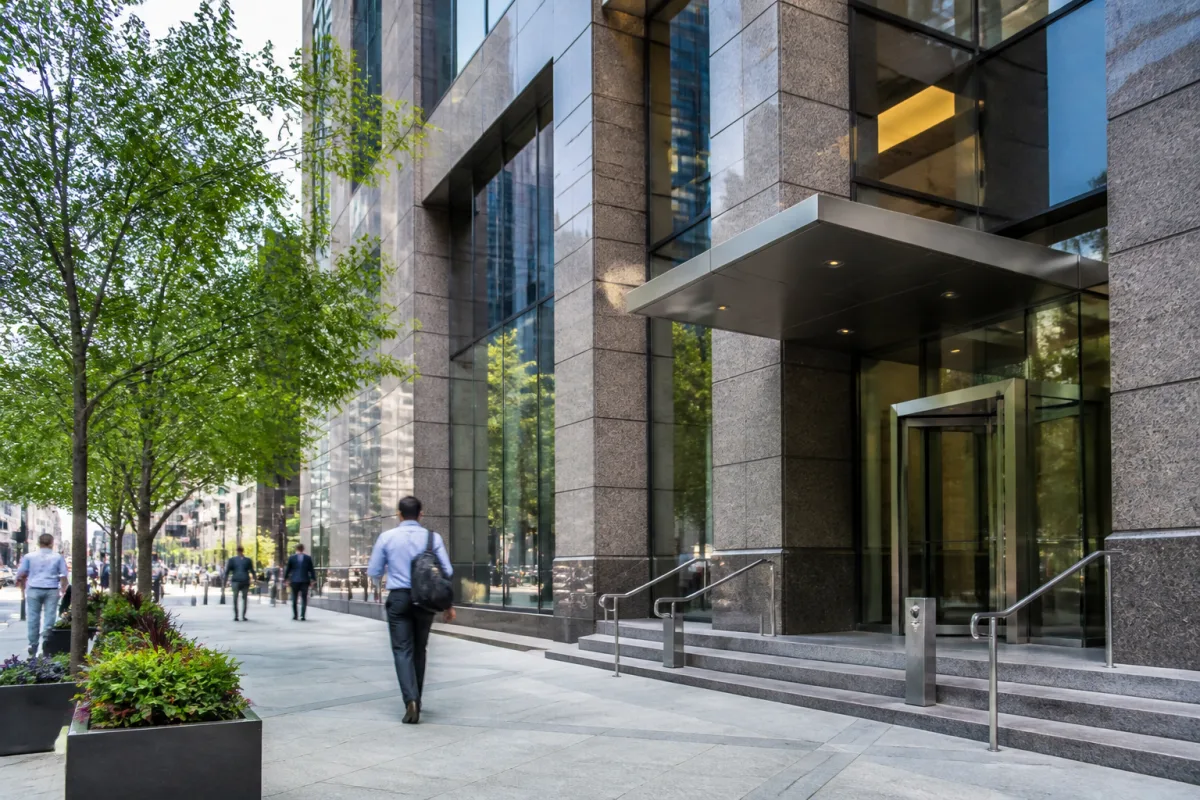
Instead of a standalone virtual office, you can arrange a sublease for part of the space from a company you know in the US — cheaper, with the same visibility benefit of a commercial address.
Lease term and business club membership instead of an office
The office lease — for both L1 and E2 — must run for at least one year. This requirement doesn’t depend on the type of space: a private office, a coworking space, or a virtual office are all subject to the same minimum term.
Sometimes the lease is structured not as a direct rental but as a business club membership with access to its amenities. For L1, this option is risky: it draws extra scrutiny from immigration authorities and can lead to a denial. For E2, club membership looks less convincing than a full office, but in practice it’s usually accepted.
Short-term contracts — for one month or three months — aren’t acceptable for either visa. For L1, this almost guarantees a denial. For E2, such a contract doesn’t automatically sink the case, but it raises questions at the interview and can complicate the review.
For L1, this almost guarantees a denial
Business club membership instead of a full office lease is a risky move for L1: it draws extra scrutiny from immigration authorities and can lead to a denial.
Post-approval office checks and a real L1 revocation case
The office can be checked even after visa approval — this kind of site-visit system has existed for a long time, and under the Trump administration the risk is elevated, since immigration authorities are tightening enforcement wherever they can. There’s a known case from about a decade ago: a client with an L1 visa leased an office but never once showed up there. During a site visit, officers spoke with neighbors and the building owner — everyone confirmed the tenant was almost never seen. On that basis, the visa was revoked. This is the only known case of a visa revocation among clients; there were other site visits, but as long as the office was actually used as intended, they weren’t even reported.
a client with an L1 visa leased an office but never once showed up there
The risks differ between the two visas. For E2, the chance of a site visit is minimal, and the consequences, if any, tend to be mild. For L1, office requirements are stricter and the chance of a site visit is higher — giving up the office after getting this visa is not advisable.

Office requirements: L1 vs. E2
| Criterion | L1 | E2 |
|---|---|---|
| Is an office required | Mandatory, dedicated commercial space | Can be skipped if you prove it isn’t needed |
| Lease term | At least 1 year | At least 1 year, if there is an office |
| Business club membership instead of an office | Risky, can lead to a denial | Less convincing, but usually accepted |
| Short-term contract (1–3 months) | Almost guaranteed denial | Raises questions, but doesn’t sink the case |
| Likelihood of a post-approval check | Higher | Minimal |
| Consequences of non-compliance | Visa revocation possible | Consequences are mild |
Can you give up the office after getting the visa, and the move to EB-1C
Giving up the office after receiving an L1 is not recommended. This matters especially if a future green card petition through EB-1C is planned: the office remains a requirement at that stage too, and immigration authorities check it. Until the entire path to a green card is complete, the office needs to be kept and paid for — dropping the lease before getting the green card is not recommended. For the L1 category, having an office is one of the factors immigration authorities weigh heavily.
When moving to EB-1C, the office remains a required element and is checked by immigration authorities — don’t drop the lease until the green card process is fully complete.
Frequently asked questions
Can you sublease office space from a company you know in the US to save money?
Yes, subleasing part of the space from a company you know in the US is a workable option: it’s cheaper than a standalone virtual office and provides the same visibility of a commercial address, which matters for the case.



Comments
Reader experience is useful, but it is not advice: check the rules on the official site.
No account needed: click Sign in, type any name, and you are done.