
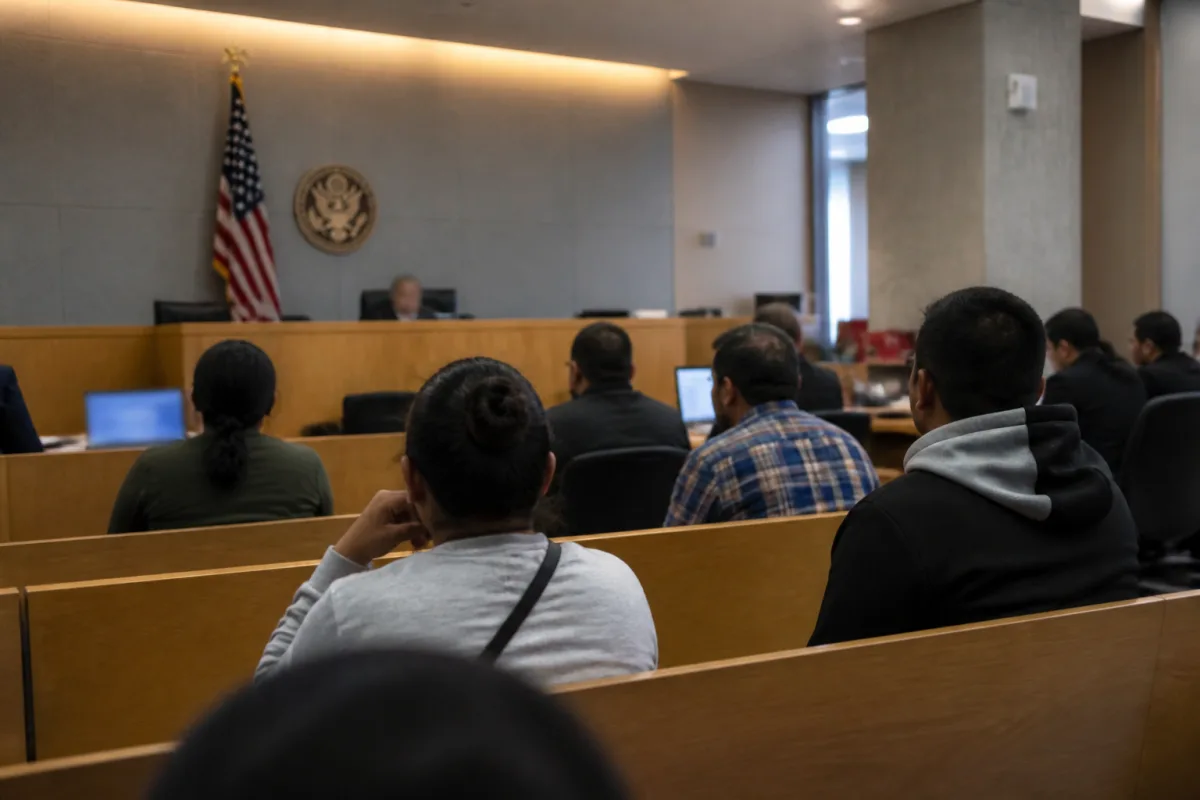

A court can deny asylum even with a complete evidentiary record of persecution if the applicant fails to prove nexus — a direct causal link between the persecution and one of the protected grounds: religion, race, nationality, political opinion, or membership in a particular social group.
In short
- Nexus is a required causal link between persecution and one of five grounds: religion, race, nationality, political opinion, or social group membership.
- A complete record of evidence of violence doesn’t guarantee asylum if the persecution is explained by personal revenge or a commercial dispute rather than a protected ground.
- A judge can separately deny withholding of removal by not believing the risk continues on return, even while accepting that past persecution was real.
- A single act — such as helping protesters without any personal political activity — can establish nexus if the authorities interpreted it as disloyalty.
- The ‘particular social group’ category is nearly impossible to assess on your own without a lawyer — the methodology for defining it is complex.
Why a Complete Evidentiary Record May Not Be Enough
An applicant can assemble a full record of evidence — threats, attacks, witness statements, confirmation that returning home would be dangerous — and still be denied political asylum. A court may even deny withholding of removal, despite formally accepting that the persecution itself actually happened.
The reason is that a court evaluates not only the fact of persecution but also its legal classification: whether the applicant’s situation falls under one of the grounds recognized as a basis for asylum. A full set of documents proves that threats and attacks occurred, but it does not automatically prove they were connected to the specific reason the law considers sufficient for protection. This gap between a proven fact and its legal classification is exactly what a licensed U.S. immigration attorney breaks down in the case discussed below.
Case Study: Why a Former Police Officer From El Salvador Was Denied Asylum
One of the appellate courts reviewed a case that appeared fully documented (the case details are not published in open sources, but the reasoning behind the decision is instructive): the applicant received neither asylum nor withholding of removal. The applicant was a former police officer in El Salvador, where membership in the group of former police officers is recognized as a distinct particular social group and accepted as a basis for asylum. He had death threats and had been attacked, both supported by testimony.
The judge told the applicant directly: he believed the facts as presented, but asylum still would not be granted. The reason — the applicant did not belong to the category the protection actually covered: the category formally existed, but it did not apply to him specifically.
The judge told the applicant directly: he believed the facts as presented, but asylum still would not be granted.
At the hearing it emerged that the persecution was tied not to the mere fact of having been a former police officer, but to specific actions the applicant had taken while on duty — he had investigated gang criminal activity. The court first accepted the social group as a valid category for the case — a stage the applicant cleared successfully. But at the next stage, when the specific facts of persecution had to be tied to group membership rather than to his professional conduct as an investigator, the link broke down. Strong documentation and credible testimony didn’t close that gap: the court believed the threats were real, but did not find they were directed at the applicant as a member of the recognized group.
What Nexus Is and Why It’s the Case’s Deciding Category
Nexus is the causal link between persecution and one of the legally protected grounds. In effect, it is its own separate category within the case: a court doesn’t just ask “were you persecuted,” it asks “were you persecuted specifically for one of five reasons.”
The law recognizes five such grounds: religion, race, nationality, political opinion, and membership in a particular social group. Before even addressing the persecution itself, a court requires establishing why it happened — without an answer to that question, a case cannot be won, no matter how serious the underlying incident looks.
This produces a rule that breaks many cases: even if someone was beaten ten times, that fact alone does not establish grounds for asylum if the beatings aren’t tied to one of the five categories. The United States does not grant asylum to everyone who has suffered violence — only to those whose case fits within nexus.
even if someone was beaten ten times, that fact alone does not establish grounds for asylum if the beatings aren’t tied to one of the five categories
The same rule applies to large-scale situations too. Even involvement in a case tied to an international criminal organization with a presence in several countries does not guarantee that the persecution will be recognized: a court may find that the link to a protected ground was not proven, and in that case, even a major, well-documented threat won’t count as a basis for asylum.
Nexus is a proven causal link between persecution and one of five grounds: religion, race, nationality, political opinion, or particular social group membership. Without this link, even serious violence doesn’t establish grounds for asylum.
Personal Revenge, Private Disputes, and Other Reasons That Don’t Count as Persecution
Even with a complete set of evidence — threats, beatings, documents — a court denies asylum if the persecution doesn’t fit any of the legally protected grounds. A typical example: an applicant ran a business, business partners forced him out by force, beat him, and threatened him, but behind it is a commercial dispute, not persecution based on political opinion or social group membership. The evidence of violence isn’t in question here — what’s missing is a category the persecutors’ motive can fit into.
The same logic applies to personal revenge. If a conflict arises between specific individuals — for example, a former boss pursues and beats a former subordinate for having quit — the prosecutor will build the defense on exactly that: showing the case isn’t about political opinion or a social group, but about a former employer’s personal grudge against a former employee. This “former employees versus a former employee” framing differs from persecution by a system: a system cares about a person’s position as such, while a former boss is taking revenge for a specific personal reason — quitting, competition, a grudge. As long as the prosecutor successfully keeps the case in that frame, even documented beatings and threats don’t turn into a basis for asylum.

If threats and beatings stem from a commercial dispute or a former boss’s personal revenge, a court won’t treat it as persecution on a protected ground — even with a complete record of violence.
Why a Judge May Not Believe There’s a Risk on Return
A judge is entitled to deny a claim by stating outright: “I don’t believe you’ll have problems if you return.” This is a separate ground for denial — it doesn’t dispute past persecution, it addresses future risk. An applicant can prove that back home he genuinely felt subjective fear and faced real problems — and still lose the case if he can’t confirm the danger still exists now.
I don’t believe you’ll have problems if you return
The weak point becomes the simple fact of having lived in the new country for a long time without evidence that the persecutors’ interest has continued. If the applicant hasn’t shown he was sought after leaving, that weakens the case. Some judges go further and ask directly: is the applicant, who calls himself an opposition activist, actually engaged in opposition activity in the country where he now lives? An answer like “no, I left and washed my hands of it” irritates some judges — and leads to a question along the lines of: what grounds are there to believe problems will arise, even if it’s proven the applicant was being sought back in 2022? Formally, this is no longer the same question as whether past persecution was proven — it’s a question of whether fear of future persecution is well-founded, and it’s decided separately.
The reverse situation strengthens a case. If an applicant continues attending rallies or organizing pickets, it’s harder for the prosecutor to challenge nexus — the link between persecution and political opinion is already visible from the simple fact of being present at a demonstration with an anti-government sign: standing on the street with such a sign is itself treated as an expression of political opinion. The same holds for continued pressure after relocation: if a person files complaints against government officials, and those officials join in the persecution instead of offering protection, that forms a separate basis for the case — the political opinion category arises precisely at the moment the authorities retaliate for the complaint, rather than simply ignoring what looked like a private dispute.
Case Study: Why Losing a Business After Helping Protesters Isn’t Always Convincing to a Court
A client owned a bar on Pushkinskaya Street in Moscow — a successful business in a prestigious location, and up to a certain point she had no problems at all with it. She herself was not involved in any opposition activity: she didn’t attend rallies and had no political activism of her own.
During protests, people being chased by police ran into her bar, and she helped them. Law enforcement traced these people through surveillance cameras and came to her with an accusation of harboring the people they were searching for. After that, the problems began: threats, summonses for interrogation, and eventually the business was seized.
This exact episode became the basis for the case: the attorney proved to the court that the business was taken not because of a commercial dispute, but specifically because of that one act — helping people being pursued during the protests. Formally, the client had no political views and no activism of her own, but the court accepted that the loss of the business resulted from political views and actions that were attributed to her.
This shows how nexus can be established without the applicant’s own political activity: the link between persecution and a protected ground can be proven through a single act that the authorities interpreted as disloyalty. The absence of any history of business conflicts before this episode became a key argument — it ruled out the theory of an ordinary commercial dispute.
How a Prosecutor Tries to Break Nexus During a Hearing
A prosecutor rarely disputes the fact of an attack itself — instead, he methodically separates the episode from the applicant’s category so the court won’t factor it into the decision. A typical tactic: an applicant who was beaten near his home is asked whether he saw the attackers’ faces, whether they wore uniforms, whether they said what the beating was for. If the answer to all of this is “no,” the prosecutor draws a conclusion — the applicant himself confirmed he doesn’t know who beat him or why, meaning there’s no link to opposition activity in this particular episode.
The danger is that an applicant can undermine his own nexus simply by agreeing with every question the prosecutor asks. In the case examined, the client had a strong foundation — photographs, court summonses, documents about threats — but one particular beating episode near his home looked isolated: the attackers gave no reason, and the client hadn’t seen their faces. The prosecutor structured the questioning to establish, step by step, that the victim didn’t know who beat him, didn’t know why, and nothing was stolen — in other words, an ordinary street attack in front of the court, not persecution based on his views.
The defense rebuilds the link through context rather than through identifying the attackers: the attorney brings the client back to the episode and asks about the threats that preceded it — the day before the beating, a call came in demanding he “shut up or things will get worse.” Comparing the date of the threat to the date of the attack shows the court a pattern, even when the attackers’ identities remain unknown.
A separate danger comes from episodes with unclear motives that end up in a case unnecessarily. In one case, the applicant’s story ran 30 pages, including an incident from several years before his opposition activity began that had nothing to do with politics. A prosecutor uses episodes like this to suggest: since the applicant had conflicts for other reasons, a later attack could also have been a private matter rather than political. The fewer unnecessary, uncategorized episodes a case contains, the harder it is for a prosecutor to steer the proceeding off track.

By agreeing with every question a prosecutor asks about an isolated attack episode, an applicant can undermine his own nexus — even with a strong evidentiary base on the rest of the case.
Can the Detention or Death of an Activist Friend Become the Basis for Your Own Case
A friend’s detention at a protest doesn’t automatically make the case yours: you have to prove that you are the one being persecuted, not simply retell someone else’s experience. A typical situation: an applicant attends a protest, a friend gets detained, and the applicant is now afraid to return to the country. There’s a case for the friend, but not for the applicant: fear alone doesn’t substitute for evidence of personal persecution.
The same rule applies to more severe situations. If an activist friend died, but there’s no evidence the death was connected to the applicant, served as a threat, or a warning to him, that alone won’t serve as direct proof in his own case. Such a fact can support the claim that a particular group is persecuted in the country generally — for example, members of the LGBT community — but on its own it doesn’t prove the danger is directed personally at the applicant.
The death or detention of someone close only becomes the basis for one’s own case once a direct link to the applicant appears: a threat, a message addressed to him, or some other indication that what happened to the friend was a warning meant specifically for him.
How to Check on Your Own Whether Your Case Has Nexus
The review starts with the applicant sitting down with the case materials and going through them point by point: is there that exact link — “I did this, and this happened to me” — and does the evidentiary record support it? If this analysis holds together consistently, the case can move forward.
With the “particular social group” category, this kind of self-review usually doesn’t work: the methodology for defining this category is complex, and without a lawyer it’s practically impossible to work out whether a specific story fits it.
With the categories of religion, political opinion, nationality, or ethnicity, the review is simpler: you need to check that the causal link is built at every step of the story. Everything described has to be tied specifically to what happened because of the applicant’s religion, nationality, or political position — without that link, an episode doesn’t work for the case, no matter how serious it is on its own.
A separate danger is imprecision in the details. An applicant may describe a genuinely severe episode, down to a beating documented by a medical report, but if the dialogue and circumstances are recounted imprecisely, the court is entitled to ask why the applicant believes the problems arose specifically because of that category. That’s why every fact and every conversation needs to be reconstructed and presented with maximum precision, rather than summarized in general terms.
Conversations and circumstances need to be reconstructed with maximum precision: imprecise details give the court a reason to doubt that the problems arose specifically because of a protected ground.
How to Check Nexus in Your Case
Frequently asked questions
Can you reapply for asylum if you were already denied once for lack of nexus?
A subsequent filing is technically possible, but the chances depend on whether new evidence has emerged specifically establishing the link between the persecution and a protected ground. If the gap that caused the first denial hasn’t been closed — no new facts supporting nexus — a second case will run into the same problem. Revisiting the story only makes practical sense once additional details that weren’t part of the first case have been found.
What if the persecutor isn’t the government but private individuals — a gang or a former employer?
The fact alone that the persecutor is a private party rather than the government doesn’t rule out asylum: what matters is whether the pressure is tied to one of the five protected grounds rather than a personal conflict. If a gang is targeting someone specifically for social group membership or political opinion, nexus can be established. If it’s about personal enmity or a commercial dispute, the case is classified differently, and evidence of violence alone isn’t enough.
Can a lawyer still help establish nexus if the applicant already gave testimony without one?
Testimony given without a lawyer doesn’t automatically sink the case, but correcting imprecise statements after the fact is harder than framing them correctly from the start. An attorney can rebuild context through additional details — for example, showing the link between threats and specific event dates — but the more contradictory the existing testimony, the harder it is to keep a prosecutor from using those contradictions against the applicant.
What is withholding of removal and how does it differ from asylum?
Withholding of removal is a separate form of relief that a court can grant even when asylum itself is denied, or it can deny both forms at once if the link between the persecution and a protected ground isn’t established. Both forms require proof of risk, but asylum additionally requires nexus to one of the five grounds, and without it, both can be denied.
Does a court consider threats from many years ago if there’s been no persecution since?
It does, but old evidence alone doesn’t guarantee that a current risk will be recognized: a judge can state outright that he doesn’t believe there’s danger on return, even if past persecution is confirmed. A gap in time without new facts about the persecutors’ continued interest weakens the position, so old threats are best supported with more recent evidence where it exists.
Can nexus be proven if the applicant never publicly expressed political opinions?
Yes: the link between persecution and a protected ground can be proven not only through the applicant’s own activity but also through how the authorities interpreted his actions. A single act — such as helping people being pursued — can be perceived as disloyalty and become grounds for recognizing a political motive, even without a history of personal activism.
What if the applicant has no medical report of the beating, only oral testimony?
The absence of a medical report doesn’t close the case automatically: a court weighs the totality of the evidence, including how precise and consistent the testimony itself is. But the less documentary support there is, the more it matters that the facts and conversations are presented with maximum precision, because imprecise details give a prosecutor grounds to question the link between the episode and the claimed cause of persecution.


Comments
Reader experience is useful, but it is not advice: check the rules on the official site.
No account needed: click Sign in, type any name, and you are done.