
For EB-1A, only independent pieces written about the petitioner by a third party — a journalist, an editor, or an outside publication — count as media coverage; material the petitioner wrote themselves, or where they’re only mentioned in passing, does not.
In short
- The piece has to be about the petitioner, written by an outside author — self-authored articles and a university profile page don’t count as evidence.
- Trade publications, professional society magazines, research highlights, and podcasts are four underused categories of media coverage.
- Foreign-language publications carry the same weight as English-language ones, but they need a certified translation to be filed.
- A screenshot with no date, author, or outlet name won’t be accepted by USCIS — you need the full page saved as a PDF.
- Media coverage is just one of ten EB-1A criteria — a petition needs to meet at least three, or show one major international award.
What actually counts as media coverage for EB-1A
The golden rule of immigration media coverage is simple: the piece has to be about the petitioner, not written by them. That distinction — about you, not by you — is one of the most common reasons self-filed petitions get denied: applicants show up with folders full of their own articles, conference abstracts, and a university bio page, and none of it qualifies as evidence.
That distinction — about you, not by you — is one of the most common reasons self-filed petitions get denied
STEM professionals tend to assume they have no press coverage for two reasons. First, they equate “media” with major national outlets — newspapers, network news, stories about a cure for a disease or a billionaire’s rocket. Second, they assume their work is too niche for anyone to ever write about: “nobody covers mechanisms.”
Both assumptions are wrong, for the same underlying reason: there are far more specialized outlets in the world than most researchers realize. People get paid full-time salaries to write specifically about one narrow lab topic — that entire layer of publications simply lives in an ecosystem the researcher never reads, because they live in academic journals, not trade press.
In practice, a petitioner sits down across from an attorney and confidently states that no coverage of their work exists anywhere. The legal team finds it within a day. That’s not false modesty — the specialist genuinely doesn’t know they were written about: their public footprint exists in a media space they never tracked.
The piece has to be about the petitioner, not written by them. That’s the line between media coverage evidence and self-authored content.
What doesn’t count: self-authored material, mentions, passing quotes
In practice, evidence folders end up full of material that looks relevant but doesn’t qualify as media coverage:
- Peer-reviewed articles the petitioner wrote, trade-journal contributions, and personal blog posts. This is the petitioner describing their own work, not an independent outside assessment.
- Conference abstracts and a university profile page. These are also created or hosted by the petitioner or their employer, not by an outside publication.
- Being listed among participants. If a name appears in a roster of 200 conference attendees, that’s not evidence — a list confirms attendance, not that anyone covered the petitioner’s achievements.
- A single sentence buried in someone else’s article. If a journalist wrote a ten-page piece and devoted one sentence to noting that the petitioner’s work exists, that’s a mention, not a piece about them. That kind of line carries almost no independent weight in a petition.
- Being cited in a bibliography. The fact that other scientists cite the petitioner’s work is useful elsewhere in the petition, but a bibliographic citation by itself is not media coverage.
The underlying principle here is the same every time: there’s a gap between being mentioned and being the subject of a piece, and that’s exactly the gap USCIS checks first.
Self-authored articles, conference abstracts, a university profile page, being listed among participants, and a single line in someone else’s article — none of these count as media coverage.
University press releases and source independence
A university press release doesn’t count as independent evidence: the employer has a stake in promoting its own employee, so the piece is, at its core, well-dressed advertising. The situation that does carry weight is different — when a journalist outside the university, say at a trade outlet, picks up that press release as a starting point and writes their own independent article from it.
The difference comes down to who decided the topic was worth covering: if an outside journalist made that call, it’s an editorial decision; if the organization itself did, it’s self-promotion. The comparison worth making here is between a diary and a biography: what carries weight for a petition isn’t the diary a petitioner writes about themselves, but the biography — however short — that someone else chose to write.
Trade and industry publications
The first place to search is narrow trade publications and industry newsletters: aerospace, semiconductor manufacturing, clinical laboratory medicine — nearly every industry has outlets like these. Their audience is practitioners “on the shop floor,” not academic researchers, which is exactly why petitioners tend to overlook this category: they publish in their field’s academic journals and never track how trade press covers their work. And yet that kind of coverage — an independent mention in a trade publication — is exactly what satisfies the media coverage requirement.
Professional society media
The second place to search is the magazines and member publications that professional societies themselves put out — IEEE, for example. Scientists pay membership dues and belong to these societies, but the glossy publication that shows up in the mail usually goes straight into the recycling bin unread — even when it contains a piece featuring them directly. That’s exactly what makes these publications an underused source of evidence: they exist, but the petitioner often simply doesn’t know about them.
Editorial research highlights
The third place to search is research highlights: editors at academic journals select the most significant papers and write summaries of them for a broader audience than the narrow circle of specialists in the field. That summary doesn’t run immediately — it appears several weeks after the original paper is published. Authors are typically not notified when the summary goes live, which is exactly why petitioners often don’t know this evidence exists and leave it out of their folder.
Because of that delay and the lack of notification, a research highlight is easy to miss when compiling evidence on your own. The only way to find one is to deliberately check the journal’s archive for the period after your paper’s publication date.
A research highlight runs several weeks after the original paper, and authors aren’t notified — check the journal’s archive for that window separately.
Podcasts, interviews, and panel discussion coverage
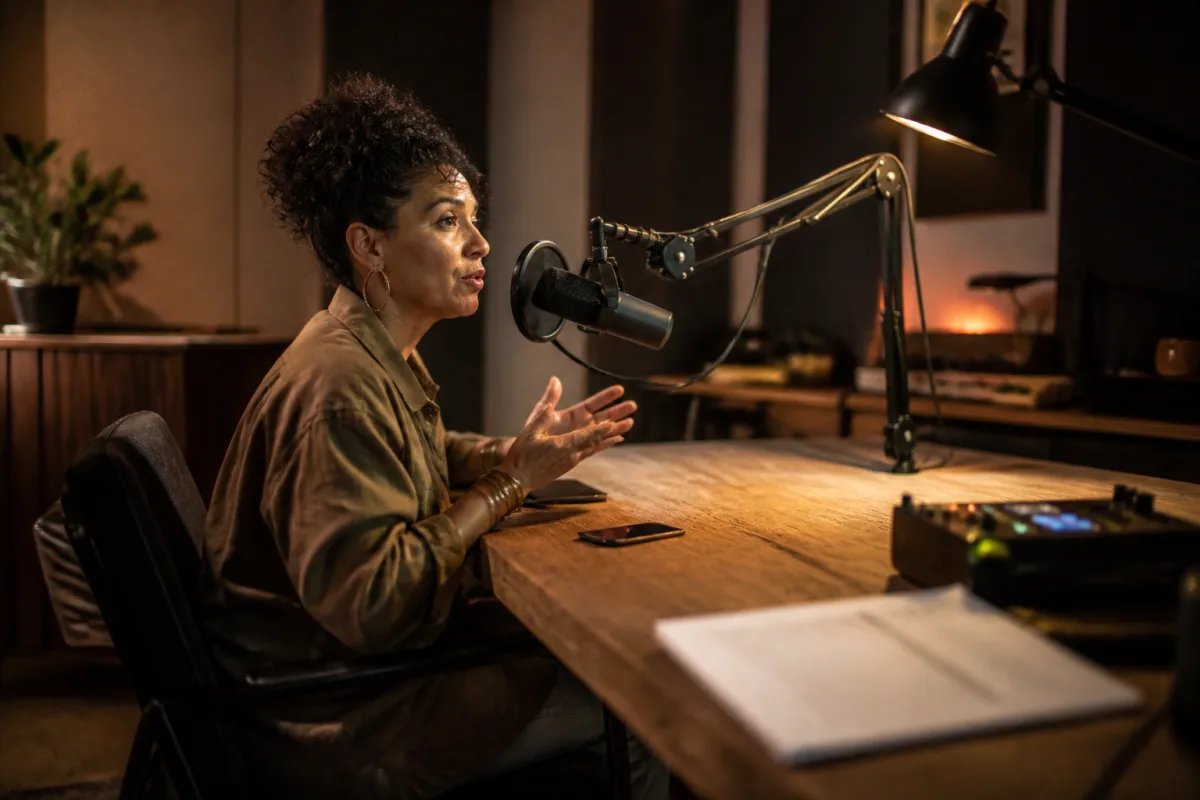
The fourth place to search for evidence is podcasts, recorded interviews, and panel discussion write-ups — a category that’s growing especially fast right now. The obvious objection: if the recording features the petitioner’s own voice, doesn’t that break the “about you, not by you” rule? No — what matters is that an outside podcast host decided on the invitation, the structure of the interview, and the publication. It’s that editorial decision, not the mere fact that the petitioner took part, that makes the recording independent material — it counts as coverage of the petitioner, not their own authored content.
No — what matters is that an outside podcast host decided on the invitation, the structure of the interview, and the publication
Format and subject matter don’t matter here. In one case reviewed, a 50-minute technical podcast interview ended up in the evidence folder — the petitioner remembered doing the interview but assumed podcasts didn’t count for immigration purposes. That’s a common and costly mistake: a piece where an independent host chose to invite a guest and shaped the conversation is no weaker than a print publication.
Foreign-language publications
The fifth place to search is non-English-language publications, and this is the biggest blind spot of all: authors of these pieces write about a foreign specialist in their own language and have no intention of ever notifying that person. In one case reviewed, attorneys found an article in a German-language engineering publication with a detailed breakdown of the petitioner’s work — it had been sitting online for four years, and the petitioner had no idea it existed, because they don’t speak German. For the evidence folder, a publication like this carries exactly as much weight as an English-language one: what counts is independent coverage of the work, not the language it’s written in.
it had been sitting online for four years, and the petitioner had no idea it existed, because they don’t speak German
These materials need a dedicated search: based on the cases reviewed, it’s enough to translate the key terms — the petitioner’s own name, their institution’s name, a specific methodology — into German, Japanese, Korean, or whatever language is relevant to the petitioner’s field, and run the search again. That takes about half an hour, and the results are often surprising even to the specialist themselves.
There’s a hard requirement for filing: if the material is in a foreign language, it needs an official certified translation into English — without the translation, the publication cannot be submitted as evidence.
A five-step plan for finding and preserving evidence
Finding the material is only half the job — it has to be documented correctly. A screenshot with no context is useless to USCIS: it proves neither the publication date, nor the author, nor even which outlet it ran in. Below is a sequence of steps that closes that gap.
- Search your name correctly. The first page of search results usually shows only LinkedIn and the petitioner’s own publications. Search the name together with the institution’s name or the specific methodology/technique the petitioner works on, and check results down to at least page 4–5.
- Search in other languages. Translating key terms and re-running the search in foreign languages takes about 30 minutes — a translation tool handles the job. Those 30 minutes often produce the most unexpected finds.
- Save the full page, not a screenshot. The saved document needs to show the article title, the publication date, the author, and the full name of the outlet — all in one file. The simplest approach is printing the page to PDF straight from the browser; if the material is in a foreign language, it needs an official certified translation into English. Saving a poor screenshot instead, and having the site disappear a year later, means the evidence is gone for good.
- Ask the press office or communications department. Their logs may show exactly who picked up a release or mentioned the petitioner in the media. A five-minute email sometimes surfaces material the petitioner didn’t even know existed.
- Say yes to media requests. Podcasts, newsletters, trade publications — any format is worth responding to: this isn’t chasing visibility for its own sake, it’s deliberately building a public footprint that later becomes evidence.
Five steps to find and document media coverage evidence
A sequence for compiling media coverage evidence on your own before filing a petition
- Search the name with the institution or methodology, check down to page 4–5 of results
- Repeat the search after translating key terms into foreign languages30 minutes
- Save the full page as a PDF with date, author, and outlet
- Ask the press office about any media mentions5 minutes
- Say yes to media requests: podcasts, newsletters, trade publications
Save the full page as a PDF with the title, date, author, and outlet — USCIS won’t accept a context-free screenshot, and a vanished website means the evidence is lost for good.
How to find and document media coverage evidence
Who this requirement applies to: self-filed, employer-filed, waiver
The media coverage requirement applies to any petition in which the candidate is asking the United States to recognize them as one of the best in their field — regardless of how the petition is filed. That covers self-filed petitions, employer-filed petitions, and petitions filed with a national interest waiver (no job offer required). The filing format makes no difference to the standard: it’s a single criterion used to establish extraordinary ability. It’s worth keeping its place in the bigger picture in mind: media coverage is just one of ten EB-1A criteria, and a petition needs to meet at least three of them (or show one major international award) to be approved — a flawless folder of press clippings alone does not guarantee approval.
Frequently asked questions
What if, after all five search steps, no independent publication turns up at all
In that case, it’s worth re-checking how thoroughly all five search areas were covered — especially trade publications, professional society magazines, and foreign-language sources, which are the ones most often skipped during a self-directed search. If there really is nothing out there, it’s reasonable to deliberately start saying yes to future media requests, podcasts, and interviews so a public footprint exists before filing.
Does the entire text of a foreign-language publication need translating, or just the key passages
If the publication is in a foreign language, filing requires an official certified translation into English — without it, the material can’t be submitted as evidence. For the search itself, translating key terms — the name, institution, methodology — is enough, but the translation of the actual document for filing needs to be complete and certified.

Comments
Reader experience is useful, but it is not advice: check the rules on the official site.
No account needed: click Sign in, type any name, and you are done.