
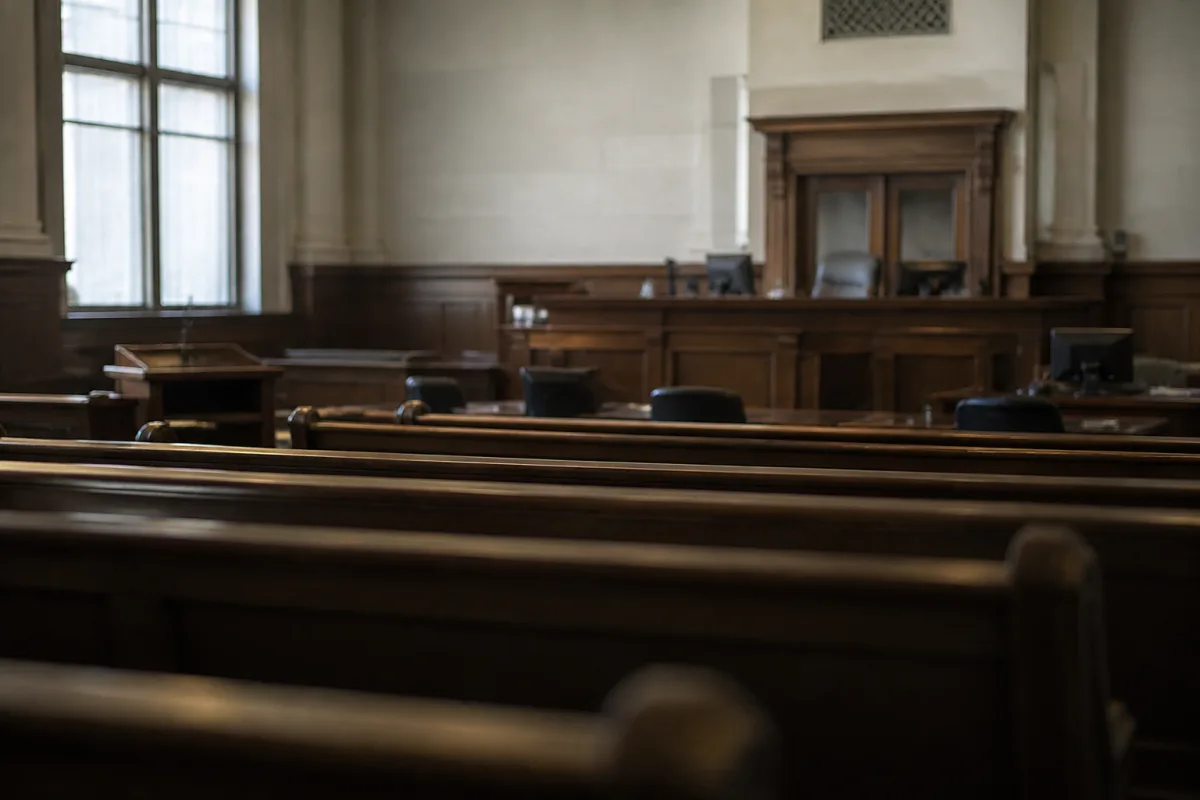

An individual asylum hearing is the final session of immigration court where the evidence of a case is examined on the merits — it opens with a technical record-building phase, and all case materials must be filed with the court in advance.
Before the Individual Hearing: Evidence Filing Deadlines
The date of the individual hearing is usually announced at the master hearing — the preliminary court session — or the judge may say the date will be mailed later. From that point, the clock starts on preparing all case materials.
The deadline for filing evidence and testimony is set by the court for the specific case — it’s normally stated in advance, and applicants need to confirm it for their own case. Filing materials after the set deadline is usually no longer possible — the court is entitled to refuse additions to the case. The filing package includes:
- the applicant’s declaration;
- evidence and exhibits supporting the case;
- witness declarations;
- a list of witnesses who will take part in the hearing.
The case has to be submitted in the form it will be presented at the hearing itself — bringing a missing document later is usually no longer an option. In practice, there are cases where documents mailed to the court never arrive and get returned to the sender, so it’s worth tracking delivery of materials and building in extra time before the deadline.
Materials filed after the court’s deadline are usually not accepted — build in extra time and confirm delivery to the court.
The Technical Phase of the Hearing: How the Court Logs the Record
The hearing opens with a technical assembly of the record: the judge swears in witnesses and goes through the list of evidence. Each piece of material gets a letter — Form I-589 becomes Exhibit A, the applicant’s declaration becomes Exhibit B, witness statements get letters C, D, E and so on, down to country condition reports.
An interpreter is already working at this stage: the judge explains through the interpreter that a technical procedure is about to take place — listing and marking the evidence in the case. The applicant stays silent through this stage: they aren’t asked anything directly, and they have no opportunity to speak up.
The technical phase lasts anywhere from 10 minutes to half an hour. If a dispute arises over particular evidence, it takes longer. The discussion at this stage isn’t driven by common sense but by legal nuance, precedent, and procedural questions — so applicants shouldn’t try to jump into the exchange between their attorney and the judge, even if they’re tempted to offer input.
Can the Government Attorney Get an Asylum Case Dismissed Without a Merits Hearing
The government attorney (DHS counsel) can try to get a case dismissed right at the technical stage, before it ever reaches the merits. One common argument is that Form I-589 doesn’t describe the circumstances of the case in enough detail. Another is that more than a year passed between the applicant’s arrival and filing the application: the government points to that gap as grounds for denial. The judge rules on the issue right there, at the hearing: if the evidence is deemed sufficient, the case can be dismissed or, conversely, allowed to proceed on the spot.
A separate basis for dismissal is a challenge to the filed materials themselves: the government argues that the submitted documents show there are no grounds to hear the case on the merits, and pushes for dismissal without a full review.
A hearing can also stall for purely technical reasons that have nothing to do with either side’s arguments. Documents sent by the applicant sometimes never reach the court or get returned to sender. There are cases where the court points to a computer outage and reschedules, because the next hearing is already booked for the following hour and there’s no time to fix the equipment. Hearings also get postponed because a judge is out sick — the new date gets communicated by phone after the applicant has already fully prepared for the original hearing.
Another technical cause of delay is a large number of I-589 forms filed in a single case — filed either by the applicant or by prior attorneys — which stalls the proceeding while the court sorts out exactly what is and isn’t on file.
Surprises can come up at this stage that no one can anticipate in advance. In that situation, the only thing that helps is an experienced, quick-thinking attorney — there’s no other way to influence how the technical phase unfolds.
Surprises can come up at this stage that no one can anticipate in advance.
What Evidence the Court May Reject: Witness Letters and Translations
A letter from a witness who isn’t present at the hearing is, by its nature, hearsay — not direct evidence. The reason lies in procedure: since the person isn’t in the courtroom, opposing counsel has no way to ask them a single question about what the letter says. In ordinary court proceedings, documents like that, with no way to cross-check them, aren’t admitted.
That said, not all sources are treated the same. Official police documents can be submitted without a separate request to the police — they’re accepted as is. Written witness statements don’t get that same leeway: their reliability can always be challenged.
In practice, applicants are advised to gather as many letters as possible — from witnesses, neighbors, anyone who can confirm the facts of the case. The government attorney may still object to a specific letter precisely on hearsay grounds, pointing out that the author isn’t physically present in court. When that happens, the judge asks for the other side’s position, and the defense points out that the court is required to consider all evidence submitted in the case — after which the document usually still gets admitted. There’s no way to predict in advance exactly what will draw an objection — opposing counsel can challenge almost any piece of evidence.
A separate vulnerability is document translations. If a translation lacks the translator’s signature, or is missing a separate certification page stating exactly what was translated, that gives the government a formal basis to challenge the document and keep it out of the record.
A translated document without the translator’s signature or a certification page stating what was translated can be challenged and kept out of the record.
In Person or Remote: Choosing the Format for an Individual Hearing
There’s no blanket rule requiring an applicant to appear at the individual hearing in person — each judge decides this on a case-by-case basis. That said, some courts are already introducing their own in-person attendance requirements: according to practicing attorneys, that trend has recently shown up in courts in New York and New Jersey, as well as in Miami — but it’s not a general rule, and it’s worth checking the practice of the specific court and judge handling the case.
Where the choice of format is left to the parties, law firms are allowed to file a request for their representatives to appear virtually. But the outcome of such requests differs depending on whether it’s the client or the attorney asking: a request for the client to appear remotely is usually denied by the court, while a similar request from an attorney working out of another state is usually approved. According to reports from immigration attorney circles, judges have recently become more likely to deny virtual appearance requests for attorneys too.
Flying in just for a hearing that may last around 10 minutes isn’t always worth it from a practical standpoint — which is why many applicants prefer the remote format when the court allows it.
The final choice of format depends on the specific case: on how the person tells their story and how prepared they are to do so. Some judges respond better to an applicant appearing in person; others are, if anything, stricter about how someone comes across on camera — and sometimes it goes the other way. That’s why the decision between in-person and remote appearance gets made individually for each applicant, not according to a single formula.
The Attorney’s Role at the Hearing: What They Can and Can’t Do
At the individual hearing, an attorney’s role is usually a passive one: they don’t argue with the court or interrupt the proceeding unless something goes beyond the ordinary course of the hearing. If an attorney starts actively arguing with the judge, that’s a sign something has gone wrong — not a normal part of the hearing. During the technical phase, applicants are advised not to get in the way of their attorney’s work or try to step into the procedure themselves — the right to make tactical calls in the courtroom stays with the attorney. When choosing an attorney, it’s worth keeping in mind that passivity and a lack of engagement during hearings is a common complaint clients have about previous lawyers, so the choice is worth making carefully before the case even begins.
An attorney can’t feed a client answers directly — not during the hearing itself, and not during breaks in a remote hearing either. Instead, a different technique is used: the attorney asks a leading question built around a key word — something like “what did you feel in that moment” — counting on the applicant to bring up fear, threats, or the impact on sleep or family on their own. Phrasing like that gets worked out in advance, during preparation, not improvised on the spot.
An attorney can’t feed a client answers directly — not during the hearing itself, and not during breaks in a remote hearing either.
Translation is a separate area of risk. Most of the testimony goes through an interpreter, who physically can’t keep up with everything that’s said and can miss individual details or key words that matter to the case. If the attorney speaks the applicant’s language and notices the translation is off, they’re not allowed to step in and correct the interpreter — a judge can call them out for it right there at the hearing. That’s why, during preparation, attorneys work in advance to get the applicant to use precise wording and terminology in their own testimony — counting on the attorney to fix a translation error in the courtroom isn’t a safe bet.

An attorney cannot feed answers to a client or correct an interpreter mid-hearing — preparation has to happen beforehand.
Preparing for an Individual Hearing: Rehearsing Questions and Keeping Dates Straight
Preparation for the hearing starts with the paperwork, but it doesn’t stop there. If an attorney asks the court for a 30- or 60-day continuance, it’s usually in the client’s interest: the 15-day window the court sometimes grants by default for a continuance is too tight to properly prepare and review the paperwork (this is a separate deadline from the evidence-filing deadline discussed above) — since there’s almost always another round of edits after the first draft.
The bulk of preparation is rehearsing the questions the attorney will ask. A script is chosen and worked out ahead of time: the attorney walks the client through their story question by question, steering the narrative so the right details come out — fear, threats, their impact on sleep and family. The questions get rehearsed over and over until the answers fully satisfy the attorney. At the actual hearing, a person’s behavior can differ from the rehearsal — that’s normal, and if the answers match what was practiced at least about 80 percent of the time, that’s considered a good outcome. Active preparation is essential here — without it, the testimony will come across weak.
A separate task is preparing for the government attorney’s questions: about the time of day, the intersection, how many people were present, how the applicant got around, and what happened next — if the case involves, say, a rally or a police visit to the home. All the facts will come out in the case one way or another; what matters is that they come out in the right order and land with the right effect.
A separate challenge is keeping a mass of detail straight: dates, the sequence of events, how many incidents there are to cover. There’s no single technique — everyone finds what works for their own memory: counting through the episodes in order, tying them to birthdays, to memorable events, to holidays.
Psychological preparation is considered just as important as factual preparation: the stakes at an individual hearing are higher than at an asylum interview. Being nervous is normal, and judges and government attorneys understand that. The attorney and client need to work as a tight team, trust each other, and understand each other without needing to spell everything out — without that rapport, preparation doesn’t deliver the result it needs to. According to attorneys who prepare clients for these hearings, preparation is what decides the outcome of the case.
Arguments the Government Attorney Uses Against the Applicant at the Hearing
After the attorney’s questions, the government attorney takes over for cross-examination — and this part of the hearing works differently: the government attorney isn’t building a case so much as trying to get the case dismissed without a ruling on the merits. In practice, the government often hasn’t read the case file in advance and doesn’t match the applicant’s facts against the facts of precedent cases — instead, it leans on a handful of go-to precedents that, in principle, allow a case to be dismissed through various routes, and simply cites them, leaving it to the defense to prove otherwise.
There are two arguments the government attorney uses most often. The first is pointing out that the application was filed more than a year after the event giving rise to the asylum claim: the government tries to turn the delay itself against the applicant. The second is the internal relocation argument: the government attorney claims the applicant could have moved to another, safer part of their home country but didn’t. How strong this argument is depends entirely on the specific attorney making it: in one case, a government attorney treated two cities more than 1,000 km apart as being in the same region, and insisted on that point without offering any real argument for it.
Questioning during this part of the hearing is mostly led by the judge, not the government attorney — according to practicing attorneys, the government often struggles to put together substantive questions. There were cases before 2017 where the government attorney conceded a case was strong and didn’t oppose a ruling for the applicant, but that outcome isn’t something to count on today.
There’s no way to prepare in advance for the government attorney’s specific arguments — the applicant can’t know exactly what will come up. The only real defense is an attorney capable of responding to whatever the government says, on the spot, during the hearing.
There’s no way to prepare in advance for the government attorney’s specific arguments — the applicant can’t know exactly what will come up.
Frequently asked questions
What happens if an applicant already missed the evidence filing deadline and couldn’t get a document in on time
If the evidence filing deadline is missed, the court is entitled to refuse to accept the addition to the case — in practice, submitting a missing document after the set deadline is usually no longer possible. The case is heard based on the materials that were filed on time, so it matters to build in extra time before the deadline and track delivery of documents to the court.
Can an applicant respond to the government attorney directly or step into a dispute between their attorney and the judge
No — during the technical phase, and during any exchange between the attorney and the judge, applicants are better off not stepping in: the discussion runs on legal nuance and procedural questions rather than common sense, and the right to make tactical decisions in the courtroom belongs to the attorney. If an attorney starts arguing with the judge, that’s a sign of a problem — not a cue for the applicant to join the conversation.
What happens if a document’s translation gets rejected for lacking the translator’s signature
If a translation is missing the translator’s signature or a certification page stating exactly what was translated, the government attorney can challenge the document, and the court is entitled to keep it out of the record. It’s worth checking translations in advance for a signature and a certification page, so a piece of evidence isn’t lost at the hearing itself.

Comments
Reader experience is useful, but it is not advice: check the rules on the official site.
No account needed: click Sign in, type any name, and you are done.