
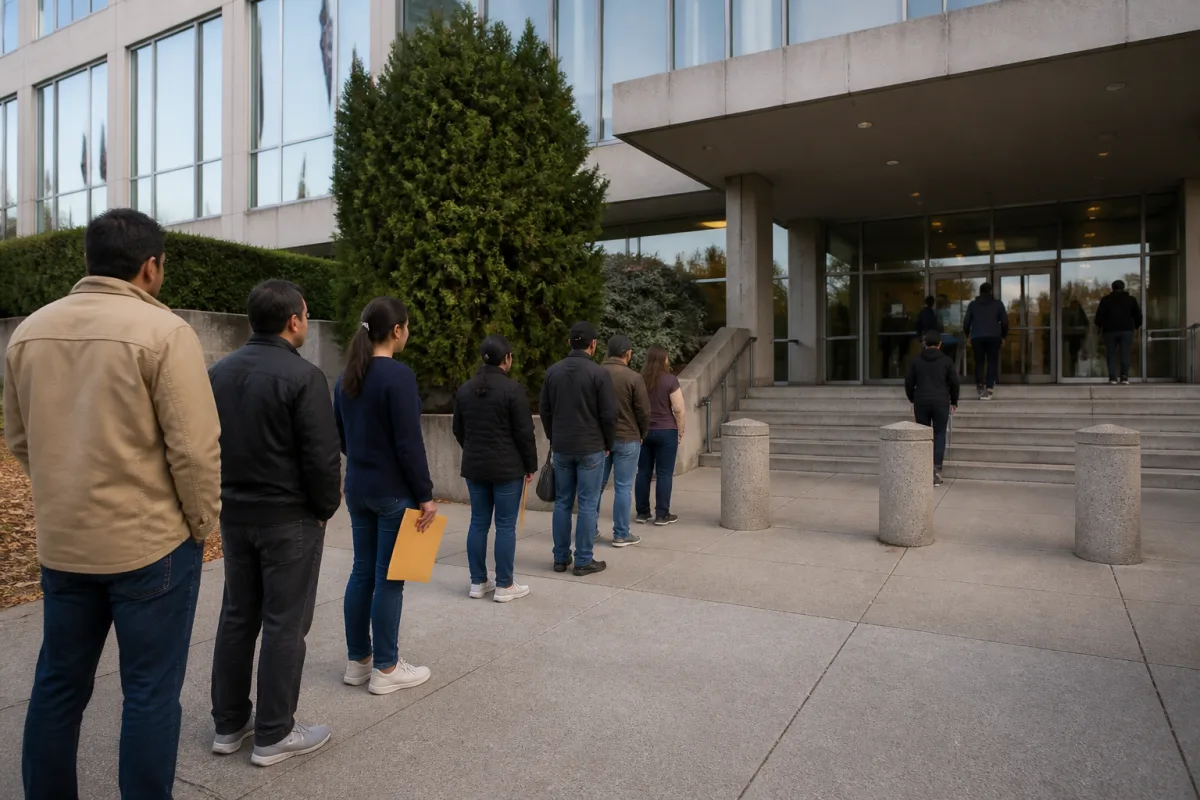

After receiving a letter from USCIS, the first step is identifying its type — a Request for Evidence (RFE) or a Notice of Intent to Deny (NOID) — because that determines the response required, the urgency, and the odds of saving the case.
In short
- An RFE means no decision has been made yet; a NOID means the officer already leans toward denial, but the case can still be saved.
- The deadline to respond to an RFE or NOID doesn’t extend for any legitimate reason — a late response is treated as no response at all.
- Usually there’s only one opportunity to respond to the letter, after which a decision is issued on the case.
- A partial response that doesn’t address every point of the objection is almost always worse than no response at all.
- Withdrawing a petition doesn’t remove the weakness the officer flagged — the decision to withdraw should only be made after talking to an attorney.
What a USCIS Letter Means: RFE, NOID, and Revocation
The first type of letter is a Request for Evidence (RFE). It means the officer cannot approve the case based on the materials already submitted and is asking for more documentation. In effect, it’s an invitation: the case is still alive, and no decision has been made yet. Even strong cases get an RFE — often the issue isn’t a weakness in the case, it’s simply that one specific type of evidence is missing.
The second type is a Notice of Intent to Deny (NOID). This is a fundamentally different situation. A NOID means the officer has already reviewed the case, formed a preliminary negative conclusion, and is disclosing it before making a final decision. The case can still be saved — it isn’t closed — but the applicant is now looking at the officer’s conclusion rather than the officer’s question, and that changes everything: what to answer, how urgently, and how to even frame the response.
An RFE and a NOID carry a different level of risk for the case, which is why the very first thing to do upon receiving a letter is to pin down exactly which of the two arrived, rather than skim it — the required response and the urgency both depend on it.
A third type of letter is less common and often confused with the first two: a notice revoking a status that was already approved. This is the most serious of the three situations and deserves a separate conversation.
| Letter type | What it means |
|---|---|
| RFE (Request for Evidence) | Specific documents are missing; no decision has been made |
| NOID (Notice of Intent to Deny) | The officer has already formed a negative conclusion, but the case can still be saved |
| Notice of Revocation | A previously approved status is being revoked — the most serious case |
RFE — evidence is missing, no decision yet. NOID — the officer already leans toward denial, but the case can still be saved. Revocation — the most serious case of all.
How to Find the Key Paragraph and Understand What the Officer Actually Doubts
The most common mistake when reading an RFE or NOID is scanning the text for reassurance that things aren’t that bad, instead of looking for the actual objection. People skim the letter looking for the word “denied”: they don’t find it — and relax, even though the absence of that word says nothing about the outcome of the case.
People skim the letter looking for the word “denied”: they don’t find it — and relax, even though the absence of that word says nothing about the outcome of the case.
Most of the letter isn’t about the specific case at all. It’s boilerplate: statutory citations, a general description of the category’s requirements. It runs for pages and reads like an extended argument against the applicant — which is exactly why these letters are scarier than they need to be. But this portion is identical across every letter in that category.
The substance usually fits into two or three sentences, sometimes a single paragraph. That’s where the officer states, in plain terms, exactly which conclusion the submitted evidence failed to establish. Finding that paragraph is the first task when reading the letter: everything else is only worth reading in relation to it.
From there, the officer’s wording should be taken at face value, not treated as a mistake to be argued away. If the letter says the evidence doesn’t establish a particular fact, insisting that it does is pointless. The productive question is different: what would actually establish that fact — and how can it be provided.
As a rule, the letter offers only one opportunity to respond, after which a decision is issued. So the answer to the objection in that one paragraph is what decides the outcome of the case — not the tone of the letter or the length of the remaining pages.
The RFE or NOID Deadline: Why It Never Moves
The deadline stated in the letter doesn’t shift because of an illness, a trip, a document delayed from another country, or because the letter wasn’t fully understood until the third week after it arrived. This applies to both types of letters — RFE and NOID alike: whatever their differences, the response deadline works the same rigid way for both.
A response filed after the deadline is treated as if no response was filed at all — the decision on the case is made without considering whatever was submitted. A legitimate reason for the delay doesn’t change that outcome; none of the situations above buys extra time.
The practical takeaway is simple: the date on the letter should be logged somewhere it’s seen every day — it’s that date, not the content of the letter, that determines whether you make it in time.
Illness, travel, a document delayed from another country — none of it extends the response deadline. A late response is treated as if none was filed.
How to Properly Respond to an RFE: Completeness and Quality of Evidence
A partial response is almost always worse than no response at all. If a letter lists four points and the applicant addresses three because the fourth turned out to be difficult, the officer decides based on what’s in front of them — and that fourth point remains unanswered in the record. Responding to an RFE or NOID isn’t about patching a gap: it’s the key opportunity to build the case, and everything that could strengthen it is worth submitting within that one package of documents.
A partial response is almost always worse than no response at all.
The most common instinct is to send more of the same documents that were already in the file. That usually doesn’t work: if the officer wasn’t convinced by the material the first time, more volume of the same material rarely changes the outcome. What moves the needle is either different evidence or the same facts presented in a way the officer can actually verify. Volume isn’t the same thing as persuasiveness.
A separate question is whether to include a written explanation when the letter seems based on a misunderstanding. The key distinction is between clarifying something the case file already supports and trying to argue that the officer got it wrong. Clarification helps; argument without supporting evidence almost never does, and a response that reads as irritated doesn’t help the person whose case is on the line.

If the officer wasn’t convinced the first time, the same document in greater volume rarely changes the outcome. What’s needed is either new evidence or old facts presented so they can be verified.
Sample RFE Response: Proving a Critical Role at a Company
Consider an anonymized case: an applicant received a six-page letter and read it through several times before she could work out what was actually being asked of her. The first step was identifying the type of letter: it turned out to be a Request for Evidence, not a Notice of Intent to Deny, which meant the case was still pending and no decision had been made.
The second step was locating the specific paragraph with the objection rather than rereading the letter from the start. In this case, the objection came down to one point: the submitted evidence established that the applicant’s position at the company was senior, but not that her role was critical. Everything else in the letter was boilerplate that appears regardless of the specific case.
Once the objection was stated precisely, the response was built not as a general case for her importance, but as a selection of specific documents aimed at that specific question. In a situation like this, the following would work:
- an organizational chart of the company with employee names;
- a description of projects that would have stalled without her involvement;
- a letter from the person who would have had to replace her, describing exactly what that would have required.
Alongside gathering the evidence, the response deadline was posted somewhere visible — on the document folder and in a calendar — and flagged to whoever else needed to know about it. That’s how the letter stops being a source of anxiety and turns into a task with a specific question and a specific date.
What Evidence Works to Prove a Critical Role
Should You Withdraw the Petition and Refile
Withdrawing a petition and refiling is technically possible, but it’s almost never the right move to make on impulse, under the strain of a difficult letter. This isn’t a decision to make alone or quickly: withdrawal carries consequences that aren’t obvious up front — they affect the applicant’s current status and how a new filing will be read.
The key detail is that the RFE or NOID letter already in hand is exactly the kind of information worth having before refiling. By withdrawing the case, the applicant doesn’t get rid of the weakness the officer flagged — they simply lose the chance to fix it within the case that’s already open, and the new petition will run into the same question with no explanation of why it came up again.
By withdrawing the case, the applicant doesn’t get rid of the weakness the officer flagged — they simply lose the chance to fix it within the case that’s already open
That’s why the decision to withdraw is a conversation to have with an attorney before taking an irreversible step. This isn’t a formality: the consequences of withdrawal affect status and can affect how the next attempt is evaluated.

If You Can’t Gather the Evidence in Time
If the necessary evidence genuinely can’t be obtained by the stated date, that’s a real situation, and there are specific options for handling it. But none of those options looks like silence or a late response: both of those close the case by default rather than leaving it open.
The conversation about a time shortage needs to happen with an attorney during the week the letter arrives, not the week the deadline expires. At that stage, there’s still a choice among several legitimate paths — submitting partial evidence, writing an explanation for the missing points, or looking at other procedural options. By deadline week, the choice has already narrowed down to whatever got prepared in time.
The conversation about a time shortage should start the week the letter arrives, not the week of the deadline — that’s when there’s still a choice between partial evidence, a written explanation, or procedural options.
The Diagnostic Value of the Letter: What It Says About Future Filings
An RFE or NOID doesn’t stop being useful once the case is closed by a decision. It’s worth reading twice: once to respond to it, and a second time to understand how the case was built in the first place. A trained officer studied the materials in detail and put in writing exactly which part failed to convince them — that’s a level of precise feedback no friend, forum, or law firm website can match.
It’s a professional assessment of the weakest point in the case, delivered for free and at a moment when it can still be fixed. If the evidence of a critical role at the company was weak this time, it will still be weak in the next filing — and in the documents the employer later submits based on the same case. In effect, the letter points to exactly what needs to be built up and reinforced over the next couple of years — not a consolation, but the most concrete clue available about the weak points of one’s own case.
One more distinction worth drawing: a denied case and a case stuck without a decision for months or years are two different scenarios that often get confused. They’re not the same problem, and they call for different responses. So whenever a case runs into trouble, the first step is pinning down exactly what you’re facing — a denial or a stalled, undecided case.
Frequently asked questions
Does receiving an RFE mean the case is likely to be denied
No, a Request for Evidence is a normal part of the process, and these requests are often successfully resolved. The outcome doesn’t depend on getting the letter itself, but on how thoroughly and accurately it’s answered.
What if the case has been stuck without a decision for months, rather than a denial letter arriving
These are two different scenarios that often get confused: a denied case and a case stuck without a decision for an extended period. The available options differ between the two, so the first step is pinning down exactly which situation you’re facing.
Can responding to an RFE or NOID be left to an attorney instead of preparing the documents yourself
There’s no direct answer to that question, but the decision to withdraw a petition and other major steps in a case are explicitly described as something to discuss with an attorney before taking any irreversible action — the same goes for a shortage of time to gather evidence.



Comments
Reader experience is useful, but it is not advice: check the rules on the official site.
No account needed: click Sign in, type any name, and you are done.