
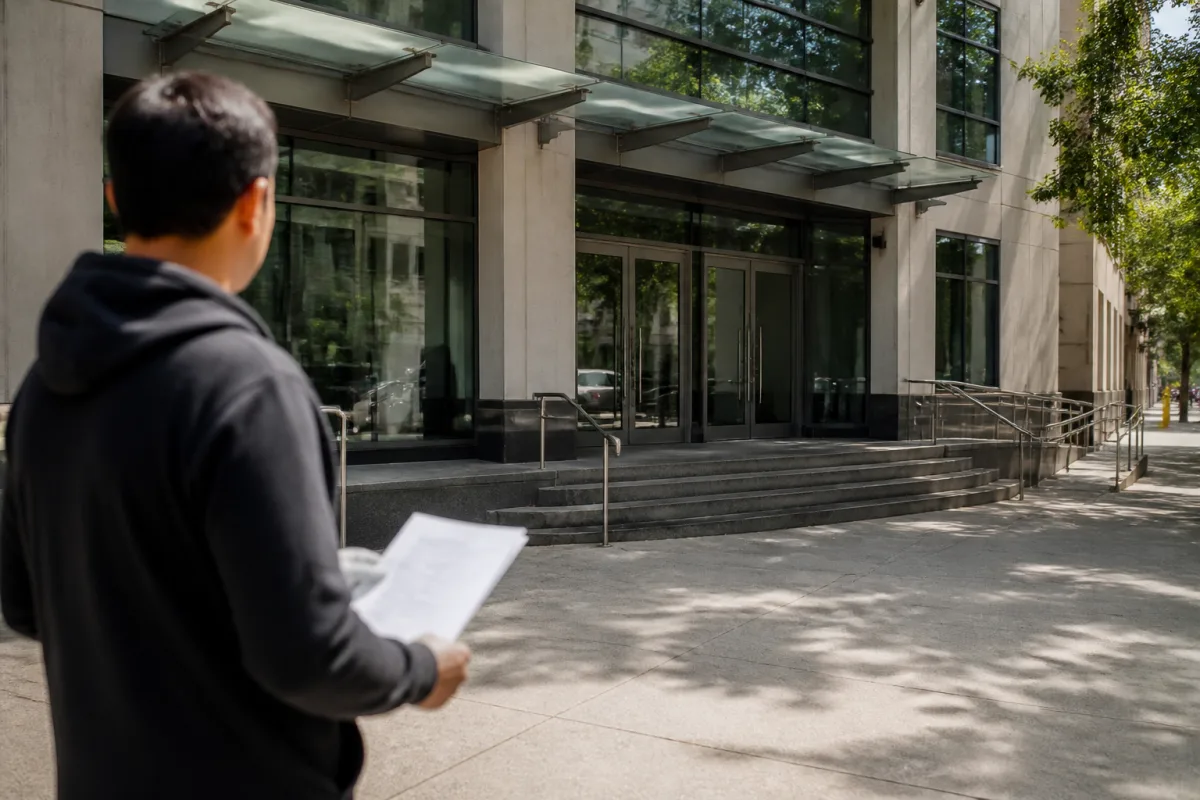

When a USCIS officer rejects a medical disability exceptions form N-648, the applicant is usually still allowed to proceed to the N-400 interview and take the English and civics test — and the denial itself can be challenged by submitting a stronger medical certification at a follow-up interview.
In short
- An N-648 denial doesn’t cancel the N-400 interview — the officer typically schedules a follow-up appointment with a new medical certification.
- The deciding factor is the doctor’s written certification, not the attorney’s arguments: the officer focuses on what’s documented, not what’s said on the applicant’s behalf.
- A certification from a treating physician who has monitored the patient for years carries more weight than a one-time remote evaluation.
- Applicants get two attempts at the N-400 test — before a follow-up appointment, it’s worth confirming with the officer whether the previous visit already counted as one of them.
- Hiring an immigration attorney is more effective before filing N-648, at the stage of choosing a doctor, than after a denial.
Why an officer rejects N-648 even when the paperwork looks complete
In the case under review, the denial came down to the format of the exam: the evaluation was conducted by a doctor over video, not in person. The applicants pointed out that USCIS guidance allows for remote evaluation and that the doctor was licensed to practice in all 50 states — but the officer didn’t treat that as enough to accept the certification. Technically meeting the website’s requirements doesn’t guarantee that a particular method of evaluation will satisfy a specific officer.
According to an immigration attorney with 18 years of experience, getting an N-648 waiver approved is harder now than it has ever been. Officers go looking for grounds to deny: in one case described, the fact that the applicant occasionally worked as a driver became the basis for doubt — treated as a sign of no real disability, even though that logic is shaky on its own terms.
According to an immigration attorney with 18 years of experience, getting an N-648 waiver approved is harder now than it has ever been.
What ultimately decides the outcome is the doctor’s written certification: according to attorneys who handle these cases regularly, what matters is what’s on the document itself, not the arguments made by a lawyer or the applicant. That’s why choosing a doctor who sees the patient regularly and can back up the diagnosis — rather than a one-time remote evaluation — directly affects whether an officer accepts the explanation for why someone can’t learn English and civics.
In one case, occasional work as a driver was enough for the officer to question the applicant’s disability — even with an otherwise compliant certification.
What kind of medical certification N-648 actually needs
The difference between a certification from a treating physician and a one-time medical evaluation is a difference in the weight of evidence, not in paperwork. A treating physician sees the patient for years, manages treatment, and can explain exactly how the condition prevents learning English and civics. A one-time exam — even from a well-regarded clinical psychologist — only captures a single moment, with no treatment history behind it.
In the case under review, the family put together a strong package: the family doctor and psychiatrist passed the full medical history to a clinical psychologist, who wrote up a detailed report. But the evaluation itself happened over video — a half-hour call, some questions, and a written report afterward. That format is what made the certification vulnerable: in this case it was called weak evidence, since a one-time evaluation, in the officer’s view, didn’t provide enough grounds for the conclusion.
The contrast is telling: on one side, a doctor who has treated the patient for eight years for a serious mental health condition that interferes with learning English. On the other, a thirty-minute call followed by a written report. According to the attorney, the second option “will never work.”
According to the attorney, the second option “will never work.”
After the denial, the family was advised to go to a local doctor — someone who personally treats and monitors the applicant. The one-time evaluator who wrote the first report said outright that this wasn’t the kind of assessment they do, and offered to write a separate letter while the applicants looked for a specialist willing to conduct a psychological evaluation specifically for N-648.
A certification from a doctor who has treated the patient for years outweighs a detailed but one-time video report — even from an experienced psychologist.
Treating physician vs. one-time evaluation for N-648
| Criterion | Treating physician | One-time evaluation |
|---|---|---|
| Length of monitoring | Years (8 years in this case) | A single session (around 30 minutes) |
| Format | In-person, ongoing | Video, one-time |
| Knowledge of medical history | Full history, manages treatment | Receives history secondhand from other doctors |
| How the officer weighs it | Strong evidence | Weak evidence |
Based on the N-648 denial case discussed in this article.
What happens at the N-400 interview after an N-648 denial
-
An N-648 denial doesn’t mean the interview itself is denied. In the case under review, the officer rejected the evaluation but didn’t cancel the appointment: he explained to the applicant why he wasn’t accepting the document, and that closed out the N-648 part of the process — the candidate was still allowed to proceed to the N-400 interview.
-
The officer schedules a follow-up interview with a new evaluation. Instead of issuing a final denial, he asked the applicant to bring a certification from a different doctor and scheduled another interview specifically to review that new evaluation.
-
The English and civics test usually still happens anyway. Based on the experience described in the case, in almost every situation where an N-648 evaluation gets rejected, the officer still lets the candidate take the test — sometimes even suggesting starting with the test first, just to see the result right away.
What happens after an N-648 denial at the N-400 interview
Three steps an applicant goes through when the officer rejects the medical certification.
- The officer rejects the N-648 certification but doesn’t cancel the interview
- A follow-up appointment is scheduled for a new medical evaluation
- The applicant is still allowed to take the English and civics test
An N-648 denial isn’t the end of the process: the officer typically schedules a new appointment and still lets the applicant take the English and civics test.
How many attempts applicants get at the naturalization test, and whether the previous visit counts
Applicants get two attempts at the N-400 test: if the first attempt isn’t passed, the follow-up interview is scheduled within 60 to 90 days. In the case under review, the interview ended with the officer rejecting the N-648, and the applicant never actually took the test itself — which raises the question of whether the officer will count that visit as one of the two allotted attempts.
Counting that visit as a used attempt would be unfair to the applicant if the right to take the test is still technically intact: the test didn’t happen because of a rejected medical certification, not because of a failed result. That’s why, at the follow-up appointment, once the applicant arrives with a new evaluation, it makes sense to ask the officer directly: does the previous visit count as the first attempt or the second? That question is worth asking before testing begins, not after — so the applicant knows exactly how many real chances remain.
Before the follow-up test, ask the officer directly whether the previous visit counts as one of the two allowed attempts — clarify this before testing begins.
Is it worth hiring an attorney after an N-648 denial
A lawyer can’t guarantee a different outcome on N-648 — that’s a point an immigration attorney with 18 years of experience makes directly while discussing this case. In his assessment, the outcome of a review isn’t determined by arguments made at the interview but by the content of the medical certification itself: the officer is focused primarily on what the doctor wrote, not what a lawyer says on the applicant’s behalf.
That doesn’t mean a lawyer is useless. The real work happens before the interview — at the stage of choosing a doctor and preparing the form: helping find a specialist who will conduct an in-person evaluation and describe the diagnosis in a way that heads off the officer’s typical objections. By the time of the interview, once the certification has already been rejected, a lawyer’s options are limited: by his own admission, turning the decision around on the spot usually isn’t something he can do.
by his own admission, turning the decision around on the spot usually isn’t something he can do
The practical takeaway: it’s more useful to bring in an attorney before filing N-648, not after it’s denied — at the preparation stage, the cost of a mistake is lower and a lawyer’s influence is greater.
Frequently asked questions
What happens if the new N-648 certification is rejected again at the next interview
The case described covers only one cycle of denial and a rescheduled evaluation, with no information about what happens if that second certification is also rejected. The underlying procedure appears the same: the officer explains the reason and likely offers another chance to submit a certification from a different doctor, but how many times this can repeat isn’t known.
Can a new N-648 be filed with a different doctor before the next N-400 interview, without waiting for it
In the case discussed, the officer scheduled the follow-up appointment himself for the new evaluation, rather than inviting the applicant to submit the document early by mail or another channel before the interview. Based on the process described, preparing the new certification was tied specifically to the next scheduled interview.
Can a clinical psychologist sign off on N-648, or does it have to be a treating physician
A psychological evaluation for N-648 is allowed and is officially recognized as part of the process — the problem wasn’t the specialist’s field, it was the format of the exam, conducted over video instead of in person. A clinical psychologist can complete the certification, but the officer weighs the depth of the doctor’s observation of the patient above the specialist’s credentials themselves.


Comments
Reader experience is useful, but it is not advice: check the rules on the official site.
No account needed: click Sign in, type any name, and you are done.