


A US tourist visa applicant from Crimea got approved not despite a complicated background, but because the officer evaluated the applicant’s current life — job, income, family, and a specific reason to return home — rather than their past.
In short
- A US tourist visa interview lasts 2 minutes, and the officer evaluates just three things: safety, a reason to return, and the temporary nature of the trip’s purpose.
- Living in an occupied territory or having a complicated background is not, by itself, grounds for denial — the officer evaluates the applicant’s current situation.
- The source of income and travel funds needs to be explained specifically, in words, rather than by pointing to a relative or a piece of paper.
- Everything written on the DS-160 gets checked against later visa procedures years down the line, up to and including the green card interview.
- Having multiple passports or ties to a disputed territory is evaluated individually by the officer — there is no single formula for approval or denial.
What the Officer Actually Checks in a 2-Minute Interview
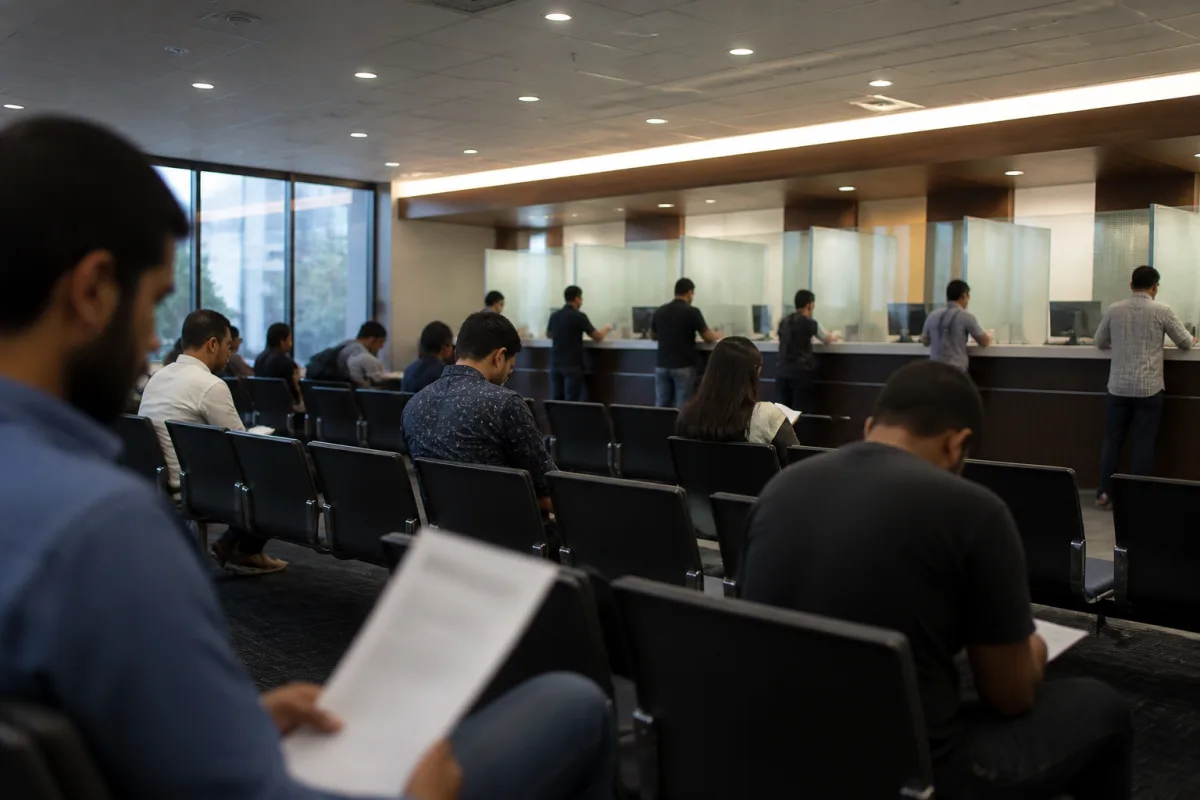
A US embassy interview lasts just 2 minutes. In that time, the officer doesn’t study the applicant’s file or go through their biography point by point — worrying about a detailed background check is pointless.
A US embassy interview lasts just 2 minutes.
In those 2 minutes, the officer evaluates three things. First — whether the applicant poses any safety concern for the country: this is the officer’s main priority. Second — whether the applicant has a reason to return home after the trip. Third — whether the purpose of the visit is genuinely temporary, or whether there’s a suspicion the person intends to work, study, or join an American fiancé: other visa categories exist for those purposes, not the tourist visa.
In the 2-minute interview, the officer evaluates only three things: whether the applicant is a safety concern, whether there’s a reason to return, and whether the purpose of the trip is temporary.
A Complicated Background and an Occupied Territory: Why It’s Not a Dead End
An applicant’s complicated background is not an automatic reason for visa denial. A telling example is the approval of a tourist visa for an applicant from Crimea in 2026: the common belief that residing in an occupied territory alone closes the door on a visa was not confirmed by this case.
What happened to the applicant in the past — for instance, in 2014, when the status of the territory they lived in changed, or why they relocated — doesn’t matter to the officer. What matters is the current situation: how the person lives now, what they do, and what ties them to a point of return. The officer only cares about the safety of their country and whether the applicant fits the visa category they’re applying for.
Similar logic played out in another case: an applicant and her daughter from Ukraine received a 10-year visa, even though their relative was in the US on humanitarian parole at the time — a circumstance many would consider an aggravating factor.
Four Things the Officer Looks At: Job, Income, Family, Obligations
The officer evaluates four things: the applicant’s job and income, and their family and obligations back home. Employment letters on their own don’t interest the officer — what matters is what the applicant says about their job and where their income comes from.
The source of income needs to be explained in words, not on paper: name what the applicant does and what they live on. Separately, the officer checks what the person will live on for the entire trip — if a six-month stay is planned, an answer like “my daughter will support me” or reliance on another relative doesn’t work. The applicant needs to show their own source — for example, renting out an apartment or personal savings.
The fourth point is obligations back home: what ties the person down and requires them to return by a specific date. This isn’t an abstract “I have a house there,” but a concrete matter with dates and responsibilities that requires the applicant’s presence.

State the source of income in words rather than proving it with paperwork: what the applicant does and what they live on — including the source of funds for the whole trip if it lasts months.
Why a Specific Purpose and an Exact Trip Length Matter
If the planned trip lasts longer than a month, the officer starts asking questions: a long stay without a clear explanation looks suspicious, especially with trips framed as “wintering” — a pattern common among retirees and parents visiting their children. In that case, the applicant needs to be ready to explain the source of funds for the entire stay: not “I live off my daughter,” but specifically — an apartment is rented out, or there are savings.
In the case discussed here, the applicant from Crimea named an exact length — 2 weeks — and justified it: in the fall, he needs to oversee the grape harvest on his own vineyard, where workers come to help. The purpose of the trip was also specific: visiting a sister and a nephew finishing high school in the US, with a brief explanation of why the relationship was close. That kind of statement ties the length of the trip and the reason to return into one coherent story, instead of leaving the officer to guess why the person is traveling and why they’ll come back.
State an exact trip length and tie it to a specific matter back home, and explain the purpose of the visit through a specific person and occasion. That way, the officer doesn’t have to guess.
Why You Can’t Embellish the Application — and What Happens If You Lie
On a tourist visa application, only the truth should be written — no invented stories, no embellished circumstances. This isn’t about checking the past; it’s about the future: a tourist visa becomes the first entry in an applicant’s visa history, and that entry stays on record.
Everything written on a tourist visa application has to hold up in later visa procedures — even if 10–20 years pass in between: a business gets opened, property gets bought, a marriage to a US citizen happens. Discrepancies surface right at the green card interview: some applicants get denied precisely because, years earlier, they wrote on the application not what was actually true, but what someone advised them to write.
The reason for a return ticket on an application can even be a pet. In one case, an applicant stated he couldn’t be away for more than two weeks because of his Labrador: the breed struggles with separation from its owner and can become depressed. For a US officer, that’s a legitimate argument — in the US, depression in animals is a recognized condition, not a reason for suspicion.
an applicant stated he couldn’t be away for more than two weeks because of his Labrador

Everything written on a tourist visa application has to hold up even 10–20 years later — discrepancies surface at the green card interview and become grounds for denial.
Multiple Passports and Territorial Status: How the Officer Evaluates Them
Holding multiple passports doesn’t automatically settle a visa case — the officer reviews such situations individually, since an applicant may have and use, at the time of applying, not just one passport but a second or third. There’s no single formula like “Ukrainian from Crimea equals denial” or “from Mariupol equals approval”: there’s a specific person and the specific circumstances of their case.
There’s no single formula like “Ukrainian from Crimea equals denial” or “from Mariupol equals approval”
When assessing passports and territorial status, three things are considered: what personal benefit lies behind the choice of one passport over another, whether it complies with the law, and how widely recognized the territory tied to the document is. A similar approach applies when an applicant has children with US status — that’s a separate question requiring a review of the specific situation.


Comments
Reader experience is useful, but it is not advice: check the rules on the official site.
No account needed: click Sign in, type any name, and you are done.