
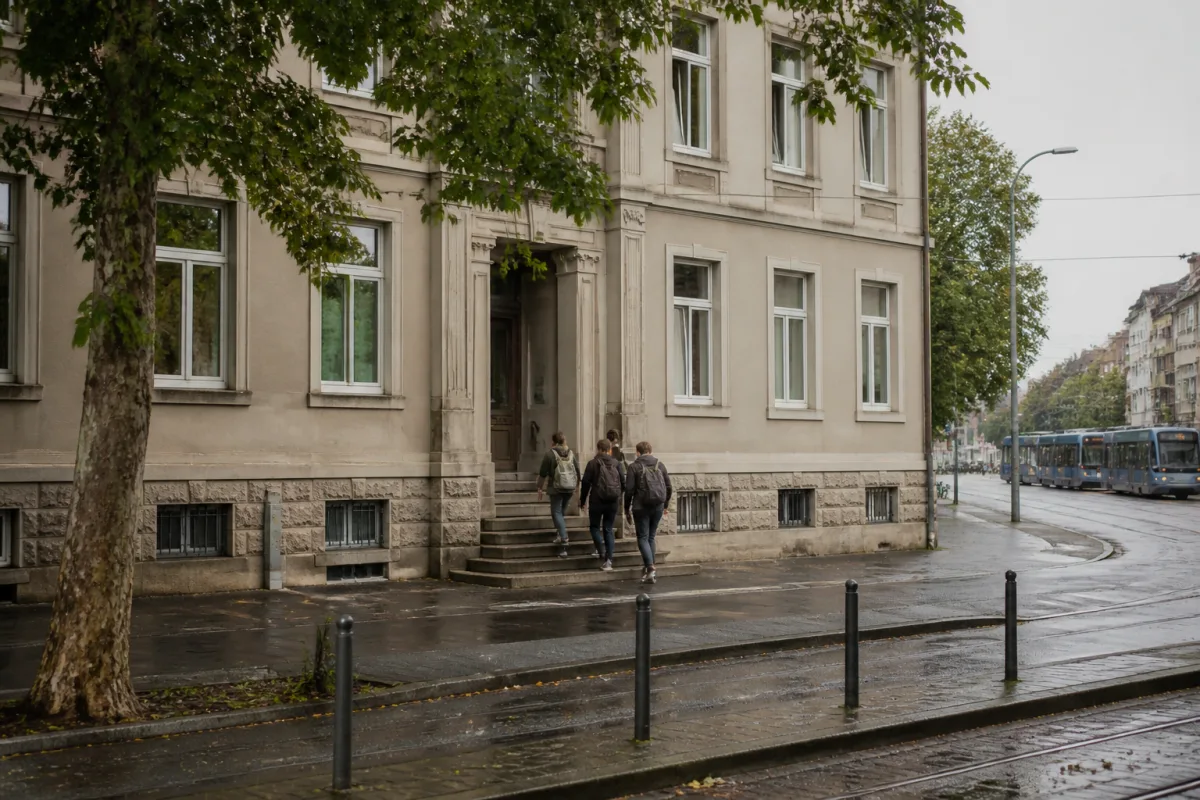

To pass the B1 exam required for German citizenship, you book a slot with a licensed testing center (such as telc or the Goethe-Institut), sit a written part on test day made up of three sections — reading, listening, and writing — and finish with a speaking test done in a pair with another candidate.
In short
- B1 isn’t always required: a school leaving certificate without a 5 or 6 in German, an Ausbildung diploma, or a German university degree can exempt you from the exam.
- The exam costs just over 200 euros and can be taken in any German city, not only where you’re registered.
- The written part runs with no break: 90 minutes reading, 30 minutes listening, 30 minutes writing — you can’t leave early.
- Listening is the part most candidates fail: the first task plays only once, the rest play twice.
- Results take 4 to 8 weeks, but that doesn’t affect the naturalization decision — the document can be submitted later.
What German level you need for citizenship, and when B1 isn’t required
For German naturalization, a B1 certificate is needed only if you’re proving your language level through an exam — not everyone has to take it. The certificate must come from a licensed testing provider, though several recognized providers exist.
German law sets out several grounds that, in practice, exempt applicants from the mandatory B1 test (check the exact wording of your situation with your local immigration authority before applying):
- around four years of schooling in a German school (confirm the precise length for your case) with promotion to the next grade — for example, up through grade 4, 5, or 7;
- a German school leaving certificate, with one condition: it must not include a grade of 5 or 6 in the subject “German”;
- a diploma from German vocational training (Ausbildung);
- a degree from a German university.
In practice, any one of these grounds usually exempts an applicant from the language exam when applying for citizenship, but the exact conditions should be confirmed with your local immigration office.
How to book the B1 exam and what it costs
Booking a B1 exam slot is almost always done online, though some testing centers don’t offer this — worth checking on the provider’s website beforehand. Register with a recognized examiner, such as telc or the Goethe-Institut: if the certificate comes from an unrecognized school, the immigration office may refuse to accept it, and the money spent on the exam is simply lost.
The exam can be taken in any German city, not just the one where the applicant is registered. This matters most where no slots are available locally: in the case described here, booking in Cottbus wasn’t possible because there were no open spots, so the exam was taken in Berlin instead.
The exam costs just over 200 euros per person, with the exact amount varying by school and region. The booking process itself was done online and took little time. In this example, the exam started at 8 a.m. on a Saturday, at Alexanderplatz in Berlin.
If an unrecognized school administers the exam, the immigration office may refuse to accept the certificate — and the money already spent on the exam is lost.
Before the exam starts: documents and personal belongings
At check-in, candidates must arrive on time and hand over a valid ID: a residence permit, national passport, or ID card. German citizens present their national ID card (Personalausweis), though taking the B1 exam in that situation is rare.
- No application form is needed — registration happens on-site, and staff find each candidate using their ID; there’s nothing to fill out in advance.
- Personal belongings are handed in right after check-in — starting with phones.
- No need to bring pens or paper — everything required for the exam, including stationery, is provided on-site.
- Candidates enter the exam room essentially empty-handed: no gadgets, no personal writing materials, no notes of any kind.
This check happens before the written part begins and takes only a few minutes — after that, candidates are seated and given the test materials.

At check-in, you only need a valid ID. Phones, pens, and paper are handed in right after registration — everything needed for the test is provided on-site.
What to bring to the B1 exam
The written part: reading, listening, and writing
The written part runs as three blocks in a row, with no break: 90 minutes for reading, 30 minutes for listening, and 30 minutes for writing.
| Part | Length | What it tests |
|---|---|---|
| Leseverstehen (reading) | 90 minutes | considered the easiest part — the one candidates fail least often |
| Hörverstehen (listening) | 30 minutes | considered the hardest part — the one that most often costs candidates the exam |
| Schreiben (writing) | 30 minutes | writing an email |
Each part comes with its own question sheet and a separate answer sheet. Only marks on the answer sheet count — anything marked on the question sheet itself doesn’t matter, though both documents must be turned in.
You can’t leave early, even if you finish ahead of time. Anyone who completes the 90-minute part in 30 minutes still has to sit out the remaining time: using a phone or talking is not allowed. The same rule applies to the writing block — even with the email already written, you can’t leave the room before all 30 minutes are up.
You can’t leave early, even if you finish ahead of time.
What makes up the written part of the B1 exam
Three blocks run back-to-back with no break.
- Leseverstehen (reading)90 minutesthe easiest part
- Hörverstehen (listening)30 minutesthe hardest part
- Schreiben (writing)30 minuteswriting an email
Reading and listening: how the tasks work and where candidates fail most
The reading section has four to six separate tasks, with answers marked on the sheet using letter circles A–G or “true/false” marks. One task works like this: the sheet prints 12–20 short classified ads, alongside descriptions of situations that need to be matched to the right ad. Each ad can only be used once, and the wording deliberately doesn’t match word for word — for example, a request for “an adventure holiday with a friend” has to be matched to an ad for bungee jumping aimed “at couples,” with no direct mention of a holiday at all.
The best approach is three passes: first read through all the tasks, then all the ads, and only then start matching them up. Before transferring answers to the final sheet, it’s worth jotting them down on the scrap space in the task booklet first and double-checking them — does the ad really name the city and detail the question is asking about. This section only requires around 60% correct answers, and the time allowed is generous: 90 minutes for the whole block. In practice, the first task can be solved in about 40 minutes, leaving just as much time for the rest — enough to reread and double-check answers more than once.
As soon as the 90 minutes are up, the task sheet for part 1 is collected and torn up — nothing can be added or corrected after it’s handed in.
As soon as the 90 minutes are up, the task sheet for part 1 is collected and torn up — nothing can be added or corrected after it’s handed in.
The B1 listening section is built from two types of tasks, and the difference between them matters a lot for strategy. In the first task, the recording plays only once, so it’s worth reading all the questions carefully before listening — that way you already know what details to listen for and what traps the recording might set. In one recorded segment, the question stated “rain is expected tonight at 7 p.m.,” while the recording itself said “severe weather is expected in Baden-Württemberg this evening” — leaving the candidate to decide for themselves whether “severe weather” counts as a synonym for rain. Mismatches like this in B1 don’t come up often, but at least a couple per exam are predictable. All the remaining listening tasks are played twice, which makes the work noticeably easier, especially if the questions have already been read in advance.
After each listening segment, there’s a short window — roughly 2 to 4 minutes — to finish filling in answers. The same trick from the reading section applies here: mark answers on the task sheet first rather than straight onto the final answer sheet, otherwise corrections mean erasing and the rows of marks lose their alignment. Listening is considered the part where most candidates fail — the difficulty comes less from the texts themselves and more from the single playback of the first task and having to guess in advance what it’s going to be about.
Listening is the hardest part of the exam: the first task plays only once, and the wording in the questions and the recording may not match word for word.
The writing section: composing an email in 30 minutes
The third task in the written part is writing an email on paper, with a subject line and body text. Around 30 minutes are allowed for the letter itself. The topic is usually everyday in nature — for example, arranging to meet an old acquaintance, describing plans, or writing about a favorite travel destination — and the task always comes with instructions on exactly what to respond to, which are worth rereading a few times to be sure what’s expected.
The space is limited — roughly a page and a half of A4, no more is needed. This is a B1-level exam, not C1, and the topic is generally there to check for an adequate language level rather than stylistic complexity: the prompts tend to be similar year to year and aren’t particularly tricky.
Handwriting matters directly: if the examiner can’t read what’s written, the work doesn’t get marked, so writing legibly — not perfect calligraphy, just legible — is essential. Basic formatting rules apply: every sentence starts with a capital letter and ends with a period, exclamation mark, or question mark, most often a period.
Notes and drafts are allowed in the margins of the scrap paper, which also has to be handed in along with the final work. A useful tactic: sketch out the text on the scrap paper first, then use the 30 minutes to copy it cleanly onto the answer sheet, focusing on spelling and capitalization rather than composing content from scratch.

The speaking part: three tasks paired with another candidate
After the written part, there’s a break of about an hour and a half before the speaking test begins. As with the written part, nothing personal can be brought in — no notes, no pens, no phone.
All candidates are first gathered in one room, where a staff member explains how the day will run. They’re then split into pairs and sent to separate preparation rooms: 20 minutes are given to prepare for the speaking part. In the prep room, each candidate sits apart and prepares alone — no talking, no reference materials. In that time, the candidate needs to think through all three tasks ahead.
The first task is almost always the same format — it’s not an individual interview but a conversation the examiners observe from the side: candidates introduce each other. You talk about yourself — who you are, where you’re from, why you’re here, what you do — and ask your partner the same questions. This task is the easiest to prepare for in advance, for example by drafting answers with the help of an AI tool if there’s no one around who speaks German. During the actual conversation, it helps to ask your partner simple, clear questions and support them if they get stuck — pairs with matching language levels are rare on exam day.
pairs with matching language levels are rare on exam day
The second task is arguing a given topic: one candidate makes the case “for,” the other “against.” The topic can’t be known in advance, which makes preparing for it harder than for the introduction task. The third task is joint planning: the pair has to work out together how to organize a surprise for a friend returning to Germany. 20 minutes are given to prepare for this task.
For all three tasks, the same advice applies: don’t write out full ready-made sentences, just short cue notes — otherwise awkward silences creep into the conversation. It also helps to think in advance about what questions your partner might ask, so you’re not caught off guard.
Candidates are called in one at a time by the examiners — usually two of them. ID is checked again before starting. Each of the three conversation topics is allotted 6 minutes, though in practice the conversation can wrap up faster — if the pair finishes in 3 minutes, the examiner will ask them to keep going, and at that point it helps to keep developing the topic yourself by asking follow-up questions. It’s best to keep the conversation as natural as possible and speak loudly and clearly so your partner can follow. If your partner gets stuck or drifts off-topic, you can gently bring them back — working as a team makes the whole speaking part easier. Once all three topics are done, candidates are led out of the room and their belongings are returned.
The B1 speaking part, step by step
Three tasks done in a pair with another candidate, 6 minutes per topic.
- ID check and gathering in the common room
- Preparing for the tasks in pairs20 minutesno talking, no prompts
- Task 1: candidates introduce each other6 minutes
- Task 2: arguing for and against6 minutestopic not announced in advance
- Task 3: planning a surprise together6 minutes
When to expect results, and whether to take the combined A2/B1 exam instead
Candidates reported different waiting times for results: one mentioned 4 weeks, another 4 to 6 weeks, a third 8 weeks. In practice this doesn’t matter much: naturalization isn’t derailed just because the result arrives a few weeks earlier or later. The exam result document is a requirement that can be submitted later, once it’s in hand.
One more thing worth deciding on is exam format: not every testing center even offers the combined A2/B1 exam — worth checking when booking. There are two reasons to pick this format. The first is less obvious: if you don’t pass at B1 level, the combined exam may still leave you with an A2 certificate — better than nothing. The second reason matters more: the combined A2/B1 exam is noticeably easier than a standalone B1, because it includes a lot of A2-level tasks. That makes it easier to pass overall.
What this means in practice
- A 4–8 week spread in waiting time for results isn’t a reason to worry — it doesn’t affect the naturalization decision itself.
- The result document can be submitted to the immigration office later, as a follow-up on a missing requirement.
- If you’re unsure about your B1 level, it’s worth asking about taking the combined A2/B1 exam instead — it’s easier and gives you an A2 certificate as a fallback.
If you’re unsure about your B1 level, ask about booking the combined A2/B1 exam instead — it’s easier and gives you an A2 certificate as a fallback even if you don’t pass B1.
Frequently asked questions
Can you retake the B1 exam if you don’t pass the first time
The material doesn’t mention a direct limit on the number of attempts. The logic of the combined A2/B1 exam shows that even if you don’t pass at B1 level, you can still come away with an A2 certificate — which suggests retaking the exam is treated as a normal option for those who don’t pass the first time.
What if there are no slots at your local testing center
You can register in any German city, not just where you’re registered — that’s the standard workaround when there are no open slots locally, taking the exam wherever spots are actually available.
Can the B1 exam be used for purposes other than citizenship
The material covers the B1 exam specifically in the context of the citizenship requirement, and doesn’t say anything about using the certificate for other purposes, such as a residence permit, work, or study.
Can you prove B1-level German without taking the exam if you have other qualifications
Yes: a diploma from German vocational training (Ausbildung) and a degree from a German university are grounds that, in practice, exempt applicants from the language exam when applying for citizenship — the exact conditions should be confirmed with your local immigration office.


Comments
Reader experience is useful, but it is not advice: check the rules on the official site.
No account needed: click Sign in, type any name, and you are done.