
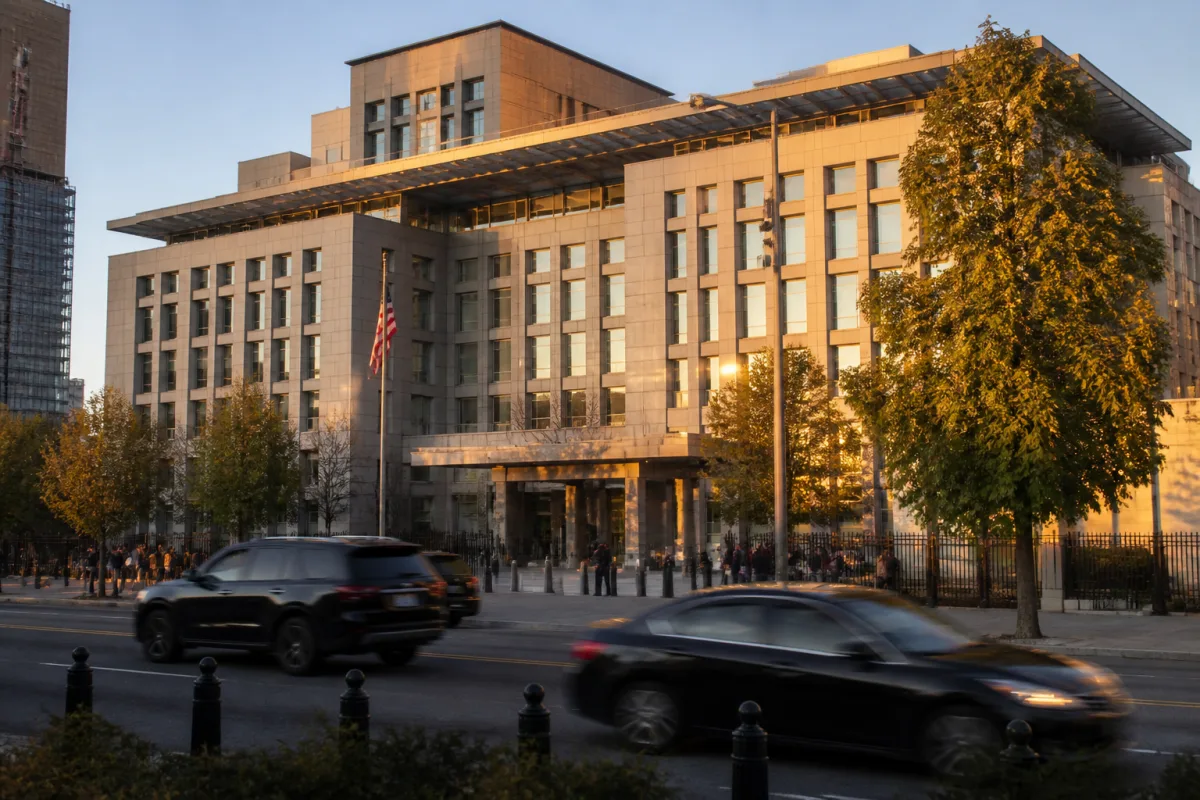
The U.S. State Department has officially lifted the visa pause for 75 countries covering immigrant and Diversity visas following the court ruling in Clinic v. Rubio, and as of September 14, 2026, this is confirmed by a cable instruction sent to embassies on September 10, 2026.
In short
- The visa pause for 75 countries was lifted by Judge Vargas’s ruling of August 24, 2026, and the State Department’s cable took effect on September 10
- Refusing applicants under Section 221(g) because of the pause is no longer allowed, and embassies must review all such prior refusals
- Cases are processed in queue order by interview date, except Diversity Visa cases, which jump the queue because of the September 30 deadline
- The government’s appeal could take 2 to 6 months at the Second Circuit, and the pause remains lifted throughout that time
- Emailing the embassy to speed up a case doesn’t help — status should be tracked through the update date on the NVC website
What happened: the Clinic v. Rubio case and the end of the pause
The lifting of the visa pause for 75 countries stems from Clinic v. Rubio, a case heard in district court. Judge Vargas ruled on August 24, 2026, under Rule 54(b) — and that ruling is what struck down the pause on visas for those 75 countries. The government disagreed with the ruling and filed an appeal, asking the court to issue a stay order that would suspend its own judgment. Because of the appeal, the case has moved to the Second Circuit Court of Appeals, which will review Judge Vargas’s decision and issue its own ruling.
Filing an appeal does not, by itself, bring the pause back: the judge’s ruling stays in effect unless and until a court separately issues a stay order. In practice, this took effect on September 10, 2026, when the State Department issued a cable instruction to embassies — a procedural document directing ambassadors to follow the court’s ruling.
Filing an appeal does not, by itself, bring the pause back: the judge’s ruling stays in effect unless and until a court separately issues a stay order.
A related case, Medani v. Trump, resulted in the pause on the Diversity Visa lottery being lifted as well. The State Department’s cable states plainly that both the pause on immigrant visas (from Clinic v. Rubio) and the pause on Diversity Visa lottery cases (from Medani v. Trump) are no longer in effect.
Judge Vargas’s ruling of August 24, 2026 lifted the visa pause for 75 countries. The government has appealed, but the pause remains lifted unless and until the court issues a separate stay order.
The State Department’s September 10 cable: what embassies were told to do
The cable directs every U.S. embassy to comply with the court ruling and formally end the pause — for both immigrant visas and Diversity Visa lottery cases. The State Department specifically stated that the immigrant visa pause is no longer in effect following Clinic v. Rubio, and the lottery visa pause is no longer in effect following Medani v. Trump. All prior guidance that had put both pauses in place has been fully rescinded.
This carries a direct consequence: no applicant may be refused under Section 221(g) on the grounds that a visa pause is in effect. Embassies are instructed to locate cases where such a refusal was already issued for that reason, review them again, and contact applicants to request any missing documents — such as a police certificate — or a repeat medical exam if the previous one has expired.
The cable requires these cases to be processed on an expedited basis and prohibits leaving any case in “frozen” status. It separately notes that lifting the pause does not mean automatic visa issuance: the officer still evaluates each applicant’s eligibility for a visa individually, case by case.
As of September 10, 2026, embassies are barred from refusing applicants under Section 221(g) on the grounds of the visa pause — all prior refusals of that kind must be reviewed again.
Reviewing 221(g) refusals issued because of the visa pause
Every applicant who received a 221(g) refusal because of the visa pause will have their case reviewed again — this is directly required by the State Department’s cable instruction. Each embassy must identify all cases in its own records where a 221(g) refusal was issued solely because of the pause, flag them, and begin working through them. No new 221(g) refusals may be issued for that reason going forward — the cable states this explicitly.
A review does not mean automatic approval: embassy staff will contact the applicant and request any documents missing from the file — for example, a police certificate. If the medical exam has expired, the consulate will ask the applicant to retake it.
Cases are not handled in the order applicants reach out — they’re processed in queue order, on a first-come, first-served basis, following the chronological order in which they originally came in. There is no way to check your place in that queue in advance: the embassy will reach out once your case comes up.
What the embassy may request during a 221(g) case review
Lifting the pause is not a visa guarantee: what the officer checks
Lifting the pause only removes a formal ground for refusal — the court ruling itself does not guarantee a favorable outcome in any specific case. A consular officer reviews each case individually and reassesses the applicant’s eligibility from scratch, rather than simply because the restriction was lifted.
Applicants must re-establish that they meet all visa requirements. What gets checked includes: general visa eligibility, security screening results, completeness of application data and documents, and whether medical exams and police certificates are still current. In some cases, officers additionally require confirmation that the applicant will not become a “public charge” — for each such case, the consular officer must fully complete a separate worksheet.
An interview that has already taken place does not close the matter for good: if the officer determines it’s necessary, the applicant will be called back for a follow-up interview. The reasoning is straightforward — enough time may have passed since the original interview that the visa eligibility assessment has expired, and some applicants will be called back for follow-up questions or additional screening.
Removing the restriction does not guarantee a visa: the officer re-checks eligibility, security screening, documents, and medical certificates for each case individually.
The order in which cases will be processed
Cases are handled chronologically on a first-come, first-served basis: the earliest interview dates — for instance, from January — are worked through first, with the embassy gradually moving toward more recent ones. This means applicants need to wait their turn — the embassy is not required to notify anyone immediately after the pause was lifted.
The cable makes one separate exception: priority for Diversity Visa applicants. Consular officers are instructed to process these cases first, ahead of the general chronological queue. The reason is a hard deadline: the lottery visa allocation expires on September 30, and any visa numbers not processed by that date are lost for good. Because of this, embassies are already reaching out to DV applicants for additional steps, such as medical exams — this category’s processing has started ahead of everyone else’s.
the lottery visa allocation expires on September 30, and any visa numbers not processed by that date are lost for good
Order in which delayed cases are processed
Cases are worked chronologically, except Diversity Visa cases — those jump the queue because of the deadline
- Cases with the earliest interview dates come firstfor example, from January
- Processing gradually moves to more recent cases
- Diversity Visa applications are processed out of orderdue to the September 30 deadline
The government’s appeal and the request for a stay order
The government has appealed Judge Vargas’s ruling and asked her to issue a stay order — a court order that would suspend the ruling’s effect. Filing an appeal does not, by itself, mean the visa pause is back on hold: the judge’s order remains in force unless and until a stay is separately granted. On September 14, the government renewed its request for a stay before Judge Vargas. Whether to suspend her own ruling is up to her, and that outcome is considered unlikely.
If Judge Vargas denies the request, the matter moves to the Second Circuit Court of Appeals, where the government has already filed its appeal. A ruling there could take anywhere from two to six months. No court has issued a stay order so far — as of September 14, 2026, the lifted visa pause remains in effect. If the appeals court also declines to issue a stay, the government retains the option to seek relief from the Supreme Court.
What’s next for the government’s appeal
The legal process could take months, and the pause stays lifted throughout
- Judge Vargas’s ruling lifting the pauseAugust 24, 2026
- State Department cable instructing embassiesSeptember 10, 2026
- Renewed request for a stay before Judge VargasSeptember 14, 2026
- Appeal review at the Second Circuit2–6 monthsif Judge Vargas denies the stay request
What applicants should do right now
Writing to the embassy to ask for faster processing is not worth doing — consular officers have no authority to act outside State Department instructions, and a flood of unnecessary emails creates a backlog that only slows down everyone else’s cases. Applicants who have already waited 4 to 6 months should hold on a bit longer and avoid requesting status updates by email — the queue moves by case number.
A sign that a case is moving forward is a frequent change in the “last updated” date on the NVC status page. If that date changes more often than usual, it means the case is being actively worked on. After a date change like that, an email with a specific request — for example, to redo a medical exam, attend another interview, or submit a missing document — usually follows within a few days. No one can name an exact timeframe for that email; it depends on the given embassy’s workload and staffing.
A sign that a case is moving forward is a frequent change in the “last updated” date on the NVC status page
Requests to speed things up don’t work and only create a backlog. Watch the status update date on the NVC site — frequent changes signal your case is being worked on.
Frequently asked questions
What if I live in a country where the pause hasn’t been lifted, or my visa falls under a different restriction
This piece covers the lifting of two specific pauses — from Clinic v. Rubio (immigrant visas) and Medani v. Trump (Diversity Visa). If a refusal or delay stems from a different ground rather than these two pauses, the September 10, 2026 cable instruction doesn’t apply to that situation, and a case review under this guidance shouldn’t be expected.
What happens if I miss the embassy’s email requesting documents after a case review
This isn’t addressed directly in the source material, but the logic of the process suggests the case would simply remain pending until the requested documents — a police certificate or a repeat medical exam, if the earlier ones expired — are provided.


Comments
Reader experience is useful, but it is not advice: check the rules on the official site.
No account needed: click Sign in, type any name, and you are done.