
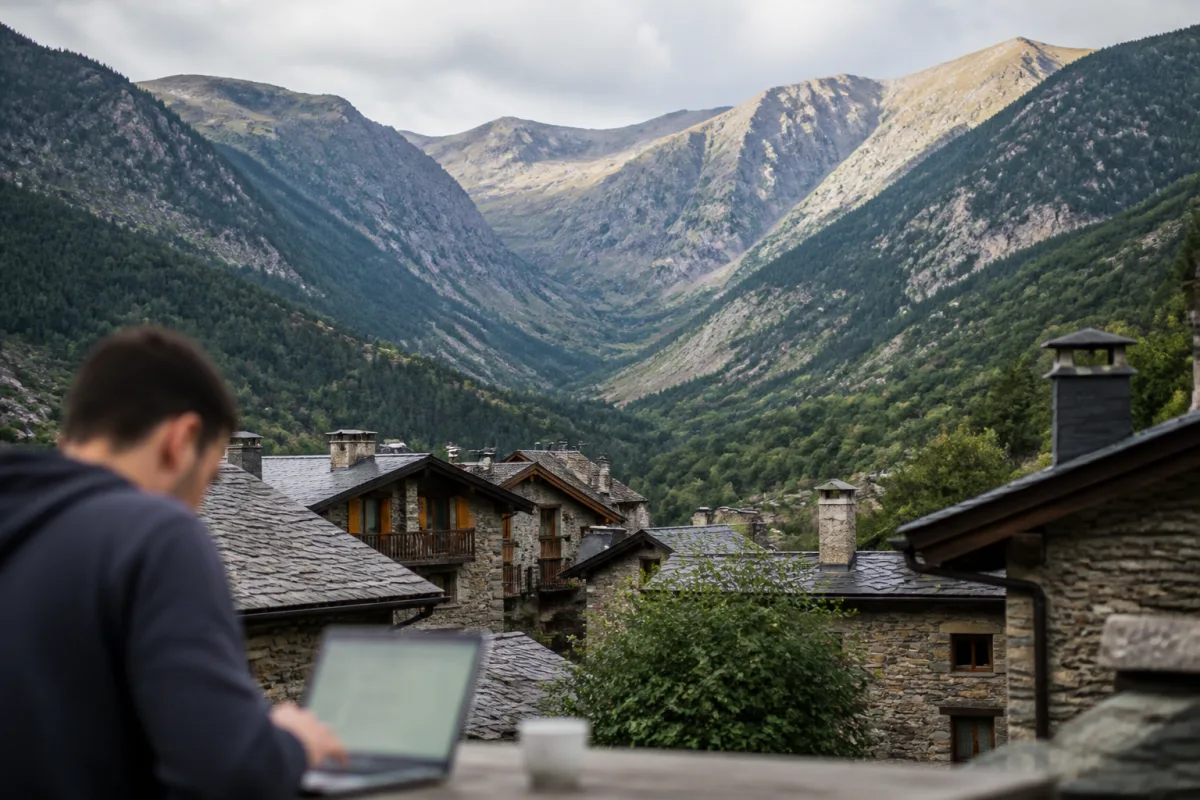

Andorra offers two types of residency with taxes up to 10% on income and corporate profits, but requires either actual residence or investments from €400,000. Citizenship remains one of Europe’s most challenging: it requires 20 years of residency, Catalan language proficiency at B1 level, and renunciation of your previous passport.
Why Andorra Attracts Residents
Andorra is an independent principality between France and Spain that is not part of the European Union or the Schengen Area. It is known not only for its tax system, but also for advanced healthcare, clean mountain climate, three educational systems, and a compact safe environment with low crime rates.
Income tax does not exceed 10%, corporate tax is around 10%, and indirect tax (VAT) is 4.5%. However, obtaining Andorran residency and becoming a tax resident are not the same thing. Tax status is determined by actual presence, the centre of vital interests, and the rules of the country from which the applicant is departing.
Third-country nationals can only enter the country via France or Spain, as there is no own international airport. This means you need to consider the rules of entry into Schengen and the corresponding status of an Andorran resident.
Active Residency for Working Residents
Active residency is intended for those who actually work and run a business in Andorra. The law provides for three options:
- employment contract with a local company and residence and work permit;
- self-employment with actual business activity in the country;
- own company where the applicant participates in business management.
All options are subject to requirements regarding company structure and actual business management. The law requires actual residence in Andorra; it is not possible to register a company on paper and spend most of the year in another country.
For employees and freelancers, permanent and actual residence is required. For company owners, a minimum of 183 days per year is set. Language requirement: A1 level at first renewal, A2 at second; for self-employed and company owners, requirements are planned to apply from 2029 onwards.
Passive Residency: Investments Instead of Work
Passive residency is intended for those who live on their own capital, investments, pensions, rental income and other independent income.
From February 2026, the minimum investment is €1 million. Funds are directed to Andorran assets provided for by law: real estate, shares of local companies, certain financial instruments, government debt or insurance products. If part of it is real estate, the value of each property must exceed €800,000.
The law allows a maximum of 6 months for the investment to be completed; in certain cases, the period can be extended by a further six months.
There is a special option in which the investment threshold is reduced to €400,000: the entire amount is directed to the Andorran housing fund (Abitagn Fund). This is not the purchase of a personal apartment, but a targeted contribution to state affordable housing programmes.
Fixed Payments and Income Requirements
In addition to the investment, a direct payment to the state is required: €50,000 from the main applicant and €12,000 for each dependent. From 2026, this money becomes a non-refundable payment and is not credited towards the total investment amount.
You must confirm sufficient income: at least 300% of the current annual minimum salary in Andorra for the main applicant plus 100% for each family member. Currently, this is approximately from €56,500 per year for the main applicant and around €18,800 for each family member.
Accommodation and health insurance are also required. The requirement for actual residence is much softer than with active residency: only 90 days per year. There is no language requirement at present, but introduction of A1 level is planned from 2029 onwards.
Path to Citizenship: 20 Years and Integration
Obtaining residency is only the beginning. The basic naturalisation period is 20 years of effective residence in the country. This is one of the longest periods in Europe.
In 2026, an important relaxation appeared: these 20 years do not have to run strictly consecutively. Various periods of residence are allowed to be combined, but the last 5 years before submitting an application must be spent continuously and actually living in Andorra.
There is an exception: 10 years of residence may be sufficient for those who have completed at least ten school courses in the Andorran educational system or completed full compulsory school education there. Separate grounds are provided for people with relatives who are Andorran citizens and spouses of citizens of the country.
To prove integration, confirmation of Catalan language proficiency at B1 level is required for applicants under 70 years of age. This is one of the highest requirements when obtaining a passport.
Andorra does not view naturalisation as an opportunity to obtain a convenient second citizenship. After a positive decision, the applicant must confirm the loss of their former citizenship. The law also provides for the loss of Andorran citizenship if an adult citizen subsequently voluntarily acquires citizenship of another state.
Sanctions and Accessibility for Citizens of Russia, Belarus and Other Countries
There is no direct public ban on residency for citizens of Russia and Belarus. However, Andorra applies international sanctions restrictions against these countries and regularly updates them in accordance with the European Union.
Many foreign investments require prior administrative permission. Banks separately check the source of funds and sanctions risks. The issue is not so much a formal ban as the structure of capital, banking compliance and the ability to carry out a specific investment.
For citizens of Kazakhstan, no specific sanctions restrictions have been identified in official sources, but each case also needs to be checked individually.
Comments
Reader experience is useful, but it is not advice: check the rules on the official site.
No account needed: click Sign in, type any name, and you are done.