

If someone with a pending I-130 petition is detained by ICE or Border Patrol, the case moves into immigration court — but a pending petition alone doesn’t prevent detention; release depends on a bond, and the future of the person’s status depends on whether USCIS approves the I-130 before the scheduled court hearings.
In short
- A pending I-130 petition doesn’t block an ICE or Border Patrol detention — it only becomes an argument once the case is actually being reviewed
- For student status, the decisive date is when the school terminates the SEVIS record, not when the F-1 visa expires
- From airport detention to release on bond took about a month, including 8 days in a Border Patrol facility
- By the December master calendar hearing, the I-130 petition will have been pending for about a year with no guarantee of approval
- A mandamus lawsuit against USCIS makes practical sense closer to day 366 after the I-130 filing, especially when deportation is a real threat
Why a Pending I-130 Doesn’t Protect You From an ICE or Border Patrol Detention
A pending I-130 petition does not shield anyone from detention: in the case examined here, the petition was already under USCIS review when Border Patrol stopped the applicant. At the time of detention, he was a student who had fallen out of F-1 status, holding an expired visa, with an I-130 petition filed jointly with his spouse — none of that prevented the detention.
At the time of detention, he was a student who had fallen out of F-1 status, holding an expired visa, with an I-130 petition filed jointly with his spouse — none of that prevented the detention.
The detention happened in April 2026 at an airport, as he was about to board a domestic flight to Los Angeles. At the TSA checkpoint, an officer checked his passport, saw the expired visa, and asked him to step aside. After several hours of questioning, officials decided to send him to a detention facility.
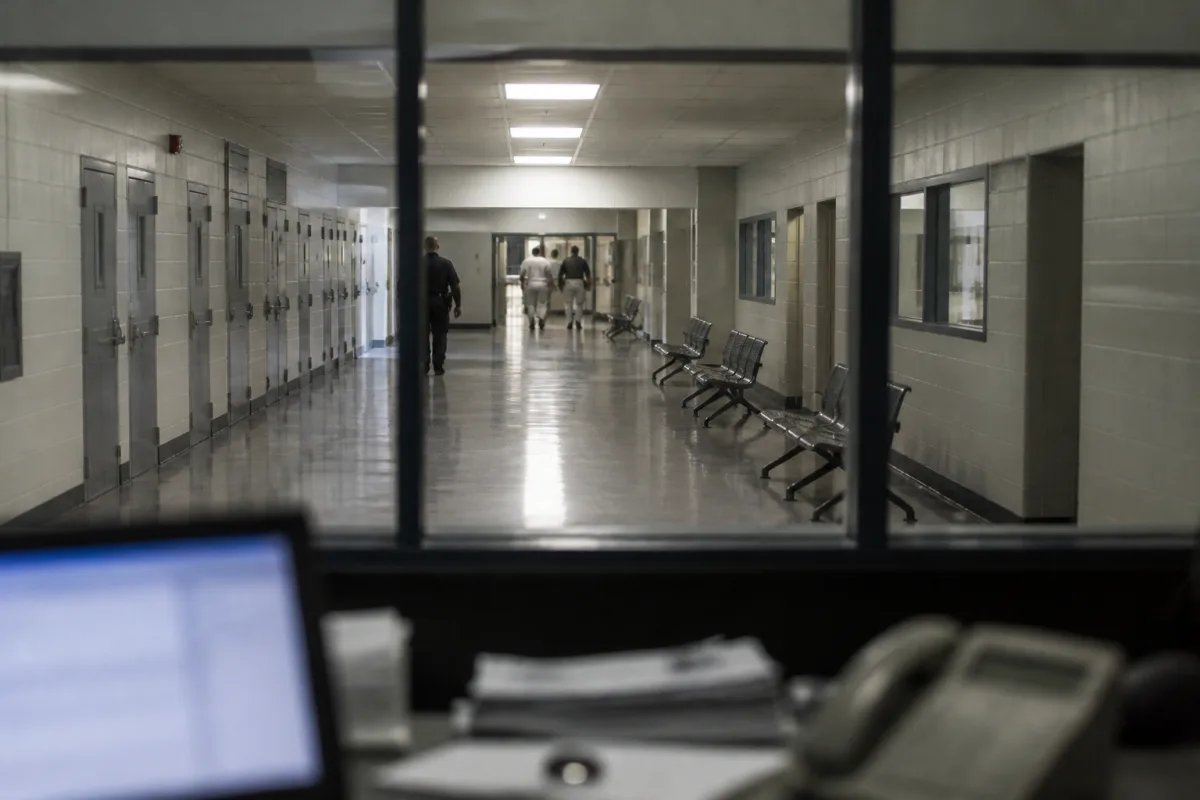
He spent the first eight days in a Border Patrol (CBP) detention facility — sleeping on the floor under plastic blankets, and losing a noticeable amount of weight during that time. After that, he was transferred to an ICE detention facility.
The takeaway: filing an I-130 does not by itself block detention or grant immunity during a document check — it only becomes an argument later, once the case is actually being reviewed.
A pending I-130 petition doesn’t grant immunity during a document check: detention happens regardless of the petition’s status. It only becomes an argument later, at the case review stage — not when you’re facing an officer.
Bond After Detention: How Release Actually Works
In this case, an immigration judge set a bond, and after nearly a month in custody the applicant was released. An attorney was brought in to handle the bond request, which was heard separately from the main immigration case. The hearing took place over video — the applicant was brought to a camera inside the detention facility itself, with no in-person appearance before the judge.
The defense’s argument centered on the fact that the detainee already had a pending I-130 and a legal path to status, rather than a record of violations — and that became the basis for setting a bond instead of denying release. After the bond was paid, an ankle monitor was placed on him, and only then was he able to fly home.
On timing: the detention happened in April, and release on bond came in May — so the whole process from arrest to release took about a month. Within that period, part of the time was spent in a Border Patrol facility and part in an ICE facility after the transfer.
From Detention to Release on Bond
The applicant’s path from the airport to the flight home took about a month
- Detained at the airportApril 2026
- Border Patrol (CBP) detention facility8 dayssleeping on the floor under plastic blankets
- Transfer to an ICE detention facility
- Bond hearing by videono in-person appearance before the judge
- Released on bondMay 2026with an ankle monitor
From the airport detention to release on bond took about a month: part of the time in a Border Patrol facility, part in an ICE facility.
Visa or Status: Why the Visa Expiration Date Isn’t What Matters
For student status, the decisive moment isn’t the visa’s expiration date — it’s the date the school terminates the SEVIS record. A visa only grants the right to enter the United States; after that, it carries no further legal weight. In this case, the applicant entered the U.S. in February 2024 on an F-1 student visa, and his OPT period expired in July 2024. Up to that point, he had only filed one application — the EAD card request for OPT — nothing else, including no I-130.
Once OPT ends, the school terminates the student’s SEVIS record, and it’s that date — not the visa’s expiration — that marks the actual loss of legal status. The exact SEVIS termination date in this case was never established: there was no contact with the school after graduation at all. It presumably happened shortly after OPT ended in July 2024, though the applicant never received confirmation of that.
The applicant was tracking the visa’s expiration date and got married a couple of months after it passed, treating that date as the meaningful marker for his status. But for immigration purposes, that’s the wrong reference point: status was already lost earlier, when the SEVIS record was terminated — not when the visa expired.
For student status, what matters is the date the school terminates the SEVIS record — not the visa’s expiration date. Tracking the visa instead is a mistake that makes it easy to miss the actual moment status is lost.
Filing the I-130 and Adjustment of Status: Where the Delay Came From
The adjustment of status application through marriage to a U.S. citizen wife was filed on December 31, 2025 — by that point, the applicant had been out of status for about a year and a half. The gap came from a problem with Form I-864 (Affidavit of Support): an acquaintance had agreed to sign it, but only after obtaining his own U.S. citizenship. He estimated a 6-month wait, and the applicant spent that entire time waiting specifically for him, without approaching a different sponsor.
After filing, the adjustment of status interview was scheduled for July. At that interview, Form I-485 was closed because the case had been referred to EOIR — the Executive Office for Immigration Review. A separate interview on the I-130 petition followed, and then a second one in October, about 10 days before this conversation took place. After that second I-130 interview, the officer said the file would be passed to the case officer for the next step.

A year and a half without status built up while waiting on one specific sponsor for Form I-864 — the applicant never looked for an alternative, even after the promised 6-month wait didn’t hold.
What Happens to the I-130 Case After Release on Bond
After the applicant’s release, USCIS called him in for interviews twice: the second one took place a few weeks before this account was given, and at it the couple was split into separate rooms for individual questioning — standard practice when reviewing a marriage-based I-130. According to the applicant, the questions were direct and the officer himself was friendly.
Two different attorneys are handling the case. The I-130 petition was originally filed by the first attorney, before the applicant was placed in removal proceedings. After the detention, a different, new attorney took over the deportation case, and she is the one accompanying him to the USCIS interviews on the marriage petition.
Two things work in the applicant’s favor: the I-130 was filed before removal proceedings began, and the volume of evidence gathered to prove the marriage — the couple submitted an initial document package and then several supplemental ones documenting the relationship’s history.
Master Calendar Hearing: What to Expect From the December Date
A master calendar hearing is a preliminary hearing in immigration court where the case itself isn’t decided on the merits — it’s an administrative check-in where the court records the case’s status and sets the next steps. In this case, such a hearing is scheduled for December 1, and the applicant’s goal there is to get the NTA (Notice to Appear) terminated and, eventually, obtain a green card. After release from the detention facility, the case gets transferred to the immigration court in whatever state the person actually lives in — in this case, California.
By the December date, the I-130 petition will have been pending for about a year, and it may or may not be approved by then — there’s no guarantee either way. If it still hasn’t been approved by the time of the master calendar hearing, the attorney typically tells the court that the petition has already gone through two interviews and the process is nearing completion, and asks for a 90-day or 6-month continuance. In this case, the judge offered a shorter window — about two months — citing limits on the court’s current scheduling practice, and the attorney had no choice but to accept it: in this particular case, a longer continuance wasn’t available.
This is where the key difference from an individual hearing comes in: at a master calendar hearing, the case is simply rescheduled, while at an individual hearing it’s decided on the merits. If the I-130 still hasn’t been approved by that point, the applicant has no real defense against deportation at that hearing. That’s why the question of how much risk remains — especially if the I-130 process is in its final stage — becomes central to planning next steps.
If the I-130 still hasn’t been approved by that point, the applicant has no real defense against deportation at that hearing.
Master Calendar Hearing: What Comes Next
The continuance requested and the one actually granted differ by more than double
- I-130 petition pending as of the hearing dateabout a year
- Continuance requested by the attorney90 days or 6 months
- Continuance granted by the judgeabout 2 monthscited limits on the court’s current scheduling practice
Master Calendar Hearing vs. Individual Hearing
| Criterion | Master Calendar Hearing | Individual Hearing |
|---|---|---|
| What gets decided | The case is not decided on the merits | The case is decided on the merits |
| What happens | The court records the case’s status and reschedules | The court issues a ruling |
| Role of an approved I-130 | Can be used to request a continuance, citing the I-130 process | Without an approved I-130, there’s no real defense against deportation |
A Mandamus Lawsuit Against USCIS: How to Speed Up an I-130 Review
A writ of mandamus is a lawsuit filed against USCIS in federal court, aimed at forcing the agency to issue a decision on a petition — not at forcing any particular outcome. The lawsuit doesn’t argue that the I-130 should be approved; it argues that the agency is unreasonably delaying a decision it was obligated to make.
The lawsuit doesn’t argue that the I-130 should be approved; it argues that the agency is unreasonably delaying a decision it was obligated to make.
In the case discussed here, the attorney is working toward day 366 after the I-130 was filed — roughly a one-year mark — as the practical threshold for filing a mandamus action in this specific case; it isn’t a universal deadline set by law for every case. The petition was filed on December 31, 2025, so in this case that rough one-year mark falls in January 2027. Before that date, filing suit is, in the defense’s assessment, less promising: it’s harder for a court to find the delay unreasonable if the informal one-year period hasn’t yet passed.
The argument rests on two facts together: the applicant has already been waiting a year for a decision, and at the same time he’s facing deportation. A one-year delay on its own may look excessive, but it’s the combination with the threat of removal that turns it into real grounds for a lawsuit — without that second element, pushing for a faster decision is much harder.
The practical trigger for calling the attorney is the judge’s ruling at the master calendar hearing. If the court grants only a two- or three-month continuance instead of the requested 90 days or six months, the defense is left without an approved I-130 by the time of the individual hearing. In that situation, the lawsuit gets filed immediately, with the hope of getting a decision on the petition in the weeks remaining before the hearing.
Mandamus timing isn’t set by statute — it’s set by practice: in this case, the attorney is targeting day 366 after the I-130 filing as the point where the delay becomes easier to argue in court.
Frequently asked questions
Can deportation be avoided at all if the marriage is suspected of being fraudulent during the I-130 review?
In this case, the risk wasn’t built on suspicion of fraud — it was built on timing: the officer at the interview was friendly, the couple was questioned separately as standard practice, and the petition filed before removal proceedings, along with the gathered evidence of the relationship, worked in the applicant’s favor.
Can F-1 status be restored once the school has already terminated the SEVIS record?
In this case, there was no contact with the school at all after OPT ended, and the exact SEVIS termination date was never established — restoring status through the school wasn’t considered in this situation, and the next step taken was filing for adjustment of status through marriage.



Comments
Reader experience is useful, but it is not advice: check the rules on the official site.
No account needed: click Sign in, type any name, and you are done.