
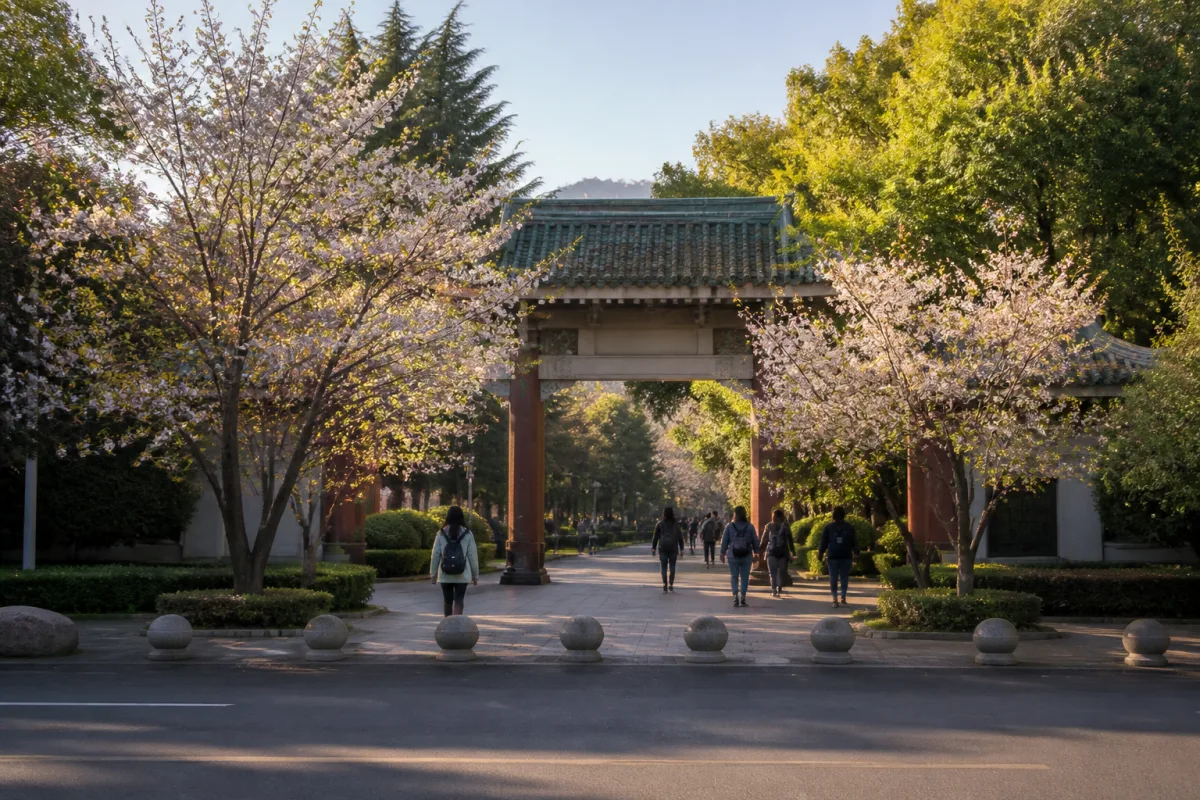

You can apply for a spring semester in China by submitting documents directly to a university that opens admissions starting in March (sometimes February) — check the admissions section on the school’s website and submit before the deadline, which usually falls in November or December.
In short
- The spring semester is almost always a language course — bachelor’s and master’s programs rarely start in spring.
- A group only launches if enough students sign up; otherwise, applicants are folded into the autumn group once it reaches the matching level.
- Application deadlines for the spring semester are usually listed in the brochure as falling in November–December.
- Scholarships for language courses are nearly impossible to get — plan on spring being a paid option.
- A provincial semester runs around 10,000 RMB for tuition and 5,000 RMB for housing, versus 27,000 RMB at Peking University.
What the spring semester is and when it starts
A spring semester means starting studies in spring rather than in autumn, which is the default. Each university decides for itself whether to admit students at this time: most schools run their main intake in September, and only larger universities additionally open a spring intake.
Classes typically begin in early March, right after winter break ends, though the exact enrollment date depends on the specific university and is confirmed in its own admissions announcement. Sometimes the semester starts earlier, in February — the exact date depends on Chinese New Year, which follows the lunar calendar, and on when the related holiday ends.
The existence of a spring intake doesn’t guarantee a group will actually form by March. If enough applicants sign up for the zero (beginner) level, the university forms a separate group and launches it in March. The same logic applies to intermediate and advanced levels: if a full group of spring applicants comes together, it launches separately; if not, those students are folded into a group that started in autumn and has reached the matching level by winter. The deciding factor for a March start isn’t the calendar date itself — it’s whether enough students have signed up to form a group.
The deciding factor for a March start isn’t the calendar date itself — it’s whether enough students have signed up to form a group.
A spring start isn’t guaranteed: a group only forms if enough applicants sign up for that level, otherwise students are folded into the autumn group.
Which universities and programs admit students in spring
Starting a bachelor’s or master’s degree in spring is unlikely: these programs almost never launch in March. Spring intakes are mostly for language semesters — filling a language class is easier than assembling a full group of international students for a specific degree program.
The reason is simple: a language course can absorb a new student into a group that already started in autumn, or form a fresh one — the entry bar is low. Bachelor’s and master’s programs don’t work that way: a university needs enough international applicants for that exact major by March, and only large universities with a high volume of applicants can pull that off.
When a university does launch a bachelor’s or master’s program in spring, it’s usually either a smaller school eager for international students and willing to accommodate them, or, conversely, a large university with enough resources to form a separate spring cohort. Master’s programs work the same way: if too few people apply for the spring intake, no group forms, and the program launches as usual in September. Cases where a master’s program actually opens in spring are rare.
Cases where a master’s program actually opens in spring are rare.
If you’re applying with an existing level of Chinese, the university may go one of two ways: form a separate group of spring applicants at the same level, or fold you into a group that started in September and has already reached that level. Both outcomes are possible, and there’s no way to predict in advance which one a specific university will choose.
Larger universities launch spring intakes more often because they draw a sizable stream of applicants year after year, but even there, the existence of a spring semester needs to be confirmed for the specific program — the size of the university alone guarantees nothing. This information is usually posted on the university’s own website.
How to check for spring semester admission on a university website
-
Go to the Admission section on the university’s website and select Pre University Program. Among all the listed programs, this is the one you want — the preparatory track where spring intakes are usually opened.
-
Find the admissions brochure. It spells out exactly how admission works for that specific year: programs, timelines, deadlines. Right now, sites still have brochures for 2026 posted, but an update is expected around late October, when the 2027 brochures go up.
-
Open the “When to apply” section in the brochure. It lists application deadlines for every semester the university offers.
-
Check whether “Spring semester” appears on the list. If it does, and the deadline next to it falls roughly in November–December, the university admits students for spring, and you can apply by that date.
-
If only “Fall semester” is listed — the program launches exclusively in autumn, and this university has no spring intake.
-
Email the admissions office directly if no formal spring intake is announced. You can ask whether they’d consider an application at a specific proficiency level for the spring semester — sometimes a university adds a student to an already-formed group without ever announcing a separate spring intake.
How to check for spring intake on a university website
Six steps from the Admission section to emailing the admissions office.
- Go to Admission → Pre University Program
- Find the admissions brochureBrochures for the new year are updated around late October
- Open the “When to apply” section
- Check whether a Spring semester is listedDeadline usually November–December
- If only Fall semester is listed — there’s no spring intake
- Email the admissions office directlyIf no formal intake is announced
If the brochure lists only a Fall semester, don’t give up on the idea right away — email the admissions office directly: sometimes a student gets added to an already-formed group without any separate announcement.
Checking for spring intake on a university website
Who the spring semester suits
- You learned about programs in China only after finishing school, college, or university. No need to wait for the fall intake — a spring semester lets you start earlier instead of losing nearly a year.
- You applied for the fall semester but weren’t admitted or were rejected. A spring intake is a second shot without waiting for the next autumn.
- You plan to start a bachelor’s or master’s degree a year from now and have already finished your previous studies. A free year before enrollment can be spent studying Chinese in China for six months, which makes the later degree program easier.
- You want to apply to a Chinese university while already in China. The typical path: a spring language semester first, then applying to a bachelor’s or master’s program the following spring, with the paperwork submitted locally.
- You want to try living in China without committing to a full year right away. A spring semester is a way to test out studying and living in the country over six months, without the commitment of a full academic year.
- Your budget is limited and you can’t afford a full year of paid language study. Six months of tuition cost less than a full year and can fit a budget that wouldn’t stretch to cover a year-long program.
- You missed the September intake. Instead of waiting a full year and preparing for the next fall application, you can quickly put together documents for the spring intake and be in China as soon as this spring.
Scholarships for the spring semester: what to realistically expect
Not every scholarship can be used for a spring semester — this needs to be checked separately for each one. A spring semester is almost always a language course, and universities rarely fund language courses with scholarships these days: schools see that students are coming on a paid basis anyway and see no reason to subsidize something that already sells on its own.
schools see that students are coming on a paid basis anyway and see no reason to subsidize something that already sells on its own
But don’t rule out a scholarship entirely. If a scholarship’s description says it covers a language year, and the application deadline falls roughly in October–November, that’s a good sign. In that case, it’s worth emailing the university directly and asking whether that scholarship can be used specifically for a language semester. If the answer is yes, all that’s left is competing for it on the usual terms. In most cases, though, plan the spring semester as a paid option funded out of pocket, rather than counting on a scholarship.

Language courses are rarely subsidized: in most cases, plan the spring semester as a paid option funded out of your own pocket.
What a spring semester in China costs
On average, a language semester costs 8,000–10,000 RMB, though the range across universities is wider than that. According to some sources, Peking University (Beida) charges around 27,000 RMB for a semester of its preparatory program — one of the most expensive programs in China — but the exact cost should be confirmed directly with the university’s admissions office. An ordinary, well-ranked provincial university costs noticeably less.
The rough dividing line is this: 10,000 RMB per semester is the upper end, typical of Beijing and Shanghai, while 5,000 RMB is a typical price at provincial universities. The same gap holds when scaled to six months: according to available figures, Beida runs around 27,000 RMB, while provincial universities run 8,000–9,000 RMB — but the exact figure for any specific school should be confirmed separately.
| Expense | Amount |
|---|---|
| Tuition (Beijing/Shanghai) | up to 10,000 RMB/semester |
| Tuition (provincial) | ~5,000 RMB/semester |
| Peking University (Beida) | 27,000 RMB/semester (~$3,700) |
| Dormitory (provincial) | ~5,000 RMB/semester |
| Flight from your home country | varies |
| Insurance | 400 RMB |
| Visa fee | varies by country |
| Registration fee per university | varies |
| Document preparation | varies |
As a rough benchmark, picture enrolling at a provincial university: tuition around 10,000 RMB, dormitory around 5,000 RMB. On top of that come a flight to China, insurance at 400 RMB, and a visa fee that varies depending on where you apply from. If you apply to several universities, a registration fee is charged separately for each one, and document preparation adds further cost on top.
What a spring semester in China costs
Main expenses for admission and one semester of study.
- Tuition (Beijing/Shanghai)up to 10,000 RMB/semester
- Tuition (provincial)~5,000 RMB/semester
- Dormitory (provincial)~5,000 RMB/semester
- Insurance400 RMB
- Registration feecharged per universityPaid separately for each school applied to
What to do after the language semester ends
After a language semester, there are three practical paths, and the choice between them depends on how strong your language skills are and how much a specific university matters to you.
Stay at the same university for the fall semester. To do this, go to the dean’s office in April or May, after you’ve already been admitted, and say you want to study for another semester. They’ll tell you which documents to redo and whether the registration fee needs to be paid again — this varies, there’s no fixed rule. The second semester might be partly covered by a scholarship or might remain fully paid, and after it you can apply to a bachelor’s or master’s program.
Apply to a bachelor’s program during the language semester itself. This path suits those who already have a solid level of Chinese or English. One language semester is used to improve your Chinese, apply to a bachelor’s program in parallel, compete for a scholarship, and move on to a bachelor’s or master’s program.
Transfer to a different university. If you didn’t like the school, or the university you actually want only admits students in September, a language semester elsewhere becomes roughly a six-month stopover. This creates a visa gap: the X2 visa that covers a student during a language semester expires around July, while enrollment at a new university usually only happens in September. For that gap — from July to September — there are three options: return to your home country, get a visa in a third country, or ask the university to help gather documents for the immigration office and arrange a temporary visa.
A fourth option is not continuing studies in China at all and going home after the language semester. That’s also a reasonable choice if staying longer isn’t the goal.
The X2 visa expires around July, while enrollment at a new university usually only happens in September. Plan ahead for that gap: go home, get a visa in a third country, or ask the university for help.
How to choose a university for the spring semester
-
Check the university’s website to see whether spring semester admission is announced. This is the first step: if a school doesn’t list a spring intake on its page, there’s no point applying and expecting enrollment in spring.
-
Factor in the region’s climate. China’s climate zones vary widely — from near-subtropical conditions to cold northern regions. You’ll be living in the chosen city for at least a couple of months before the weather warms up, and if you can’t handle heat well, through the entire summer season too, so it’s worth thinking about climate ahead of time, not after enrollment.
-
Match the cost to your budget. Price differences between universities are significant, as covered in the section on spring semester costs. The choice between a capital-city and a provincial university should come down to how much the applicant is actually willing to spend.
Frequently asked questions
Can I start a bachelor’s degree right away in spring if I already have a diploma and no time to wait until September?
Practically no: bachelor’s programs almost never start in spring, because the university needs to assemble a full group of international students for that specific major, and only large universities manage that. A more realistic path is to start with a spring language semester and apply for a bachelor’s program in the next regular intake.
What happens if a separate spring group doesn’t form for my level of Chinese?
If too few applicants share your level, the university won’t launch a separate spring track — instead, it folds spring applicants into a group that started in autumn and has reached the matching level by then. There’s no way to know in advance which option a specific university will choose.
Can I transfer to a spring semester if I’m already studying at another university in China?
There’s no direct answer for this exact situation, but a similar scenario is described for transferring between universities after a language semester: if the university you want only admits in September, a gap of roughly six months opens up, which has to be filled with a language semester somewhere else.
What do I do if my visa expires before I’ve been admitted to a new university?
The X2 visa is valid roughly until July, while enrollment at a new university usually happens only in September. For that gap, there are three options: return to your home country, get a visa in a third country, or ask your university to help gather documents for the immigration office for a temporary visa.
Do I need to pay the registration fee again if I stay at the same university for a second semester?
There’s no fixed rule — whether you need to redo documents and pay the fee again is something the dean’s office will tell you after admission, in April or May. The second semester might end up partly covered by a scholarship, or it might remain fully paid.
What happens to my language semester enrollment if I decide not to continue studying in China?
Simply finishing the language semester and going home is also a reasonable choice if staying in China long-term isn’t the goal: there’s no obligation to continue studying after one semester.
Can I just ask the admissions office about a spring intake if the brochure only lists a fall semester?
Yes — if no formal spring intake is announced, it’s worth emailing the admissions office directly and asking whether they’d consider an application at a specific proficiency level for the spring semester. Sometimes a university adds a student to an already-formed group without ever officially opening a separate spring intake.



Comments
Reader experience is useful, but it is not advice: check the rules on the official site.
No account needed: click Sign in, type any name, and you are done.