
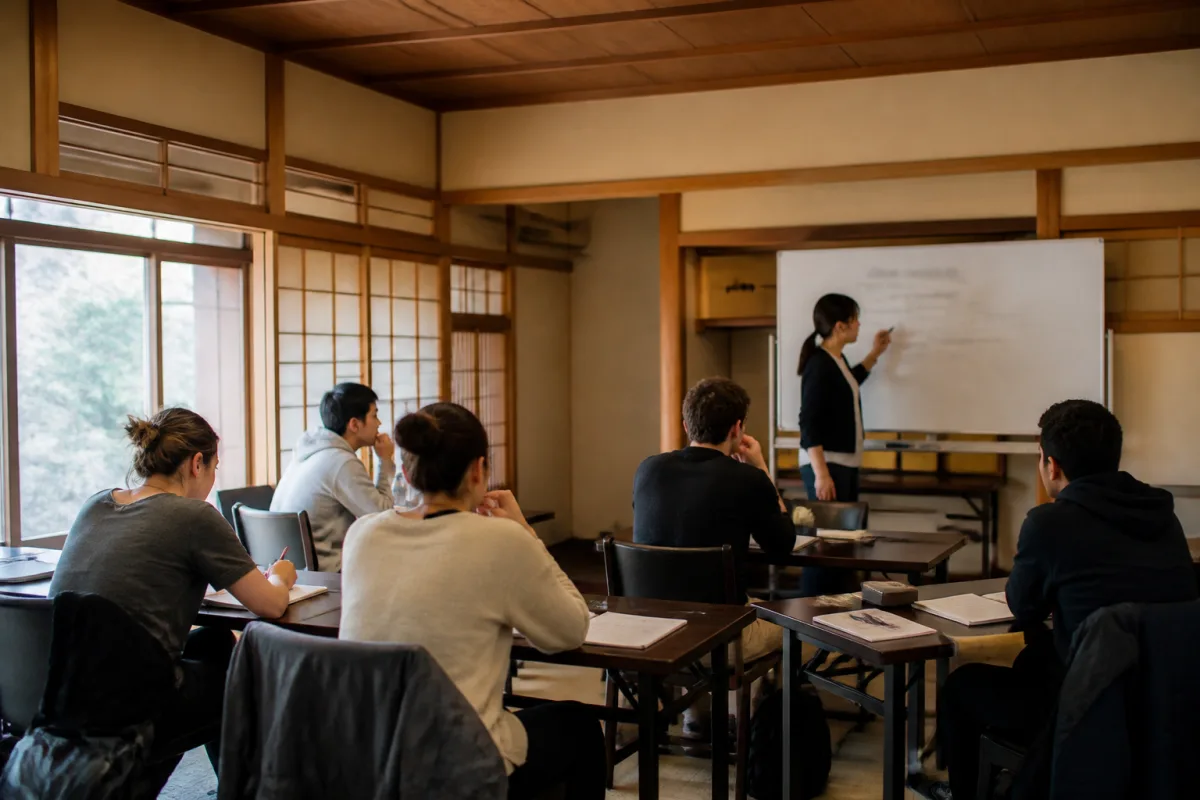

A short-term program at a Japanese language school runs from 2 weeks to 3 months on a simplified visa with no right to part-time work, while a long-term program runs from 1 to 2 years on a student visa that allows part-time work and requires a more complex document package — and switching from short-term to long-term status without leaving Japan is not possible.
Why You Can’t Switch a Short-Term Visa to a Long-Term One in Japan
Switching from a short-term visa to a long-term one while staying inside Japan is not possible — this is a common misconception among people who go on a short-term program hoping to “decide on the spot if they like it.” A short-term visa is similar in type to a tourist visa and is issued easily precisely because it does not allow a change of status within the country.
Switching from a short-term visa to a long-term one while staying inside Japan is not possible — this is a common misconception among people who go on a short-term program hoping to “decide on the spot if they like it.”
If, after arriving, the wish to continue with long-term study comes up, the only path is to leave Japan and apply for a long-term visa from scratch, either from your home country or from a third country. Entering Japan under the new conditions is only possible after that visa is approved — not before.
Long-term study programs are only reviewed four times a year, and that alone sets the lower bound for the wait — a minimum of 6 months from departure to a possible return. In practice the timeline runs longer: a realistic waiting period is around 8 months, once document preparation and the review itself are factored in.
So the plan of “going short-term first and figuring it out later” actually means leaving the country, a pause of several months, and filing documents from zero — not a status change completed in a single visit to immigration.
Short-Term Study Program: Length, Documents, Conditions
A short-term program runs from 2 weeks to 3 months — the maximum length allowed for this type of study trip to Japan. It’s set up to be as simple as possible: a minimal document package and a free visa. Nearly any of the country’s more than 1,000 language schools will accept students for short-term study.
Study can start in any month of the year — unlike the long-term program, which has fixed intake dates. Deciding to go to Japan a month from now isn’t an obstacle: schools accept applications year-round and process them quickly.
This format suits several types of applicants:
- people who have never been to Japan and aren’t sure whether the country and language-school study are a good fit for them;
- people who want to combine a vacation with study — spending 3 weeks or a month in Japan, traveling and studying at the same time;
- people who see short-term study as a trial run before committing to a long-term program.
In practice, the short-term program is often used as a test drive: applicants arrive, see whether they like the country and the school, and only then decide whether to apply for long-term study. More cautious applicants build the path in three stages — a tourist trip first, then a short-term program, and only then long-term study. With enough budget, this is a workable way to test Japan step by step before committing to a long-term visa.
Short-Term Program Restrictions: Part-Time Work and Finances
On a short-term program, part-time work in Japan is fully prohibited — no exceptions and no unofficial workarounds. This isn’t a formality that can be quietly skirted: Japan strictly enforces its laws and expects the same compliance from foreign nationals. Breaking this rule, like breaking any other immigration rule, risks deportation or a lifetime entry ban.
Since part-time work is off the table, a student won’t gain any new source of income while in Japan — which means the entire trip budget has to be saved up in advance. For a 3-month stay, that means savings need to cover tuition, housing, food, local travel, and leisure for the full length of the stay. The budget needs to be calculated carefully and in advance — and that applies to any trip to Japan, not just the short-term program.
Long-Term Program: Study Length and Changing Status Without Leaving
A long-term language study program runs from 1 to 2 years — that’s the maximum; staying in Japan longer under this program isn’t possible.
After two years at a language school, there’s no need to leave the country to continue studying: status can be changed on the spot. One option is to enroll in a vocational college (senmon gakko) and stay in Japan for another 2 years. Another is to enroll in a university or graduate program — the next stage of education (shingaku), which follows language school and isn’t capped at a fixed extension the way the college route is.
Documents for a Long-Term Student Visa as of Spring 2026
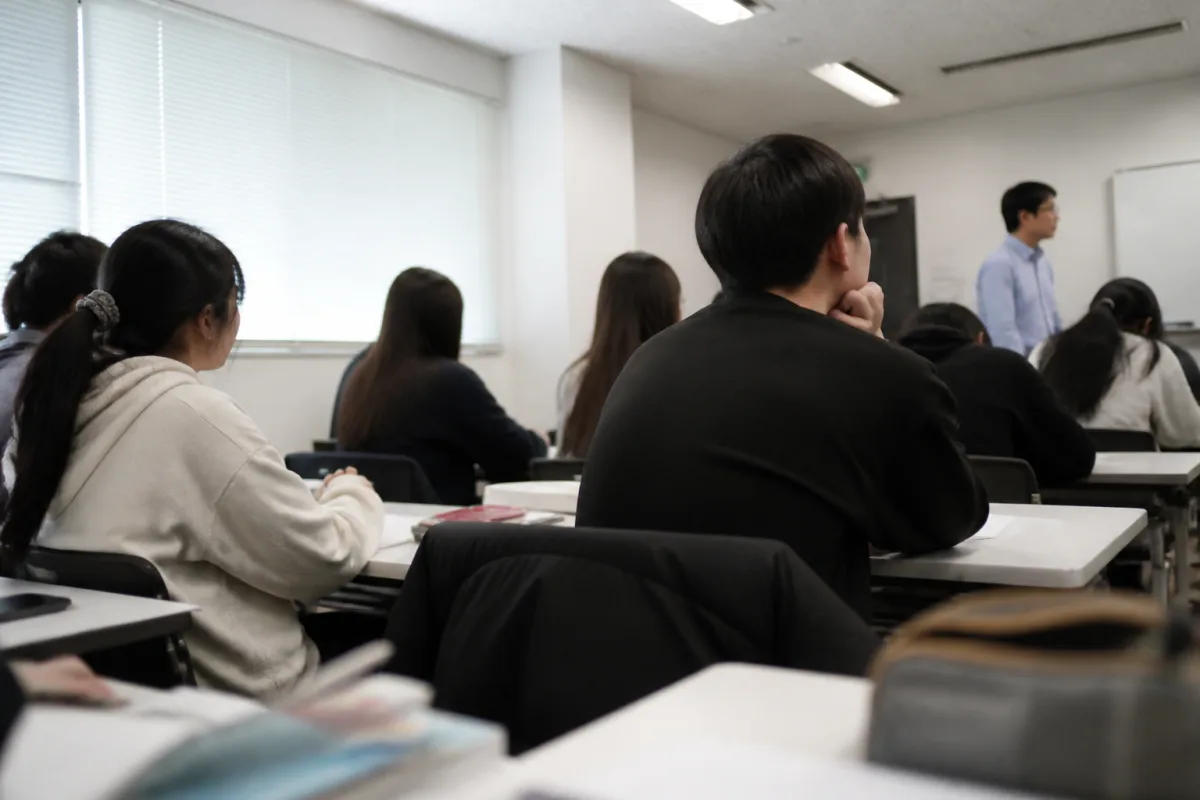
Document requirements for the student visa have gotten stricter recently — language schools and immigration are scrutinizing applicants more closely.
- Proof of Japanese language study. This is one of the hardest requirements to meet — and it’s not the financial part that’s difficult, it’s the supporting evidence. Applicants need either a JLPT certificate at N5 level (or higher), or a certified document confirming 150 hours of Japanese language study.
- If a JLPT N5 certificate exists, the 150-hour study certificate isn’t formally required for the application. Without the certificate, documents won’t be accepted without the proof-of-hours letter. In practice, though, partner schools request both documents anyway.
- Despite this not being formally mandatory, partner schools in practice request both documents upfront — the JLPT certificate and the 150-hour proof — so immigration has no questions about the applicant’s level of preparation.
- The school may additionally require a letter of recommendation, a character reference, or proof of attendance at trial lessons.
- Sponsor letter. Required if the trip is fully or partly funded by a sponsor, along with proof of the sponsor’s employment or enrollment.
- Bank account. A verified account is required — the applicant’s own, a sponsor’s, or both combined. The balance on the account(s) at the time the certificate is issued should be around US $18,000.
- This figure is based on the approximate cost of 2 years of study and living in Japan — it serves as proof that the applicant has funds for the entire period.
- Some claim that $15,000, $10,000, or even $5,000 on the account is enough. An application can be filed with any amount, but it won’t guarantee the same outcome as a balance of around $18,000.
The full document set — certificate or proof-of-hours letter, sponsor letter, verified bank account — is submitted together with the application for the long-term student visa.
The Language School Admission Interview: What It Involves
Today an interview with school representatives has become a mandatory step for applicants — it used to be optional, and was sometimes conducted in English or Russian. Now the interview is strict and consists of two parts.
- Introduction and self-presentation in Japanese. The candidate is asked to introduce themselves — to talk about themselves in Japanese. The level doesn’t matter in itself: if the documents state N5, the applicant is expected to give a self-introduction at N5 level, not below it.
- Verification of the stated language level. The second part checks the applicant’s actual Japanese ability. If the certificate or JLPT result states N5, the questions will be at N5 level; if it states N3, the check will be at N3 level.
This is how the school cross-checks the level stated in the documents against the real level: inflating it on paper and failing to back it up at interview no longer works — both parts are now checked rigorously.
Discipline on the Long-Term Program: What Skipping Classes Can Cost You
Skipping classes and being late on the long-term program can lead to visa cancellation and deportation — this isn’t a myth, it’s standard practice at Japanese language schools. With repeated attendance violations, the school reports the student to immigration, and from that point the decision is no longer the school’s to make — it’s the state’s.
The reason for this strictness lies in the format of the program itself: it demands real commitment to learning Japanese, not just formal presence in class. If a student is also working part-time, job-hunting, or preparing to apply to a vocational college or university at the same time, the workload becomes academically heavy — a large volume of material has to be mastered alongside a high level of discipline and effort.
A separate challenge early on is the lack of a familiar environment: no family, friends, or native-language speakers nearby, and everyday matters — like paperwork at the local ward office or communicating at a part-time job — have to be handled in an unfamiliar language. That’s exactly why serious Japanese preparation before arrival isn’t a formality — it’s a way to make the first few months easier. Without a basic command of the language, adjusting takes noticeably longer.
The adjustment period itself takes roughly a couple of months, after which things get noticeably easier. The higher the level of Japanese on arrival — ideally at least a solid N4 — the faster this period passes and the fewer everyday difficulties come up along the way.

Advantages of the Long-Term Program: Part-Time Work and Changing Status
The main advantage of the long-term program is the legal right to work part-time, up to 28 hours a week. This part-time work isn’t just about covering housing, tuition, and food — it builds real-world language practice outside the classroom and speeds up language growth. It also becomes the first line on a Japanese résumé — the first work experience, the first contact, and the first networking on the Japanese side.
That résumé line matters for anyone who wants to stay in Japan and work. To get a work visa, you need to find an employer willing to sponsor it — and a first part-time job along with a letter of recommendation from the Japanese side improves the odds of that.
The long-term visa allows a change of status while staying in Japan — for example, switching to a work visa without leaving the country. If a job offer comes in after finishing language school, the status can be changed on the spot, without leaving Japan. The same goes for continuing education: enrolling in a vocational college, university, graduate program, or doctoral program doesn’t require leaving the country either — the visa status changes right where you are.
How to Tell a Good Language School From a Weak One
The difference between schools isn’t in the name of the program, but in how the teaching itself is structured. At a good school, the language is taught systematically and methodically: alongside grammar and vocabulary, students are prepared for interviews, university admissions, and job searches. At a weak school, teaching relies on an outdated method that nobody takes seriously, and no one prepares students for interviews, university, or work.
The difference shows up in cost, too. At weak schools, almost every extra service is paid separately: consultations, job fairs, and other kinds of support come with a separate bill. At strong schools, comprehensive support is in most cases included in tuition and costs nothing extra.
A separate marker of quality is whether the school has a dedicated advisor. Some schools have one, some don’t. Where an advisor is in place, they help the student find work or get into college, and that help is free — the advisor’s school is invested in the outcome, not selling the service separately.
So before enrolling, it’s worth asking not just about the program and tuition cost, but about exactly what the school provides for free: interview prep, job-placement support, and a dedicated advisor — or whether all of that will come as a separate charge.
Frequently asked questions
If you leave Japan and reapply for a long-term visa, how long does the wait take?
A realistic waiting period is around 8 months, factoring in document preparation and review time. The lower bound is a minimum of 6 months, because long-term study programs are only reviewed four times a year.


Comments
Reader experience is useful, but it is not advice: check the rules on the official site.
No account needed: click Sign in, type any name, and you are done.