


Preparing for a Japan student visa means studying the language, choosing a language school and city, gathering and translating documents, applying through the school to the immigration authorities, and picking up the visa at a visa application center — a process that takes about three months from submitting documents to approval, plus a few more days at the visa center.
In short
- Learning Japanese happens in three stages: an online course, SCOL lessons with JLPT N5 prep, then full immersion after the move.
- Notarized translation isn’t required — the school accepts a ChatGPT translation as long as it’s carefully checked.
- It takes about 3 months from submitting documents to an immigration decision, and the passport with the visa is ready 4 days after the visa center visit.
- A mismatch between the data on the initial application and the renewal can be treated as deception by immigration and lead to a denial.
- Tuition transfers usually go through without issues, while housing transfers can get flagged for currency control because of a Japanese-language invoice.
How Japanese language study works before the move
Learning Japanese before the move happens in three stages: an initial online course, lessons at a language school, and finally the real immersion that starts once you actually land in Japan.
The first stage is an online Japanese school with pre-recorded lessons. This is a basic introduction to the language — the writing systems, first grammar points, and vocabulary, without a demanding workload.
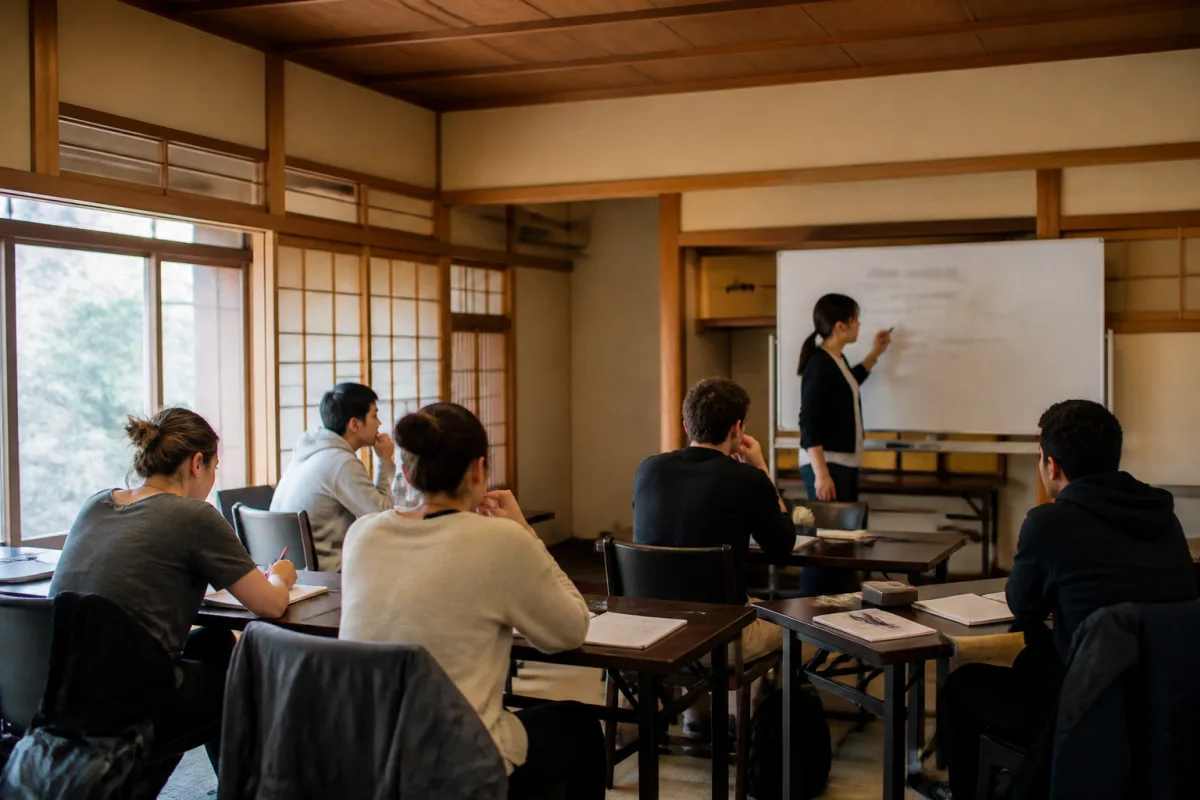
The second stage is classes at SCOL. Even before the first lesson, students were expected to already know the writing systems and a minimal base, and after every class, on top of the main homework, extra materials were added for self-study — vocabulary, grammar, and reading assignments. Alongside the main program ran a separate mini-course preparing for the JLPT N5 exam, which required active participation in class. The first JLPT exam in this experience was taken in the summer of 2025.
The third stage begins only after arriving in Japan — the so-called “real world” of the language environment. Right after arrival, a placement test sorts students into classes according to their level. Based on that test, one student ended up in class two, roughly corresponding to a level between the end of N5 and the middle of N4 — a placement that seemed too low at first glance but turned out to be nearly accurate in practice. Going back over grammar at that level helped solidify the material and brought conversational Japanese up to a workable standard.
Going back over grammar at that level helped solidify the material and brought conversational Japanese up to a workable standard.
Three stages of learning Japanese before and after the move
From the online course to full immersion in Japan’s language environment.
- Online Japanese schoolWriting systems, basic grammar and vocabulary
- SCOL school + JLPT N5 prepFirst JLPT exam taken in summer 2025
- Language environment after the movePlacement test and class assignment
How to choose a language school in Japan
Language schools differ by focus, and the right choice depends on the ultimate goal of the move. Some schools prepare students for university admission and have connections that help with placement after graduation. Others focus on building resumes and preparing for job interviews, offering a separate business course centered on keigo (formal business Japanese) and office manners. A third type of school is built around cultural immersion and events, without a strong emphasis on the language itself.
If the goal is serious language study followed by employment, it’s worth looking for a school with exactly that profile: a strong focus on Japanese plus job-search support after graduation.
When making the final choice, it’s worth paying attention to the student body. Some schools cater mainly to Asian students: the curriculum assumes they already know kanji well, so there’s little extra emphasis on it. Other schools are built for European students, with the curriculum adjusted to their level and needs, including a more thorough breakdown of kanji.
Define the goal — study, employment, or cultural immersion — and check the student body: schools for Asian and European students explain kanji very differently.
Types of language schools in Japan by focus
Table scrolls sideways
| School type | University prep | Employment (business course) | Cultural immersion |
|---|---|---|---|
| Main goal | University admission | Resume and interviews | Events and cultural environment |
| Connections after graduation | Help with university admission | Help with job placement | Not a priority |
| Focus on language | Strong | Strong, plus keigo and office manners | Light |
The right school depends on the ultimate goal of the move — study, employment, or cultural immersion.
Which city in Japan to choose for studying
Before the move, you need to decide not only on a school but also on the city you’ll live in. Tokyo is generally seen as the best option for anyone thinking long-term: it’s a major industrial hub with plenty of jobs, schools, and part-time work opportunities, not to mention far more concerts, exhibitions, and other events than in smaller cities.
That choice has a downside, too. Tokyo’s main drawback is fierce competition: getting hired by most Japanese companies as a foreigner without business-level English is nearly impossible, and not everyone reaches that level. On top of that comes a higher cost of living — rent and everyday expenses in Tokyo run higher than in smaller cities.
The alternative is to consider other major cities or smaller towns, even a Japanese village, if that kind of lifestyle suits you better. The choice here comes down entirely to personal goals and priorities.
A separate point is where housing sits relative to the school. You need to decide in advance whether you’re willing to spend several hours a day commuting each way, or whether you’d rather live ten minutes on foot and sleep in a bit later. Like the choice of city, this depends on personal preference and budget.
What documents are needed to apply for a student visa
The language school forwards the collected documents to Japan’s immigration authorities to obtain entry permission, which is why it only accepts them after its own review. Documents in Russian are not accepted — everything has to be translated.
Translation is required for an employment certificate and a higher-education diploma (if the applicant has one). A particular challenge is the employment certificate itself: an HR department may refuse to issue it in English, citing a lack of language skills, which means arranging for a certificate at least in the applicant’s native language first and then translating it independently.
Beyond the certificates, applicants fill out a detailed application form in English. It covers:
- education — school, university, college;
- work experience;
- a motivation letter — a separate section worth thinking through in advance, since it’s often the part the language school asks follow-up questions about.
After that, the documents go through two layers of review. First a dedicated manager at the language school checks them, then the school itself. At this stage, the school may ask clarifying questions about the documents, the application form, or the applicant’s education — it needs a complete and accurate package so that Japan’s immigration authorities don’t raise questions of their own later.
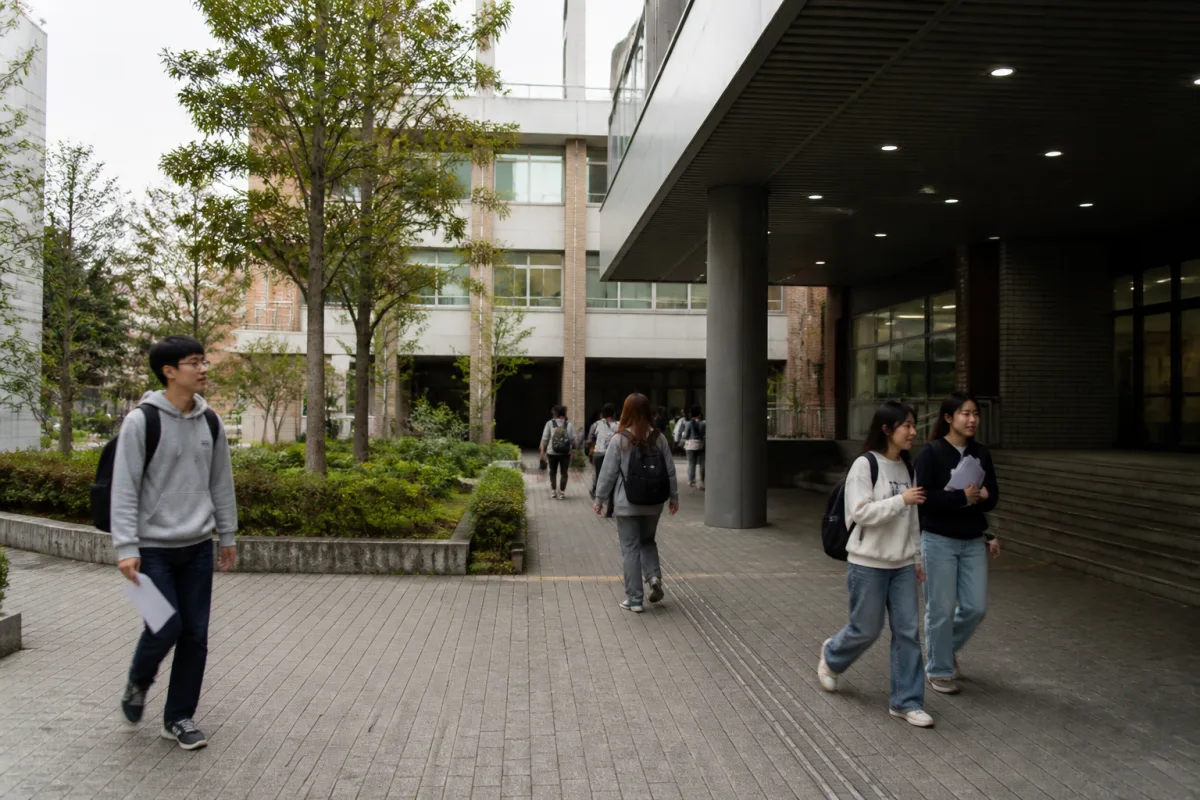
A dedicated school manager reviews the documents and application first, then the school itself — only after that does the package go to Japan’s immigration authorities.
What to prepare for a student visa application
Does the translation need to be notarized, and can you use ChatGPT
A notarized translation of documents is not required to apply for a Japan student visa — the language school accepts a regular translation. ChatGPT can be used for translating into English: in this case, that’s exactly how the documents were translated, and the school accepted them without complaint.
That said, AI-generated translations need careful attention: the result should be checked at least ten times before it’s sent to the school’s manager. A mistake in translating a certificate or diploma can lead to extra clarifying questions once the school reviews the documents.
Translating all the documents and filling out the application form takes roughly a full day — it’s not a five-minute formality but a separate task worth preparing for in advance.
In practice, the translation itself isn’t always the hard part — getting the documents in the first place can be. An employer’s HR department doesn’t always agree to issue a certificate of employment and salary in English, citing staff who don’t speak the language. In that case, the certificate has to be issued in the applicant’s native language first and then translated independently.
AI can be used to translate documents, but the result should be double-checked at least ten times: a mistake in a certificate or diploma means extra follow-up questions.
Why the information on your application and renewal must match
Every application and document needs to contain information that’s as accurate and consistent as possible — Japan’s immigration authorities cross-check the data submitted at the initial visa application against the data provided at renewal.
There’s a known case where applicants listed one set of information when first applying for a student visa and a different, inconsistent set at renewal. There’s a known case where immigration treated this kind of discrepancy between the initial application and the renewal as an attempt at deception — the visa renewal was denied. This shows that inconsistencies in the data can genuinely become grounds for refusal.
There’s a known case where immigration treated this kind of discrepancy between the initial application and the renewal as an attempt at deception — the visa renewal was denied.
To avoid this, it’s worth keeping a copy of everything submitted at the initial application. At renewal, the same data should simply be copied over and double-checked before submission, rather than relying on memory.

Processing time and picking up the visa at the application center
Once the documents are submitted to the language school and all its questions are answered, the waiting begins: it takes 3 months to receive a positive response from immigration.
- Waiting for the decision. If all the language school’s questions have already been resolved, the odds of a positive response from immigration are, based on this experience, rated as very high — there’s usually not much reason to worry at this stage.
- Receiving the certificate. Along with the positive decision, immigration issues a Certificate of Eligibility for the student visa, delivered through the language school.
- Paying for tuition. At the same time as receiving the certificate, the first 6 months of tuition need to be paid — without this payment, you can’t move on to the next step.
- Applying at the visa center. With the certificate and proof of payment in hand, you need to go to the visa application center: register online in advance, arrive at the scheduled time, and submit the documents.
- Receiving the passport with the visa. 4 days after submitting the documents at the visa center, the passport with the visa stamped in it can be picked up — this is where the visa process ends.
From the immigration decision to the visa in your passport
Five steps after a Japan student visa application is approved.
- Waiting for the immigration decision3 months
- Receiving the Certificate of EligibilityDelivered through the language school
- Paying the first 6 months of tuitionRequired before the next step
- Submitting documents at the visa centerOnline registration in advance
- Receiving the passport with the visa4 days
About 3 months from submitting documents to an immigration decision; after paying tuition and visiting the visa center, the passport with the visa is ready in 4 days.
How to find housing and transfer money for tuition in Japan
Renting an apartment in Japan requires a large upfront payment: part of the sum is refunded at the end of the lease, and part is not, because of the customary practice of a “gift” money to the landlord for the right to live in the unit. For this reason, many language school students choose a share house instead — housing that resembles a dormitory: shared common areas plus a private room that locks.
When choosing a share house, it’s worth considering the cost, the distance from the school, reviews from previous tenants, and the nationality mix of the other residents — that mix affects everyday habits and the language spoken in the house. For two people, it makes sense to look for a room bigger than the standard six tatami mats. Even searching off-season, it’s possible to find a room around 20 square meters, which counts as a good result for Tokyo.
Transferring money for tuition and housing
Not every bank in a home country can send money to Japan, and getting a Visa or Mastercard issued abroad doesn’t always work out either. In that situation, it helps to use a bank that does handle international transfers — in the case described here, that bank was ATB.
Tuition payments usually go through without issues, but a transfer for housing can get flagged for currency control. The reason is that the invoice from the share house arrives in Japanese, and the bank requires a translation of it. After the translation is submitted, the bank can go a week without providing any update on the payment status: phone calls and attempts to sort it out remotely don’t get results. An in-person visit to a bank branch resolves it faster — the transfer goes out the very next day.
An in-person visit to a bank branch resolves it faster — the transfer goes out the very next day.
Frequently asked questions
Can you apply for a Japan student visa without a higher-education diploma
The material mentions the diploma as a document to be translated “if you have one,” meaning its absence doesn’t rule out applying. Otherwise, the package consists of an employment certificate, the application form, and a motivation letter — these are what the language school reviews before forwarding everything to immigration.
Can you rent a regular apartment instead of a share house if you don’t want roommates
That option exists, but it comes with a large upfront payment, part of which isn’t refunded — Japan has a customary practice of a money “gift” to the landlord for the right to live in the unit. That cost is exactly why many language school students choose a share house as a more affordable alternative.

Comments
Reader experience is useful, but it is not advice: check the rules on the official site.
No account needed: click Sign in, type any name, and you are done.