


Choosing a Japanese language school comes down to the city, the teaching method, and the kind of support you get — and that’s easy to see when comparing two partner schools, Human Academy and ILA Kobe, which differ in size, location, and teaching approach.
In short
- A two-year program at a Japanese language school costs roughly $20,000.
- The coordinator works with 16 partner schools out of more than 1,000 operating in Japan.
- An interview with the Japanese school is a mandatory admission step — without it, enrollment generally isn’t possible.
- Human Academy provides free coordinator support for visas, job search, and interviews, separate from tuition.
- Two years at a Japanese college are officially recognized as higher education.
How many language schools are there in Japan, and why compare specific ones
As of 2026, Japan has more than 1,000 language schools for international students, and at first glance choosing between them looks like a formality: school websites look alike, with similar photos and similar promises of exam prep. In reality, the specific school you choose determines what level of Japanese you’ll reach by graduation and whether you’ll be able to find a job or get into a university afterward — this isn’t a minor detail, it’s the key factor in the whole program.
That’s why this comparison isn’t built on an abstract ranking of schools, but on direct experience working with specific partners. Back in 2012, the coordinator started with a single partner school — ISI — and now works with 16 partner schools, some of which were added quite recently. Narrowing down from a thousand options left a shortlist of schools whose teaching method, curriculum, and materials have been tested in practice, not just described on a website.
Back in 2012, the coordinator started with a single partner school — ISI — and now works with 16 partner schools
How much does two years at a Japanese language school cost
A two-year program at a Japanese language school runs roughly $20,000 USD. The exact amount depends on the specific school and can vary, so it’s worth confirming the actual cost directly with the school you’re considering. The total also shifts with the city, housing conditions, and the school itself: expenses in Tokyo differ from those in smaller cities, as do housing and everyday living costs.
Beyond the money, getting ready to apply also takes a toll on your nerves: you need to learn Japanese, ideally pass the JLPT, and gather documents — and all of this usually has to fit into about six months before applying to a school.
Two years of study cost roughly $20,000, and there are usually only about six months before applying to a school to handle documents, language learning, and the JLPT.
Human Academy: a large school with campuses in Tokyo and Osaka
Human Academy’s main campuses are in Tokyo and Osaka — both are already accredited and accept students without any additional restrictions. Beyond these two cities, the school is growing four more campuses: Yamaga, Kobe, Shikoku, and Hiroshima — they’re operating, but still going through accreditation, and are expected to gain official status soon.
Among these additional locations, Yamaga near Tokyo is often considered by students looking to save on rent compared to the capital. Kobe is described as a student city by the sea with mountains nearby, another campus operates on the island of Shikoku, known for its hot springs and nature, and Hiroshima sits further south on the island of Honshu.
Human Academy is a large-scale school with a well-organized system, operating in some of the country’s biggest cities. It’s one of the earliest partners, with a relationship going back years: a personal introduction with the school’s representative happened back in 2015, when he visited the office in Kazan. In August, there was another Zoom meeting lasting about an hour and a half, where the program’s features and the school’s strengths were discussed.
Current applications confirm the interest: two students already submitted their documents in late September, aiming to start in Japan in April 2027.
Teaching method and programs at Human Academy
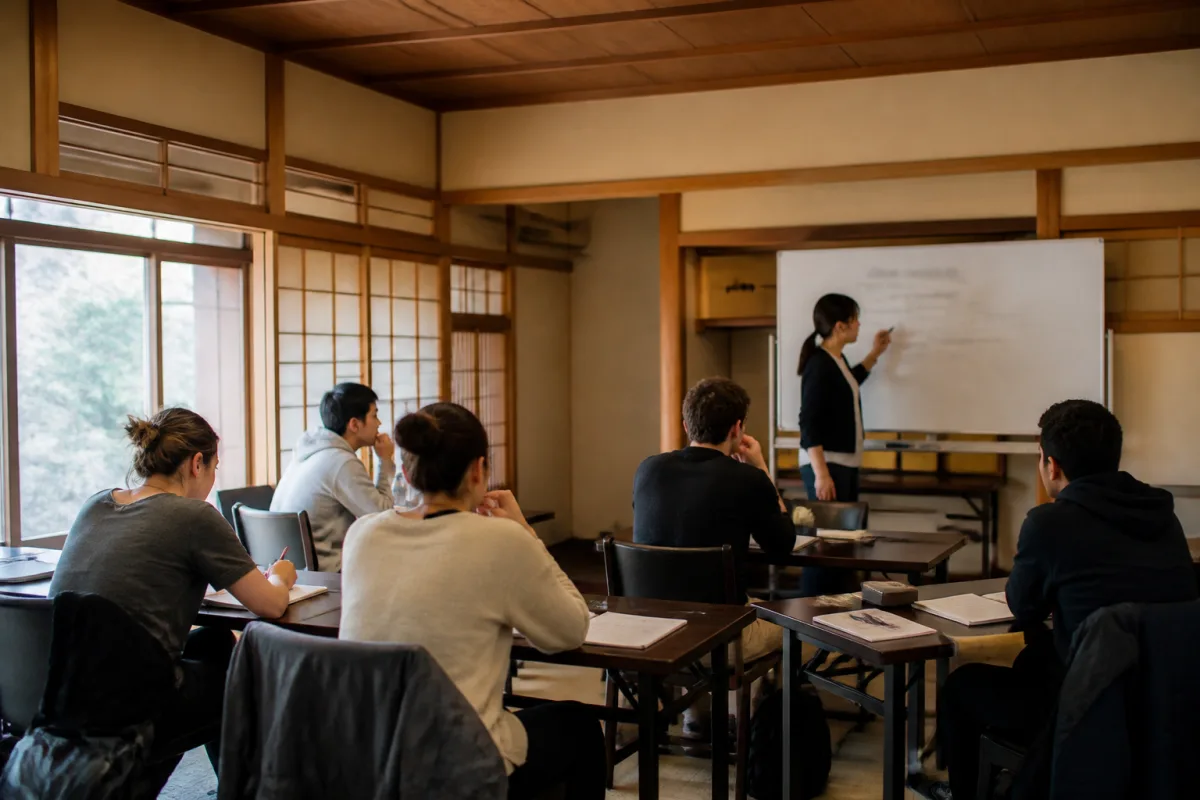
Human Academy’s method focuses on practical, conversational Japanese rather than memorizing grammar rules: students start speaking from day one, with minimal time spent on rote drilling. This emphasis on conversation doesn’t come at the expense of JLPT prep — it adds what’s actually useful for everyday and student life in Japan from the very start.
The curriculum was developed by the school’s own methodologists, and classes are built around Human Academy’s in-house textbooks. These materials are popular enough that students from other schools use them too — a rare case, since most schools produce textbooks strictly for internal use.
These materials are popular enough that students from other schools use them too — a rare case
Alongside core Japanese classes, there’s a flexible set of optional modules to choose from:
- Japanese culture;
- JLPT prep;
- interview prep for college admissions or job applications;
- and other electives — from cultural courses to practical ones needed for enrollment.
A separate track covers career support: in-house guidance for college or university admission and for job placement. This isn’t a one-off consultation but structured, ongoing work: based on what coordinators see, most students enrolling in Japanese language schools are aiming for one of two things — continuing their education at a college or university, or finding a job and getting sponsored for a work visa. Human Academy has built separate prep tracks for each of these goals, complete with materials and interview practice.
Compared with the other partner school covered here, Human Academy offers a strong foundation in Japanese thanks to its scale and structured system — in contrast to the smaller, more business-oriented format of the alternative.
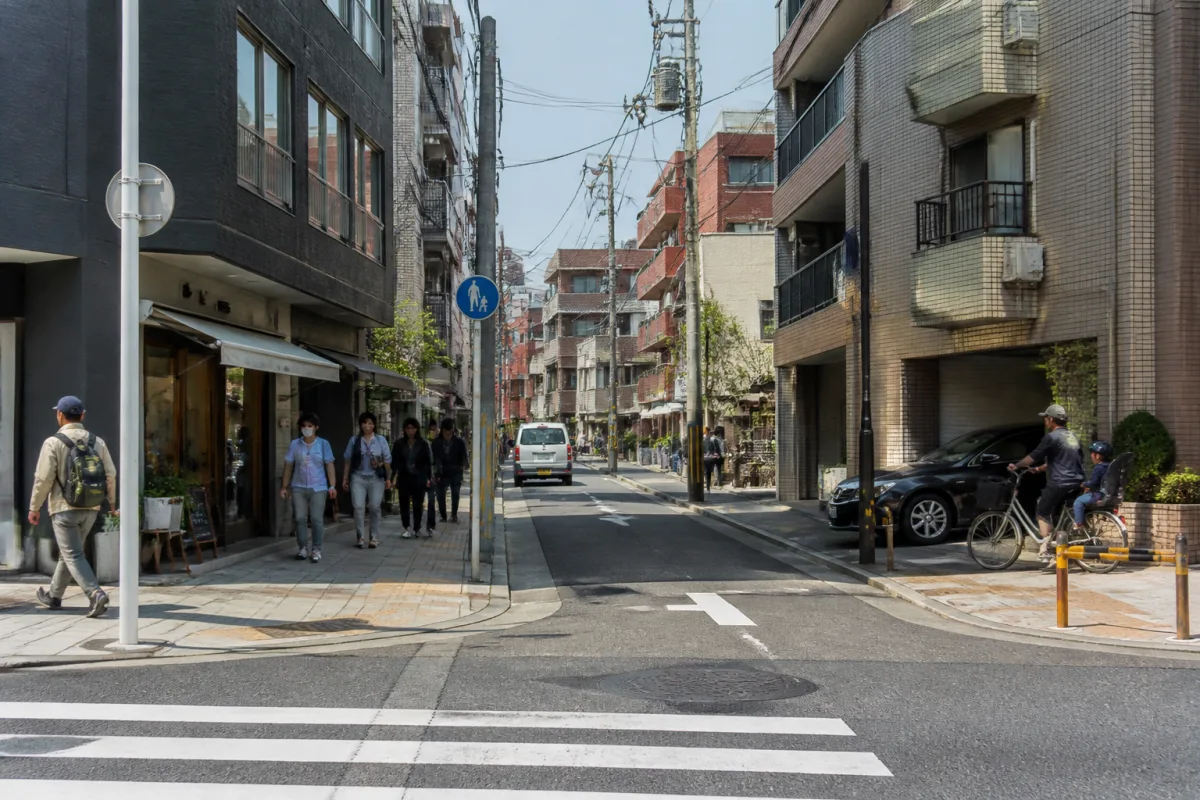
Most students at Japanese language schools are working toward one of two goals: getting into a college or university, or finding a job and securing a work visa. Human Academy has built a separate prep track for each goal.
ILA Kobe: a small school in the student city of Kobe
ILA Kobe stands for International Language Academy Kobe — the second partner school, and the direct opposite of Human Academy in format. Where Human Academy is a large-scale school with a tight system across major cities, ILA Kobe is a cozy, small-scale school in the smaller city of Kobe with a more intimate atmosphere.
The city itself gives the school some built-in advantages. Housing in Kobe is noticeably cheaper than in Tokyo, while public transport is still well developed. Thanks to the mild climate, a bicycle remains a practical way to get around town for almost the whole year.
Beyond the standard academic track for college and university admission, ILA Kobe also offers a dedicated business Japanese program. It’s built for students planning a career at Japanese corporations, not just those preparing for exams.
The school has direct ties with colleges and universities in Japan — a practical advantage that makes college admission afterward easier. For anyone planning to continue studying after language school, that’s a meaningful point, especially since two years at a Japanese college is officially recognized as higher education.
In terms of program content, ILA Kobe strikes a balance between academic Japanese and a business-oriented environment, while easing students into a smaller city — a contrast to the strong language foundation that Human Academy’s method provides.
ILA Kobe’s direct ties with colleges and universities make admission easier after language school, and two years at a Japanese college officially count as higher education.
Human Academy or ILA Kobe: how to choose between them
The choice between the two schools comes down to what matters more: scale and structure, or a smaller setting with an easier pace of adjustment.
| Criteria | Human Academy | ILA Kobe |
|---|---|---|
| Format | Large-scale school with a tight system | Small school with a cozy atmosphere |
| Location | Major cities in Japan | Smaller city of Kobe, close to the sea |
| Teaching focus | Conversational Japanese from day one, in-house textbooks, wide range of electives | Balance of academic Japanese and business environment, easier adjustment |
| Best for | Students who want a strong language foundation and are preparing for admission in a major city | Students looking for a less intense pace and the feel of a smaller student city |
| Partner status | Official SCHOL partner | Official SCHOL partner |
Both schools’ SCHOL partner status means the same document prep process and visa support for students — the difference lies only in the format and the city, not in the school’s reliability.

Human Academy or ILA Kobe
| Criteria | Human Academy | ILA Kobe |
|---|---|---|
| Format | Large-scale school with a tight system | Small school with a cozy atmosphere |
| Location | Major cities in Japan | Smaller city of Kobe, close to the sea |
| Teaching focus | Conversational Japanese from day one, in-house textbooks, wide range of electives | Balance of academic Japanese and business environment, easier adjustment |
| Best for | Students who want a strong language foundation and are preparing for admission in a major city | Students looking for a less intense pace and the feel of a smaller student city |
| Partner status | Official SCHOL partner | Official SCHOL partner |
Both schools’ SCHOL partner status means the same document prep process and visa support for students.
Coordinator support while studying in Japan
Human Academy provides individual coordinator support to every student — not a generic consultation, but personal, ongoing guidance. The coordinator handles technical details that are hard to find through public sources: how the visa process works, where to look for a job, and how to prepare for an interview with an employer.
For students of this partner school, this support is free — there’s no separate fee for the coordinator. This arrangement was agreed specifically with Human Academy and doesn’t apply to every student at the school by default.
The value of a coordinator grows with distance from home: once a student is in Japan, thousands of kilometers from their usual environment, having someone who knows the Japanese system from the inside helps close the gaps that are hard to figure out alone. This is especially noticeable with Human Academy’s six campuses across different cities — a coordinator helps students find their footing no matter which campus they choose.
There’s also a separate flexible tuition payment plan, available to students enrolling through this partner school.
Human Academy students get individual coordinator support — for visas, job search, and employer interviews — at no extra cost.
How admission prep works: from choosing a level to the interview
Choosing a school starts with a preliminary interview: figuring out the student’s current Japanese level, their goals, and their planned departure timeline — without this, matching a student to the right school isn’t possible.
The rest of the admission process involves several steps.
- Choosing a support format. There are two options: three modules — from scratch to N5, N5+N4, and full N4 — or a program structured as N5, N5+N4, N4+. Both formats guide the student from the first letters of the alphabet to boarding the plane.
- Choosing a school and corresponding with it. All contact with schools in Japan is handled without the student involved — from requesting documents to finalizing details.
- Gathering documents. Students get a list of required paperwork and are kept on track to prepare it on time.
- Finding housing. Housing in Japan is sorted out in parallel with the documents, with feedback at every stage.
- Interview prep with the school. An interview with the Japanese side has become a mandatory part of admission at most partner schools — without it, admission generally isn’t possible.
- Getting language study certificates. Students receive certificates confirming they’ve completed language preparation.
- Taking exams ahead of time, so the level is documented before admission.
- Planning the timeline. The entire schedule — from the start of classes to departure — is mapped out in advance, so the student can focus on learning the language instead of logistics.
An interview with the Japanese side has become a mandatory part of admission at most partner schools — without it, admission generally isn’t possible
The interview with the school isn’t a formality you can skip — it’s a mandatory step, and it’s specifically what students prepare for separately, going through likely questions ahead of time.
The path from choosing a school to leaving for Japan
Eight steps to prepare for admission to a Japanese language school
- Choosing a support format (modules up to N5, N4, and beyond)
- Choosing a school and corresponding with it
- Gathering documents
- Finding housing
- Interview prep with the schoolmandatory admission step
- Getting language study certificates
- Taking exams ahead of time
- Planning the timeline before departure
What to complete before applying to a language school
Language prep before the trip: from zero to N1
Language preparation is handled by a separate program, not directly tied to the admissions coordinator: the team has been teaching Japanese for more than 16 years. You can start at any level — including from zero, with no prior knowledge of Japanese — and work up to N1.
Classes are taught by native Japanese instructors who specialize in teaching the language. The method is partly modeled on how Japanese is taught in Japan itself — because of this, students who go through this prep tend to face less adjustment stress once they’re studying in the Japanese system on the ground.
The core program comes with a set of additional materials:
- a conversation club with native Japanese speakers and instructors — held twice a month;
- extra language-focused live sessions;
- checklists and other self-study materials.
The whole package is designed so that, by the time of the move, the student’s language level already allows them to study comfortably at their chosen school, instead of starting Japanese from zero once they’re there.
Frequently asked questions
Can you transfer from one partner school to another if the format doesn’t work out
There’s nothing in the available materials about transferring between partner schools after classes have started, so there’s no definitive answer here. But the school is chosen in advance, through a preliminary interview, precisely to avoid this situation: the coordinator matches the format to the student’s language level, goals, and departure timeline before documents are even submitted.
What happens if you don’t pass the JLPT before leaving for Japan
There’s no direct answer for this scenario, but the prep process is designed so the exam is taken ahead of time: one of the steps is taking exams before enrollment, so the language level is documented before the student is accepted into the school.
Can you apply to Human Academy or ILA Kobe on your own, without a coordinator
The materials only cover the path through a coordinator and partner school: all contact with schools in Japan is handled without the student involved, from requesting documents to finalizing interview details. There’s no information on applying independently without this kind of support.
Do you need to pay for language courses and admission coordinator services at the same time
These are two separate programs with separate payment structures. The admission coordinator is provided free of charge for students of the partner school — there’s no separate fee. Language prep from zero to N1 is a separate program, not directly tied to the admission coordinator, and its cost is handled on its own.
Can you go straight to a Japanese university, skipping language school, if your Japanese is already strong
This scenario isn’t addressed in the materials — throughout, the path runs through a language school as a mandatory first step before college, university, or employment. There’s no information on direct university admission without attending a language school first.


Comments
Reader experience is useful, but it is not advice: check the rules on the official site.
No account needed: click Sign in, type any name, and you are done.