


Enrolling in a Japanese language school means choosing a school that fits your goal, gathering and translating your documents into English, waiting for the immigration bureau’s decision and a Certificate of Eligibility, and then getting your visa at a visa application center.
In short
- Preparing for a Japanese language school happens in three stages: an online foundation, a prep school leading up to JLPT N5, and adjustment after the move
- Application documents are translated into English and reviewed by an assigned coordinator and the school itself
- From receiving the Certificate of Eligibility to holding a passport with a visa takes about 4 days after submission, while waiting for the immigration decision takes around 3 months
- A mismatch between the information submitted initially and at visa extension is treated by Japan’s immigration authority as deception and results in denial
- A share house replaces a regular apartment for newcomers — cheaper and simpler to arrange than a long-term lease
The Path to Enrollment: Three Stages of Learning Japanese
Preparing to enroll in a Japanese language school breaks down into three stages: a kind of “preschool,” “school,” and “adult life” after moving to Japan.
The first stage is an online Japanese course with pre-recorded lessons. There’s no strict oversight here beyond your own discipline: video lessons cover both kana alphabets, hiragana and katakana, basic grammar, and first vocabulary. This is an entry-level stage that gives only the most general sense of the language — the real difficulty is still ahead.
The second stage is studying at SQOL school. Even before the first class, at a so-called lesson zero, students had to learn the alphabets and a minimal base on their own. After the first lesson, alongside the main homework, extra materials for independent study were handed out: vocabulary and grammar. Studying at SQOL fell in the summer of 2025 — by that point, the first JLPT N5 exam was already scheduled. Alongside regular classes, the school ran a short prep course for that exam, which required serious preparation for every session and active participation. The JLPT N5 exam was passed with a high score.
After the exam, lessons at the language school itself began even before the move — by the student’s own admission, without much enthusiasm, but the material was gradually absorbed.
The third stage is “adult life” after the move to Japan. Here came a placement test, which placed the student into the second class — roughly a level between the end of N5 and the middle of N4. The placement turned out to be accurate: going over the grammar again reinforced the material, and spoken Japanese improved to an acceptable level. Even students starting at zero, placed in the easiest class, complain about the sheer volume of information, grammar, and kanji — a language school in Japan demands intensive work no matter your starting level.
Even students starting at zero, placed in the easiest class, complain about the sheer volume of information, grammar, and kanji
How to Choose a Japanese Language School
Choosing a language school is one of the most important steps toward moving to Japan, and it needs to be approached with several factors in mind at once. The first and most important is your goal, because schools differ by focus.
Some schools prepare students for university admission and even have connections that help with employment after graduation. Others help with building a resume and preparing for interviews — these schools may run a separate business course focused on keigo (polite speech) and office etiquette. A third type of school leans into cultural immersion and various events, without a strong focus on the language itself.
In the case described here, the choice went to a school focused on Japanese language study and subsequent employment — studying in Japan costs a fair amount, and the goal was to get a genuinely solid result in the time available. The choice landed on RC Japanese Language School in Tokyo.
Another criterion is the student body. Some schools are geared toward Asian students who are already familiar with kanji, so the program doesn’t emphasize learning the characters. Other schools are built for European students and design the curriculum around the fact that kanji is entirely new material for them.
What Else to Consider
- Program focus — university prep, employment prep, or a cultural lean.
- Student body — schools geared toward Asian or European students.
- Location relative to housing — are you willing to spend several hours a day commuting, or would you rather live a 10-minute walk from school, factoring in your budget.
Sorting through all the nuances on the first try is hard — this is genuinely worth the time to research carefully.
Decide on your goal first — university admission, employment, or cultural immersion: this determines the school’s program and its connections.
Which City in Japan to Choose for Study
Tokyo suits anyone whose plans go beyond just studying at a language school. It’s a major industrial hub: more jobs, more universities, more part-time work opportunities, not to mention events like Tokyo Game Show. In that sense, Tokyo is comparable to a city that serves as the country’s main center of gravity for everything.
Tokyo’s main downside is high competition. For employment at most Japanese companies, a foreigner is practically expected to have business-level English, and not everyone has that. On top of that comes the cost of living: rent and expenses in Tokyo are higher than in other Japanese cities.
An alternative is to consider other major cities or, conversely, smaller towns: some dream of living in a Japanese village, others of the Shibuya district with its neon signs. The choice here depends on personal goals: Tokyo is worth choosing as a place to live during your studies and for a while after, while you look for work and before you settle on a move to another region.
When choosing a neighborhood, it’s important to factor in its location relative to the school. You need to decide in advance whether you’re willing to spend several hours a day on a round-trip commute, or whether you’d rather sleep in a bit longer and walk to school in 10 minutes. This is a matter not just of convenience but of budget: pricier housing usually means a shorter commute.
What Documents Are Needed to Enroll in a Japanese Language School
The language school then reviews the submitted package itself and forwards it to Japan’s Immigration Services Agency — specifically to get the entry permit issued. Documents in your native language aren’t accepted: a certificate of employment, a university diploma, and similar papers need to be translated into English. In the case described here, notarizing the translations wasn’t required — a standard translation was enough, but it’s worth double-checking the text carefully if a machine translation tool was used, and confirming requirements with the specific school in advance.
Separately from the translations, a lengthy application form in English needs to be filled out: it covers the school, university, college, and full work history. The form also includes a short motivation-letter section — it’s worth thinking through in advance, because the school may ask follow-up questions about it. Translating the documents and filling out the form takes about a day — this isn’t like booking a plane ticket; the process requires carefully checking every item.
Getting the employment certificate can present an unexpected hurdle: the HR department is entitled to refuse to issue a certificate of work experience and salary in English specifically, if the staff don’t speak the language. In that case, the document has to be translated independently.
The collected documents are sent to an assigned coordinator, who reviews them again and forwards them for review to the language school itself. The school may ask follow-up questions about the documents, the application, or your education — this is a standard part of the process: the school has an interest in submitting as complete and accurate a package as possible to the immigration authority, so no questions come up on that end.

Documents to submit to a Japanese language school
Do Document Translations Need to Be Notarized for a Japan Visa
In the case described here, notarizing the translations wasn’t required — the documents were translated independently. But requirements can vary depending on the school and the representative office, so it’s worth confirming them in advance. In this case, the documents were translated into English using ChatGPT, then sent to the assigned school coordinator, who forwarded them to the language school itself for review.
Every form and document needs to contain information that is accurate and consistent. There’s a known case where applicants listed one set of details when applying for a student visa and a different, conflicting set when applying for an extension. Japan’s immigration authority cross-checked the first and second submissions, found the discrepancy, treated it as an attempt to deceive — and denied the visa extension.
Japan’s immigration authority cross-checked the first and second submissions, found the discrepancy, treated it as an attempt to deceive — and denied the visa extension
To avoid ending up in that kind of situation, it’s worth keeping a record of all the information submitted on the initial application: when extending the visa, that same information should simply be copied over and checked again, without creating any discrepancies with what was already submitted.
If the details on your visa application and your extension application don’t match, the immigration authority will treat it as an attempt to deceive and deny the extension.
How to Get a Visa After Receiving the Certificate of Eligibility
After the documents are handed off to the language school and all its questions are answered, the waiting begins: it takes around 3 months to get a positive decision from the immigration authority. There’s no need to worry about that timeline — once an applicant has answered all of the school’s questions, immigration usually doesn’t raise any further questions, and the decision tends to be favorable.
- Get the Certificate of Eligibility. Along with a positive decision from immigration, the language school passes on the Certificate of Eligibility for a student visa (COE) — this is what opens the door to the visa application center.
- Pay for the first 6 months of tuition. Payment is made right away along with receiving the certificate, before the visa documents are even submitted.
- Submit documents at the visa application center. The process here is clearly defined: you register online in advance, arrive at your scheduled time, and hand over the documents.
- Pick up your passport with the visa. The passport with the visa stamped in it is issued 4 days after the documents are submitted — no further questions come up at this stage.
From Certificate of Eligibility to a Japan Visa
Four steps from getting the COE to holding a passport with the visa in hand.
- Get the Certificate of Eligibility (COE)
- Pay for the first 6 months of tuition
- Submit documents at the visa application center
- Pick up your passport with the visa4 days
Housing in Japan and Share Houses: What to Look For
Renting a regular apartment in Japan is difficult for a newcomer for two reasons at once. First, leases are only offered on a long-term basis. Second, moving in requires a large upfront payment: part of that sum is refunded when the lease ends, and part is not, because it’s customary in the country to give the landlord something like a gift for the right to live there — and that money is never returned.
Because of this, many people arriving to study choose a share house instead — an option similar to a dormitory: common areas plus a private room that locks. It’s cheaper and simpler to arrange than a regular rental apartment, but there are still things worth paying attention to here as well.
When choosing a share house, it’s worth considering:
- the cost of living there;
- the distance from the language school;
- reviews from previous residents;
- the nationality mix of housemates — it can be a mixed group, with residents from various countries.
For two people, it’s important to plan for a bigger room in advance: in one case, the search was for a room larger than six tatami mats, and even arriving off-season, a 20 m² room was found — a result considered a solid win. Overall, finding housing in Tokyo is realistic, but almost always comes with trade-offs on price, size, or location.
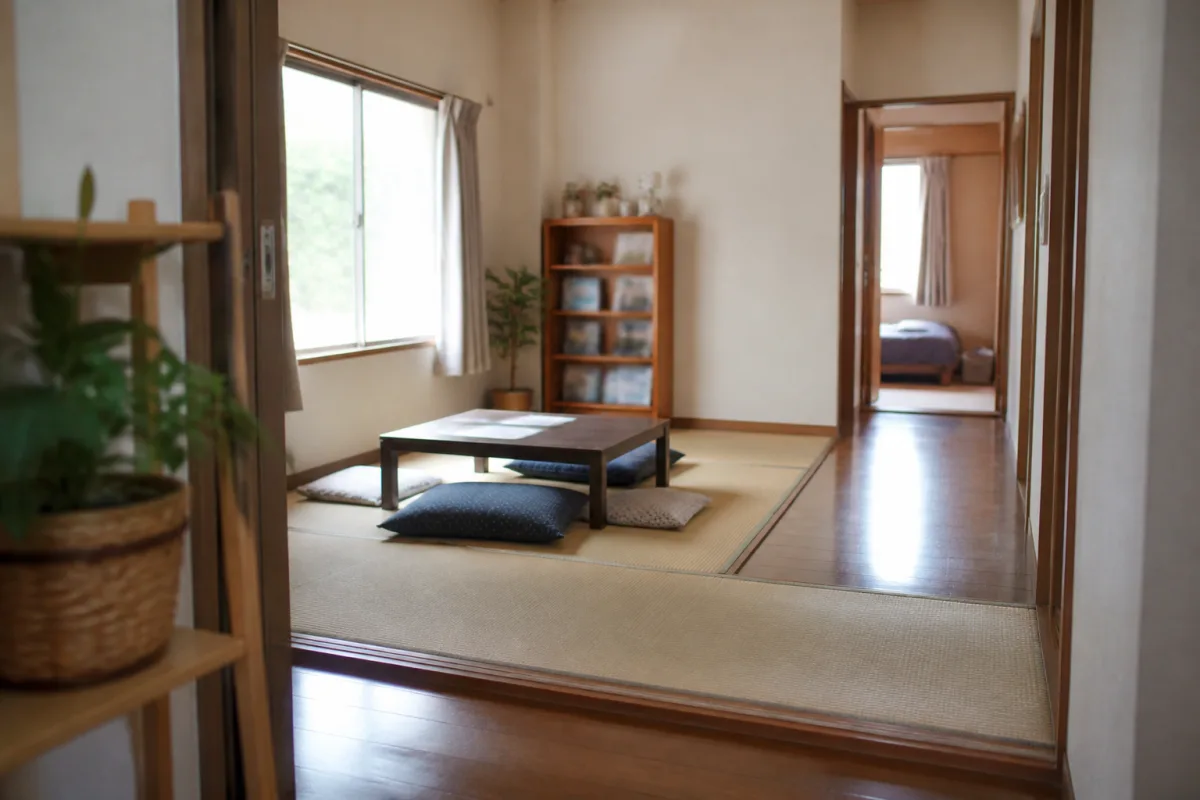
When searching for a share house for two people, plan for a room larger than six tatami mats from the start — that’s roughly 20 m².
How to Transfer Money to Japan for Tuition and Housing
Because of the situation back home, not every bank in Ukraine can send transfers abroad. In the case described here, there was no Visa or Mastercard, so the transfer was made through a different bank. Payment for the school went through without issues, but the payment for housing got flagged for currency control review.
The reason was that the invoice from the share house was issued in Japanese, and the bank required a translation. The translation was provided quickly, but after that there was no response from the bank for about a week: calls and attempts to find out the transfer’s status went nowhere.
there was no response from the bank for about a week: calls and attempts to find out the transfer’s status went nowhere
Things only moved forward after visiting the bank in person — the transfer went out the next day, and all that was left was for the recipient to wait for the funds to arrive. Based on this experience, if you run into a similar currency control delay, don’t wait around and call — it’s more effective to go to the bank in person right away and push for a resolution on the spot.
If a transfer gets stuck in currency control and the bank goes quiet for a week, it’s more effective to go to the bank in person right away rather than calling and waiting.
Frequently asked questions
Can you enroll in a Japanese language school with zero knowledge of Japanese?
The article notes that even students starting at zero, placed in the easiest class, study successfully, though they do complain about the sheer volume of information, grammar, and kanji. A language school in Japan demands intensive work regardless of your starting level.
What should you do if HR refuses to issue an employment certificate in English?
If HR staff don’t speak English, they’re entitled to refuse to issue a certificate of work experience and salary in that language. In that case, the document has to be translated independently, just like the other paperwork for the language school application.
How long does the whole process take overall — from submitting documents to the school to getting the visa in your passport?
After the documents are handed off to the language school and all its questions are answered, waiting for the immigration authority’s decision takes around 3 months. After receiving the Certificate of Eligibility and paying for the first 6 months of tuition, submitting documents at the visa application center takes a few more days, and the passport with the visa is issued 4 days after submission.
Do you need a high level of English in Tokyo to find a job?
Yes — for employment at most Japanese companies, a foreigner is practically expected to have business-level English, and not everyone has that. That’s Tokyo’s main downside, along with heavy competition among job seekers.
What does a renter get in exchange for the non-refundable upfront payment when renting housing in Japan?
The non-refundable part of the upfront payment is a customary practice in Japan of giving the landlord something like a gift for the right to live there. That money is never returned, unlike the other part of the deposit, which is refunded once the lease ends.
Can you rent a share house in Japan for just one person instead of two?
The material describes a case of finding a room specifically for two people — the search was for something larger than six tatami mats, and a 20 m² room was found. The selection criteria themselves don’t depend on the number of residents: cost, distance from the school, reviews from previous residents, and the nationality mix of housemates.
What should you do if a bank is taking too long to respond about an international money transfer?
Based on the experience described here, if a transfer gets delayed due to currency control, don’t wait around and call — calls and attempts to find out the transfer’s status didn’t lead anywhere. It’s more effective to go to the bank in person right away: the transfer went out the very next day after the visit.


Comments
Reader experience is useful, but it is not advice: check the rules on the official site.
No account needed: click Sign in, type any name, and you are done.