
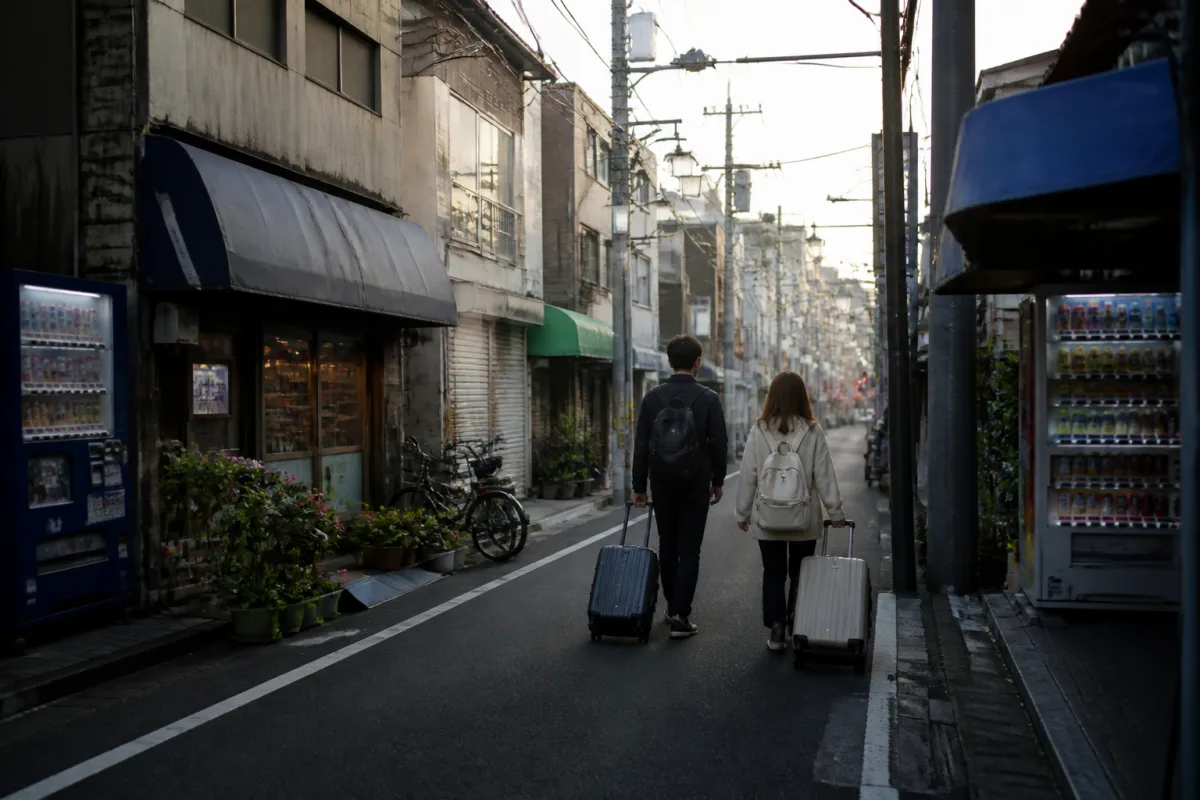

According to students who’ve gone through it, studying at a Japanese language school isn’t travel-brochure romance — it’s a visa status with hard edges: city hall registration within the first days, a routine closer to high school than university, and a strict cap of 1 year and 9 months with no extension beyond that.
In short
- The first weeks after moving are dominated not by adjusting to the country but by bureaucracy: city hall, pension insurance, and getting the school routine set up, almost with no pause in between.
- Group placement at language school isn’t decided by the written test alone — the oral interview can push the expected level down.
- The two-week “tourist to local” turning point doesn’t really happen: three months in, some students are still mid-adjustment.
- The language barrier doesn’t lift in a couple of weeks even with daily classes — the limit of a real conversation can be as short as 10 minutes.
- A language school student visa is bound by a hard time cap, after which you have to extend status, change it, or leave the country.
The First Days After Moving: What Happens Right Away
The first task after arrival isn’t rest — it’s setup: moving into a share house and buying the basics for daily life. Almost immediately there’s a trip to city hall to register and handle paperwork, including pension insurance enrollment, which means working through several offices back to back.
At the same time, logistics around the school need sorting out: how to actually get to class — by subway or by bike — and that route has to be worked out in advance. Communication at city hall and at school often happens in English, which new arrivals don’t always speak fluently, so even these routine errands become a source of stress.
The feeling of being a tourist for the first two weeks simply doesn’t happen: school, city hall, and daily errands all start almost at once, with no buffer for acclimating. While a pile of confusing paperwork is still unresolved and things haven’t settled, everything feels complicated and tangled — a feeling students describe specifically about the first few weeks, before the bureaucratic side falls into place.
City hall, pension insurance, school, and logistics all start almost at once, in English that isn’t your native level — the feeling of a tourist trip never happens at all.
Day One at Language School: Orientation and the Placement Test
The first school day has two parts: orientation and a placement test. This is the first point where expectations about the move meet reality — up to this moment, everything could still be filed under preparation.
Group placement isn’t based on the written test alone. In one account, the written test was followed by an oral interview with two teachers, and that interview ended up deciding the final group level: the student expected a stronger class, but after the interview landed a level below what the written score alone would have suggested. The oral portion tests something the written test doesn’t — how easily someone follows spoken speech and how confidently they speak, not just whether they know the grammar.
the student expected a stronger class, but after the interview landed a level below what the written score alone would have suggested
The final group may not match the level a student expected of themselves before leaving home: written knowledge and speaking ability are scored separately on the test, and the interview can outweigh the formal result.
Group placement isn’t decided by the written test alone — the oral interview can outweigh the formal score and push the expected level down.
What Japanese Level Do You Need to Enroll, and How Fast Does It Grow
At the start, two students’ self-assessments diverged almost immediately: one rated their own kanji, grammar, and reading as a confident N4 on the JLPT scale, while admitting listening comprehension was weaker from less practice. The other student rated them higher — N4 moving toward N3 — while rating themselves lower: N4 in confidence but N5 in speaking. The gap between these assessments is expected: the JLPT scale tests reading, grammar, and listening separately, not conversational ability, so the same person can be “N4 on paper” and “N5 in conversation” at once.
Over the course of one academic term, progress showed up more clearly in speaking than in formal level. One student describes the starting point this way: on arrival they could only manage a couple of words like greetings and goodbyes; by the end of the term they were building simple everyday sentences, grammar mistakes and all.
Listening comprehension followed its own track. One student started at N5 and, after the placement test plus interview, landed in a class below what they’d expected — at that point, teachers were hard to follow at all. By the end of the term, that same student understood roughly 90% of what the homeroom teacher said, though they note teachers deliberately simplify their speech. By their own estimate, their level rose from N5 to N4, even though it had earlier been assessed as “beginner N4.”
Formal results back up the progress: final tests were scored at the maximum, except for pronunciation, which came in one point lower. Another student sat a final grammar-and-vocabulary test worth 150 points total.
Japanese Progress Over One Academic Term
Speaking and listening comprehension advanced more visibly than the formal JLPT level.
- At the start: vocabularya couple of words (greetings, goodbyes)
- At the start: understanding the teacherhard to follow at allN5 level
- By term’s end: speakingsimple everyday sentenceswith grammar mistakes
- By term’s end: understanding the homeroom teacherroughly 90%teachers use simplified speech
- By term’s end: self-rated levelrose from N5 to N4
The Study Routine and Classmates: Who You’re Actually Studying Alongside
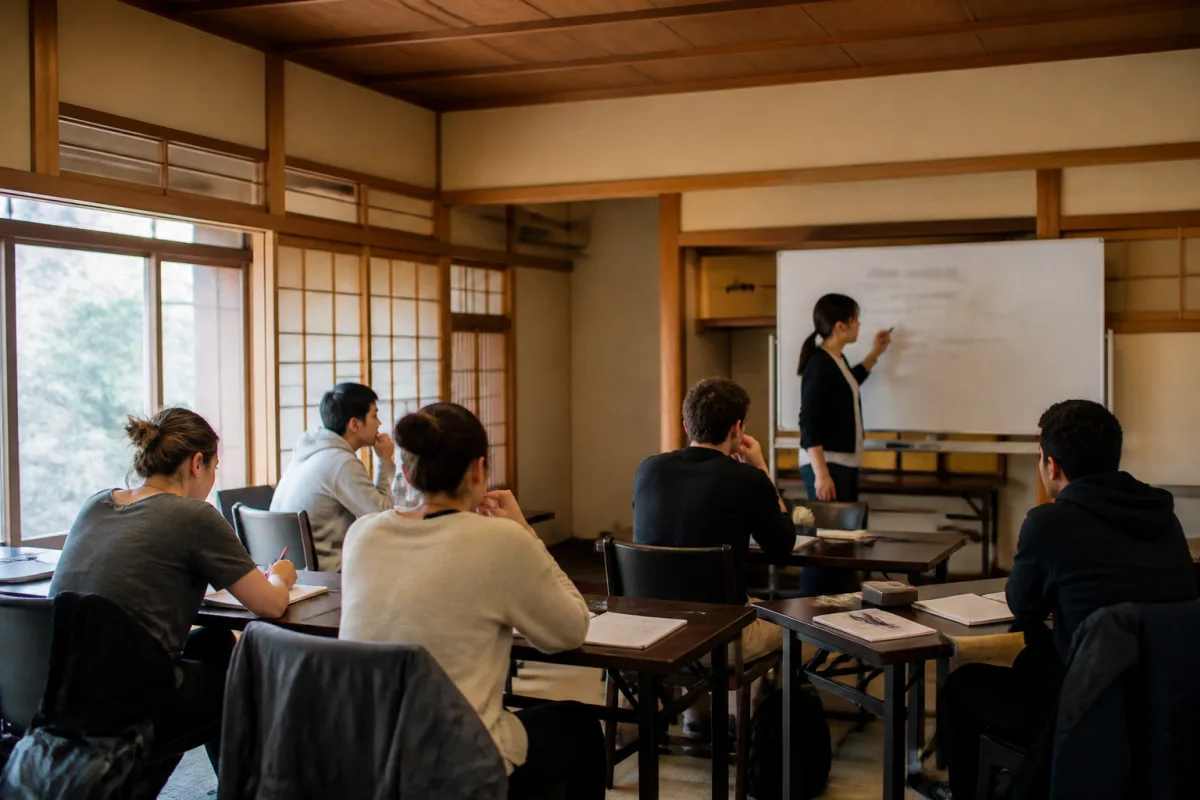
The study routine at a language school is closer to high school than university: a fixed schedule, daily classes, and homework — not the open timetable university students are used to. Life during this period turns into a loop: morning chores and cooking, then class, then homework and sleep after school, and back around again. In that rhythm it’s easy to temporarily forget you’re in Japan at all, rather than in some ordinary everyday routine.
As the course progresses, the program shifts more toward speaking practice and interaction between classmates, rather than staying focused on grammar and writing alone.
The classroom mix is uneven, and expectations about it often don’t match reality. The common image of Chinese students as table-tennis enthusiasts, for instance, doesn’t hold up in practice. At the elementary level at least, most Chinese students are recent high school graduates whose move to Japan is usually their parents’ decision rather than their own, driven by fierce competition to get into Chinese universities. Japanese language study, in that case, is a shorter route into higher education than fighting for a spot at a Chinese institution.
Away from parental oversight, some of these students relax: not paying attention in class, showing up late, getting distracted by their phones. Instead of studying systematically, they often lean on the similarity between Japanese and Chinese. But that’s not the rule across the board: in older classes, where classmates are closer in age, awareness and performance tend to be higher, and some classmates score the maximum on every test — 100 out of 100.
A class doesn’t automatically turn into a problem, either: it can be perfectly comfortable, with no one disrupting lessons. Socializing, though, often stays confined to school hours — after class, classmates go their separate ways, and some rush to leave early to catch an evening train and avoid a packed car.
Expectations about classmates often don’t match reality: motivation levels differ in younger groups, but that doesn’t mean the class itself will be a problem.
How Long Adjusting to Life in Japan Actually Takes
Expectations before the move were specific: the feeling of “we just got here” was supposed to end after 2 weeks, after which Tokyo would become home rather than a destination. Previous trips to Japan — this was already a third visit by the time of the move — had created confidence that fear around the flight, the subway, and daily logistics wouldn’t come up at all.
In practice, the two-week turning point never arrived. Three months into living in the country, one student described the adjustment period as unfinished — “it’s still kind of ongoing, even now” — mainly around language and everyday interactions with staff, in the kitchen, at hotels. The feeling of “we arrived as tourists for 2 weeks and then we’re heading back” never showed up at all, unlike what had been expected beforehand.
The feeling of “we arrived as tourists for 2 weeks and then we’re heading back” never showed up at all
Within that period, what builds up is a gradually deepening routine, not a single turning point. At the start, everything still felt tangled because of the fresh bureaucratic hassle of the first weeks. By the time a full academic term had passed and prep for the next one had begun, that feeling gave way to a different one — that this is genuinely living here, not just having arrived. A second student deliberately set aside 3 months for adjustment, expecting that by the next term she’d be used to the study routine and would start socializing more outside of school. The same three months later, she describes it as an adjustment period gradually turning into ordinary life — despite the hassle of paperwork and the job hunt for an arubaito.

The Language Barrier: Why It Doesn’t Vanish in a Couple of Weeks
The language barrier persists even months into life in Japan — and that’s not down to a lack of classes. In one account, a student admits the barrier is strong and hasn’t lifted yet, and she attributes it partly to her own personality — being an introvert, which makes stepping outside her comfort zone physically hard, not just linguistically hard.
The real marker of progress here isn’t a grade at school — it’s how long you can hold up in an actual conversation. In practice, that’s about 10 minutes of talking with Japanese people in the dorm kitchen before serious fatigue sets in. The issue isn’t not knowing the words: every sentence has to be built in your head before it comes out of your mouth, and it’s that internal effort that wears you out faster than the conversation itself.
every sentence has to be built in your head before it comes out of your mouth, and it’s that internal effort that wears you out faster than the conversation itself
The one expected point of relief isn’t a specific test passed — it’s a timeframe: the hope that after six months in Japan, things will noticeably get easier. Until then, the only thing to lean on isn’t waiting for a sudden breakthrough, but building up grammar and drilling exercises that gradually turn into spoken language as the school’s program moves forward.
The Language School Student Visa: How Long You’re Allowed to Stay
A language school student visa isn’t indefinite: study at a language institution generally doesn’t exceed 2 years, and the specific length of stay is set individually and can be renewed within that overall cap. Don’t count on a long cushion of time — this is a requirement of the country’s residency rules, not something set by any individual school. Status as a language school student isn’t open-ended: it runs for a set period, and once that period ends you either extend or change status, or leave.
This time limit is worth factoring in before the move itself: it determines how much time there is to build up the language, figure out next steps in Japan, and prepare the following move — whether that’s university enrollment, a change of status, or heading home.
Language school student status runs only for a set period — once it ends you have to extend or change status, or leave the country.
Staying in Japan After School: A Personal Choice and Its Cost
The wish to stay after finishing school isn’t abstract for these students — it grew out of specific moments of life in Japan. One student recalls climbing up to a rooftop and taking in the view of the city, and in that moment knowing she wanted to stay here for the long term.
Comfort in Japan, in their experience, comes down directly to money. Living in the country is “really great” — but only with a financial base behind it; otherwise the prospect narrows down to endless work just to get by. So the goal isn’t staying on a kōshiin (language school student) status forever, but finding work that’s actually theirs and earning a living from it in an easier mode, rather than working to exhaustion.
For another student, the reason to stay isn’t the view from a window — it’s a sense of place: in Japan she felt comfortable in a way she never did in Moscow. One of them puts it plainly: he’s happy and doesn’t regret the move, and he wants to hold on to that feeling going forward.
Frequently asked questions
How long does a language school student visa in Japan actually last, and can it be extended?
A language school student visa is capped at 1 year and 9 months, and it can’t be extended beyond that limit. The specific length of stay within that cap is set individually, so once it runs out you either have to change status (by enrolling at a university, for instance) or leave the country.
Can you switch to a different class at the language school if your final level turns out lower than expected?
The source material doesn’t cover any process for switching classes after placement. What’s known is only that a group’s level is set using a combination of the written test and the oral interview, and the result can fall short of a student’s expectations — but what to do next if the outcome is disappointing isn’t addressed in the accounts described.
What can you do if the language barrier still hasn’t broken after three months?
There’s no direct fix described, but the one expected point of relief isn’t a specific milestone — it’s a timeframe: the hope that six months into life in Japan, things will get noticeably easier. Until then, the only thing to rely on is building up grammar and gradually converting what’s been learned into spoken language as the school’s program moves forward.
Can you enroll in a Japanese language school with zero Japanese?
Yes — some students do arrive at zero level, including a share of Chinese high school graduates sent by their parents right after finishing school. Either way, the final group level is decided on-site through the placement test and interview, not set in advance.
What happens after finishing language school if you don’t go on to university?
The source material doesn’t address this scenario directly: the students quoted talk about wanting to stay in Japan by finding their own path and earning a living, not about specific post-school statuses. As a general rule, a language school student visa runs only for its set period, after which you either have to change status or leave the country.


Comments
Reader experience is useful, but it is not advice: check the rules on the official site.
No account needed: click Sign in, type any name, and you are done.