


Whether a domestic US flight is safe depends on whether you are still within your authorized period of stay: inside that window the risk of ICE detention is minimal, but once it expires the risk is high — even if you’ve already filed for adjustment of status.
In short
- Domestic flight risk depends not on visa type, but on whether the period of stay granted at entry (I-94), not the visa’s expiration date, has run out.
- You can check the end date of your lawful stay on the CBP website by pulling your I-94 record.
- If detained with a pending adjustment of status, the case stays open until the I-130 is decided, and release can require a bond of around $20,000.
- About 99% of permanent residents fly domestically without issues, but the risk rises sharply on international trips.
- Conditional residents with a pending I-751 should check their petition status before flying back — a flight with a layover abroad can count as international.
Who can safely fly domestically on a valid status
Lawful presence covers people in F-1 or H-1B status, or anyone still within the period granted at entry on a B-2 tourist visa. A B-2 tourist visa can allow a stay of up to 180 days at entry — and that figure comes from what the Customs and Border Protection officer wrote down at the border, not from the visa’s own expiration date.
If that period hasn’t run out yet, a domestic flight within the US carries no meaningful risk of ICE detention: staying within your authorized period of stay is exactly what counts as “valid status” and removes the question of risk on flights inside the country. This holds the same way for a study, work, or tourist visa — what matters isn’t the visa category itself, but whether the authorized period of stay has expired.
what matters isn’t the visa category itself, but whether the authorized period of stay has expired
For a domestic flight, what matters isn’t the visa type (F-1, H-1B, B-2) but whether the period of stay granted at entry has expired.
How to check the date your authorized stay in the US ends
- Search “CBP I-94” online.
- Go to the site that comes up — it lets you pull your most recent I-94 record.
- The system will show the date through which you’re authorized to stay in the US on your current entry.
This date is not the date the visa was issued — it’s the period of stay that the border officer set at entry.
How to find the end date of your authorized stay
Three steps to check your period of stay via your I-94 record.
- Search “CBP I-94” online
- Go to the site and pull your most recent I-94 record
- Get the end date of your authorized staythis is not the visa’s issue date
Search “CBP I-94” and pull your most recent record — the system shows the exact end date of your authorized stay, which is not the same as the visa’s expiration date.
After the authorized stay expires: risk even with a pending adjustment of status
Lawful presence covers people in F-1 or H-1B status, or anyone still within the period granted at entry on a B-2 tourist visa. A B-2 tourist visa can allow a stay of up to 180 days at entry — and that figure comes from what the Customs and Border Protection officer wrote down at the border, not from the visa’s own expiration date.
What happens if ICE detains someone with a pending adjustment of status
Once detention happens, the situation gets harder because the I-130 petition filed alongside the adjustment of status package hasn’t been approved yet (c11). It’s specifically an approved I-130 that a defense attorney needs to get removal proceedings terminated — without it, that argument doesn’t work (c11).
In practice, this turns into weeks or months at a detention facility: there have been cases where a person stayed there until an immigration judge recognized their right to status (c12). In one such case, after that recognition, the judge set bond, and release cost around $20,000 — the amount depends on the specific case (c13).
Meanwhile, the case stays open: removal proceedings continue until the I-130 gets a decision. A separate problem is how fast defense counsel actually gets involved: according to practitioners, roughly two weeks often pass from the moment of ICE detention before an attorney starts actively working the case (c14). Those two weeks are spent in a detention facility — away from family and work.
roughly two weeks often pass from the moment of ICE detention before an attorney starts actively working the case
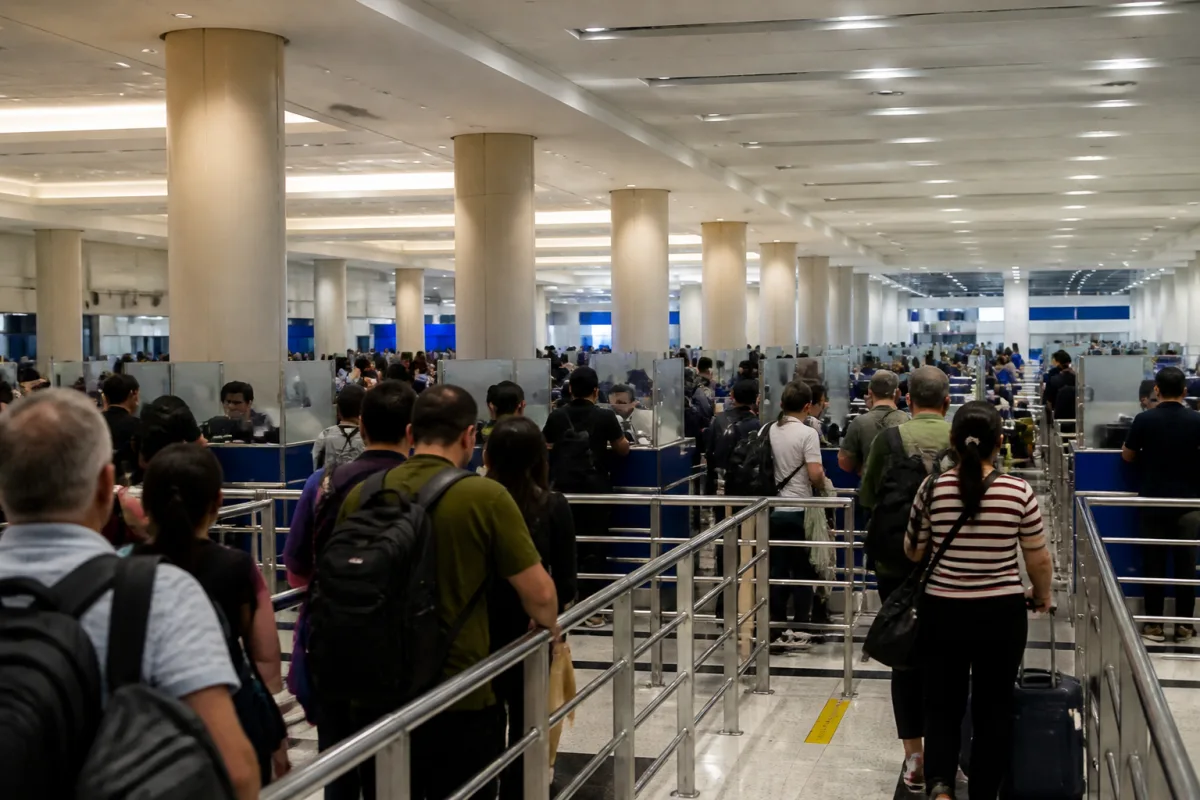
Even once the right to status is recognized, release can require a bond of around $20,000, and it can take about two weeks in detention before an attorney starts actively working the case.
Permanent residents: when a green card doesn’t protect you from risk
Permanent residents can, in most cases, fly domestically without concern — detention on a purely domestic flight, from one home airport to another, remains practically unheard of (c18, c22, c32). The risk for a resident doesn’t come from green card status itself, but from specific circumstances: problems with how the green card was obtained, prior arrests or criminal charges, or spending too long outside the US (c19, c20). A rough estimate cited in the source material puts the figure at around 99% of permanent residents who can travel without serious issues, though the outcome always depends on the specific facts of the case (c21).
The risk changes sharply on international trips — that’s where cases are documented of a resident being held for hours of additional screening and questioned about how they obtained their green card. “International” here includes not just a flight leaving the continental US, but also a technically domestic flight that stops over in another country: if the plane makes a technical stop in, say, Canada, and especially if passengers have to leave the terminal, the flight is treated as international (c23).

Even a technically domestic flight with a layover abroad, especially one requiring passengers to leave the terminal, is treated as international — carrying risk even for green card holders.
Conditional permanent residents with a pending I-751: different rules apply
A conditional permanent resident differs from a regular one in that their status rests on an I-751 petition that hasn’t been approved yet (c26). Such travelers should be more cautious when flying than residents without conditions on their residence (c24) — but that caution is specifically about international flights, not domestic travel within the country: most of the documented problems for conditional residents are tied to international trips (c27).
The risk arises because a flight can quietly become international. Flying, say, from Maine to California with a layover in Canada technically makes it an international flight — especially if passengers have to leave the terminal (c25).
In one such case, a conditional resident was detained precisely while returning from an international trip: it turned out their I-751 had been denied, and they’d already been issued an NTA before landing back in the US.
it turned out their I-751 had been denied, and they’d already been issued an NTA before landing back in the US
If an I-751 petition has been pending for a long time, it’s worth checking the case status before flying back to the US (c28). If it turns out a denial has already been issued, it makes sense to contact an attorney ahead of time and discuss a plan in case of detention at entry.
If an I-751 has been pending for a long time, check the case status before flying back to the US, and if it’s been denied, contact an attorney in advance.
Permanent resident vs conditional permanent resident: flight risks compared
| Criterion | Permanent resident (green card) | Conditional permanent resident (pending I-751) |
|---|---|---|
| Basis of status | Green card without conditions | I-751 petition, not yet approved |
| Risk on domestic flights | Practically nonexistent | Low, but caution is warranted |
| Risk on international flights | Additional screening possible if issues exist with how the green card was obtained, past arrests, or extended absence | Main source of problems — most detention cases are tied to international travel |
| What counts as an international flight | Any flight outside the continental US, including a technical stop abroad | Same criterion — a layover abroad with exit from the terminal |
| Recommendation before travel | Factor in the specific circumstances of the case | Check I-751 status before the return flight |
Figures reflect the source material only, with no additional sourcing.
Frequently asked questions
Can I take a domestic flight in the US if my visa has already expired but I’ve filed for adjustment of status?
No, a domestic flight after your authorized period of stay on a tourist visa has ended carries a high risk of detention, even if an adjustment of status application has already been filed. ICE officers can treat that overstay as grounds for detention regardless of the status of pending paperwork.
What happens if I file for adjustment of status before my visa’s authorized stay expires?
If the adjustment of status application is filed before the authorized period of stay ends, the person remains in that period lawfully rather than being considered to have violated it. This doesn’t eliminate the risk on domestic flights after the stay has actually expired — the situation still calls for caution.
Can someone get out of a detention facility on bond if ICE detains them with a pending adjustment of status?
Yes, in some cases an immigration judge sets bond after recognizing the person’s right to status — in one such case the amount was around $20,000, but it depends on the specific case and can vary.
If a plane makes a technical stop in another country without passengers leaving the terminal, is it still considered an international flight?
The risk is highest specifically when passengers have to leave the terminal during a technical stop — that’s explicitly mentioned as an aggravating factor. Landing in another country at all is already treated as making the flight international, so such a flight warrants more caution than an ordinary domestic one.



Comments
Reader experience is useful, but it is not advice: check the rules on the official site.
No account needed: click Sign in, type any name, and you are done.