


For a Canadian business expanding into the US, the choice between an E-2 and an L-1 visa comes down mainly to the parent company’s headcount and where the investment money comes from: E-2 suits small and mid-sized businesses with an investment of roughly $100,000, while L-1 fits companies with 10 or more employees, where staffing structure matters more than where the money originated.
In short
- E-2 doesn’t require a minimum headcount in either Canada or the US — it works even for a 3-employee business.
- The benchmark investment for E-2 is around $100,000, but the real condition is being able to prove where that money came from.
- L-1B caps out at 5 years in status, L-1A at 7 years; E-2 has no time limit on status at all.
- Essential employee status under E-2 lets someone get status without relocating to the US — visits as infrequent as once a month can work.
- An approved L-1 covers roughly 70% of EB-1C’s requirements, but it doesn’t guarantee the green card automatically.
Why Canadian businesses are looking harder at a US presence right now
Over the past two weeks, most immigration consultation requests have been tied to tariff news and the strain in trade relations between Canada and the US. Among those reaching out are not only Canadian but also British businesses: any company trading with the US feels the effects.
By line of work, this is mostly metal fabrication and HVAC (heating, ventilation, air conditioning) companies — hands-on manufacturing and trade businesses. By size, it ranges from very small shops to companies with 10–50 employees.
Tariff and trade negotiations between Canada and the US are ongoing, and until the outcome is settled, customs issues and duties are a concern for businesses on both sides of the border. As a result, foreign companies that already ship goods to the US or deal with the American market but have no physical presence there are increasingly having to seriously consider setting one up — not as a relocation, but as opening operations in the country.
Some business owners frame this move as a way to expand an existing business while also optimizing their tax position through a US presence. For others it’s less of a choice than a necessity: to keep working with American clients, they have to change the business model that worked until now. For Canadian businesses, this feels sharper because of decades of close economic ties with the US.
E-2 for small business: a metal fabrication case from Ontario
A telling example is a metal fabrication company from Burlington, Ontario, with three employees. The business runs a CNC machine that cuts metal and wood with high precision and covers two lines of work: manufacturing, supplying, and installing metal staircases, plus making gym equipment — squat and bench press racks — for schools, universities, and colleges.
Three employees at the parent company is too small to even consider L-1: the company simply doesn’t reach the scale needed. But for E-2, that’s not a problem: the visa sets no requirement for the number of workers at the parent company back home or for the planned US headcount. A small Canadian company with a handful of employees is a normal, workable E-2 candidate — not an exception.
In practice, for cases like this, the investment is estimated at around $100,000 — not an official minimum (USCIS does not set a fixed figure for E-2), but a benchmark sufficient to show a serious commitment to this particular business. That amount can be contributed in different ways: transferring part of the existing equipment (in this example, the same CNC machinery) from the Canadian company to the US one, or putting in cash and buying new equipment locally. Canadian companies more often choose the first option: machinery, trucks, and other assets are simply moved across the border and contributed as capital to the newly formed US company — procedurally, this is relatively straightforward.
In this case, the owner did not plan to put personal funds into the US business: all equipment and assets belonged to the Canadian company. In that structure, it makes more sense to set up the US company owned by the Canadian company itself rather than by an individual — the Canadian company then becomes the owner of the US subsidiary. This single-corporate-shareholder structure also carries tax advantages on the Canadian side, which is why the “parent company — subsidiary” setup is common among Canadian clients, rather than direct ownership of the US business by an individual.
E-2 sets no minimum headcount for either the Canadian parent company or the future US operation — so a three-person business can file for this visa even though it would fall short of the scale required for L-1.
E-2 as an employee: essential employee status without moving to the US
An E-2 visa can be obtained two ways: as an investor in a US business, or as its employee. The second path is called essential employee status, and it’s not for everyone — the applicant has to prove that this specific person is necessary for the business to operate.
A management title isn’t required for this. A fitting example is a trades or manufacturing specialist — say, someone who has serviced a particular piece of equipment for 10–15 years. When that equipment moves to the US, this specialist is needed to install it, get it running, and train American staff to operate it — that’s what makes someone an essential employee.
If the applicant is the owner of the Canadian company, proving indispensability is usually not an issue: they get E-2 as a key employee rather than as an investor. It hasn’t always worked that way, though: in one case, an owner opened a new operation in New York State with no plan to relocate to the US herself — and the E-2 visa went not to her, but to one of her employees.
The main advantage of this path is that it doesn’t require moving to the United States. A business owner from Ontario can open a branch, say, in Buffalo — about an hour and a half to two hours by car from Toronto — and drive over to check on operations during the day, returning home in the evening. E-2 gives flexibility: a person can be in the US literally every day of the year, or come for just a week once a month to oversee the business.

Why relying on visa-free travel to the US is risky
Canadian citizens travel to the US under the Visa Waiver Program and formally don’t need a visa to enter. In practice, with frequent trips — through Toronto’s airport or a land border crossing — CBP officers can stop a traveler and ask about the purpose of the visit.
If an officer suspects someone is effectively working in the US while entering visa-free, they may issue a warning: this is the last entry without a visa, and the person needs to get proper status going forward. This happens fairly often in practice — a border officer will say outright that they’ve seen the person too many times and it’s time to formalize status. E-2 removes exactly this uncertainty: an investor or employee works in the US on a legitimate legal basis, and an officer has far less reason to suspect illegal work or an overstay — although the status remains temporary and still requires showing an intent to leave the US once it ends.
this is the last entry without a visa, and the person needs to get proper status going forward
Tax residency status is a separate matter. As long as the number of days spent in the US stays under a certain threshold, a person doesn’t become a US tax resident — even though, for most Canadians, becoming a US tax resident would actually lower their taxes. For business owners coming from jurisdictions with lower taxes than the US, that’s an extra reason to keep track of days spent in the country rather than simply relying on visa-free entry.
A telling pattern shows up among owners of already large companies: many of them have owned US property for years and visit regularly for vacation, yet never got a visa — they enter as ordinary visitors under the visa waiver program. As long as the trips stay occasional, this works, but as the business grows and visits become more frequent, the same approach turns into a border risk.
Frequent US trips under the Visa Waiver Program without proper status carry risk: a CBP officer may suspect illegal work and warn outright that the next entry without a visa will be the last.
L-1 for larger businesses: when a company outgrows E-2
Formally, the bar for L-1 is low: for the parent company to qualify, 10 employees is enough — the same figure many small-business owners considering E-2 already have. But in practice, the visa is used by companies of a different scale entirely. We’re usually talking about businesses with 30, 50, or even 100-plus employees, with meaningful revenue and turnover, and often already some kind of US presence.
The difference isn’t the formal threshold — it’s why a company chooses L-1 over E-2. L-1 was built for larger structures: it fits when the parent company outside the US far exceeds the minimum staffing requirement and is ready to open or expand a subsidiary in the US, rather than simply invest in one.
That said, a large company isn’t required to pick L-1. A business with 50 employees in Canada and a US presence — say, 10, 20, or 30 workers on the American side — can perfectly well file for E-2. In other words, company size opens the door to L-1 without closing the door to E-2.
So the choice between the two visas isn’t a matter of counting heads. It calls for a close look at the specifics of the case and the company’s long-term plans: whether it intends to expand through investment, open a permanent legal presence in the US, or eventually move toward a green card through the L-1A category and the EB-1C path.
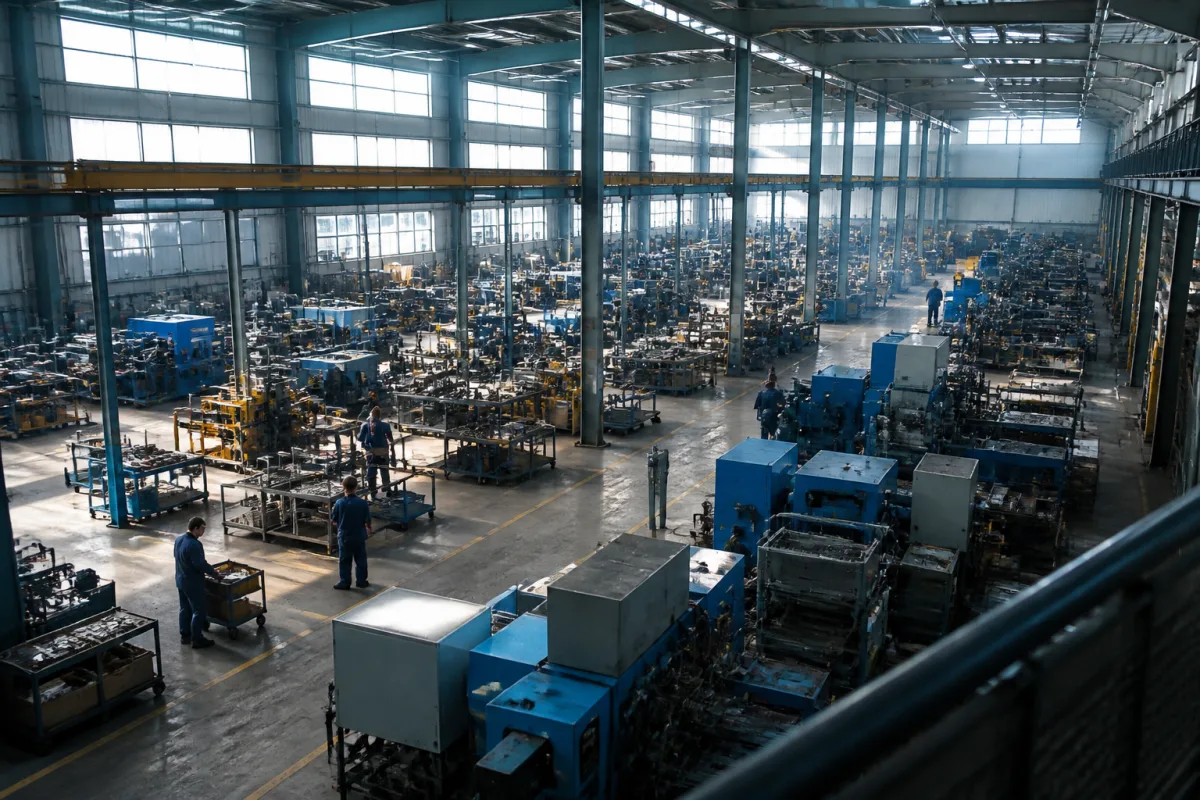
Even a company with 50 employees and a US presence isn’t required to file for L-1 — it can still go with E-2 if its plans don’t involve a large-scale expansion of legal presence.
L-1A and L-1B: time limits in status and the path to EB-1C
L-1 splits into two subcategories: L-1A for managers and executives, and L-1B for employees with specialized knowledge. In practice, L-1A filings are far more common than L-1B.
The difference between the two comes down to seniority. For L-1A, a manager is someone who oversees a major company function: a CFO, CMO, CTO, or head of a technical department. An executive is a step above that — effectively a CEO or COO, a position senior to department heads. L-1B is built for employees with narrow, focused expertise important to the foreign company; such specialists may have no direct reports at all, or a few — the key criterion isn’t a management role but the uniqueness of their knowledge.
The main drawback of L-1 compared with E-2 is the time limit on status. Under L-1B, a person can stay in status for up to 5 years; under L-1A, up to 7 years. E-2 has no such cap at all. The visa’s own validity period (not the time limit in status) for both E-2 and L-1 depends on the applicant’s nationality: Canadians, Britons, and most Western Europeans automatically get E-2 issued for 5 years at a time. For L-1, that figure isn’t specified for Canadians and Britons.
The next step after L-1 is the EB-1C category, which leads to a green card. L-1 isn’t the only route to it: in theory, someone could start with E-2 and later move to EB-1C, or file for EB-1C directly without going through L-1 — that path is just less common. To avoid running into the time limit — 5 years under L-1B or 7 under L-1A — most applicants file for EB-1C or another green card option well before that deadline hits.
The L-1-to-EB-1C pairing is so common because the requirements for the two categories overlap heavily — the overlap is estimated at around 70%. That means an approved L-1 covers roughly 70% of the path to EB-1C, but it doesn’t guarantee the green card: EB-1C carries additional requirements beyond what was already reviewed for L-1.
an approved L-1 covers roughly 70% of the path to EB-1C, but it doesn’t guarantee the green card
Time limits in status: L-1A, L-1B, and E-2
E-2 has no upper limit on time in status — unlike either L-1 subcategory.
- L-1B (specialized knowledge)up to 5 years
- L-1A (managers and executives)up to 7 years
- E-2 (investor or employee)no time limitrenewable as long as the investment remains active
Where the money comes from: E-2 requires proof of source, L-1 doesn’t
For E-2, the initial investment is estimated at roughly $100,000 — USCIS sets no official minimum, but once the petition is approved, immigration doesn’t re-examine the case from scratch at every renewal: it goes back to that same original investment and checks how much was put in and by whom. That means E-2 can be filed even years after the US business started — years of successful operation don’t stand in the way of that.
A hypothetical case: a business has been running in the US for 5 years, started with a $500,000 investment, and the reinvested capital by now runs into the millions. For comparison, an EB-5 scenario was also discussed, where an investor would have to personally put in $800,000. For E-2, neither revenue, nor accumulated assets, nor a grown headcount matters — only the original investment counts.
The problem arises when there’s no way to prove where that original sum came from: no bank statements survived, no paper trail showing the money moving from the Canadian investor into the business. Even if a company that started with a modest $100,000 in a small coworking space has grown to seven- or eight-figure revenue, the lack of proof for that first $100,000 makes an E-2 filing problematic.
the lack of proof for that first $100,000 makes an E-2 filing problematic
This is exactly the kind of situation where L-1 can turn out to be the more realistic option: this visa is noticeably more lenient about where the invested money came from and how much exactly was put in — immigration doesn’t require a detailed explanation of fund origin or amount. The investor or owner still has to put in some money, but there’s no minimum requirement: in one of the scenarios discussed, $20,000 in equity was enough for L-1, because the business landed large contracts right away instead of running purely on the investor’s cash.
For L-1, the key requirement is showing the company has enough funds to support growth, and the source of those funds can be anything — revenue from a completed contract, sales income, not just the Canadian investor’s contribution. For E-2, by contrast, it must be shown that the Canadian investor was the one who first put roughly $100,000 into the business — without that paper trail, the visa isn’t granted.
The flip side of this flexibility on L-1 is the staffing requirement: it calls for showing more employees both abroad and in the US than E-2 does. The choice between the two visas in borderline cases depends on the specifics of the file, so for cases like this it’s worth getting an opinion from a qualified immigration professional.
Without surviving bank statements for the owner’s original investment, filing for E-2 becomes problematic — even if the business has since grown to a multimillion-dollar turnover.
E-2 vs L-1: key differences for a business
| Criterion | E-2 | L-1 |
|---|---|---|
| Minimum company headcount | not set | 10+ employees at the parent company |
| Proof of fund origin | must prove the source of the original investment (~$100,000) | fund source doesn’t need detailed explanation |
| Time limit on status | none | 5 years (L-1B) or 7 years (L-1A) |
| Path to a green card | via transition to EB-1C or another category | direct path to EB-1C, ~70% requirement overlap |
| Typical business scale | small and mid-sized business | companies with 30–50+ employees |
Based on the cases and benchmarks discussed in this article, not on official USCIS minimums.
Frequently asked questions
Can a Canadian company file for E-2 or L-1 if it isn’t selling directly into the US yet and is only weighing market entry
The cases discussed here always involve companies that are already trading with the US or already feeling the effects of tariff changes on existing shipments — that’s exactly what’s pushing them to open a physical presence in the country. Both visas are built for growing an already-operating business, not for starting from zero with no existing tie to the American market.
What happens if an investor gets E-2 but then decides to scale down or close US operations
E-2 status remains temporary and requires showing an intent to leave the US once it ends, and renewals are based on reviewing that same original investment. If the US business stops operating, there’s no longer a basis to keep the status — the visa is tied directly to an active investment and a running company.
Aside from the investment itself, what does it cost to set up a US company for E-2 or L-1
A separate figure for company registration or legal support wasn’t given in the cases discussed — wherever amounts came up, they referred specifically to the business investment (for example, around $100,000 for E-2, or $20,000 in equity in one of the L-1 scenarios), not to the incidental costs of setting up the structure.
Can someone switch from L-1 to E-2 if the company doesn’t manage to get a green card before the 5- or 7-year limit runs out
There’s no direct answer on that particular switch: the path discussed ran the other way — from E-2 to EB-1C, or starting directly with EB-1C instead of going through L-1. Nothing specific was said about moving back from L-1 to E-2 once the time limit in status runs out.
What happens if a CBP officer warned about a last visa-free entry and the person still came back without a visa
That specific scenario wasn’t addressed — only the warning itself was described, after which the officer expects proper status to follow. What exactly happens on a repeat entry after such a warning wasn’t clarified.



Comments
Reader experience is useful, but it is not advice: check the rules on the official site.
No account needed: click Sign in, type any name, and you are done.