
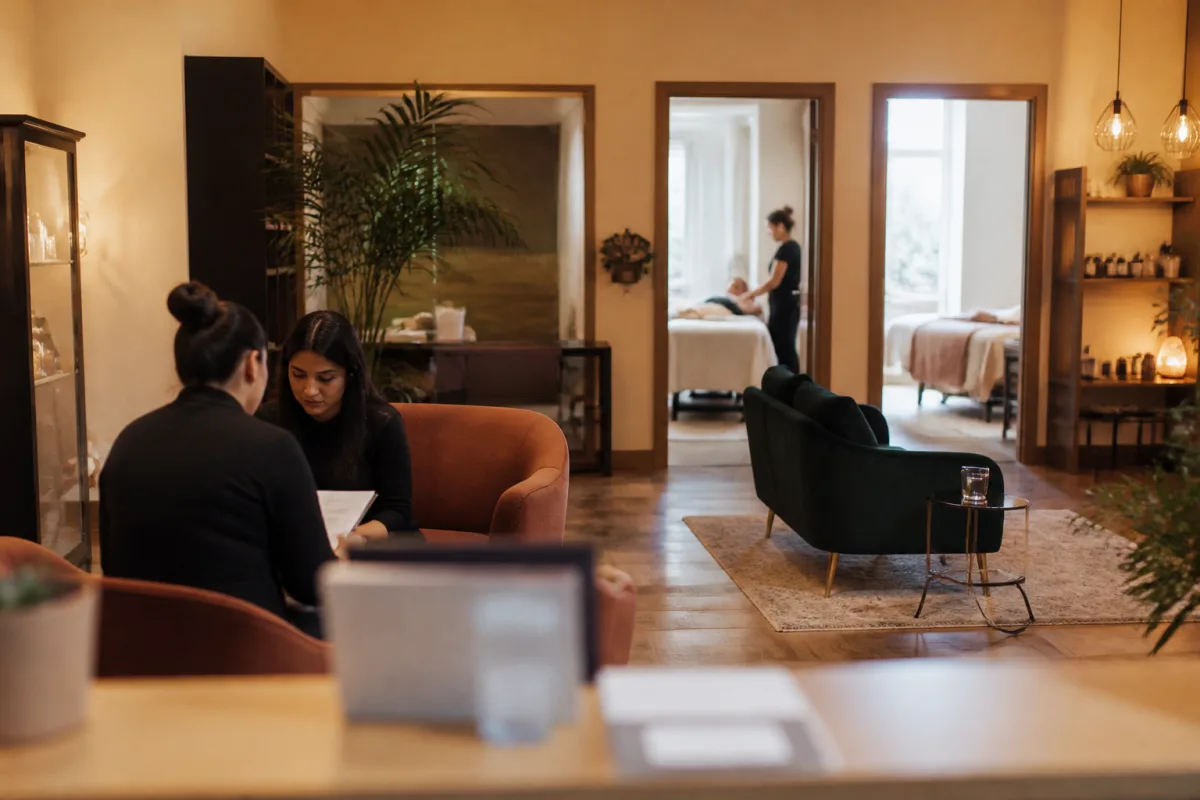

An immigrant couple’s path to opening a beauty studio in Canada combined vocational training, a commercial lease, and hands-on renovation — the case below walks through a studio opened 3-4 years after their move, with rent around $4,700 a month and a renovation-and-furniture budget of roughly $15,000.
In short
- After 1,100 of the required 2,200 training hours plus a final exam, you can already get licensed and start working as a massage therapist.
- A two-year massage therapy program typically requires a study permit — a work permit only works as an exception that needs to be confirmed with the college.
- Renting a space at $4,700 a month required paying for two months upfront plus a deposit at the start, due to having no business track record.
- A 5-year, 5-month lease can’t be broken early, and in bankruptcy, the debt transfers to the owners personally.
- The full renovation and furniture budget came to $15,000, financed through a mix of personal savings and a loan.
The Path to Their Own Business: From Arrival to Opening Day
Katya and Yaroslav came to Canada on a visa, and 3-4 years after the move they opened their own beauty studio. Katya came up with the studio’s name, and Yaroslav agreed without objection. The number 19 in the studio’s name refers to the couple’s wedding date — for them, that date is tied to the kind of love the studio tries to express through how it treats clients.
Roles in the business are split by area of work. Katya handles client acquisition and communication with the team — she’s the one negotiating with the studio’s specialists. Yaroslav focuses on massage services and the hands-on side of that work.
The family keeps two separate budgets: a household budget for personal needs, and a separate business budget for studio expenses. Money for growing the business comes out of the household budget, not the other way around.
Massage Therapy Training in Canada: Timeline, Hours, Licensing
Training as a massage therapist started only after the move to Canada — this wasn’t a profession either of them had practiced back home. They found a college in Calgary, and that’s where the training took place.
The full college program runs two years and totals 2,200 training hours — the full amount required to become a licensed massage therapist. The first year consists of 1,100 hours and ends with a separate final exam, after which graduates are already allowed to work.
Why You Can Start Working at This Stage
The first-year block is the foundation: after 1,100 hours of training, students receive a license and can work as a massage therapist right after year one, without waiting for the full 2,200 hours. From there, it’s possible to either open an independent practice or take a job at a clinic — while continuing the second year of training in parallel.
Language of Instruction and Exams
All coursework is taught exclusively in English, with heavy use of Latin medical terminology — that combination was the hardest part of the whole process. To complete the first year, students must pass exams after every sub-block of the program, and at year’s end, a two-part final exam covering theory (anatomy) and practical skills. During the practical portion, instructors assess how the massage is performed and how confidently the student carries themselves.
All coursework is taught exclusively in English, with heavy use of Latin medical terminology — that combination was the hardest part of the whole process.
Massage Therapy Training Timeline in Canada
The two-year program splits into two 1,100-hour blocks, and the first already qualifies you to work.
- First year of training1,100 hoursEnds with a final exam (theory + practical)
- Allowed to start workingafter year 1Licensed to practice independently or work for a clinic
- Full program length2,200 hours / 2 yearsRequired to complete the full license
The full massage therapy program in Canada is 2,200 hours over two years. But after the first 1,100 hours and a final exam, students can already get licensed and start working while continuing their training.
Can You Study on a Work Permit Without Resident Status?
In this particular case, the college accepted enrollment based on an existing work permit, without a separate study permit. But that isn’t the general rule: under IRCC rules, studying without a study permit is only allowed for short courses lasting six months or less. A two-year massage therapy program typically requires its own study permit, so it’s worth confirming your specific situation with the college and checking current IRCC requirements before enrolling.
Under IRCC rules, studying without a study permit is only allowed for courses of six months or less. A two-year program typically requires a separate permit — confirm your status and eligibility before enrolling.
Finding a Location for a Beauty Studio: Criteria and Timeline
The search for a location started in January and took roughly one to two months. During that time, they personally viewed about five options — the rest were ruled out just from browsing listings on marketplace sites and other platforms.
The location they ultimately settled on wasn’t found on their own but through a real estate agent: he found an option that matched all their criteria, and after a viewing, they negotiated the lease. Before that, the space had been occupied by a medical practice — likely a clinic.
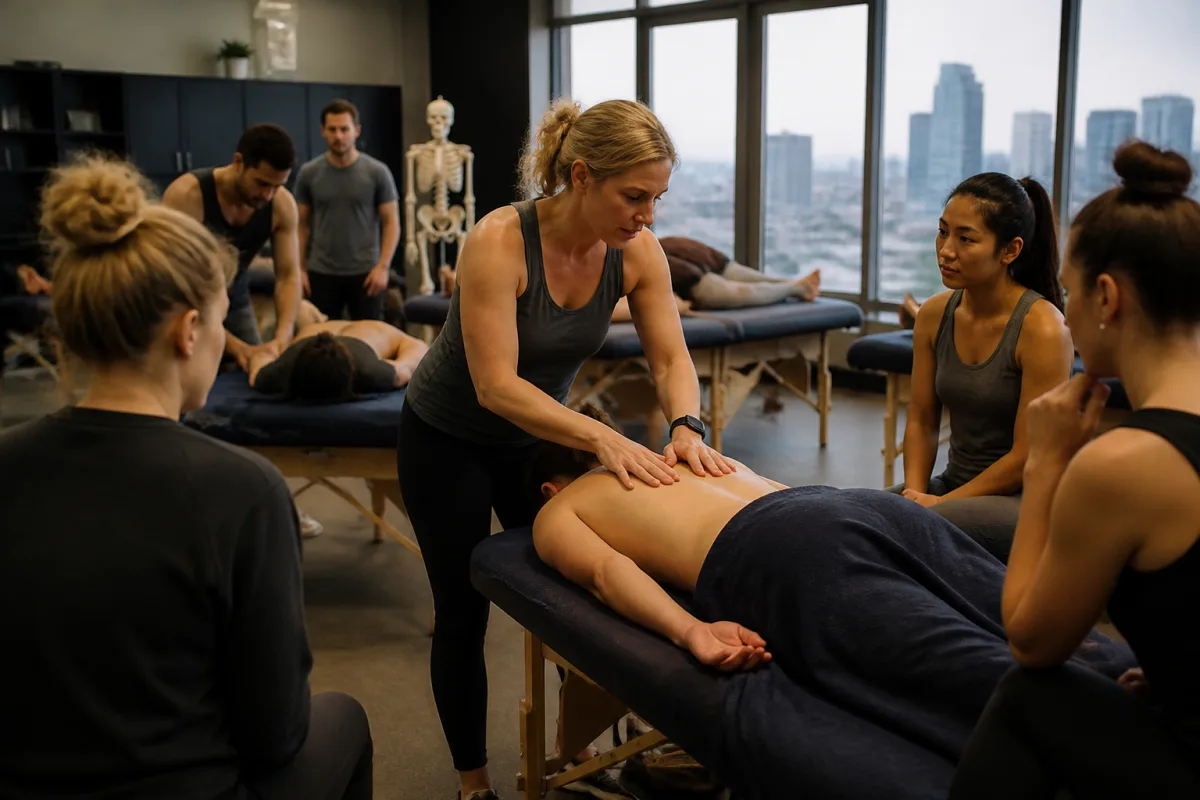
The new space had to meet several non-negotiable requirements tied to the specifics of a cosmetology and massage business:
- four to five separate treatment rooms;
- a bathroom located directly inside the unit;
- a sink in every treatment room — needed for cosmetology procedures;
- a separate area for reception or displaying cosmetics.
These criteria ultimately determined which of the options they viewed actually fit.
Criteria for Choosing a Beauty Studio Location
Commercial Lease: Contract Length and What Happens in Bankruptcy
The lease was signed for five years and five months — a term the landlord required, and one that can’t simply be ended early. Some landlords dictate the length outright: only three years, only five, eight, or ten — and the tenant has to work around that, without knowing where the business will even be by then.
Fully breaking the lease isn’t possible, but it can be reassigned to another business — provided the landlord agrees. Before approving that, the landlord always screens the incoming tenant; just how strict the process is becomes clear from the fact that every new business moving into the location for the first time gets the same level of scrutiny.
Bankruptcy is a separate risk. If the business goes bankrupt, the lease payment obligation shifts to the owners personally, rather than staying with the corporation. Landlords often spell this out directly in the contract, stating that owners can’t simply walk away if the business fails — the liability is placed on them personally.
If the business goes bankrupt, the lease payment obligation shifts to the owners personally, rather than staying with the corporation.
Before signing, it’s worth reading the entire contract and every clause carefully: most terms in a standard lease are written to favor the landlord, not the tenant. That said, a tenant is entitled to propose their own terms during negotiation — there’s no reason to be hesitant about that.
most terms in a standard lease are written to favor the landlord, not the tenant
A tenant is entitled to propose their own contract terms during negotiation — a landlord’s standard lease shouldn’t be treated as final.
How Much Does Renting a Beauty Studio Space Cost in Canada?
Rent for the studio space, including utilities, runs about $4,700 a month. The payment at signing wasn’t a single amount: it covered the first month’s rent, a deposit, and an additional month paid in advance. The landlord required that extra month upfront specifically because the business was new at the time, with no track record in the market. In the end, the couple had to cover the equivalent of two months’ rent plus a deposit right at the start — before the studio had even seen its first client.
A landlord may require a new business with no track record to pay for two months upfront plus a deposit — before the first client even walks in.
DIY Renovation and Decor: Building a Foam Wall Step by Step
The decorative wall at the studio’s entrance was built entirely by hand — the work took about three days. The owner didn’t want to spend money on a pre-made solution, even though friends suggested just ordering finished panels.
The build started with sourcing materials: foam board, spackling compound, and spray foam adhesive. The foam board turned out to be unusually dense and hard to work with — every piece had to be cut by hand. The pieces were arranged to resemble stone masonry and glued into place, often without waiting for the adhesive to fully set.
Next came the spackling: first with putty knives, then by hand wearing a glove, which gave a better finish. A friend took on painting the wall using a spray gun. The first paint choice didn’t work out, so they repainted it about 4-5 times before landing on the right shade.
The final step was attaching the letters, which had been painted ahead of time: the goal was for them to look dimensional, almost floating. For mounting, they fell back on a method from childhood — long nails once used to insulate a house with foam board. The right nails weren’t available at Home Depot, so they ended up ordering them from Amazon.
Table: Stages of Building the Wall
| Stage | What Was Done |
|---|---|
| Materials | Foam board, spackling compound, spray foam adhesive |
| Cutting and assembly | Stone-like shapes from dense foam board |
| Spackling | First with putty knives, then by hand |
| Painting | Spray gun, repainted 4-5 times |
| Letters | Painted separately, mounted with nails ordered from Amazon |
How Much Does Renovation and Furniture Cost for a Beauty Studio in Canada?
Materials for the decorative wall cost $300. Spackling used up about five large buckets, costing $200. The foam board was free, and spray foam adhesive came to another $100, using 8-10 cans at $10 each. The letters for the wall, custom-ordered to match the space, cost an additional $20.
Initially, the renovation budget — separate from furniture — was set at around $1,000. But the combined budget, including furniture, was planned differently: around $15,000, and that’s the figure they ultimately landed on, with only minor extra costs.
That $15,000 covered everything tied to the space itself: shelving, tables, chairs, flooring, and the wall itself. It also included sofas, treatment couches, and the rest of the studio’s furniture.
The opening was financed through personal savings and a loan. The loan is being paid off gradually now: the payment isn’t fixed, but depends on how busy the salon is — in slower months, they put less toward it. They worked out in advance how much they’d need to set aside each month to pay off the loan within a year.
Renovation and Opening Budget for the Beauty Studio
The decorative wall and the full space renovation stayed within the planned $15,000 budget, furniture included.
- Wall materials$300Foam board, spackling compound, spray foam
- Spackling$200About five large buckets
- Spray foam adhesive$1008-10 cans at $10 each
- Wall letters$20
- Renovation without furniture (planned)$1,000Initial estimate
- Full budget with furniture$15,000Shelving, tables, chairs, flooring, wall, sofas, treatment couches
Frequently asked questions
Can you open a business in Canada if you arrived on a regular work visa rather than an investor or business visa?
In this case, the couple arrived on a visa and only opened the business 3-4 years after the move, once they were already settled in the country. The article doesn’t describe a separate visa category for starting a business — what mattered here was time to adapt, time to train in a new profession, and time to save up money, not the immigration status they arrived with.
Can you fix a mistake with a rented location if the business’s needs change after signing?
A lease can’t be fully terminated, but it can be reassigned to another business provided the landlord agrees. Before approving that, the landlord always screens the incoming tenant with the same level of scrutiny applied to any new business moving into the location for the first time.
What happens if you fail the final exam after the first year of massage therapy training?
The material doesn’t address this — it only covers that after 1,100 hours and a two-part final exam (theory and practical), you’re allowed to start working. There’s no information on the consequences of failing or whether a retake is possible.



Comments
Reader experience is useful, but it is not advice: check the rules on the official site.
No account needed: click Sign in, type any name, and you are done.