
Health coverage in Spain comes in two forms — public, through social security contributions and free at the point of care, and private, at roughly €60 a month — and the healthcare system itself is built to move patients with serious conditions to the front of the line quickly.
In short
- Access to public healthcare in Spain requires legal status, padrón registration, and paying contributions — roughly €300–400 a month for the self-employed and contract workers.
- Drugs for severe cases cost €6,000–8,000 a month, but the state covers them as long as the patient is legally enrolled in social security.
- Private insurance at around €60 a month doesn’t replace public healthcare — it closes the wait for routine check-ups and tests.
- A doctor’s path from the former USSR to practicing in Spain: degree homologation, then either a 4–5 year residency, a general practitioner diploma without residency, or a related master’s degree of about 9 months.
- Clinical guidelines in Spain exist only in electronic form and are updated faster than a printed document could stay current.
How Spain’s healthcare system is built: severe cases come first
Spain’s healthcare system is built around patients with serious conditions who need immediate intervention: they get priority, and the logic runs the other way from what many expect — the patient doesn’t adapt to the system, the system adapts to the patient. Primary care doctors are the ones who assess priority: they ask about symptoms and decide, based on the answers, how urgent the case is. A cough that drags on for a few weeks, for instance, isn’t always something you’ll get seen for quickly — but the moment signs of something serious appear, the response is immediate.
the patient doesn’t adapt to the system, the system adapts to the patient
Access to this system is tied to legal residency status, registration at your address (the padrón), and paying contributions: once those conditions are met, the state takes responsibility for a person’s health, in old age and in illness alike. This applies to both forms of coverage — public and private are each recognized by the system as grounds for receiving care.
Severe cases get priority, not the queue order. Access is tied to legal status, the padrón, and contributions — public or private coverage.
Transport for patients in remote areas: what an ambulancia actually is
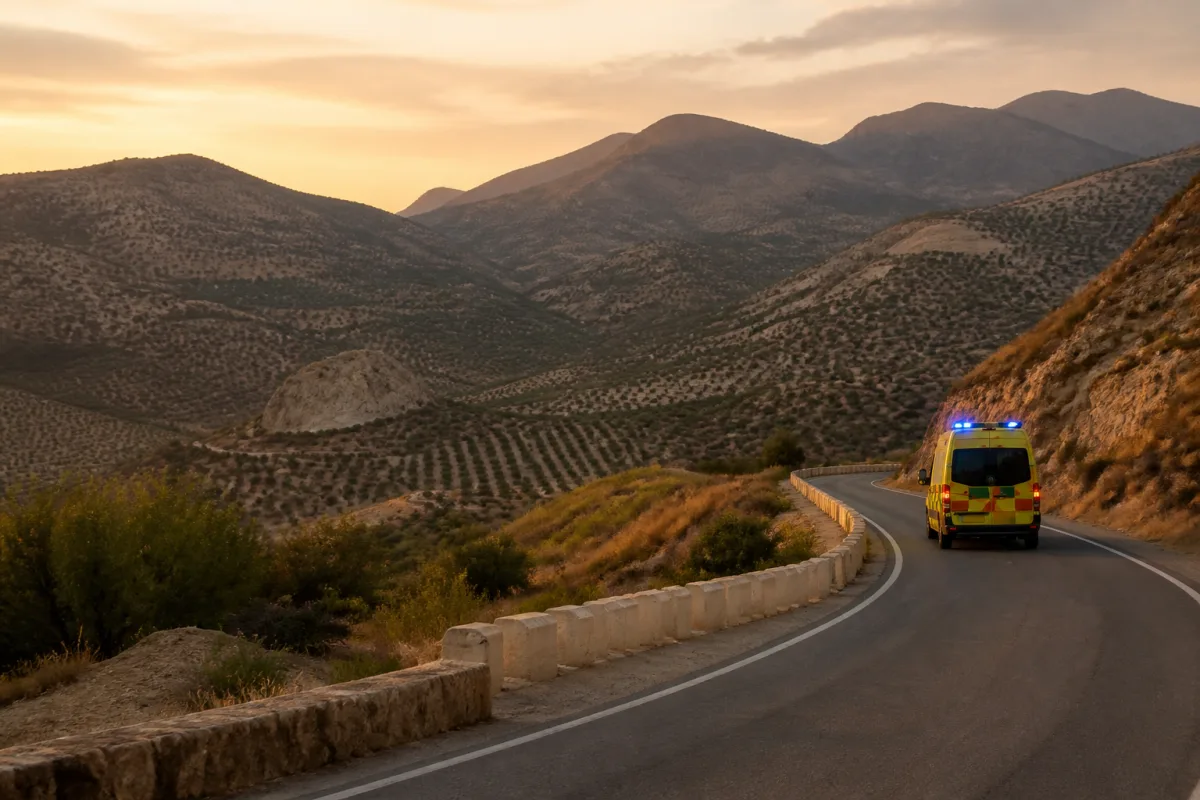
In oncology, patients need to come to the hospital every 2–3 weeks — timing matters for treatment. But some patients live 80–90 km from the hospital: one Spanish hospital where a doctor interviewed for this piece works, for example, serves exactly these kind of remote areas. Getting there on your own is physically difficult: you need a car, and intercity buses run only every 3–4 hours — not something you can build a treatment schedule around.
For cases like this, Spain has a separate transport arrangement. The patient flags the problem in advance, at the previous consultation: if they won’t be able to make it on their own, the doctor requests an ambulancia for them.
An ambulancia isn’t an ambulance in the emergency sense — it’s a scheduled transport service that takes patients to the hospital and back. In effect, it works like a delivery service, except what’s being delivered is a person: the patient is brought in on time for the start of treatment, the doctor examines and treats them, and then they’re driven home.
Because of this, even patients who physically can’t get there on their own don’t have to work out the logistics themselves — the hospital organizes it.
If you won’t be able to get to the hospital for treatment on your own, say so at the previous consultation — the doctor will arrange scheduled transport.
Bloodwork, a CT scan, and treatment in one day: how the doctor builds the patient’s route
In Spanish oncology, the patient’s route through the system is planned by the treating doctor, not the patient. The doctor works out in advance where the patient will have each test done and tries to fit everything into one place, on one day.
If a patient needs a CT scan, the doctor tries to schedule it at the same hospital where treatment is happening, whenever that’s possible. The reason is simple: the alternative hospital might be around 120 km away, and making that trip for a single scan isn’t practical.
Blood tests work on different logic. They don’t have to be done at the hospital at all — a clinic near home works just as well, even one five minutes’ walk away. The doctor reviews the results in the system the next day, so the patient doesn’t need to make a special trip to the hospital just to have blood drawn.
In practice, it looks like this: the patient comes in in the morning, has bloodwork done, the doctor reviews it and discusses the patient’s condition with them, and then prescribes the next treatment cycle. The cycle itself takes 2–3 hours, and that same evening — around 5 p.m. — the patient gets a CT scan at the same hospital, ready to head home by 6 p.m. That way, bloodwork, consultation, treatment, and a CT scan all fit into one visit instead of several separate trips on different days.
When it’s not possible to fit everything into a single day, the hospital adjusts the schedule around the patient, not the other way around: if someone mentions they have an ophthalmologist appointment that day, for example, their consultation gets moved to another date — even if that means more patients for the doctor on a different day.
the hospital adjusts the schedule around the patient, not the other way around
One patient visit instead of several separate trips
How bloodwork, a consultation, treatment, and a CT scan fit into a single day
- Bloodwork (clinic near home)morning
- Exam and results discussion with the doctornext day
- Treatment cycle2–3 hours
- CT scan at the same hospitalaround 5 p.m.
- Patient ready to head homeby 6 p.m.
Clinical guidelines for doctors: how often they’re updated
Based on one doctor’s experience, the clinical guidelines that doctors in Spain train and work from are updated frequently — individual provisions get revised within just a few months of new data appearing.
The guidelines aren’t printed: the document exists only in electronic form, freely available on a specialist portal or website, and that’s where the doctor pulls the current version from. A printed version wouldn’t make sense here — by the time a print run reached a clinic, part of the protocol would already be out of date.
Breast cancer treatment guidelines are a telling example: there’s no separate printed manual for this area, and there isn’t going to be one, because oncology changes faster than a paper document could ever be updated. A new drug can make the previous treatment regimen obsolete in a matter of days: as soon as the health ministry sets a procurement price for a medication, it can be prescribed to a patient within the public healthcare system — free of charge for the patient.
What treatment and health insurance cost in Spain
Under Spain’s public healthcare system, a patient generally doesn’t pay out of pocket for treatment itself — this applies to oncology too, though prescription medication taken on an outpatient basis can carry a partial co-payment, the size of which depends on the patient’s income. If a drug has just cleared the ministry’s procurement process and a purchase price has been set, the doctor can prescribe it to the patient through public healthcare even if the medication was unavailable only recently.
Behind this sits real cost: drugs used in severe cases run €6,000–8,000 a month — and that’s just the medication itself, not counting the blood tests before every cycle, or the work of the doctor, the nurse, and patient transport. The state covers this bill as long as the patient is legally enrolled in the social security system.
The entry ticket to that system is social security contributions. Self-employed workers and those on a contract in Spain pay roughly €300–400 a month. This isn’t an extra fee tied to a specific treatment — it’s a monthly payment that opens access to public healthcare for anything that comes up, from a routine check-up to costly therapy.
The public system does have a weak spot: routine check-ups and non-urgent procedures are where appointments are hardest to get, especially in the public sector. Some newer treatment methods may also fall outside what the system covers, even though they exist and are used elsewhere.
That’s where private insurance comes in alongside public coverage — for around €60 a month, it gets you tests and examinations without the wait. The point isn’t to replace the public system but to fill its gaps: if something serious happens, the costs don’t fall on the patient and their family, unlike a situation where expensive treatment has to be found and paid for independently.
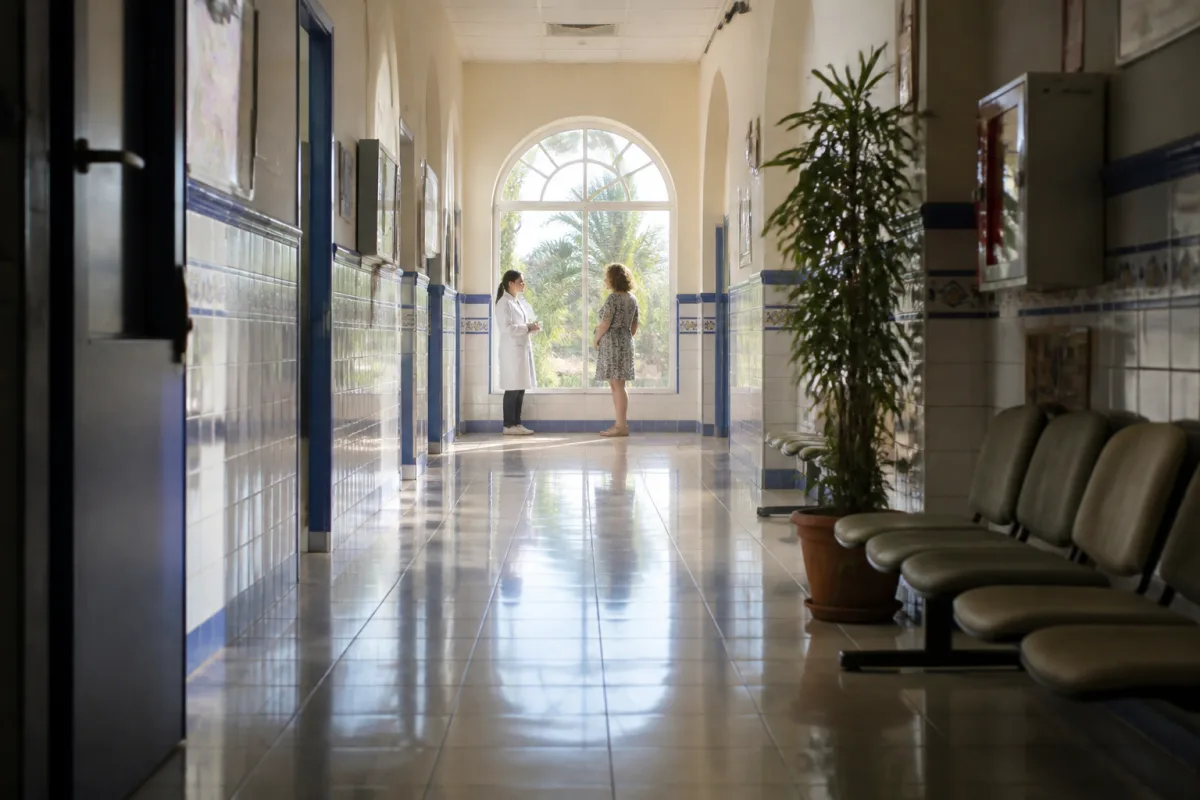
Routine check-ups and non-urgent procedures are where public-sector appointments are hardest to get. Private insurance at roughly €60 a month closes that gap.
Doctor and patient: the personal approach in Spanish oncology
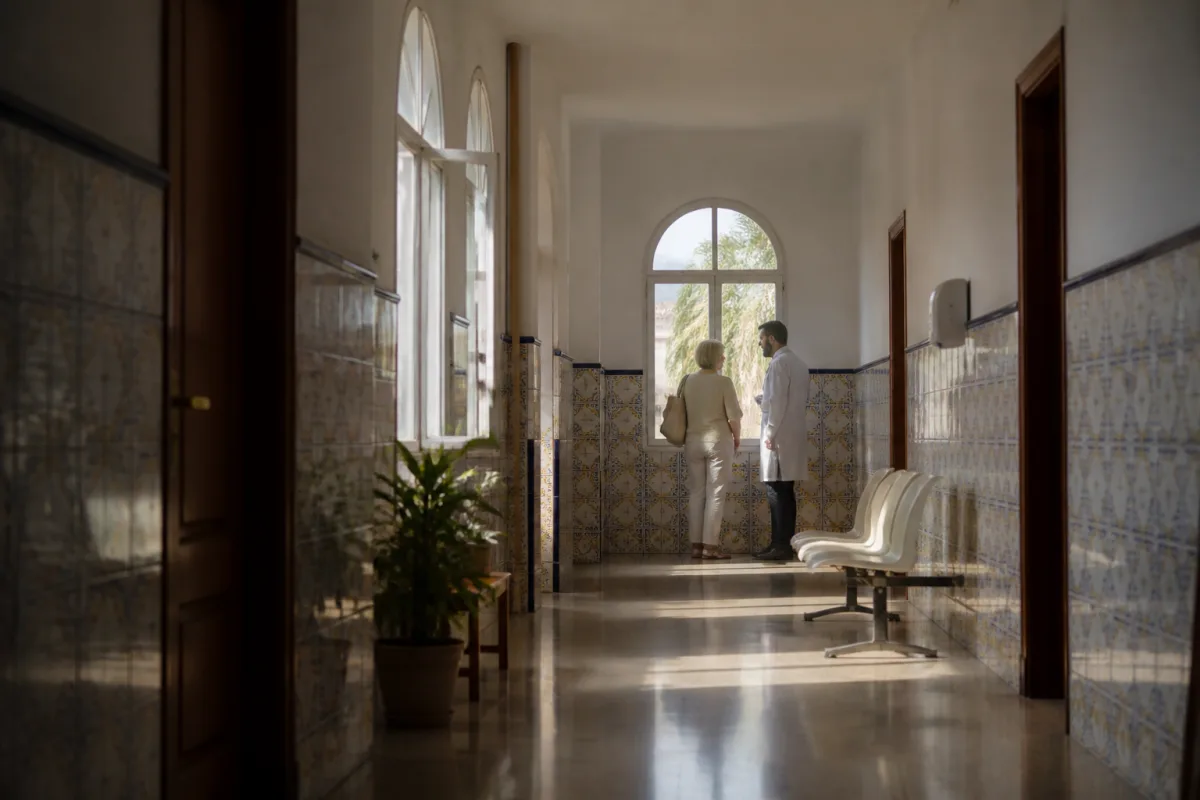
In Spanish oncology, doctors are trained not to put up a barrier between themselves and the patient — an approach that runs directly opposite to what’s standard in post-Soviet countries. During consultations, doctors often skip the white coat entirely: just a badge, with ordinary, unguarded behavior. It builds trust: the patient sees that the doctor isn’t “working against them” but is on their side.
Physical contact is part of this model: a doctor might stand up, hug a patient or shake their hand, step out from behind the desk and sit next to them during the conversation. Few personal boundaries remain in place — a doctor, for instance, won’t give a patient their personal phone number or WhatsApp.
In oncology, the ability to connect with patients is treated as a core skill of the specialty: if a doctor can’t build a normal rapport, that’s a sign the field isn’t the right fit for them. The communication has to be genuine — patients feel it when something is fake, especially when the news is bad.
patients feel it when something is fake, especially when the news is bad
Working with the family during a critical period is a practice of its own. In one case, two months before a patient’s condition approached critical, the treating doctor and the hospital began calling relatives regularly, arranged a round-table meeting, and offered psychological support. The treating doctor called the family every day, explaining the situation and offering support, all while managing many other patients at the same time.
If a patient has no relatives nearby, the doctor asks the patient directly whether they’d like someone contacted, and if they agree, calls the person named. Without the patient’s permission, a doctor isn’t allowed to discuss their case with a third party — that’s a requirement under data protection rules. During the COVID-19 pandemic, when relatives weren’t allowed to visit patients, the hospital called families constantly so they wouldn’t be left without news.
Missing a doctor’s appointment in Spain: what happens to your booking
There’s no formal rule covering this — a lot depends on who takes the call. In one described case, a patient missed an allergist appointment for a legitimate reason and was told they’d have to book again from scratch.
But in practice, the same system also works differently in other cases: if a patient doesn’t show up, someone contacts them, asks why, and checks on their condition. If the issue is purely logistical and unrelated to the diagnosis, the patient is simply given a new date without having to go through the booking process again from zero.
Which of these two outcomes applies in any given case can’t be predicted in advance — it depends on the specific doctor or department.
There’s no single rule: in one case a patient was told to rebook from scratch, in another they got a new date right away. The outcome depends on the specific doctor or department.
How a doctor from the former USSR can get their degree recognized and start practicing in Spain
The process of getting a medical degree recognized (homologación) can start while the doctor is still at home: they file the paperwork for recognition and keep working and earning at home in parallel while preparing to relocate. For those with the financial means, the recommended route is to move to Spain and prepare for the MIR exam in person — this is considered the more effective path. It’s worth keeping in mind that only doctors whose degree has already been homologated in Spain are allowed to sit the MIR, and a separate, limited quota of places applies to specialists from outside the EU, so a residency spot isn’t guaranteed in advance. For those without that option, courses remain available, but the decisive factor is self-discipline — without it, courses and tutors don’t produce results, especially when it comes to learning the language.
Once the degree is recognized, a doctor has a choice. The full route is a 4–5 year residency, at the end of which a specialist diploma is awarded. During that time, quality of life takes something of a hit because of on-call shifts and a schedule close to what’s standard in the former USSR, where a ten- or twelve-hour working day with on-call duty is the norm. Outside residency in Spain, an 8 a.m.–3 p.m. schedule is common, leaving time after work for lunch and personal matters.
The second option is to skip residency altogether and get a general practitioner’s diploma, allowing someone to start working in the system right away, without four years of training. This path pays more than a doctor earns during residency and suits those whose life circumstances don’t allow for going back to studying. The third path is a master’s degree in a related field — in cosmetology, for example: combined with a homologated diploma, a roughly nine-academic-month master’s like this can produce a workable option that takes far less time than a five-year residency.
A degree earned in Spain is also recognized elsewhere in Europe, which gives a doctor the option to move and work in another European country if needed — though few programs among them cover the cost of relocation and residency training.
Paths to practice in Spain for a doctor from the former USSR
How long each route takes after a degree is homologated
- Full residency with a specialist diploma4–5 years
- General practitioner diploma without residencyno extra training
- Master’s in a related field (e.g. cosmetology)about 9 months
How a doctor from the former USSR can start practicing in Spain
Three paths to practicing medicine in Spain after degree recognition
Table scrolls sideways
| Criterion | Residency | GP diploma | Related master’s degree |
|---|---|---|---|
| Duration | 4–5 years | no extra training | about 9 academic months |
| Outcome | specialist diploma | work as a GP right away | a workable option in a related field, e.g. cosmetology |
| Income during the process | lower, due to resident status | higher than during residency | not described |
| Schedule/workload | on-call shifts, schedule close to the former USSR | not described | not described |
Based on the account of a doctor who made the transition from medicine in the former USSR to oncology in Spain.
Why Spain’s healthcare system works: the bond between patient and team
The strength of this medical system lies in the working connection between patient and system, not in any particular technology or protocol. That’s the assessment of a practicing doctor who made the journey from medicine in the former USSR to oncology in Spain.
The team working toward a result for the patient isn’t just doctors. It includes the patient themselves, their relatives, and other medical staff — everyone involved in the treatment in one way or another. This team shares a single goal: to do the best possible for the patient, specifically what the patient themselves wants, within what the system can realistically offer.
This approach, in the doctor’s experience, doesn’t wear a person down: when the relationship with patients is built the right way, the fatigue of working with people doesn’t pile up. The working day ends without a sense of unfinished business — with the sense that what needed to be done, was done.
The contrast is a situation familiar across the former Soviet space, where a serious illness catches a person off guard: money and treatment have to be tracked down only after the diagnosis is already made, and not everyone has access to complex treatment. Spain’s model is built differently — through the bond between a person and a system, rather than a solo search for a solution.
Frequently asked questions
How much does a general practitioner earn in Spain without going through residency?
The exact salary isn’t known, but working right after earning a general practitioner diploma, without going through residency, is known to pay more than a doctor earns during residency itself.
Comments
Reader experience is useful, but it is not advice: check the rules on the official site.
No account needed: click Sign in, type any name, and you are done.