
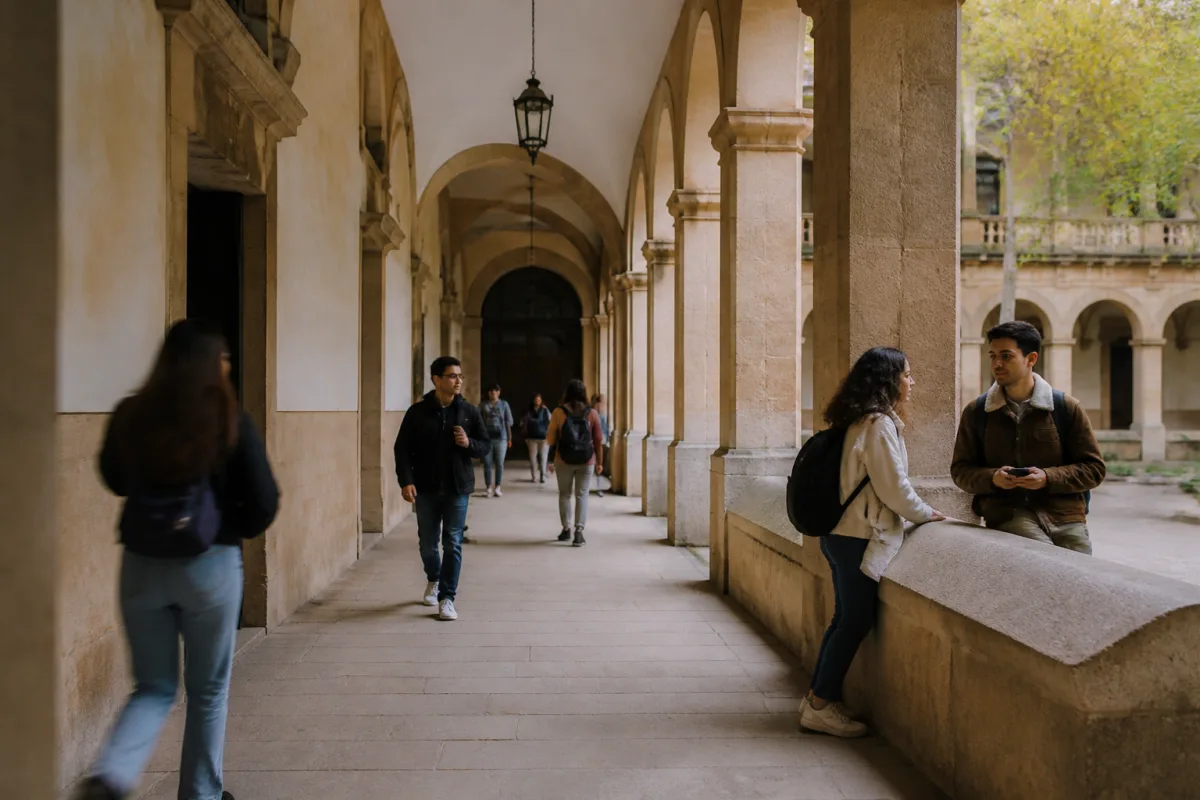

No, it isn’t too late to start a degree in Spain at 30, 35, or even 40 — age stops being the main obstacle once studying genuinely fits your life and career goals.
In short
- The age spread at Spanish universities is wide: from 18 up to nearly 50 in master’s programs.
- A second degree is typically pursued after 25, a third after thirty — and juggling studies with adult life is harder than the act of returning to the classroom itself.
- Student visa documents can be filed while already inside Spain, not only from your country of residence.
- Spanish can be brought from zero to a level sufficient for master’s-level study within six months.
- There are four scenarios for studying after 30: carrying a profession forward, adding a new specialization onto existing experience, a complete career change, and studying as a way to settle into the country’s system.
Does Age Really Matter When Applying to a Spanish University
The main fear before applying after thirty isn’t age itself — it’s the mental image of a classroom full of 18- to 21-year-olds. In practice, that expectation doesn’t hold up: the makeup of a cohort depends on the program and shifts from one intake to the next.
In one program, most classmates turned out to be the same age or slightly older — among them were some of the youngest in the group. In a master’s program completed later, students’ ages ranged up to around 50. In other words, the age spread at Spanish universities is wide, and an adult student doesn’t stand out the way it might seem in advance.
A second degree is typically pursued after 25, a third after thirty. Experience shows that juggling studies with work and family turns out to be harder than simply sitting back in a classroom among younger peers.
There’s also another side to this: with age, the higher stake isn’t the barrier to entry — it’s the cost of choosing wrong. At 18, picking the wrong field is an easy mistake to make; at 30, the same mistake costs more. But choices made at a mature age also tend to be more deliberate: a person already knows whether they want to work with people or not, where their strengths lie, and why they need specific knowledge. That’s why a second full degree often ends up more purposeful than the first.
with age, the higher stake isn’t the barrier to entry — it’s the cost of choosing wrong
The age spread at Spanish universities is wide — from 18 to nearly 50. The real challenge after thirty isn’t getting admitted, it’s the cost of choosing the wrong specialization.
Why Age Becomes an Advantage Rather Than a Drawback
After thirty, studying feels different than it did right after school: an adult student understands why they need specific knowledge and where it’s taking them. Listening to a lecturer, they immediately connect the material to practice — asking how to apply it at work, or noticing what the theory is missing for real-world tasks.
This also changes classroom behavior: an adult student isn’t shy about raising a hand and asking a practical question that genuinely matters to them, instead of silently taking notes on theory. Behind this is life and professional context — experience that new knowledge can be built into.
With this approach to learning, age stops being a drawback and becomes an advantage: it offers something a recent high school graduate doesn’t have — a clear sense of where you’re heading, and experience that turns theory into a usable tool.
A Real Case: Starting a Master’s Degree at 36
A client from Belarus was 36 when she enrolled in a master’s program in Spain — a two-year one, even though most local master’s programs run for a single year. She wasn’t relocating alone: her spouse and two children moved to Spain with her, meaning this wasn’t a start from scratch but the relocation of an entire family, with all the household logistics, finances, and shared responsibility that involves.
The case became more complex because the original request was different: the client initially wanted to enroll in vocational training. But her circumstances made university admission possible — and in her situation, that turned out to be the more advantageous option for visa and immigration purposes compared with vocational education. The decision was revised in favor of university.
In this case, the student visa documents were filed while already inside Spain, rather than from her country of residence. The application succeeded: she became a student, started attending classes, and settled into the academic routine.
the student visa documents were filed while already inside Spain, rather than from her country of residence
If a request for vocational training doesn’t lead to favorable visa conditions, it’s worth revisiting the decision in favor of university — it can turn out to be the more advantageous option.
Moving Without Knowing Spanish: How Realistic Is It
Before relocating, it’s worth clarifying two practical points: whether the chosen status grants the right to work, and how long the student visa is issued for — these parameters depend on the program and shape the entire relocation plan.
Not knowing Spanish at the start isn’t a reason to postpone the move: it simply means the route begins one step earlier — with learning the language. A telling example: an applicant relocated to Spain under temporary protection status with a 9-year-old child, not speaking a word of Spanish. Within six months she brought her Spanish up to a level sufficient for university study, and by October she was already attending a master’s program taught in Spanish — while continuing to work and raise her child.
A common strategy is to build the move in stages rather than trying to fit it into a single month:
- Year one — language learning; at this stage it’s possible to enter a preparatory year for vocational schools and other institutions. This is one of the fastest relocation routes. During this year, a person adapts and brings their Spanish up to speed.
- Year two — the next step: some go on to a master’s program, some choose vocational courses, and others move from a language program into digital nomad status and start working remotely.
If the language isn’t needed at all, there’s a separate route: vocational courses that don’t require any knowledge of Spanish or English to enroll.
A Staged Move Through Studies Without Knowing the Language
How the first two years of relocation can be structured without Spanish at the start
- Year oneLanguage learning, a preparatory year for schools and vocational institutions
- Year twoA master’s program, vocational courses, or a shift to digital nomad status
Before relocating, it’s important to find out whether the status grants the right to work and how long the student visa is issued for — the entire relocation plan depends on these two factors.
Scenario 1 and 2: Carrying a Profession Forward and Building a New Specialization
Studying after thirty isn’t about erasing prior education and experience — it’s about using them as a foundation. Two scenarios are built on exactly that principle.
- Carrying a profession forward without changing fields. The education and experience are already there, but the Spanish labor market works differently: in some fields, qualification recognition is required; in others, diploma homologation — as is the case with doctors. Sometimes additional education or a master’s degree is needed; sometimes all that’s missing is the language and professional contacts for employment. This isn’t starting a career from zero — it’s continuing it in a new country.
- A new specialization layered onto existing experience. This option suits those unwilling to abandon years of professional grounding: a new qualification is added to accumulated experience rather than replacing it. In this case, a person enters the labor market not as a fresh graduate but as a specialist with experience plus an added qualification.

Scenario 3: A Complete Career Change After 35–40
The third scenario is a full career change: at 35–40, a person decides not to continue their previous career but to start a new one from scratch. A typical way this decision gets put into words is simply not wanting to spend another twenty years doing the same thing.
simply not wanting to spend another twenty years doing the same thing
Unlike choosing a profession at 18, this decision rests on self-knowledge: an adult already knows whether they want to work with people or, on the contrary, prefer to limit that kind of contact, and in which areas they truly excel. That’s why a second full degree often turns out more deliberate than the first — it’s built not on guesses about a future career, but on experience that has already shown what fits and what doesn’t.
Scenario 4: Studying as a Way to Settle Into Spain’s System
The fourth scenario differs from the first three: here, studying isn’t a tool for changing or carrying forward a profession — it’s a way to settle into the country’s system. This is one of the most popular relocation paths to Spain.
In this scenario, the diploma isn’t the only value. Alongside coursework, a person picks up the language, builds relationships with classmates and instructors, absorbs professional terminology in Spanish, and builds contacts — the kind of networking that’s hard to get while staying outside the country. Studying in a new country allows someone to stay longer than a tourist or short-term status would permit.
That said, education is just one migration route among several, not the only one. For some, a student visa is the right fit. Others already have remote work — a completely different relocation path. And some find a job in Spain directly, which is yet another way in. The choice among these routes depends on a person’s specific situation, not on which one is considered the most reliable.

How to Choose the Right Relocation Route Through Studies
A route is worth evaluating holistically — accounting for family composition and budget, not just the existence of a study program.
Before even considering studying after 30, it’s worth honestly answering five questions.
- Where exactly do I want to end up after finishing the program? Not an abstraction like “work in marketing,” but which specific field, what role, what day-to-day tasks, and what income you’re aiming for.
- Do I actually need a university degree for that? Sometimes the goal is reachable without a diploma — and then studying isn’t a required step.
- What from my previous experience can I carry over? A prior profession and skills are rarely written off entirely — the question is how to fit them into the new program.
- Does the program realistically fit into my current life? This includes work, a spouse or partner, children, and current language level.
- Will life actually change once the program is finished? If, a year or several years later, the diploma is in hand and nothing in life has changed, it’s worth honestly asking whether the path was worth it.
The last question deserves an especially honest answer: it’s what separates studying as a deliberate route from studying as a way to postpone a decision.
If nothing in your life has changed a year or more after finishing the program, it’s worth honestly asking yourself whether this was a deliberate goal or just a way to postpone a decision.
Five Questions to Ask Before Studying After 30
Frequently asked questions
Can I apply for a student visa without a Spanish language certificate?
Formally, a certificate isn’t always required — there are routes where the language isn’t needed at all, such as vocational courses that admit students without any knowledge of Spanish or English. But for a program taught in Spanish, the language will still need to be picked up — it’s just possible to do that after relocating.
What if I’ve already chosen a field but I’m not sure it’s the right fit at 30-40?
It’s worth working through five questions about the goal of relocating: where exactly you want to end up after studying, whether a diploma is even necessary for that, what from past experience can realistically be carried over, whether the program fits your current life, and whether anything will actually change once it’s finished. If the answer to that last question is “no,” that’s a signal to reconsider the choice before starting, not after.
Can I move to Spain to study if the goal isn’t to work in a new field but simply to get legal status?
Yes, that’s a separate and common motive: studying is used not as a tool for changing careers but as a way to settle into the country’s system — learning the language, building contacts, and obtaining a status that allows more time in the country than a tourist stay would. In this case, the diploma isn’t the main value but a byproduct.
What’s more advantageous for visa and immigration purposes — enrolling in a university degree or vocational training?
For visa and immigration purposes, a university degree generally turns out to be the more advantageous option compared with vocational training — this is confirmed by a real case where a request for vocational training was revised in favor of university for exactly that reason. That said, the choice still depends on a person’s specific situation.
Are there alternatives to studying for relocating to Spain if a diploma isn’t needed?
Yes, education is just one migration route among several, not the only one. It’s possible to relocate through remote work as a digital nomad or find a job in Spain directly — the choice among these paths depends on a person’s specific situation, not on which one is considered more reliable.
How long does a student visa last, and does it grant the right to work?
The length a student visa is issued for, and whether it grants the right to work, depend on the specific study program — this needs to be clarified in advance, before relocating, since the entire relocation plan depends on these parameters.
Is it realistic to combine studying in Spain with work and raising a child?
Yes, a real case confirms this: an applicant with a 9-year-old child relocated without knowing Spanish, brought the language up to a level sufficient for study within six months, and by October was attending a master’s program in Spanish while continuing to work and raise her child.
Comments
Reader experience is useful, but it is not advice: check the rules on the official site.
No account needed: click Sign in, type any name, and you are done.