
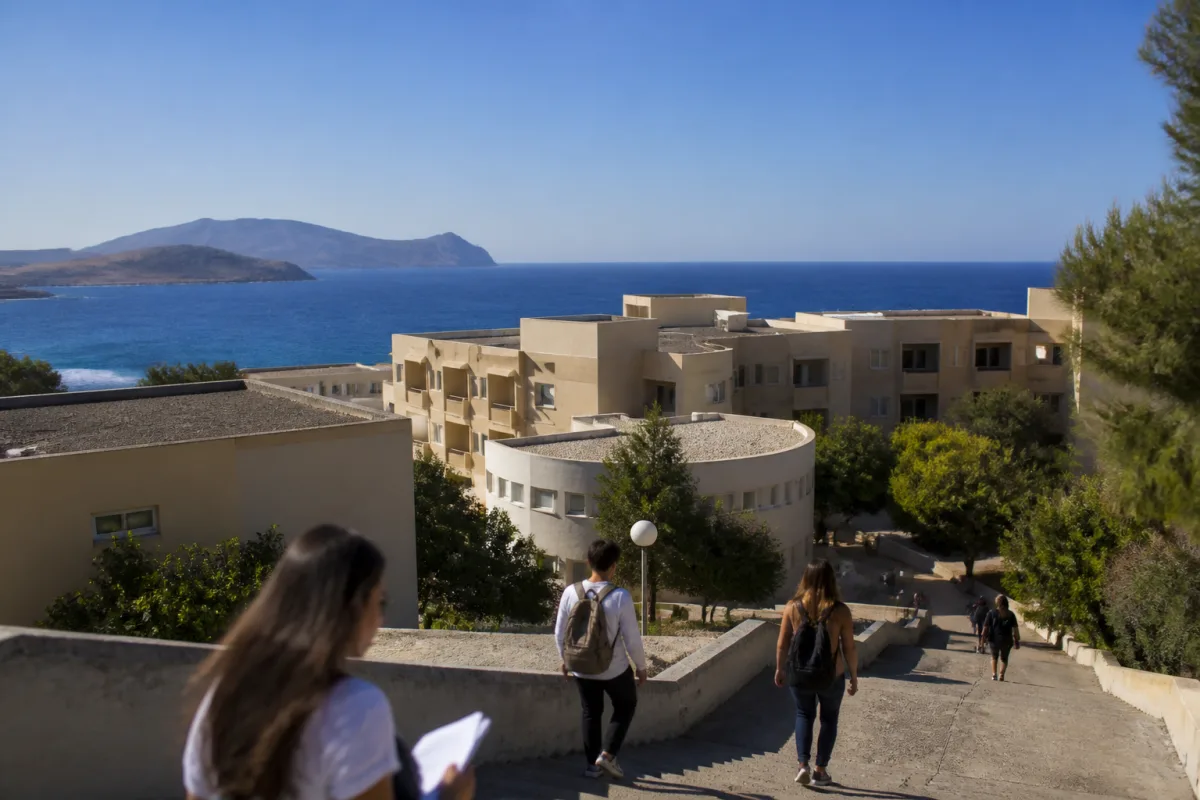

A student from Russia is in his second year of a computer science bachelor’s degree at the University of Crete — one of Greece’s strongest technical universities — and describes the program as tough but doable.
In short
- Admission to a computer science bachelor’s in Greece requires Greek at the B2 level (the Πιστοποίηση Ελληνικής Γλώσσας exam)
- The first semester is the hardest: every lecture has to be retranslated and reworked at home, but by the second semester the translation workload drops sharply
- A first-year student’s workload is about 7 hours a day: 4 hours of lectures plus 2–3 hours at home
- The university provides meals and housing only during the academic year — in summer (July–August) students have to find their own place to live
- The bachelor’s takes 4 years, a master’s in Greece takes just 1 year, and admission requires a strong GPA plus three letters of recommendation
How he got into the University of Crete’s computer science program
The subject of this profile is a high school graduate from Saratov, Russia, who started preparing for admission while still at home. Alongside studying for his final school exams, he learned Greek online with a tutor. He sat his final school exams early, in March, then traveled to Athens and took the Greek language exam there, passing at B2 level (the state exam, Πιστοποίηση Ελληνικής Γλώσσας, is held in May and September — the material doesn’t specify which sitting he took). That certificate was the language requirement for bachelor’s admission. After the exam, he went back to Russia for the summer, then headed to the island of Crete, to Heraklion, where he began his computer science studies. By the time of the interview, he had finished his first year — passing all ten exams, five per semester — and was in his third semester.
The language barrier: how long it takes to get used to academic Greek
Academic Greek used in computer science lectures is a world apart from the everyday conversational Greek that gets you through daily life: knowing enough to ask for directions as a tourist or student doesn’t come close to covering the vocabulary needed to discuss complex technical concepts and specialized terminology in class.
The first semester was by far the hardest: after every lecture, he had to go home and translate everything he’d just heard all over again. Lectures at the university are posted online on each professor’s own page — every instructor maintains a personal site with materials — so he could rewatch them separately, drilling terminology on one pass and working through the actual subject matter on another.
The first semester was by far the hardest: after every lecture, he had to go home and translate everything he’d just heard all over again.
By the second semester, comprehension problems had noticeably eased, and by its end the need to rewatch lectures at home had almost disappeared: most of the material was already clear during the lecture itself. Time at home shifted from memorizing terms to actually doing homework, practice problems, and lab assignments.
The exception is genuinely difficult subjects that don’t click on the first pass: those still require extra reading, translating, and working through at home. Subjects heavy on math, by his account, no longer present that kind of difficulty.
How many hours a day first-year students need to study
In the first year, the average is two lectures a day: one in the morning, one after the lunch break, and then it’s home for the day. At home, the material isn’t just reviewed — it has to be reread and translated from scratch, which takes another 2–3 hours. Add it up and it comes to roughly 4 hours of class time plus 3 hours of translation at home, or about 7 hours of study a day in total.
Lab work for the harder subjects added to the load on top of that: homework had to be prepared in advance, and then on an assigned day a small group had to show up to the lab — sometimes in the evening, at 19:00–20:00 — and demonstrate it to the instructor in person.
What a first-year student’s study day looks like
About 7 hours a day go into lectures and translating material at home.
- University lectures≈4 hourstwo lectures: morning and after lunch
- Translating and reviewing material at home2–3 hours
- Lab sessions for harder subjectssometimes 19:00–20:00defending homework in person before the instructor
It averages out to about 7 hours of study a day: 4 hours of lectures plus 2–3 hours at home translating and working through material. On top of that, lab sessions are sometimes scheduled for 19:00–20:00.
The hardest subjects in first-year computer science
Digital design (digital circuit design) is one of the toughest subjects of the first semester. The difficulty isn’t the volume of lectures — it’s the sheer number of extra homework assignments, each requiring separate preparation.
The grading works like this: the student prepares the assignment at home and, on an assigned day, brings it to the lab to demonstrate the result live. A group of ten shows up for grading on the same day. The subject is called a “lab” precisely because theoretical knowledge has to be proven through hands-on skills right there in the lab, not on paper. The grading slot wasn’t always convenient — sometimes lab sessions ran at 19:00 or 20:00.
The second toughest block is theoretical computer science. There, solving a problem isn’t enough: you have to prove whether it can be solved by any algorithm at all — that is, establish whether it’s decidable in principle. That demands abstract mathematical thinking, and a student with a weak grasp of math and logic struggles with the subject.
In brief
- Digital design — heavy homework load with in-person lab defenses, sometimes in the evening.
- Theoretical computer science — problems about proving algorithmic decidability, grounded in abstract math and logic.
The hardest subject of the first semester — not because of lecture volume, but because of the number of homework assignments that have to be defended in person in the lab, sometimes in the evening.
The hardest first-year subjects
| Criterion | Digital Design | Theoretical Computer Science |
|---|---|---|
| Where the difficulty lies | A heavy volume of homework assignments, each requiring separate preparation | You have to prove a problem is algorithmically decidable, not just solve it |
| Grading format | In-person defense in the lab before the instructor | Theoretical problem sets |
| When grading happens | Sometimes in the evening, 19:00–20:00 | — |
| Who finds it hardest | Students who don’t prepare for labs well in advance | Students with a weak grasp of math and logic |
The bachelor’s degree year by year: when it gets easier
The first two years at Greek technical universities are the hardest stretch: that’s where most of the demanding theoretical coursework sits, the foundation the whole future profession is built on. Every new subject builds on the one before it — terminology and topics overlap, so skipping or half-learning one thing causes problems the following year. Unlike school, where you could skip music or art as a “minor” subject, there are no minor subjects here: everything has to be sat through, studied, drilled, and passed, ideally without any backlog.
there are no minor subjects here: everything has to be sat through, studied, drilled, and passed, ideally without any backlog
From the third and fourth years on, the load shifts: the program includes more elective courses — ones students choose themselves based on their intended specialization. That’s especially true for computer science, because the field is enormous and contains dozens of narrow subfields rather than one fixed set of courses. For comparison: in Russia’s MIPT nuclear physics program, second-year students study general law alongside their core subjects — the Greek computer science program has no equivalent non-major coursework like that.
He passed every exam on the first attempt, but it was hard: preparation started about a month before each exam session and consumed all his time, leaving nothing for rest or anything else. As a result, student life in the early years runs in cycles — session to session, with a noticeable dip in free time toward the end of each semester.
Exam prep needs to start about a month ahead — and everything else gets put on hold for that stretch.
Instructors and classroom atmosphere at a Greek university
Nearly all instructors — he puts it at 99.9% — strike him as excellent specialists: researchers, not schoolteachers, many of them trained at universities in the US and UK. Lectures use video and live demonstrations, with material explained visually. Only 2–5% of instructors stick to an old-school approach — he and classmates had issues with how those few presented material. The rest, usually aged 30 to 50, come across as lively and motivated: they joke around, and it’s clear the work interests them.
The classroom atmosphere is informal: no one forces students to sit still, and you can step out of a lecture whenever you need to. That’s a departure from the strict discipline of school classrooms, and it feeds into the overall feel of the program — hard, but comfortable.
Student housing and meals: what the university provides
The university provides three meals a day in the cafeteria, seven days a week, including holidays. Meals are cafeteria-style: students combine dishes themselves — a cutlet with pasta or with vegetables — and control their own salt and seasoning.
The dorm isn’t a building with rooms along a corridor in the usual sense — it’s a full-fledged hotel, with students assigned an entire floor that includes a pool, a steam room, and two lounge areas. The sea is 300 meters from the building, and it’s visible right from the room’s balcony.
A typical day runs almost like a work schedule. It starts at 7:00 with getting up and heading to the university, continues with lectures and homework before and after lunch, and wraps up with dinner at 19:00 — only after that does he head back to the hotel by bus, using a discounted student transit pass. The routine is the same on weekdays and weekends alike.
What happens to housing and meals in the summer
The university provides housing and meals only for the academic year, and the last month covered is June, which also coincides with the summer exam session. After June comes a two-month stretch where the student has no university support and has to fend for himself. Classes don’t resume right away either: summer break officially ends September 1, but the whole month of September is still vacation time, and classes don’t actually start until October. In effect, the gap between losing university support and getting it back stretches to nearly three months, though housing and meals become available again as early as September.
For those two summer months, the solution is straightforward: rent an apartment on your own. In a regular dorm, someone else cleans, changes the bedding, and handles meals — in summer, all of that, from cooking to cleaning, falls on the student. Moving out of the dorm and finding new housing happens every single summer — it’s not a one-time hassle but an annual one.
Moving out of the dorm and finding new housing happens every single summer — it’s not a one-time hassle but an annual one.
University-provided meals and housing only run through the academic year, ending in June. For July and August, students need to rent their own apartment and handle daily life themselves.
After the bachelor’s: how long exam results take, and master’s programs in Europe
Exam results aren’t announced right away — after sitting an exam, there’s another 2–3 week wait. Based on his experience, it’s worth padding your timeline: don’t expect a quick turnaround.
A computer science bachelor’s degree in Greece takes 4 years. The goal isn’t just to graduate, but to graduate with a strong GPA, since that’s what admission to a master’s program hinges on: a strong GPA and three letters of recommendation are required.
The master’s degree itself — called a “master’s” across Europe and the US — takes just 1 year in Greece. Across Europe more broadly, program length depends on the country and field: in most cases, a non-medical master’s also fits into one year, while technical master’s programs run from one year to a year and a half. Business schools offer MBA programs starting at 11 months, and some highly specialized programs — such as one at the intersection of IT and finance at the Sorbonne — run for 2 years.
Timeline: from bachelor’s to master’s
| Program | Length |
|---|---|
| Bachelor’s in Greece | 4 years |
| Master’s in Greece | 1 year |
| Master’s in Europe (non-medical) | usually 1 year |
| Technical master’s programs | 1–1.5 years |
| MBA | from 11 months |
| IT & finance, Sorbonne | 2 years |
Timeline: from bachelor’s to master’s
Program lengths after high school — from exam results to a master’s degree in Europe.
- Waiting for exam results2–3 weeks
- Bachelor’s in Greece4 years
- Master’s in Greece1 year
- Master’s in Europe (non-medical)usually 1 year
- Technical master’s program1–1.5 years
- MBAfrom 11 months
- IT & finance, Sorbonne2 years
Frequently asked questions
Can students split summer rent with classmates instead of finding housing alone
The material only states the fact that for the two summer months when the dorm is closed, the student rents an apartment on his own. It says nothing about sharing a lease with classmates, so that possibility can’t be confirmed.
Can students choose a different specialization within computer science after the first two years
Yes: from the third and fourth years, the program includes more elective courses that students choose themselves based on their intended specialization. This is especially pronounced in computer science, since the field is large and spans dozens of narrow subfields rather than one fixed set of courses.
How long does the whole path from bachelor’s admission to a master’s degree in Greece take
A computer science bachelor’s in Greece takes 4 years, and a master’s there takes another 1 year — so the entire path from admission to a master’s degree in Greece comes to roughly 5 years, assuming a student moves straight from the bachelor’s into the master’s.



Comments
Reader experience is useful, but it is not advice: check the rules on the official site.
No account needed: click Sign in, type any name, and you are done.