
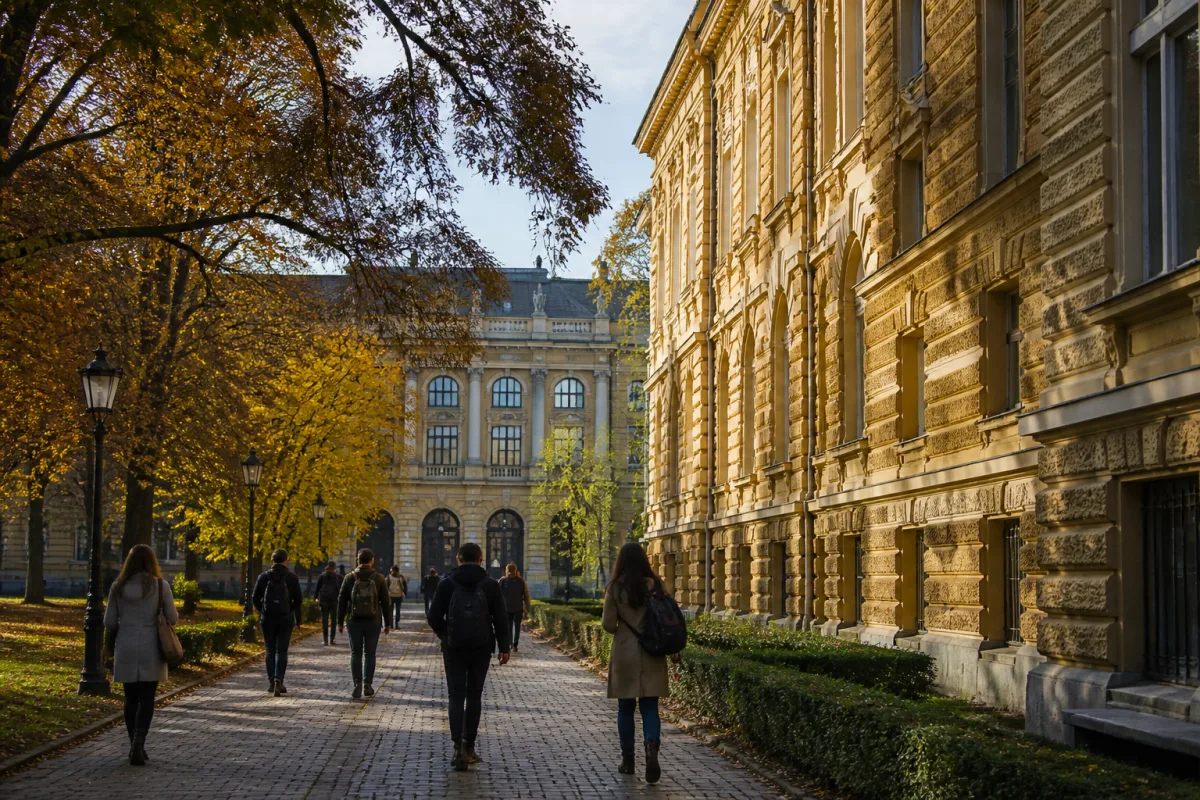

There are two separate routes into a Hungarian university — self-funded direct admission or competing for the state-funded Stipendium Hungaricum scholarship — and each has its own deadlines, documents, and procedure that should not be mixed up.
In short
- There are two independent routes: self-funded direct admission to a university, and competing for the Stipendium Hungaricum scholarship through the Tempus Public Foundation.
- For Stipendium Hungaricum you need to apply twice — on the national portal and through your country’s sending partner — otherwise the application doesn’t count as submitted.
- Only a citizen of a country on the current round’s partner list can apply for Stipendium Hungaricum, and that list is reapproved every year.
- Without the scholarship, a bachelor’s degree costs €3,000–6,000 a year, a master’s €2,000–5,000 a year.
- Students can work up to 30 hours a week during the academic year, and full-time during holidays.
Two Routes Into Hungary: What’s the Difference
Admission to a Hungarian university follows one of two routes, and each has its own procedure. The first is direct, self-funded admission: every university runs its own applicant portal, with its own document package and its own deadline. The second is the Stipendium Hungaricum scholarship, a separate state-run competition: the application goes through the Tempus Public Foundation system and the student’s country’s sending partner, and then through the university’s own selection process.
There’s no single portal for self-funded applications: a student normally registers directly on the chosen university’s website, and each program can have its own registration, its own document set, and its own internal deadline. Stipendium Hungaricum is trickier: saving a form on the Hungarian portal isn’t enough — both parts of the procedure, the national one and the university one, have to be completed, or the application doesn’t count as submitted. There’s another limit worth noting: not every international student can apply for Stipendium Hungaricum — only a citizen of a country that is listed as a partner country in the current round of the competition. That list is reapproved every year, so it’s worth checking in the current call for applications before starting to prepare.
saving a form on the Hungarian portal isn’t enough — both parts of the procedure, the national one and the university one, have to be completed, or the application doesn’t count as submitted
Only a citizen of a country listed as a partner country in the current Stipendium Hungaricum round can apply. The list changes every year — check it in the current Call for Applications.
Hungary’s Education System: How Long You’ll Study
Higher education in Hungary follows the Bologna system: a bachelor’s degree runs 3–4 years, a master’s 1.5–2 years. Medicine, dentistry, architecture, and a few other fields are the exception: instead of a separate bachelor’s-plus-master’s structure, they run as a single 5–6 year program with no split between degree levels.
This structure will be familiar to anyone who’s already dealt with European higher education: bachelor’s and master’s degrees convert between Bologna Process countries without extra red tape. For an applicant, this means choosing between fields is also a choice between different program lengths and a different point at which a degree holder can enter the job market.
How to Choose a Program and Check Scholarship Eligibility
Choosing a program is best started not from university rankings but from field of study: Hungary is traditionally strong in medicine, engineering and technology, and business and economics — but that’s a general guide, not a ready-made list for every applicant.
For each specific program, you need to check separately: the language of instruction, the content of the curriculum, requirements on prior education (whether subjects like math, biology, or chemistry are required), and the format of the entrance exam or interview.
It’s also worth checking tuition cost and, separately, whether Stipendium Hungaricum is even available for the chosen program: the scholarship covers a limited list of fields, and whether a given program falls within that list determines whether you can apply for it at all.
The rule that follows: you can’t just pick any program from a university’s catalog and submit documents automatically — first check whether applying is even possible, and only then build a shortlist of several realistic options rather than betting on a single choice.
you can’t just pick any program from a university’s catalog and submit documents automatically
Stipendium Hungaricum covers a limited list of fields. Before choosing a program, confirm it’s actually on that list.
Admission Requirements: Bachelor’s, Master’s, Documents, and English
Bachelor’s applications are usually submitted right after finishing secondary school — the university checks the diploma, grades, and relevant subjects. You don’t have to wait until the diploma is actually issued: many universities accept applications while a student is still in their final year, based on current grades and a certificate confirming expected graduation. But a formal secondary school diploma isn’t enough for every program: engineering programs may check math and physics, medicine checks biology and chemistry, and creative fields may ask for a portfolio. If subject knowledge is missing, some universities offer a foundation year.
For a master’s degree, the requirement is different — a relevant bachelor’s diploma. The university compares not just the name of the previous major but the actual courses taken and their credit hours. Switching into a related field is possible, but it has to be justified academically: the applicant needs to show that their coursework is close enough to the chosen program.
How the Selection Process Works
There’s no single application portal — a student registers on a specific university’s website and goes through a sequence of steps:
- fill out an online application form;
- upload a passport and educational documents;
- attach proof of English proficiency and a motivation letter;
- pay an application fee, if the program requires one;
- go through an interview or entrance exam;
- receive an offer and meet the financial conditions for enrollment.
Selection most often happens online. At the University of Debrecen, for example, this means an interview or exam, and for some programs English and subject knowledge get checked as well: medicine requires biology plus either chemistry or physics, with a written section followed by an oral interview.
Documents and English
The basic package usually includes a passport, a secondary school diploma or university degree with a transcript and translations in the required format, a CV, a motivation letter, an English certificate — unless the university verifies language proficiency in its own interview — plus medical documents or a portfolio if the program requires them.
The approximate English level for most programs is B1–B2, but the exact minimum, and which test and score satisfy it, is always set by the individual program. Some universities are willing to assess language skills directly in an interview; others require an official certificate — this needs to be confirmed before registering for an exam, not after.
How University Selection Works
The sequence of steps for registering on a university’s website.
- Fill out the online application form
- Upload passport and educational documents
- Attach proof of English proficiency and motivation letter
- Pay the application feeif required by the program
- Complete an interview or entrance exam
- Receive an offer and meet the financial conditions
Bachelor’s applications are judged on the school diploma and relevant subjects, sometimes a portfolio. Master’s applications are judged on how closely the bachelor’s coursework and credit hours match — not just the name of the major.
Basic Document Package for University Applications
Motivation Letter and the Stipendium Hungaricum Competition
A motivation letter for Hungary shouldn’t come down to a generic statement about loving to travel. It needs to show why this specific program is the right fit, what knowledge the applicant already brings, and how the program connects to their future career.
For the Stipendium Hungaricum scholarship, this matters even more: an application isn’t just paperwork — it’s entry into a full competition, where the motivation letter directly affects the selection outcome.
Deadlines: When to Apply for Stipendium Hungaricum and for Self-Funded Admission
January is the general benchmark for submitting a Stipendium Hungaricum application, but the exact deadline is set fresh in each new round (the Call for Applications), so the precise date needs to be confirmed against the current call. That means preparation for the next intake should start as early as autumn 2026, with the announcement tracked from there.
The Stipendium Hungaricum procedure has two parts, and both matter. Beyond the form on the Hungarian portal, a candidate also needs to register through their own country’s channel — the agency designated as the sending partner for the current competition round. Which countries actually count as partners in a given cycle needs to be checked against the current Call for Applications, since the list can change from year to year — with its own documents and its own internal deadline. Saving only the portal form isn’t enough.
For self-funded admission, deadlines are usually later, and there’s no single cutoff — each program has its own calendar that needs to be checked separately.
The best strategy is to submit applications for both routes in winter or, at the latest, in spring: that leaves time for the entrance exam, tuition payment, and visa processing. Opening up a program’s requirements for the first time in January is already too late — they need to be reviewed well ahead of time.
Opening up a program’s requirements for the first time in January is already too late — they need to be reviewed well ahead of time
The form on the Hungarian portal isn’t enough — you also need to register through your own country’s sending partner agency, with its own deadline and documents.
What Stipendium Hungaricum Covers, and What Tuition Costs Without It
In the current competition round, Stipendium Hungaricum provides full tuition waiver, health insurance, and a number of additional benefits for bachelor’s, master’s, and one-tier programs. A separate monthly living allowance is also provided — its amount is set anew in each competition round, so the current figure needs to be confirmed against the active Call for Applications. The main saving is fully covered tuition plus the option of living in a dormitory, with the monthly allowance covering part of ongoing living costs on top of that.
Without the scholarship, tuition in Hungary is paid, but noticeably cheaper than in most of Europe: a bachelor’s degree averages €3,000–6,000 a year, a master’s around €2,000–5,000 a year.
The city you choose has a major effect on the final cost: renting a room in a shared apartment varies by region.
| City | Room in a shared apartment |
|---|---|
| Budapest | 100,000–140,000 forints a month |
| Debrecen, Pécs | around 80,000 forints a month |
That rent difference adds up to a saving of thousands of euros over the course of a degree, so the city should be chosen based on cost of living as well as the university itself.
Tuition Costs in Hungary Without a Scholarship
Approximate yearly cost by degree level.
- Bachelor’s degree€3,000–6,000 per year
- Master’s degree€2,000–5,000 per year
After Enrollment: Residence Permit and Working While Studying
After enrollment, a student applies for a residence permit for study purposes — a separate procedure that starts only after an admission offer from the university has been issued. It usually requires the offer letter itself, proof of tuition payment or scholarship coverage, a housing lease, and health insurance. The exact procedure and where to apply should be checked against the current rules of the relevant consulate, since they can differ depending on the country of application.
During the academic year, an international student can work up to 30 hours a week. During holidays and non-term periods, full-time work is allowed, within the set limit.
After graduating, the route has a career continuation: it’s possible to apply for a residence permit for job-seeking or for starting a business.
Frequently asked questions
Can I apply for Stipendium Hungaricum if my country isn’t on the current round’s partner list?
No: only a citizen of a country listed as a partner country in the current Stipendium Hungaricum round can apply. That list is reapproved every year, so it needs to be checked in the current Call for Applications before you start preparing documents — if your country isn’t on the list, self-funded admission is the only remaining route.
How long does a student residence permit last, and does it need to be renewed?
No specific duration is given: the available material only covers the procedure for applying for a student residence permit itself, and notes that the exact procedure and place of application should be confirmed against the current rules of the relevant consulate, which vary depending on the country of application.
Comments
Reader experience is useful, but it is not advice: check the rules on the official site.
No account needed: click Sign in, type any name, and you are done.