
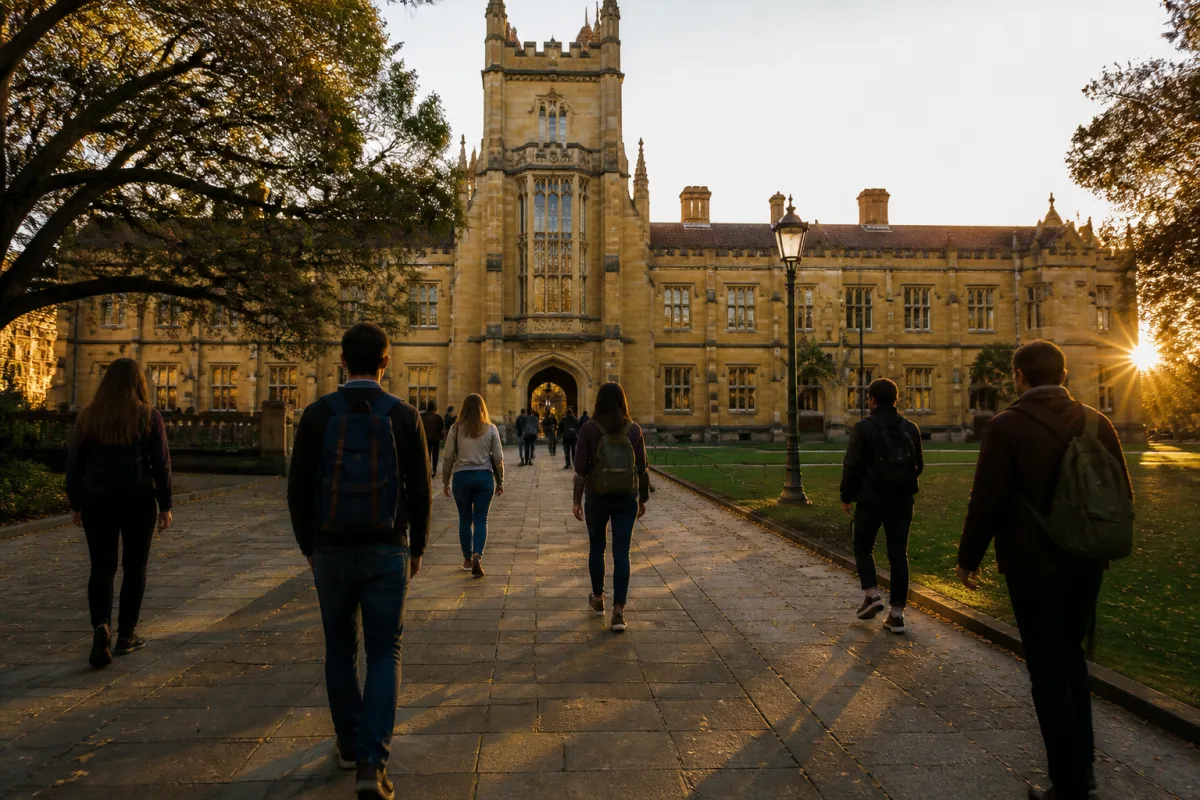

Applying to a UK university works differently for undergraduate and postgraduate study: undergraduate applications go through the single UCAS system with strict deadlines, while postgraduate applications are submitted directly to each university, with its own timeline and admission rules.
In short
- An undergraduate degree takes 3 years (4 in Scotland), while a postgraduate degree can often be completed in a single year.
- Undergraduate applications go through UCAS no later than mid-January; postgraduate applications go directly to the university with no single deadline.
- Tuition runs £10,000–40,000 a year for undergraduate study and £9,000–30,000 for postgraduate study, with living costs starting from £1,000 a month.
- After an unconditional offer, the university issues a CAS for the student visa application, and a Graduate Visa becomes available after graduation.
- Scholarships such as the UCL Global Undergraduate Scholarship or the Gates Cambridge Scholarship are awarded competitively, not guaranteed to everyone.
Undergraduate or Postgraduate: Differences in Structure and Requirements
An undergraduate degree in England, Wales, and Northern Ireland takes 3 years; in Scotland, it takes 4 years. A postgraduate degree can often be completed in a single year — one of the key differences between the British system and many others.
Undergraduate applicants typically apply straight from secondary school or a preparatory programme, while postgraduate applicants apply after completing an undergraduate degree. Whether an international applicant’s school-leaving certificate qualifies for direct undergraduate entry is decided by each university individually — there is no single rule that applies across the board. In some cases a foundation year, A-levels, or an IB programme is required before the main course, but this is just one possible route, not a mandatory step for everyone.
For postgraduate admission, universities look at a different set of criteria: a bachelor’s degree, the relevance of previous coursework, work experience, and a clear sense of purpose for the chosen programme.
If a bachelor’s degree isn’t directly related to the intended postgraduate field, conversion programs make it possible to switch direction — for example, moving from the humanities into business, marketing, or analytics. A previous degree doesn’t lock in the rest of a career path.
How long undergraduate and postgraduate study takes
A postgraduate degree in the UK can often be completed in a year — one of the features that sets the system apart from many others.
- Undergraduate in England, Wales, Northern Ireland3 years
- Undergraduate in Scotland4 years
- Postgraduate1 yearin many cases
Submitting Applications: UCAS for Undergraduates, Direct Applications for Postgraduates
Most undergraduate applications go through the single UCAS system, where one application can include up to five course choices. UCAS requires education details, the list of chosen courses, a reference, and a personal statement.
In its current format, the personal statement isn’t a single long essay but answers to three questions: why the applicant wants to study the chosen subject, how previous study has prepared them for the course, and what else they’ve done outside the classroom. The overall limit is around 4,000 characters. Universities care less about general statements of passion and more about evidence of genuine interest — projects, books, competitions, work placements, and what the applicant took away from them. This approach ties personal experience to the chosen course and makes the application more convincing.
Postgraduate admissions work differently: applications are submitted directly through each university’s website, and there is no single deadline. Some universities run application rounds, while others accept applications until places are filled.
It’s three answers, not an essay: why this subject, how past study prepared you for it, what you’ve done outside the classroom. The limit is around 4,000 characters, and evidence of genuine interest matters more than general statements.
Application Deadlines for 2027 Entry
- Mid-October — the deadline for Oxford, Cambridge, and most medicine and dentistry courses.
- Mid-January — the deadline for most other undergraduate courses through UCAS.
- Check the exact date for each cycle on the UCAS website in the year of application — the calendar can shift slightly from year to year.
- Applying after the official deadline is sometimes still possible, but popular courses and scholarship funding often close earlier — January is better treated not as the moment to start working on an application, but as the point by which the full document package should already be ready.
- Postgraduate deadlines follow no single calendar — each programme sets its own, and they need to be tracked individually for each university and course.
January is better treated not as the moment to start working on an application, but as the point by which the full document package should already be ready
Popular courses and scholarships can close before the official deadline. Applying after the deadline is sometimes possible, but it shouldn’t be relied on.
Conditional and Unconditional Offers: How a University Confirms a Place
After reviewing an application, a university most often issues a conditional offer — a place offered on certain conditions, such as reaching a required English language level or submitting final grades. This isn’t the final decision yet, but an invitation with conditions that need to be met by a set deadline.
Once all the conditions are met, a conditional offer becomes an unconditional offer — one with no further conditions attached. Receiving an offer from a university doesn’t automatically mean a place is fully secured: the offer letter should be read carefully to check exactly which requirements and deadlines apply, and these need to be met on time.
Receiving an offer from a university doesn’t automatically mean a place is fully secured
A conditional offer comes with requirements (language level, final grades) that must be met by a deadline. An unconditional offer is only issued once they’re fulfilled.
What Documents Are Needed to Apply
The basic document package is the same for undergraduate and postgraduate applications:
- school certificate or degree transcript with current grades;
- proof of English language proficiency;
- personal statement;
- references;
- passport.
For postgraduate applications, a CV is added to this list. Creative courses typically also require a portfolio. For some programmes, the university may also set a test, an interview, or a written task — this depends on the specific course.
For English language proficiency, IELTS 6.5 is a common benchmark, though more competitive universities may require a higher score.
The number of documents submitted doesn’t decide the outcome on its own: grades, experience, references, and the personal statement need to come together into one clear story — why the applicant chose this programme and how it connects to their future goal.
Basic document package for applying
How Much Studying and Living in the UK Costs
| Expense | Annual/monthly range |
|---|---|
| Undergraduate tuition for international students | £10,000–40,000 per year |
| Postgraduate tuition for international students | £9,000–30,000 per year |
| Lab-based, clinical programmes, MBA | notably above the average range |
| Living costs outside London | from £1,000 per month |
| Living costs in London | £1,300–1,500 per month |
Undergraduate tuition for international students ranges from £10,000 to £40,000 per year, and postgraduate tuition from £9,000 to £30,000. Lab-based and clinical programmes, as well as MBAs, can cost noticeably more than this range — the exact figure should be checked on the specific course page.
Living costs are a separate line in the budget. Depending on the city, this starts from £1,000 per month and has no real upper limit. In London, £1,300–1,500 per month is a typical benchmark, so choosing a strong university outside the capital can sometimes cut the overall budget by roughly £1,000 a month.
Scholarships for International Students
University scholarships reduce the cost shown on a course page and are awarded separately from it. For undergraduate study there’s the UCL Global Undergraduate Scholarship; for postgraduate study, options include ThinkBig at the University of Bristol, the Clarendon Fund for master’s and PhD study at Oxford, and the Gates Cambridge Scholarship for postgraduate and doctoral programmes.
The scale of support varies by programme. UCL either covers full tuition or pays for accommodation separately, while ThinkBig covers the entire cost of tuition.
Selection also works differently across programmes: some scholarships are considered automatically alongside the course application, while others require a separate form and essay, usually submitted ahead of the main deadline. Conditions and scholarship offerings change from year to year, so each programme should be checked on the university’s official website.
Scholarships are awarded competitively, not handed out to everyone, so they shouldn’t be counted on as a guaranteed discount. In practice, the level of support varies: some scholarships at UK universities reach several thousand pounds, but not every applicant who applies receives one.
Scholarships are awarded competitively, not handed out to everyone, so they shouldn’t be counted on as a guaranteed discount
When comparing offers, it’s the overall budget that matters, not the size of a single discount: tuition minus the scholarship, plus living costs and other required expenses. Sometimes a programme with a smaller scholarship in another city turns out cheaper than an option in London.
Compare the overall budget, not the size of one scholarship: tuition minus the scholarship, plus living costs. A smaller scholarship in another city can sometimes work out cheaper than a London option.
After the Offer: Student Visa, Working During Studies, and the Graduate Visa
Once the conditions of an unconditional offer are met, the university issues a CAS (Confirmation of Acceptance for Studies), which the applicant then uses to apply for a student visa. The visa application requires proof of tuition payment and evidence of funds for living costs. The exact amounts and how long funds need to be held in an account should be checked before applying on the official government website, as these requirements change periodically.
During their studies, many students are allowed to work up to 20 hours a week, if permitted under their visa conditions. After graduation, a separate immigration route is available — the Graduate Visa — which allows graduates to stay in the country after completing their programme. Its current terms and conditions should be checked closer to graduation, since they too are subject to change.
From unconditional offer to visa
The path from a confirmed university place to starting studies in the country.
- Meeting the conditions of an unconditional offer
- Receiving a CAS from the university
- Applying for a student visaproof of payment and living funds
- Studying with the option to work up to 20 hours a weekif permitted under visa conditions
- Graduate Visa after completing the programmecheck conditions closer to graduation
Frequently asked questions
What if a school certificate doesn’t qualify for direct undergraduate entry?
If a university doesn’t consider a certificate sufficient for direct admission, applicants are typically offered a foundation year, A-levels, or an IB programme before the main course. Which route is needed is decided by each university individually — there’s no single rule covering all international certificates.
Can you apply for a postgraduate course if your bachelor’s degree is in a different field?
Yes — conversion programs exist for exactly this purpose, allowing a change of direction, such as moving from the humanities into business, marketing, or analytics. A previous degree doesn’t close off other postgraduate specialisations.
What happens if the conditions of a conditional offer aren’t met in time?
A conditional offer only becomes unconditional once all the stated conditions are met by the deadline the university sets out in the offer letter. That’s why it’s important to check exactly which requirements and deadlines apply in the offer itself, and to meet them on time — otherwise the place won’t be fully confirmed.
Does the right to work 20 hours a week carry over to the Graduate Visa?
The 20-hour weekly limit applies to the period of study on a student visa. The conditions of the Graduate Visa, including the ability to work after graduation, are separate and should be checked closer to graduation, as they can change.
Comments
Reader experience is useful, but it is not advice: check the rules on the official site.
No account needed: click Sign in, type any name, and you are done.