
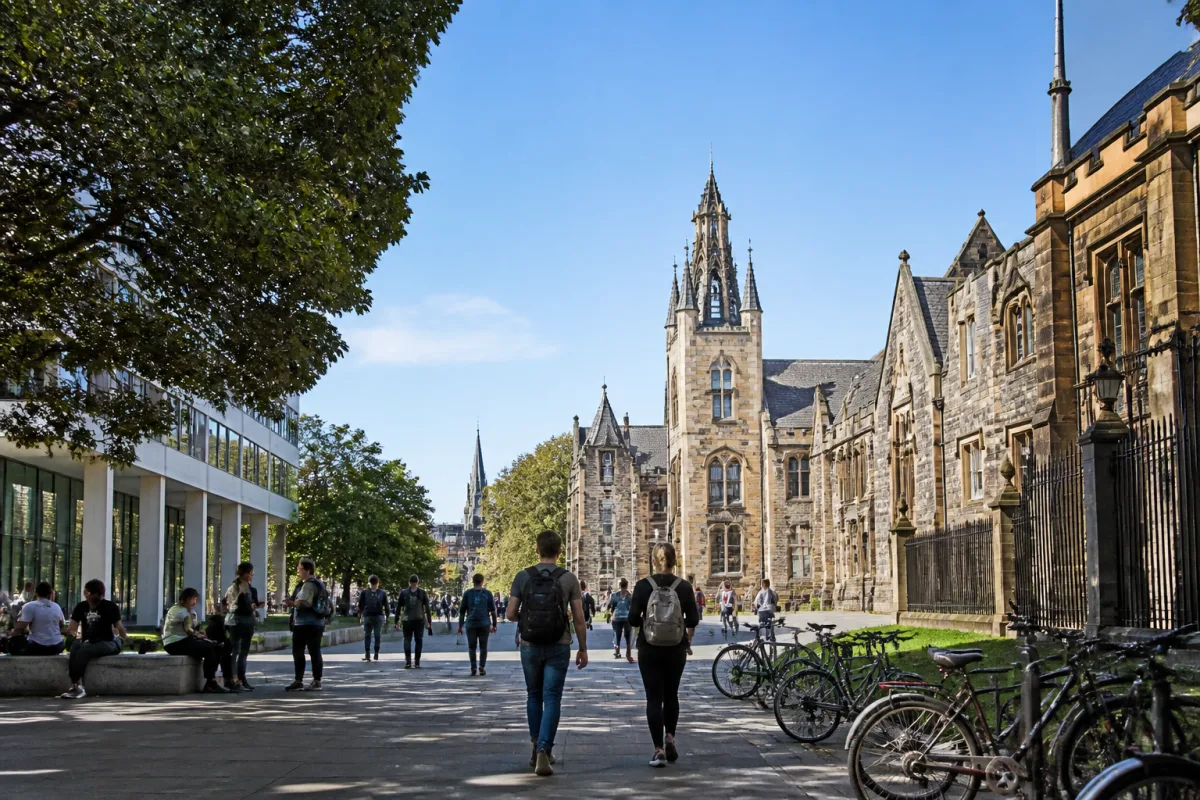

There’s no single right answer: in 2026–2027 the US is tightening student and work visas, the UK is extending the path to permanent status, Germany is introducing a new test for master’s applicants, and Australia is recording record refusal rates — so the right country depends on which specific changes and trade-offs an applicant is willing to accept.
In short
- The $1,000 H-1B filing fee has been struck down, and the proposed four-year cap on student visas has been frozen and is currently off the table.
- CPT in the US is now only granted if the internship is listed in the curriculum as a mandatory part of the degree.
- In the UK, the path to ILR has grown from 5 to 10 years, and the post-study work permit has been cut to 18 months starting January 2027.
- Germany introduced an additional dMAT test for Indian master’s applicants, while the post-graduation work permit still stands at 18 months.
- In Australia, Perth and Adelaide offer more jobs and more lenient rules than Sydney and Melbourne, despite record-high visa refusal rates.
What changed in US student and work visas
The Trump administration ordered US embassies abroad to pause processing new applications from students. At the same time, the largest overhaul in years of H-1B and student visa rules is being prepared — it concerns who will be able to study, work, and stay in America, and for how long.
Student visa refusals have become noticeably more common — by some estimates, only a portion of submitted applications are approved. Most universities have stopped supporting students with their paperwork.
Student visa refusals have become noticeably more common — by some estimates, only a portion of submitted applications are approved.
Separately, a proposed four-year cap on student visas was under discussion: anyone exceeding that period would have needed a separate extension from US authorities. That rule was frozen before taking effect and is currently off the table.
Among the negative initiatives of the past year and a half, the $1,000 fee for filing an H-1B petition was also struck down — removed by both the administration and the courts.
The proposed four-year cap on student visas was frozen and is currently off the table, and the $1,000 H-1B filing fee was struck down by both the administration and the courts.
CPT in the US: why internships got harder to secure
CPT (Curricular Practical Training) is a work authorization for internships during studies that supplements the student visa. Authorities have said they will no longer grant CPT unless the internship is listed in the program as a mandatory part of the degree. The problem is that almost no program makes an internship mandatory — it’s usually an optional element the student chooses to pursue.
Without that mandatory status written into the curriculum, getting CPT is now nearly impossible, and without an internship it’s harder to build the experience needed for graduation and later employment. Against this backdrop, most universities have simply stopped helping students with CPT paperwork.
As a result, the choice of university directly affects the odds of completing an internship: it’s worth checking in advance which programs support CPT and are willing to list practical training as a mandatory degree component. This should be checked at the application stage, not after enrollment — the rule stands until a court overturns it.
CPT is now only granted if the internship is listed in the curriculum as a mandatory part of the degree — almost no program does this. Check before applying, not after enrollment.
H-1B and EB-1: what changed with fees and the green card
The $1,000 fee the Trump administration introduced for the H-1B visa has been struck down — the decision was made at the government level, and the courts upheld it.
That doesn’t solve the broader problem with getting an H-1B itself: employers are increasingly reluctant to sponsor the visa. This has made an alternative route more attractive — the EB-1 visa, which leads to a green card in 2–3 years, including for citizens of India. By some estimates, approval rates in this category on the government’s side are fairly high.
Some applicants skip a master’s degree altogether and head to the US directly to work on an O-1 visa — a category for profiles with a research track record.
It’s worth preparing for sponsorship early, well before departure. Adding a few academic publications to one’s profile noticeably improves the odds by the time the job search begins — that kind of head start lets a candidate search for work even without a visa in hand or confirmed sponsorship from an employer.

A few academic publications on your profile before departure noticeably improve sponsorship odds — you can job-search even without a visa in hand.
US job market and salaries in 2027
A $1,000 monthly salary for a fresh graduate with no experience is a rare benchmark on the global market, but in the US it’s a realistic entry-level figure. For a specialist with five to six years of industry experience, a $3,000 monthly salary is common — not an exception, but a typical outcome for someone already established in the market.
The US remains the country with the largest number of job openings among all study and work destinations — positions exist in tech, business, finance, and healthcare, essentially across nearly every sector of the economy. That’s precisely why the return on an American education remains among the highest in the world, and the global exposure adds extra value to the degree.
The problem isn’t salaries or the number of openings — it’s access to them. Employers are growing less willing to sponsor visas for foreign employees, and without a visa or work authorization a graduate can’t actually realize that return on investment described above. The rising number of visa refusals adds to the difficulty — which makes choosing the right university and preparing for the job search a critical step long before enrollment.
US salaries by experience level
The income gap between an entry-level hire and an experienced specialist.
- Fresh graduate, no experience$1,000per month, entry level
- Specialist with 5–6 years of experience$3,000per month, common outcome
UK: the path to ILR is now 10 years instead of 5
UK Home Secretary Shabana Mahmood announced an overhaul of legal migration rules, set out in the government’s immigration White Paper. The main change concerns ILR (Indefinite Leave to Remain) — settled status: the qualifying period is being extended from 5 to 10 years.
That timeline can be shortened through English proficiency. The baseline requirement is A-level English. If an applicant’s English is at degree level, they can qualify for a shortened nine-year path to settled status — instead of the standard ten years.
Alongside the timeline and language changes, the government is introducing a “genuine character test” as a condition for obtaining ILR. It assesses an applicant’s conduct over their years in the country and their social contribution — including volunteering or community work, such as involvement with NGOs. Settled status in the UK used to be available after 5 years — now that’s treated as the exception, available only to applicants with a high level of English, rather than the standard scenario for a student or worker.
The standard path to settled status grew from 5 to 10 years. It can be shortened to 9 years only with degree-level English, plus a new “genuine character test” is being introduced.
UK post-study work permit cut to 18 months
The Graduate Route — the permit that lets a graduate stay in the UK and look for work after their studies — has been cut from 2 years to 18 months. The new period applies to students starting their studies from January 2027.
At the same time, language requirements have risen: a B1 level is enough to study, but actually landing a job in the UK now requires a level above B2. That gap — you can study at a lower level but you can’t work at it — is what creates the main problem for recent graduates in practice.
you can study at a lower level but you can’t work at it
Finding work in the country is already difficult: employers are reluctant to sponsor visas, and graduate employment has been a persistent issue for years. Shortening the permit simply narrows the window available to find a sponsor.
Employment odds vary sharply by field. Graduates in sustainability, marketing, writing, and English fare worst — these fields have noticeably fewer openings. The picture is better in medicine, cybersecurity, and finance — graduates in these fields more often manage to find work and stay in the country without having to return home. An added advantage for UK master’s and PhD programs is that they tend to be shorter than in several other countries, which lowers overall study costs.
The post-study work permit was cut from 2 years to 18 months for students starting from January 2027 — less time to find a sponsor.
Germany: the dMAT test and the risk of political shifts
Germany has introduced a new dMAT (Digital Master Assessment Test) specifically for Indian master’s applicants — an additional requirement that didn’t exist before. The reason the test targets this group specifically relates to a pattern authorities identified: some Indian students were enrolling in German universities solely to enter the country rather than to actually study, and after enrollment were staying in Germany without continuing their studies. dMAT is a response to that pattern and has noticeably complicated applications for future Indian master’s students.
On the political front, the AfD party is gaining influence, stating its intent to restrict not only illegal but also legal migration and to change existing rules. Similar anti-immigration protests took place across most European countries over the past year, including the Netherlands and Italy — part of a broader trend that also affects Germany’s migration policy. For now, the tightening mainly targets illegal entry, but legal migration and permanent residence are gradually becoming harder too.
Against this backdrop, the post-graduation work permit in Germany still stands at 18 months — enough time to find an employer and switch to a work-based status.
Australia: record refusal rates and rules for students
Australia is recording its highest visa refusal rate in 10 years. That doesn’t mean every genuine applicant is being turned down: last year the country introduced a new requirement, the genuine student test, which evaluates an applicant’s profile as a whole. It assesses the purpose of the trip (study versus an attempt at employment), how well the applicant’s background matches the chosen program, and the reason Australia specifically was chosen.
In practice, the test doesn’t work as precisely as intended — genuinely qualified students get caught up in refusals too. The real reason lies elsewhere: the country enforces an annual cap on the number of international students it admits. As that cap nears its limit, entry gets restricted, and applications with less compelling profiles get rejected to avoid exceeding the quota.
genuinely qualified students get caught up in refusals too
That said, Australia remains one of the strongest study destinations if the program and region are chosen deliberately. Regions like Perth and Adelaide offer more job opportunities, longer post-study work permits, and more lenient rules for international students than the already crowded Sydney and Melbourne, where finding work and settling in is harder.
During studies, students are allowed to work 48 hours per fortnight. After completing a degree, graduates receive a work permit ranging from 2 to 4 years — the exact length depends on the level of the qualification earned.
Work rights and permits for students in Australia
How much students can work during and after their studies.
- Work during studies48 hours per fortnight
- Post-study work permit2–4 yearslength depends on the qualification level
Perth and Adelaide offer more jobs, longer post-study work permits, and more lenient rules than the crowded Sydney and Melbourne.
Frequently asked questions
What happens to students already studying under the US four-year student visa cap?
The rule proposing a four-year cap, which would have required a separate extension once exceeded, was frozen before taking effect and is currently off the table. That means students who have already been studying longer than four years don’t need to seek any additional authorization from the government — the requirement isn’t in force right now.
Can you get an EB-1 without a master’s degree, straight after a bachelor’s?
There’s no direct answer to this, but the described path shows that some applicants skip a master’s degree altogether and go straight to the US to work on an O-1 visa — a category for profiles with a research track record. That suggests a route to research-based visas is possible without an additional degree, provided the profile meets the category’s requirements.
Should you choose Perth or Adelaide over Sydney and Melbourne if program quality matters more than the city?
Choosing a region and choosing a program are two separate factors: Perth and Adelaide offer more jobs, longer post-study work permits, and more lenient rules for international students compared to the crowded Sydney and Melbourne. But that doesn’t remove the need to evaluate the program itself separately — the region affects employment outcomes, not the content of the course.

Comments
Reader experience is useful, but it is not advice: check the rules on the official site.
No account needed: click Sign in, type any name, and you are done.