


In short
- STEM graduates in the US get up to 36 months to find work under OPT, versus 12 months for other fields.
- In Germany, permanent residence becomes available after more than 2 years of work in the field, with pension contributions and language proficiency met.
- In Canada from 2026, a full three-year PGWP is guaranteed only for university programs; college graduates need their program on the in-demand occupations list.
- In the UK, the Graduate visa shrinks from 2 years to 18 months for applications submitted from 1 January 2027.
- In the Netherlands, Orientation Year status lowers the salary threshold required to hire a graduate as a highly skilled migrant.
United States: OPT and the STEM OPT Extension — up to 36 months
An international student who studied in the US on an F-1 visa typically receives OPT (Optional Practical Training) after graduation — a temporary work authorization tied to their field of study, valid for up to 12 months. This isn’t a free period to work anywhere: the job has to be directly related to the degree earned. Taking a job as a barista or a front-desk administrator at a gym just to wait out the clock isn’t allowed — work outside the field counts as a status violation.
Taking a job as a barista or a front-desk administrator at a gym just to wait out the clock isn’t allowed — work outside the field counts as a status violation.
For graduates of STEM programs (science, technology, engineering, math), the rules shift in their favor: they can apply for the STEM OPT Extension and get another 24 months on top of the standard period. In the best-case scenario, a STEM graduate ends up with up to 36 months of legal work time in the US, compared with 12 months for everyone else.
But OPT isn’t a standalone status — it’s a temporary bridge after university, and every bridge has an end. Within the 12 or 36 months allotted, the next step has to happen: finding an employer willing to sponsor a full work visa — most often H-1B, though it isn’t the only option, as other work visa categories can fit in specific cases. The shorter the OPT period, the fewer chances to enter the visa lottery: a graduate with 12 months effectively gets one shot, while someone with 36 months can try three times.
Legal work period after graduation in the US
STEM graduates get three times as long to find an employer as everyone else
- Standard OPTup to 12 months
- STEM OPT Extensionup to 36 monthson top of standard OPT
OPT grants up to 12 months of work in your field; STEM graduates get up to 36. But it’s a temporary bridge: within that window, you need to find an employer willing to sponsor a work visa.
Germany: up to 18 months to find work, with a path to permanent residence
A graduate of a public or officially recognized private university in Germany can apply for a special residence permit valid for up to 18 months. The state sets aside this time specifically for finding qualified employment matching the graduate’s field — a generous cushion for adjusting while interviews are underway.
While this period runs, working isn’t restricted: any side job is allowed to cover living costs while the search for a degree-matched position continues.
Once a job matching the diploma is found, the graduate switches to a work residence permit without extra bureaucracy. If the starting salary clears the legal threshold, an EU Blue Card is issued instead of a standard work permit — it comes with broader social and career guarantees.
Permanent residence becomes available after a little over 2 years of working in the field in the country, provided the standard requirements are met, including at least 24 months of pension contributions and working-level German.
Finland: up to 2 years to find work or start a business
After earning a degree from a Finnish university, graduates can apply for a special residence permit to look for work or start their own business — valid for up to 2 years. Throughout that time, working is allowed with no restriction on field: as an engineer or as a store consultant, there’s no requirement to work strictly within the degree.
Finland is built more flexibly than many of its peers in this comparison: the student visa doesn’t expire the day of graduation. The two-year permit can be requested within a set window after finishing studies, and that window stays open for several years after the diploma is issued — useful, for instance, if the graduate goes home for a while first. Another feature: the 2 years don’t have to be used consecutively — the permit can be split and requested in parts.
Netherlands: the Orientation Year for graduates
After completing an eligible higher-education program in the Netherlands, a graduate qualifies for the Orientation Year (zoekjaar in Dutch) — a dedicated job-search period of roughly 12 months. During this time, living and working in the country legally requires no additional permits.
The real value of this status shows up once a graduate finds a permanent employer and moves into a highly skilled migrant position. Normally, to hire a foreigner for such a role, the government requires the company to pay a high minimum salary — a bar many local companies aren’t willing to clear for a student with no work history.
But for those holding Orientation Year status, a significantly lower salary threshold applies. The government is effectively signaling to employers that hiring this kind of graduate is cheaper and simpler from a tax standpoint — a real edge in interviews.
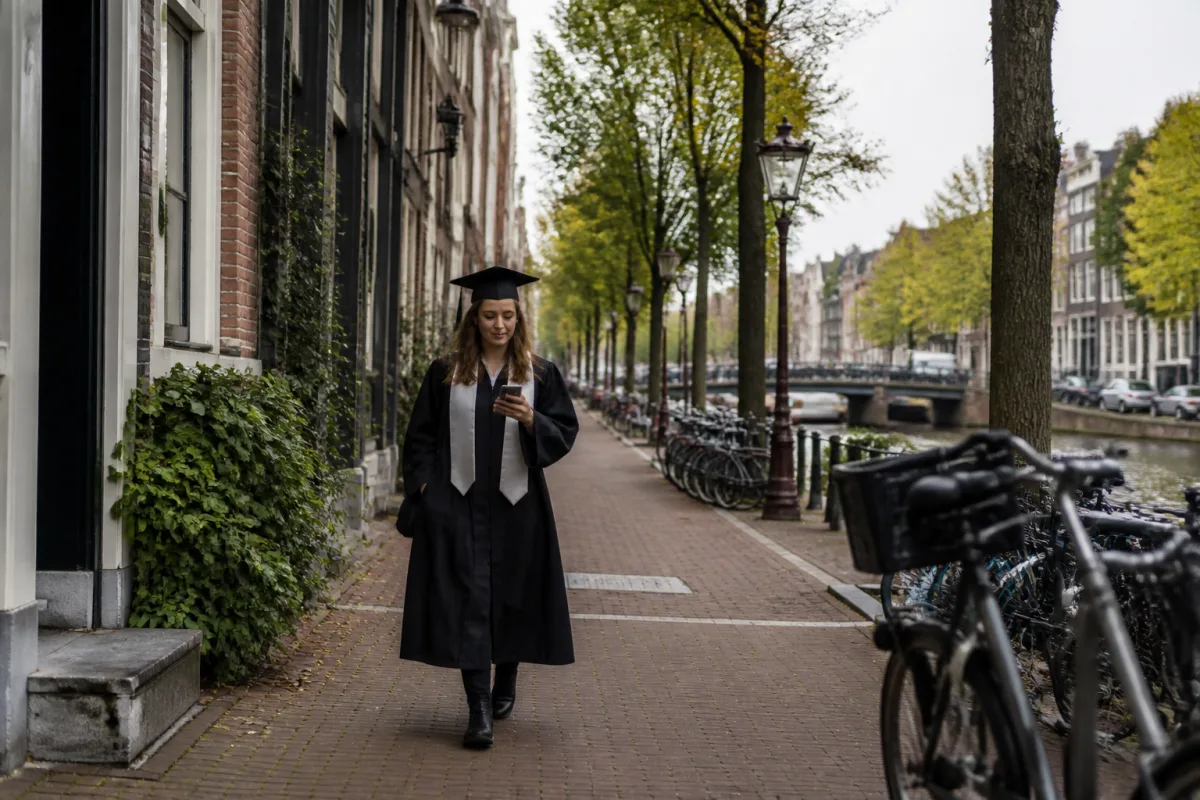
Graduates with Orientation Year status can be hired below the usual salary threshold — worth raising as a point in your favor during interviews.
Ireland: the Third Level Graduate Programme by degree level
In Ireland, university graduates can use the state’s Third Level Graduate Programme, and its length is tied directly to the level of the degree earned.
A standard honours bachelor’s degree sits at Level 8 of the national qualifications framework — it comes with up to 12 months to find work. Graduates who go on to a master’s or a higher level (Level 9 and above) get double that: up to 24 months of legal stay, provided all programme rules are followed.
Those two years aren’t just time to live in the country — they’re meant for one specific task: securing a job and transitioning to a standard work permit. That’s a big part of why Ireland is a popular pick for anyone planning a master’s in tech or finance from the start: there’s enough time to land a role at a large company with an Irish office and move onto standard work status without having to leave after graduation.
Canada: the PGWP — 8 months to 3 years under the 2026 rules
Enrolling at any Canadian college used to be a guaranteed route to a 3-year work visa after graduation — but that no longer holds in 2026. Canadian graduates now receive a PGWP (Post-Graduation Work Permit), a temporary work authorization lasting anywhere from 8 months to 3 years depending on the program and institution.
Enrolling at any Canadian college used to be a guaranteed route to a 3-year work visa after graduation — but that no longer holds in 2026.
Under the current rules: a master’s program of at least 8 months, with other requirements met, earns a full three-year PGWP — even if the master’s itself only took a year to complete. Bachelor’s programs of 2 years or longer also guarantee a permit of up to 3 years.
College graduates face a stricter condition: a work permit is only issued if the program appears on a specific list of in-demand fields. University graduates — bachelor’s, master’s, and doctoral — are exempt from this requirement. That makes picking a cheap two-year college program without checking its status on the current list a real risk of ending up with no PGWP at all. Whether a program qualifies needs to be confirmed before any tuition is paid.
The PGWP is a temporary tool: it provides Canadian work experience, which earns points in the Express Entry immigration system, but it doesn’t make anyone a Canadian resident automatically. Those points still have to be earned in a competitive pool.

College graduates only qualify for a PGWP if their program is on the in-demand occupations list. Confirm this before paying tuition, or risk ending up with no work permit at all.
UK: Graduate visa — 2 years now, 18 months from 2027
As of August 2026, a bachelor’s or master’s graduate in the UK can get a Graduate visa valid for 2 years, provided the application is submitted on or before 31 December 2026.
The government has already confirmed the shorter duration officially: for every application submitted from 1 January 2027 onward, the Graduate visa will run for 18 months instead of two years. PhD holders keep the three-year limit for now.
The Graduate visa can’t be extended indefinitely — once the allotted 18 months or 2 years run out, the choice is either to find another route to stay or to leave. Staying in the UK beyond that point means moving onto a Skilled Worker visa, which requires the job and salary to meet government thresholds. Those thresholds are reviewed regularly, so the actual figures need to be checked at the time of application rather than assumed from past years.
The gap between 2 years and 18 months shows why a migration plan can’t be set once and forgotten: a student starting a bachelor’s degree in autumn 2026 will graduate several years later — by which point the rules may already look different from today’s.
a student starting a bachelor’s degree in autumn 2026 will graduate several years later — by which point the rules may already look different from today’s
UK Graduate visa: what changes from 2027
The Graduate visa duration shrinks by six months for applications filed from 1 January 2027
- Graduate visa duration (bachelor’s/master’s)PhD holders keep the 3-year limit
Checking the rules in advance: the case of a 4-year bachelor’s degree
Current Graduate visa conditions don’t guarantee the same rules will still apply in 4 years. That 4-year span isn’t an abstraction — it’s exactly how long a standard bachelor’s degree takes, and over that stretch, salary thresholds for work visas and the Graduate visa’s own terms can be revised more than once.
This isn’t a reason to skip studying abroad — it’s a reason to plan the migration path early and check it twice. The first check happens at the start, before applying to university. The second is a checkpoint a year before graduation, once it’s clearer what rules will be in force by the time the diploma is issued. Planning around the conditions that were current at enrollment and not checking official sources again until graduation is a strategic mistake.
Check migration rules twice: before applying to university, and again a year before graduation, when the actual rules at that point become clear.
How much time each country gives graduates to find work
Table scrolls sideways
| Country | USA | Germany | Finland | Netherlands | Ireland | Canada |
|---|---|---|---|---|---|---|
| Job-search period | up to 12 mo. (STEM up to 36) | up to 18 months | up to 2 years | about 12 months (Orientation Year) | 12 months (Level 8) or 24 months (Level 9+) | 8 months to 3 years (PGWP) |
| Restricted to work in your field | yes, restricted | no, any work allowed | no, no restriction | no, no permit required | depends on programme rules | depends on programme |
| Next step | sponsored work visa (often H-1B) | work residence permit or EU Blue Card | move to work status | highly skilled migrant position | standard work permit | Express Entry / work visa |
Figures reflect the period described in the article and are subject to change — verify at the time of application.
Frequently asked questions
What happens if no employer is found to sponsor a work visa during OPT or STEM OPT
The legal work period under OPT ends, and without switching to another status — such as a work visa like H-1B — continued stay in the US on student status is no longer possible. The shorter the OPT period was, the fewer attempts there were to secure such a visa.
Can you switch employers during the post-graduation job-search permit in Germany or the Netherlands
While the transitional permit is in effect — whether Germany’s 18-month job-search period or the Dutch Orientation Year — the graduate searches independently and isn’t tied to one employer, so changing plans or talking to different companies during this period doesn’t violate status.
What if no job in the graduate’s field is found within 2 years in Finland
There’s no requirement to work strictly in the field during this permit — any job is fine while the search for the right role continues, since the Finnish system doesn’t restrict employment to the graduate’s area of study during this period.
Can you leave Finland for a while and come back later to use the rest of the job-search permit
Yes — a feature of the Finnish system is that the two-year permit doesn’t have to be used consecutively: it can be split and requested in parts, and it can be applied for within several years after the diploma is issued.
What happens if a master’s program in Canada lasts less than 8 months
The full three-year PGWP is tied specifically to a program of at least 8 months, other requirements being met, so a shorter master’s program doesn’t qualify for the maximum three-year permit under these conditions.
Can you apply for a PGWP if a college program isn’t on the in-demand occupations list
No — college graduates face a strict condition: a work permit is only issued if the program is on the specific in-demand occupations list, and this should be checked before paying tuition, not after graduating.
What happens to the UK Graduate visa if the diploma is awarded after 1 January 2027
The Graduate visa’s length depends on the date the application is submitted, not the date the diploma is awarded: for every application filed from 1 January 2027 onward, the visa runs for 18 months instead of two years, except for PhD holders, who keep the three-year limit for now.



Comments
Reader experience is useful, but it is not advice: check the rules on the official site.
No account needed: click Sign in, type any name, and you are done.