
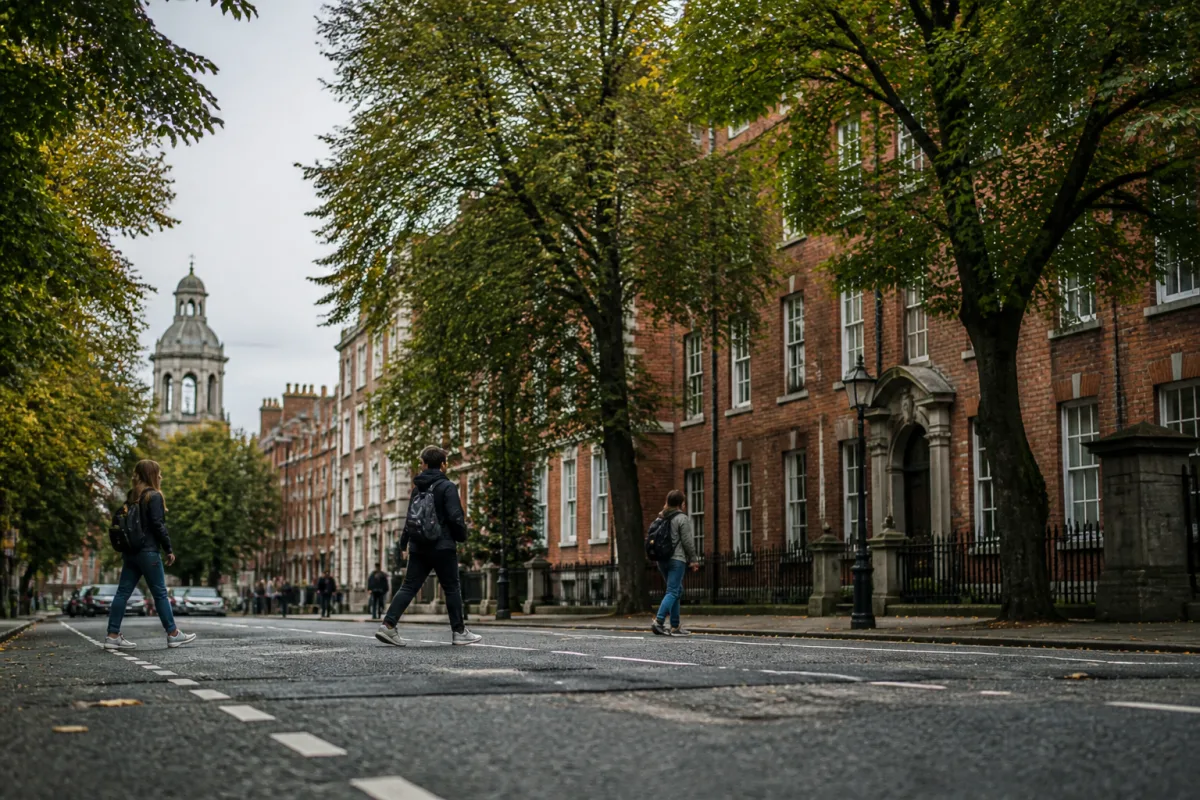

In 2027, the top study-abroad destinations are the US, Germany, Australia, Singapore and Ireland, while Canada and the UK deserve a cautious look because of quotas, unstable visa policy, and post-graduation employment difficulties.
In short
- The US remains the ROI leader: O-1 approval reached 94% in 2025, and an employer isn’t required to file for it.
- Australia has introduced a hard cap of 295,000 international students a year, while refusal rates for Indian applicants reach 40%.
- Germany is nearly free to study in (€300–400 a month for living costs), but without German, finding a job is practically impossible.
- Canada has cut international student intake by 80% and has all but stopped issuing post-graduation work permits and PR.
- In Ireland, the path to PR requires securing an Employment Permit before Stamp 1G expires, or the graduate must leave the country.
5. Ireland: fast track to PR, but expensive tuition
Ireland takes fifth place in the ranking mainly because of the presence of major tech companies: Google, Microsoft and Meta all have their headquarters here, and the country has been less affected by recent political shifts than its neighbors. After graduation, a post-study permit (Stamp 1G) applies: 12 months for bachelor’s graduates and up to 24 months for master’s graduates and above, subject to conditions. From there, a path to permanent residency opens through a sequence of immigration statuses — Stamp 1G, Stamp 1 and Stamp 4 — but switching out of Stamp 1G requires securing an Employment Permit in time: without one, the graduate must leave the country once the permit expires.
The main drawback is tuition cost: an estimated €25,000 a year, with living costs in popular cities like Dublin or Cork adding further expense. The high price is partly explained by the fact that the country has only two leading universities most applicants want to get into, which drives competition especially hard.
When to apply
Applications open around November, with official deadlines set for April–May. But those deadlines shouldn’t be relied on: in practice, places and funding run out long before the formal submission date. Anyone applying after the official deadline risks being left without affordable housing or a scholarship — both tend to run out well ahead of the formal cutoff.
At the same time, the job market is small compared to the US or the UK, with fewer openings. Estimates suggest around 76% of students found work in 2024, and employment for international graduates took an average of about 9 months after finishing their studies.
Ireland’s official application window runs April–May, but places and scholarships run out much earlier. Relying on the formal deadline is risky.
Moving on from Stamp 1G only works if an Employment Permit is secured in time — without one, the graduate must leave the country once the permit expires.
4. Singapore: stability and high salaries versus a steep cost of living
Singapore ranks fourth as one of Asia’s key business hubs, with a strong job market in IT, AI, healthcare, business and finance. Entry-level hiring is tightening here, but that’s happening almost everywhere in the world right now, not just in Singapore. The upsides include low taxes, a stable Singapore dollar, and political stability: the country keeps attracting talent while many others are closing their doors to foreigners.
The main downside is cost. Because the country is so small, housing and tuition are very expensive. An even bigger problem is the absence of a post-study work permit as such: long-term visas are only issued if you have an employer, and if you can’t find a job after graduating, staying in the country may not be possible. PR (permanent residency) isn’t guaranteed either, no matter how many years someone has worked there.
One way around this is the Singapore ONE Pass — it grants a long-term visa either for a very high salary or for an outstanding profile with no salary requirement at all. It’s essentially an equivalent of permanent residency: the visa can be renewed for the holder and their family without being tied to a specific employer. But preparation has to start early — applying for a ONE Pass at the last minute isn’t realistic.
Post-graduation employment is generally not a problem. In 2024, 87% of graduates found work within 6 months of graduating; in 2025 the figure dropped to 83%, in line with the global trend, but it remained fairly high.
At a glance
| Pros | Cons |
|---|---|
| Strong job market in IT, AI, finance | No post-study work permit |
| Low taxes, stable currency | Very expensive housing and tuition |
| Political stability | PR not guaranteed even after many years of work |
| Graduate employment at 83–87% (2024–2025) | ONE Pass requires advance preparation |
Grants a long-term visa with no employer tie, based on a high salary or an outstanding profile. Preparation needs to start early — it can’t be filed at the last minute.
3. Australia: long work permits, but tight student quotas
After graduation, students can get a work permit under the subclass 485 visa: up to 2 years for a bachelor’s, up to 3 years for a master’s or a bachelor’s with honors in STEM fields, and up to 4 years for a PhD. Australia offers many paths to permanent residency, and in a number of places both study and work take place in English.
The main difficulty is visa refusals. For applicants from India, the refusal rate reaches around 40%. The reason is the genuine student requirement test, introduced in 2024: immigration officers check the purpose of study, choice of university, and the applicant’s overall profile. The test was brought in after a wave of fraud, when some agents were sending students with forged diplomas and certificates.
For applicants from India, the refusal rate reaches around 40%.
Against a backdrop of mass anti-immigration protests — Australia reportedly led in their scale over the past year — the government introduced a strict quota: no more than 295,000 international students a year. Because of this, a student can receive an offer from a university and still be denied a visa: the visa cap runs out before the application cap does, and some applicants simply fail the genuine student requirement test. Restrictions keep tightening: international students and graduate visa holders will no longer be allowed to bring family members with them.
A separate route for strong specialists is the National Innovation Visa. There’s no points system here, no regional or employer sponsorship required: being an expert in your field is enough to get PR, with processing taking under 9 months. It’s worth starting the application roughly a year in advance — it’s one of the best routes available today, but it can’t be filed on short notice.
Post-study work permit by degree level in Australia (subclass 485 visa)
The length of the post-graduation work permit grows with the level of the degree
- Bachelor’s degreeup to 2 years
- Master’s / bachelor’s with STEM honorsup to 3 years
- PhDup to 4 years
Australia has capped international student intake at 295,000 a year. Even with a university offer, the visa may not come through — the visa cap runs out before the application cap does.
2. Germany: near-free education, but German is non-negotiable
Germany takes second place in the ranking thanks to near-free education: a student’s costs mostly come down to living expenses, around €300–400 a month — roughly a third of what the same costs would run in India (c43, c44). The low cost keeps the financial risk minimal while the returns stay high: the country welcomes international students and skilled specialists, including through programs German diplomats have publicly described as aimed at Indian applicants (c42). Mechatronics, mechanical engineering and IT remain popular fields (c47).
After graduation, an 18-month post-study work visa is available — longer than in most neighboring countries — along with a theoretical path to permanent residency via the EU Blue Card (c45, c46). Opportunities aren’t limited to Berlin and Munich; they’re spread across other regions of the country too (c47).
The language requirement
Getting a job in Germany without confident German is practically impossible: this requirement applies to nearly all positions, not just as a formality for the visa (c48).
Political risk: AfD
The main risk for students in 2026–2027 is the rising popularity of the AfD party, which is gaining influence quickly amid recent anti-immigration protests (c49, c51). In the September 2026 elections, the party won 44% of the vote in one region — a notable shift compared to the historical dominance of left-leaning parties (c50, c52). The AfD has previously stated its intention to restrict all forms of immigration, including legal immigration, and if it comes to power, students would likely feel the effects of that policy (c53, c54).
Who Germany suits
Germany is a good option for those who don’t want to take out a study loan and prefer minimal spending over maximum return: the payoff is positive, though not as high as in, say, the US (c55). Thanks to its socially oriented economy, the country offers a decent work-life balance and a reasonable salary, though not the kind of income that puts someone among the world’s top earners (c56). Choosing Germany means being willing to learn German, accepting a somewhat lower return on investment, and integrating into the local culture (c57).
Getting hired in Germany without confident German is practically impossible — it applies to nearly all positions, not just as a visa formality.
1. The US: still the best ROI, despite the H-1B crackdown
The US tops the ranking, even though immigration policy here has tightened more than anywhere else under the Trump administration. The main problem is the H-1B visa: employers are widely refusing to sponsor it, and the F-1 → H-1B pathway that students relied on for roughly 20 years is effectively broken. This is likely the first time in history that graduates in a country with an economy and job market of this scale haven’t been able to find work after their studies without trouble.
the F-1 → H-1B pathway that students relied on for roughly 20 years is effectively broken
There is a solution: the O-1 visa and the related EB-1 green card. In 2025, 94% of O-1 petitions were approved, and historically the approval rate has stayed above 90%. If applicants prepare in advance and file right after graduation, O-1 can be obtained instead of H-1B. No employer is required for this: an applicant is entitled to start their own company and file a petition on their own behalf.
Most of the headline-grabbing initiatives from the Trump administration have either been halted, suspended, or struck down by the courts. For instance, the proposed $100,000 fee for filing an H-1B petition has been blocked by two courts. A proposal to cap student stays at four years, with mandatory USCIS approval required for any extension, was halted by a judge in Boston — the day before it was due to take effect — because the government couldn’t justify it as a national security threat. As a result, the real-world impact on student visas and H-1B so far has been limited, even though employers remain spooked and cautious.
Corporations and university associations have fought for students’ interests, so most of the proposed restrictions never actually took effect — only minor changes have gone through. Those willing to put in the work to find a job are still getting hired, and the return on investment in a US education remains the highest in the world: no other country can match its combination of leading universities teaching in English. Despite falling enrollment numbers, hundreds of thousands of students keep heading to the US — which is exactly why the country still holds the top spot in the ranking.
Prepare in advance and file right after graduation, and O-1 can replace H-1B. No employer is required — applicants can start their own company and file a petition on their own behalf.
Countries to avoid: Canada and the United Kingdom
Canada is the first country worth avoiding: it keeps cutting its quota for international students every year. The country’s prime minister has said the number of international students has been cut by 80%, asylum seekers by 70%, and temporary foreign workers by 60%. Universities still accept international applicants, but getting a visa after admission is now difficult — it’s the visa numbers that are capped. Where around 700,000–800,000 students used to go to Canada to study each year, the current limits allow for roughly 110,000–150,000, or at most 200,000 spots a year.
It’s not just about entry visas. Canada has all but stopped issuing post-graduation work permits and PR — the very things students went there for in the first place, along with affordable healthcare. Invitations for immigration draws are limited, and without French, getting PR has become noticeably harder. In practice, this is producing a reverse flow: people already in Canada are increasingly looking for ways to move to the US, because PR never came through for them.
people already in Canada are increasingly looking for ways to move to the US, because PR never came through for them
The second country is the United Kingdom, and the reason is instability in visa policy: the rules around status change almost every month. The timeline to get Indefinite Leave to Remain (ILR) isn’t fixed — it can be 5, 10, or 15 years depending on the case — making it impossible to know in advance what happens after graduation. On top of that, tuition and living costs are high. After the Post-Study Work (PSW) visa, many graduates can’t find a job, and those who do often run into employers unwilling to sponsor a skilled worker visa — which makes the overall ROI of studying in the UK low.
Instead of studying in the UK, people are turning to the Global Talent visa — it’s filed directly, without an employer sponsor. Building a profile strong enough to apply for it typically takes around 6–8 months. Once granted, this visa lets the holder work for any employer, start a business, or study — and once the term ends, they can get PR directly, skipping the intermediate statuses.
International student quotas in Canada
The number of spots for international students has shrunk several times over in just a few years
- Annual international student intake
International student numbers have been cut by 80%, asylum seekers by 70%. Where 700,000–800,000 students used to go each year, the cap now sits at 110,000–200,000 spots.
Canada and the UK: why they deserve a cautious look
| Criterion | Canada | United Kingdom |
|---|---|---|
| Student quotas | Cut to 110,000–200,000 spots a year (was 700,000–800,000) | No quotas, but unstable status rules |
| Path to PR / ILR | Post-graduation work permits and PR have all but stopped | ILR timeline isn’t fixed: 5, 10, or 15 years |
| Language requirement | Without French, getting PR is noticeably harder | Not specified |
| Alternative route | Moving to the US after PR falls through | Global Talent visa with no employer sponsor (6–8 months to build a profile) |
Figures are presented as reported by the article’s author.
Frequently asked questions
Can you stay in Germany permanently after graduating without fluent German?
On paper, the path to permanent residency via the EU Blue Card is open, but in practice it’s different: getting hired for almost any position requires confident German — it’s not a visa formality but a real employer requirement. Without the language, finding a job and establishing yourself in the country will be very difficult, which in turn makes the path to permanent residency harder too.
What would happen to student visas in Germany if the AfD came to power?
The party has stated its intention to restrict all forms of immigration, including legal immigration. If that happens, international students would likely feel the effects — potentially including tighter conditions for staying and working — though no specific measures have been adopted so far.
Can you get an O-1 visa in the US without an employer?
Yes: an applicant is entitled to start their own company and file a petition on their own behalf, so an employer isn’t required for O-1. That makes it a real alternative to H-1B for those who prepare in advance and file right after graduation.
Is it worth considering Canada if you already have a university offer?
A university offer alone doesn’t guarantee a visa: the number of student visas is capped separately from university admissions, and Canada keeps cutting that cap every year. In practice, even admitted applicants can end up without an entry visa.
What should you do if you’re already studying in Canada and can’t get PR?
In practice, many people already in Canada are looking for ways to move to the US, because post-graduation work permits and PR are becoming harder to get there, and without French the odds of getting PR are even lower.
How is the UK’s Global Talent visa different from a regular work visa?
Global Talent is filed directly, without an employer sponsor, and once granted it lets the holder work for any employer, run a business, or study. When the term ends, the holder gets PR directly, skipping intermediate statuses — unlike the skilled worker visa, where everything depends on an employer being willing to sponsor.


Comments
Reader experience is useful, but it is not advice: check the rules on the official site.
No account needed: click Sign in, type any name, and you are done.