


A marriage-based green card can be obtained through two different processes — adjustment of status inside the US or consular processing abroad — and the right choice depends on where the immigrant spouse is right now, how they entered the country, and whether they’ve accumulated unlawful presence.
In short
- The choice between adjustment of status and consular processing depends on where the spouse is right now and how they entered the US.
- Visa overstay forgiveness only works for spouses of US citizens and only with lawful entry — it doesn’t extend to spouses of green card holders.
- Leaving the US for a consular interview without an approved I-601A can trigger a 3- or 10-year reentry bar.
- EAD and advance parole must be filed separately from the green card application: leaving without advance parole voids the entire case.
- A marriage under two years old at approval results in a conditional green card valid for two years — the petition to remove conditions must be filed 90 days before it expires.
Two paths to a marriage green card: what’s the difference
Getting a marriage-based green card runs through one of two processes, and this isn’t just a question of which form to download: the choice decides whether the foreign spouse stays in the US for the entire procedure or has to leave the country.
The first path is officially called adjustment of status. It’s designed for someone who is already physically present in the US and eligible to become a permanent resident without ever crossing the border again. Reviewing the paperwork, processing the case, and the final interview all happen inside the country, under USCIS — US Citizenship and Immigration Services. A typical applicant doesn’t need to book a return flight home: the entire process wraps up on US soil, next to the citizen spouse.
The second path works differently: it can require the foreign spouse to leave the US and finish the green card process at an American consulate abroad. This isn’t a status adjustment inside the country — it’s a separate procedure run through an embassy, and it means departure is mandatory, no matter how solid the marriage is or how much supporting evidence has been gathered.
Adjustment of status vs. consular processing
| Criterion | Adjustment of status | Consular processing |
|---|---|---|
| Where the applicant is located | Inside the US | Abroad / leaving the US |
| Where the interview happens | Inside the country, at USCIS | At a US embassy abroad |
| Do you have to leave the US | No | Yes, mandatory |
| Options if denied | Motion to reopen, appeal inside the country | Limited legal protection abroad |
| Visa overstay forgiveness | Available for spouses of US citizens | Not applicable |
| Reentry bar risk | None | Arises upon leaving with accrued unlawful presence |
Comparison based on the sections above covering the domestic and overseas paths to a marriage-based green card.
Work and travel abroad on the domestic path: EAD and advance parole
After filing the initial petition establishing the marriage and the green card application itself, spouses usually file separately for two more documents that provide real practical benefits while the case is pending.
The first is the Employment Authorization Document (EAD). Without it, the foreign spouse has no legal right to work in the US, can’t be paid legally, and can’t build a real financial history. Green card processing often takes over a year, and for all that time an EAD lets the spouse work legally in any US state.
The second document is advance parole — permission to leave the US and return. The word “parole” in immigration law has nothing to do with criminal law: it’s an official government decision to let someone into the country, or allow them to remain, without a formal visa. Advance parole is pre-approved permission to return to the US after a temporary trip abroad.
There’s a critical catch here: if the spouse leaves the US without advance parole while the green card application is pending, the government automatically treats the application as abandoned. The case is simply cancelled, and the person ends up outside the country with no way back in and no pending application left inside the US.
if the spouse leaves the US without advance parole while the green card application is pending, the government automatically treats the application as abandoned
If the spouse leaves the US without advance parole while the application is pending, USCIS automatically treats the case as abandoned — there’s no coming back and reviving it.
What happens if the application is denied on the domestic path
In the worst case, a USCIS officer denies the green card application. On the domestic path, that denial letter arrives by mail at the applicant’s US address — they remain next to their spouse, not stranded outside the country.
Physical presence in the US grants access to legal defenses: the applicant can file a motion to reopen or challenge the decision before a judge, right there in the country. That’s the “safe failure” principle at work — even a denial doesn’t separate the spouses or end the process while an appeal is underway.
Who actually qualifies for adjustment of status: lawful entry
The law requires that entry was lawful: the applicant must have been “inspected and admitted.” In practice, this means the person came through an official US port of entry — say, stepped off a plane at O’Hare — and a Customs and Border Protection officer checked their documents and authorized entry.
That authorization can come in different forms: a tourist visa, a student visa, or another category. In the same group are people who entered under the Visa Waiver Program — for example, a British citizen who used ESTA. Entry on ESTA counts as a lawful admission exactly the same way a visa entry does.
What matters here is the fact of inspection and admission at the border, not how long the person stayed legally afterward. Even if the authorized period of stay expired after entry, what determines access to adjustment of status is the moment of crossing the border — whether it was lawful or not.
Forgiveness for overstaying a visa: who gets it, and who doesn’t
Overstaying a visa is forgiven when filing for adjustment of status — but only for spouses of US citizens, and only under strict conditions. Take an example: a tourist got a six-month visa but stayed in the country two and a half years past the authorized period — that’s accumulated unlawful presence, which in almost any other situation shuts the door on legalization.
For this case, the law has a forgiveness clause covering “immediate relatives” of a US citizen, and a citizen’s spouse falls into that category. If entry into the country was lawful, the visa overstay is forgiven when filing for a status change: immigration authorities are aware of the visa violation, but the government’s interest in keeping a US citizen’s family together outweighs the penalty for overstaying. The unlawful period is effectively neutralized — but only for one specific purpose: filing for adjustment of status inside the country.
This forgiveness comes with two hard limits.
First — it only covers the overstay, not the entry itself. The original entry must have been lawful. If someone crossed the border outside a port of entry, the forgiveness doesn’t apply at all — there’s simply no legal basis for it.
Second — the forgiveness only works for spouses of US citizens, and doesn’t apply the same way to spouses of green card holders. The difference comes down to how visa quotas are structured: immediate relatives of US citizens aren’t subject to numerical caps, while spouses of green card holders fall into family preference categories with strict annual limits and long waiting lines. Because of this, the law requires spouses of green card holders to maintain continuous lawful status in order to change it inside the country. If the overstay had belonged to a green card holder’s spouse rather than a citizen’s spouse, adjustment of status would be closed to them — they’d have to go the consular route instead.
Visa overstay forgiveness applies only to spouses of US citizens, and only if entry was lawful. It doesn’t apply to spouses of green card holders.
How consular processing works: the embassy path
This path is mandatory for anyone who entered the US without inspection at the border: the law flatly bars them from adjustment of status, and there’s simply no route other than consular processing.
The procedure runs through a set sequence of steps:
- The US citizen spouse files an I-130 petition establishing the relationship.
- Once USCIS approves it, the case moves to the National Visa Center (NVC).
- The NVC collects fees and civil documents — birth certificates, police clearance certificates.
- Once the document package is accepted, the NVC schedules an in-person interview at the US embassy in the foreign spouse’s country of residence.
- The interview must be attended in person — there’s no remote option for this step.
- Upon approval, the consular officer stamps an immigrant visa into the passport; permanent resident status is granted upon entry into the US.
For a spouse who lives abroad permanently and has never been to the US, this is a standard, predictable procedure — exactly as it’s designed to be. But for someone already inside the country who ends up on this path involuntarily — most often because they entered without inspection — the interview abroad turns into a trip with the risk of not being able to come back, not a formality.
Consular processing: the embassy path
Six sequential steps from the I-130 petition to the visa stamp in the passport.
- US citizen files I-130 petitionestablishes the relationship
- Case moves to the National Visa Centerafter USCIS approval
- NVC collects fees and documentsbirth certificates, police clearance certificates
- NVC schedules embassy interviewat the foreign spouse’s place of residence
- In-person interviewno remote option
- Visa stamped in passportresident status granted upon US entry
The 10-year reentry bar: why leaving the country can become a trap
Congress introduced penalties for unlawful presence in 1996, and they’re exactly what turns consular processing into a trap for anyone who entered the US without inspection. The mechanism is simple: more than 180 days but less than a year of unlawful presence triggers a three-year reentry bar. A year or more triggers a ten-year bar.
The key detail buried in the statute: unlawful presence accrues while the person is physically in the US, but the bar itself only kicks in the moment they leave the country. As long as someone stays in the US without status — five years, ten years, however long — there’s technically no bar at all. It appears the exact second the plane leaves US airspace.
Which creates the paradox this section exists to explain: consular processing legally requires leaving the country for the embassy interview — but the act of leaving is precisely what activates the ten-year reentry bar. Someone who filed the paperwork themselves, paid the fees, and got an interview date is convinced they’ve reached the finish line. In reality, by boarding that flight for the interview, they’re triggering their own ten-year exile.
In reality, by boarding that flight for the interview, they’re triggering their own ten-year exile.
Reentry bar for unlawful presence
The length of the bar depends on how many days someone stayed in the US without status.
- More than 180 days but less than a year3-year reentry bar
- A year or more10-year reentry bar
The reentry bar doesn’t apply while someone is living in the US without status. It activates the moment they leave — exactly when consular processing requires flying out for the interview.
Provisional waiver (I-601A): how to avoid a 10-year separation
The tool that solves this problem is called the provisional unlawful presence waiver, Form I-601A. Before 2013, the order of operations was different: a person would leave the country, thereby triggering the reentry bar, get denied at the consular interview — and only then file a waiver request, waiting months or years in their home country without knowing whether they’d ever be allowed back. The government reversed the sequence: now the waiver for unlawful presence can be requested while still inside the US.
It’s important to understand the limits of this tool: I-601A only works in combination with consular processing. It doesn’t open access to adjustment of status inside the country — the applicant still has to leave for the consular interview no matter what; the waiver simply removes the threat of a years-long reentry bar by the time that trip happens.
Here’s the mechanics: the spouse files I-601A and waits for a decision at home, next to their family. If the waiver is approved, they travel to the consular interview abroad already holding an approved waiver in hand. The waiver removes specifically the 3- or 10-year unlawful presence bar problem — but it doesn’t guarantee the visa itself: the decision on every other ground (whether the marriage is genuine, health, other requirements) is still made by the consular officer at the interview.
The approval standard is strict: the applicant has to prove that the US citizen spouse would suffer extreme hardship if the foreign spouse were denied entry. This is about the citizen’s suffering, not the applicant’s. Courts have explicitly established that ordinary emotional distress and financial inconvenience from separation don’t count as extreme hardship.
The review looks at the totality of circumstances, searching for hardships that go beyond the typical. Among the recognized factors: the US citizen has a serious illness and the spouse is their primary caregiver; loss of a home or business due to the disappearance of the spouse’s income. Separately, officers examine why the citizen can’t relocate abroad with the spouse for the entire length of the bar — that is, for 10 years. Extreme hardship has to be proven under both scenarios: separation and relocation. For the relocation scenario, arguments like the unavailability of needed medical care in the destination country, serious discrimination, or a language barrier can apply.
A successful petition often runs hundreds of pages and includes financial models, medical records, psychological evaluations from therapists, and research into conditions in the spouse’s home country. That volume of evidence explains the main practical rule: leaving the US should only happen after the waiver is fully approved. Leave earlier, and the mechanism fails — the bar activates before the forgiveness exists.
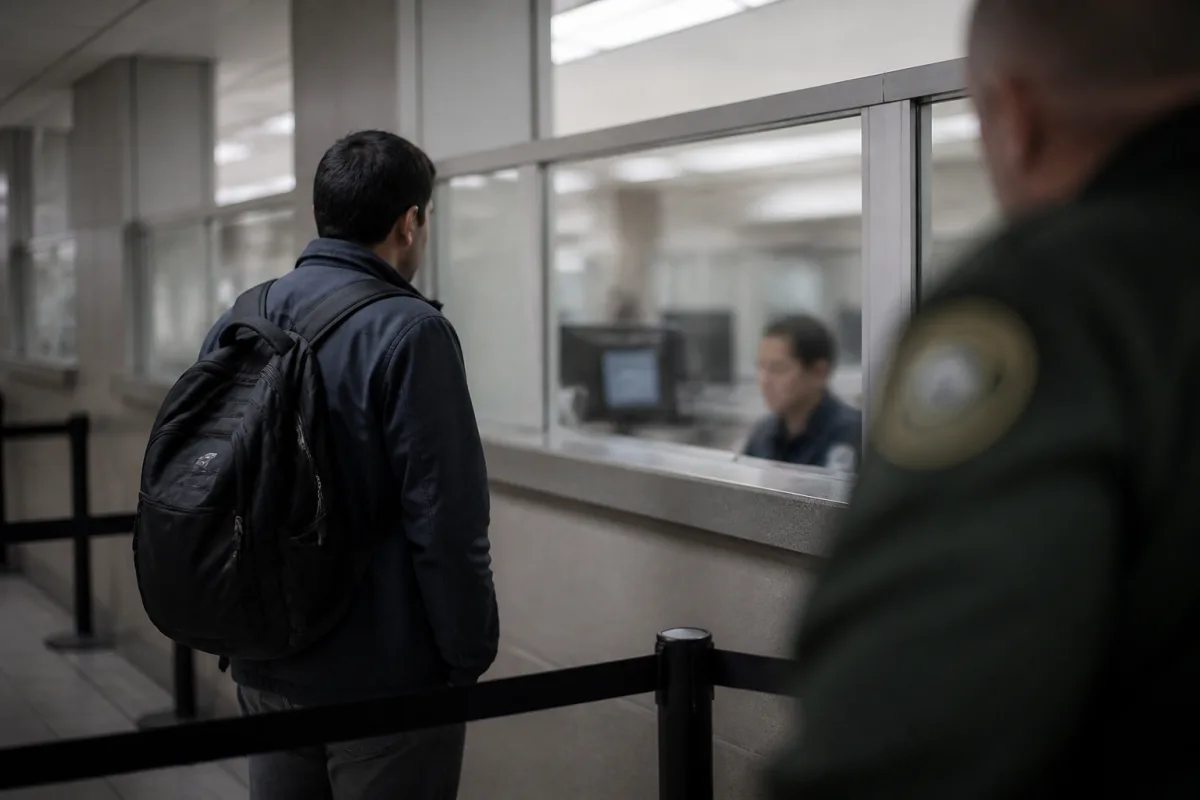
Leaving the US is only safe after I-601A is fully approved. Leave earlier, and the bar activates before the forgiveness exists.
The May 2026 memo: did it actually shut down the domestic path
In May 2026, according to media reports, USCIS issued a memo, after which headlines claimed the government wants everyone to file from their home country and that the domestic path is being shut down. The official text of this document could not be found on the USCIS website, so the analysis below relies on quoted excerpts and statements from an agency spokesperson. That headline take is a distortion of what actually happened.
Before the memo, a checklist principle applied: an applicant who entered lawfully, is in a genuine marriage, and has a clean record got the green card almost automatically — meet the statutory conditions, get the card. The memo directed officers to drop that approach and treat adjustment of status as a matter of discretion and administrative grace. The wording shifts the balance of power: meeting the criteria used to mean approval; now the applicant also has to convince the officer that they deserve the decision.
meeting the criteria used to mean approval; now the applicant also has to convince the officer that they deserve the decision
What actually fueled the panic wasn’t the memo’s text itself but a spokesperson’s statement the next day: people temporarily in the country should prepare to return home to file, barring exceptional circumstances. That’s the line that spread across the internet — but the phrase “exceptional circumstances” doesn’t appear in any operative section of the memo itself. It was press-facing rhetoric from a spokesperson, not a standard that binds the officer reviewing a case: the officer is bound by statute, not by a quote.
Congress did not pass a new law. Based on the available quotes and clarifications, the memo did not override the statute — the domestic path was not legally shut down, though the full text of the document couldn’t be independently verified. The basic eligibility conditions for adjustment of status remain the same (as covered above), but a directive is now in effect to scrutinize cases more closely within that discretionary framework. In practice, this means more requests for additional evidence, closer scrutiny of proof that the marriage is genuine, and more attention to any negative factors in the file — the application now calls for a fuller, more careful document package than before.
Four questions that determine your route
To figure out which of the two paths fits a specific couple, it’s enough to answer four questions in order.
-
Where is the immigrant spouse right now — abroad or in the US? If abroad, the only realistic option is consular processing: the applicant interviews at the embassy or consulate serving their place of residence.
-
If the spouse is already in the US — how did they enter: with inspection and admission, or without it? Lawful entry opens the door to adjustment of status. Entry without inspection generally closes it — leaving only consular processing.
-
Who is filing the petition — a US citizen or a green card holder? This determines whether the overstay-forgiveness clause applies: spouses of US citizens get overstayed time forgiven on the domestic path; spouses of green card holders usually don’t.
-
Has the applicant accrued unlawful presence that makes leaving the country dangerous? If so, and every other factor points to consular processing, the act of leaving alone triggers the reentry bar. In that case, a provisional waiver strategy needs to be built before booking any flights — otherwise, leaving turns into a trap instead of a step toward the green card.
Timeline, cost, and the conditional green card: what comes next
Both routes typically take 1 to 2 years — the common belief that consular processing is faster doesn’t hold up in practice. The external route depends on several slow-moving bodies: the case passes through the National Visa Center and then through the consulate. The NVC has a large backlog, and many consulates have significant delays scheduling interviews, so there’s often no time advantage.
The cost picture is similar: baseline expenses on both paths are comparable, and both require substantial government filing fees and a medical exam. The difference is in optional, not mandatory, payments: on the domestic path, that’s the fees for EAD and advance parole — the documents for work and travel abroad while the application is pending.
The two-year conditional green card
If the marriage is less than two years old on the day the green card is officially approved, the spouse receives not a permanent card but a conditional one valid for two years. It’s the same permanent resident status with all the same rights, but with a built-in check: the government wants to confirm, two years later, that the marriage wasn’t entered into solely to obtain documents.
Ninety days before that card expires, the marriage’s legitimacy has to be proven all over again — a joint petition to remove conditions has to be filed, with a new package of documents proving the couple has been living as married. Getting the green card, in this sense, only closes out the first stage: what follows is proving the marriage didn’t fall apart during those two years.
Frequently asked questions
Can you switch from consular processing to adjustment of status if circumstances change after filing
The material doesn’t directly address this scenario — the article covers how to choose a route using the four questions at the start of the process, but doesn’t cover switching routes after documents have already been filed.
What happens to an applicant’s child if the marriage is recent and a conditional green card applies
This falls outside the scope of the material — the article covers the conditional green card as it applies to the spouse and the requirement to prove the marriage is genuine, but doesn’t address the status of an applicant’s children in this situation.


Comments
Reader experience is useful, but it is not advice: check the rules on the official site.
No account needed: click Sign in, type any name, and you are done.