

For a 2026 N-400 interview, bring your interview notice, green card, photo ID, all passports, and marriage and tax documents — the interview itself covers a civics test, an English test, and a line-by-line review of your application by a USCIS officer.
In short
- The civics test version is set by your N-400 filing date: October 20, 2025 or later means 128 questions; earlier means the older 100-question test.
- The 2025 test stops once you hit 12 correct answers out of 20, or 9 wrong ones — after that, no more questions are asked.
- Every document is needed in both original and copy form; a missing document can stop the interview, but an extra one never has.
- Undisclosed arrests or charges are a common cause of denial: a disclosed problem is usually workable.
- Citizenship doesn’t begin at interview approval — only after taking the oath at the ceremony.
Which Civics Test You’ll Take in 2026
Since October 20, 2025, USCIS has used a new 128-question civics test. Which version an applicant takes — the 2025 test or the older 2008 test — is decided not by the interview date, but by the date the N-400 was filed.
If the N-400 was filed on or after October 20, 2025, the applicant takes the 2025 version. If the form was filed before that date, the older 2008 test applies. The difference isn’t just the version number: the two tests draw from different question pools, use a different number of questions asked at interview, and set a different passing threshold.
If you’re not sure which test applies to your case, check the date on the receipt notice for the original N-400 (Form I-797C) — that date, not the scheduled interview date, determines the test version.
A separate complication involves questions with “floating” answers: some questions ask about the current president, vice president, Speaker of the House, Chief Justice of the Supreme Court, and the applicant’s state governor and capital. These answers must be correct as of the day of the interview, not the day the applicant started studying — it’s worth checking them against a current source right before meeting the officer.
These answers must be correct as of the day of the interview, not the day the applicant started studying
The test version is determined by your N-400 filing date, not your interview date: filed on or after October 20, 2025 means the 2025 test with 128 questions; filed earlier means the older 2008 test.
How Many Questions the Officer Asks and How Many You Need Right
The officer asks questions verbally, one at a time, from the pool of 128 questions — no multiple choice, no written format, just a direct face-to-face conversation. Each question is asked exactly as worded in the official pool, without rephrasing.
For the 2025 test, the officer may ask up to 20 questions. The test stops as soon as the applicant reaches 12 correct answers — at that point the officer announces that the civics portion is passed. If the applicant reaches 9 incorrect answers before hitting 12 correct ones, the test stops there and that portion counts as not passed.
Applicants aged 65 or older with 20 or more years as a permanent resident qualify for the 65/20 exception: a simplified test drawn from a special set of 20 questions, of which the officer asks 10, with 6 correct answers needed to pass.
For the 2008 test the parameters differ: based on available information, the pool consists of 100 questions, the officer asks up to 10 of them, and 6 correct answers are typically required to pass — it’s worth confirming the current requirements on the official USCIS page before the interview.
Some questions accept more than one correct answer — naming any single valid one is enough, and the answer doesn’t need to be detailed. If an answer isn’t known, it’s better to say so directly and move to the next question: a wrong answer counts against the applicant, and blind guessing doesn’t reduce that risk.
a wrong answer counts against the applicant, and blind guessing doesn’t reduce that risk
Civics Test Passing Thresholds
How many questions are asked and how many correct answers are needed, by applicant category.
- 2025 test12 of 20Pool of 128 questions
- 65/20 exception6 of 10For applicants 65+ with 20+ years of permanent residency
The 2025 test stops once you reach 12 correct answers out of 20. If you don’t know an answer, it’s better to admit it and move on than to guess — a wrong answer counts against you.
Which Documents You Must Bring to the N-400 Interview
Arriving at the interview with incorrect or missing documents can cause a delay or a rescheduled date — so the entire packet should be assembled well in advance, not on the morning of the appointment.
The required minimum is the same for every applicant:
- Interview notice (Form I-797) — with the date, time, and address of the USCIS office; don’t leave home without it.
- Original permanent resident card (green card) — the original, not a photocopy.
- Government-issued photo ID — for example, a state driver’s license or ID card.
- All current and expired passports and travel documents covering the entire period as a permanent resident, not just the current passport — the officer uses these to verify travel history.
- Social Security card — not formally on the official list, but in 2026 it’s often requested as well to verify identity and work history.
Every document should come in both original and photocopy form: the officer may keep a copy for the applicant’s file and return the original on the spot. The general rule is to bring more documents than seem necessary: if a document is relevant to the case and there’s any doubt about bringing it, bring it. A missing document can stop an interview; an extra one has never caused a problem.
Required Document Packet for the N-400 Interview
Documents on Marriage, Taxes, and Criminal History
If the applicant is married, the interview requires a marriage certificate, and for any previous marriages, divorce decrees, annulment certificates, or a spouse’s death certificate. When filing under the three-year rule (based on marriage to a U.S. citizen spouse instead of the usual five years of residency), applicants also need proof of the spouse’s citizenship and evidence that the marriage is bona fide: joint bank statements, joint tax returns, a lease in both names, joint insurance policies.
Tax documents depend on the filing basis: the last 5 years for a standard application, or 3 years when filing based on marriage to a U.S. citizen. These are federal tax transcripts or certified copies of returns. USCIS expects the applicant to have no outstanding tax debt; if a debt exists, bring proof that it’s being resolved — for example, a payment plan.
Any records of arrests, charges, or court proceedings should be brought along, even if the case was closed or the record was sealed. Failing to disclose this information is one of the most common and serious mistakes applicants make: the right approach is to disclose everything and let the officer assess the situation, rather than deciding in advance what matters.
A separate list should cover every international trip since becoming a permanent resident: destinations and approximate dates. If there have been many trips, or any trip lasted longer than 6 months, the travel history is worth double-checking in advance, since a long absence can call the continuity of residence into question. Men required to register with Selective Service need proof of that registration.
Bring records of every arrest, charge, or proceeding, even if the case was closed or the record was sealed. Failing to disclose this information is one of the most serious mistakes applicants make.
How Interview Day Unfolds: From Arrival to the Officer’s Office
- Arrive at least 30 minutes before your scheduled time. This isn’t a buffer for running late — it’s the minimum time built in just for entering the building.
- Allow extra time for travel, parking, check-in, and security screening. USCIS offices follow a strict check-in order, and being late can affect how your application is handled going forward.
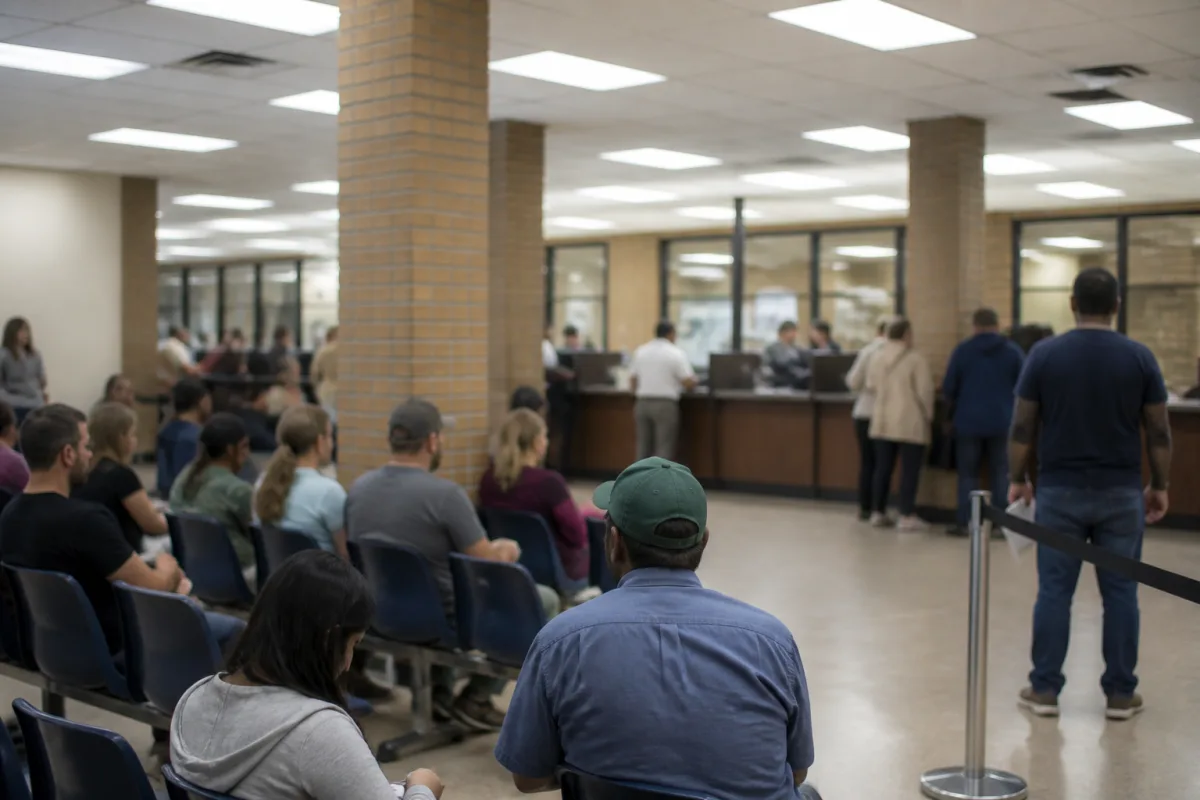
- Present your interview notice and photo ID at the front desk. After that comes security screening, then waiting until the officer calls the applicant by name.
- Once called, the applicant is taken to a private office with a USCIS officer. The interview doesn’t take place in a courtroom or as a formal hearing — it’s a private, one-on-one conversation in an office.
- The officer will ask the applicant to raise their right hand and swear to tell the truth. This oath isn’t a formality: from that point on, every answer is treated as sworn testimony.
- Answer every question honestly and accurately. If a question isn’t clear, it’s fine to ask the officer to repeat or explain it — that isn’t held against the applicant or counted as a mistake.
If attending the scheduled interview isn’t possible for any reason, USCIS must be contacted before the appointment date to reschedule it. Simply not showing up isn’t an option: the application is placed on hold, and the applicant has one year to restart the process — otherwise the application can be denied automatically.
The officer at the interview isn’t trying to catch the applicant in a mistake or intimidate them: the officer’s job is to verify whether the applicant meets the requirements for naturalization.
N-400 Interview Day: From Arrival to the Officer’s Office
The sequence of steps an applicant follows on the day of the naturalization interview.
- Arrive at the USCIS officeat least 30 minutes early
- Complete check-in and security screening
- Present interview notice and photo IDAt the front desk
- Wait to be called by name
- Go to the USCIS officer’s office
- Take the oath to tell the truth
How the English Test Works During the Interview
The English test has three parts — speaking, reading, and writing — and all three happen during the interview itself; no separate exam is scheduled for it. The officer doesn’t evaluate the ability to speak and understand English as a separate block, but throughout the entire meeting — starting from the moment the applicant walks into the office. The officer listens to how the applicant answers the N-400 application questions and responds to the civics questions, and draws a conclusion from those answers rather than from a separate “test” conversation.
The naturalization test includes two required components — English and civics — and both must be passed successfully unless the applicant qualifies for an exception or exemption based on age, length of residency, or a medical condition.
The required level isn’t native-speaker fluency — the officer only needs to confirm that the applicant can communicate in English at the level needed for everyday life.
For the reading portion, the officer offers a choice of three sentences, and reading just one of them correctly out loud is enough to pass. The sentences use simple vocabulary built around citizenship and American history — nothing specialized.
The writing portion works the same way: out of three sentences, correctly writing just one is enough. Minor errors in grammar, punctuation, or spelling don’t count as a failure — what matters is that the sentence remains understandable.
Review of the N-400 Application and the Three Possible Interview Outcomes
Besides the English and civics tests, the officer reviews the N-400 application line by line and asks questions about the applicant’s background and eligibility for naturalization. This part of the interview covers personal history: name, address, employment, marital status, criminal history (if any), travel history, and membership in organizations. The main rule here is to answer honestly and accurately: if anything on the application has changed since it was filed, it needs to be reported to the officer, including any arrests, charges, or court proceedings that weren’t previously disclosed. A disclosed problem is usually workable; an undisclosed one can lead to denial.
A disclosed problem is usually workable; an undisclosed one can lead to denial
At the end of the interview, the officer announces one of three outcomes.
- Approved. The applicant will receive a notice with the date and time of the oath ceremony. Citizenship doesn’t take effect at the moment of approval — only after taking the oath at the ceremony — and until then, the applicant can’t apply for a U.S. passport or take other actions that require citizen status.
- Continued case. If USCIS needs more information, or if the applicant didn’t pass part of the test, the case is continued and instructions for next steps are sent. If the English or civics test wasn’t passed, a second attempt is scheduled — typically within 60–90 days of the first interview. A continued case is not a denial.
- Denied. USCIS will provide a written explanation of the reason and information on how to appeal or reapply. Depending on the reason for denial, the underlying problem can often be fixed and the application refiled.
After Approval: The Oath Ceremony and What Not to Do Beforehand
Approval at the interview doesn’t make the applicant a citizen: status only changes after the oath ceremony, and USCIS sends the date and time separately. This date can’t be skipped — if attending isn’t possible, USCIS must be contacted immediately to reschedule the ceremony.
Between interview approval and the oath, two firm restrictions apply. International travel during this period should be discussed with an immigration attorney in advance — the applicant’s status at this stage requires careful handling. Registering to vote before the oath is also off-limits: voting before naturalization is complete can carry serious legal consequences, including criminal liability.
The ceremony itself is the final step of the process. It’s held at a USCIS office, courthouse, community center, or other venue: sometimes it’s a small gathering of a few applicants, sometimes a hall with hundreds of people from dozens of countries at once. At the ceremony, applicants turn in their permanent resident card, raise their right hand, and recite the Oath of Allegiance. With the final words of the oath, the applicant becomes a U.S. citizen.
Between approval and the ceremony, you can’t register to vote, and international travel should be cleared with an attorney first — your status hasn’t changed yet.
Pre-Interview Checklist: 5 Steps of Final Preparation
-
Determine your civics test version. Anyone who filed the N-400 on or after October 20, 2025 takes the 2025 test with 128 questions; anyone who filed before that date takes the older 2008 test with 100 questions. This determines which question list to review in the final days.
-
Update your answers with current officials’ names. This covers the president, vice president, Speaker of the House, Chief Justice of the Supreme Court, and the applicant’s state governor and capital — this information changes and needs to be current as of interview day, not as of the day the applicant first studied the questions.
-
Assemble your document packet. This includes the interview notice, green card, photo ID, all passports, Social Security card, tax transcripts, marriage documents (if applicable), and any other papers relevant to the specific case.
-
Practice the civics answers out loud in English. Do this as if the conversation is already happening with the officer in the office — hearing your own voice say the correct answer reinforces the material more than reading it again silently.
-
Arrive 30 minutes before the scheduled time. If there are unresolved questions about the application, travel history, taxes, criminal record, or any other aspect of eligibility for naturalization, it’s best not to walk into the officer’s room without first consulting an experienced immigration attorney.
Frequently asked questions
What happens if I miss my scheduled N-400 interview?
USCIS must be contacted before the appointment date to reschedule it — simply not showing up isn’t an option. In that case the application is placed on hold, and the applicant has one year to restart the process; failing to do so can result in the application being denied automatically.
Can I travel internationally between interview approval and the oath ceremony?
During this period the applicant’s status requires careful handling, so international travel should be discussed with an immigration attorney beforehand. Before taking the oath, the person isn’t yet a citizen, and certain actions that require citizen status aren’t available at that point.
Can I vote in an election before the oath ceremony?
No — registering to vote or voting before naturalization is complete isn’t allowed. Doing so can carry serious legal consequences, including criminal liability, so citizen status needs to be officially in place first.
Does the 65/20 exception apply to the English test too, or only to civics?
The material describes the 65/20 exception in relation to the civics test: a simplified set of 20 questions, of which the officer asks 10, with 6 correct answers needed to pass. There’s no information here about whether this exception extends to the English test.
What if the governor or another official from the test questions changes while I’m preparing?
Answers about the current president, vice president, Speaker of the House, Chief Justice of the Supreme Court, and the applicant’s state governor and capital need to be correct as of interview day, not the day preparation began. It’s worth checking these answers against a current source right before meeting the officer.
Do I need travel documentation if one of my trips lasted longer than 6 months?
Yes — a separate list of trips with destinations and approximate dates is required for every applicant, covering the entire period since becoming a permanent resident. If any trip lasted longer than 6 months, it’s worth double-checking that history in advance, since a long absence can call the continuity of residence into question.



Comments
Reader experience is useful, but it is not advice: check the rules on the official site.
No account needed: click Sign in, type any name, and you are done.