


After receiving a Notice to Appear, you need to show up for every hearing the court sets — first the master calendar hearing, then, if needed, the individual hearing — because an NTA by itself doesn’t mean deportation; it opens a process in which the respondent has the right to contest the facts and apply for relief.
In short
- An NTA must state specific grounds for removal — the respondent can contest the facts or accept them while applying for relief.
- Appearing at the hearing is mandatory regardless of detention risk at the courthouse — avoiding it doesn’t remove that obligation.
- You can leave the country without notice only before a court date is set — after that, a no-show leads to a removal order in absentia.
- If an I-485 is still pending with USCIS, the applicant can raise that with the judge as part of the relief being sought.
- Showing up at least for the master calendar hearing to request voluntary departure is safer than simply not appearing.
What a Notice to Appear is and how removal differs from deportation
An NTA is a charging document: the law requires the government to state why it was issued to this specific person. Near the top of the form there’s a numbered list — the specific grounds on which the person was placed into removal proceedings.
It’s worth not confusing two terms. Removal is the process in which the government must first prove removability — that grounds for removal actually exist. Only after that is a person moved into deportation proceedings. Until removability is established, talking about deportation is premature.
After receiving an NTA, the respondent — the term used for the person the case is against — isn’t required to simply agree with what’s written. There are two paths: contest the facts stated in the document, arguing they’re incorrect, or accept the facts as accurate while still applying for relief — a form of protection that allows someone to stay despite the stated grounds.
The government must first prove removability — that grounds for removal exist. Only after that do deportation proceedings begin.
Do you have to appear in person, and how to appear online
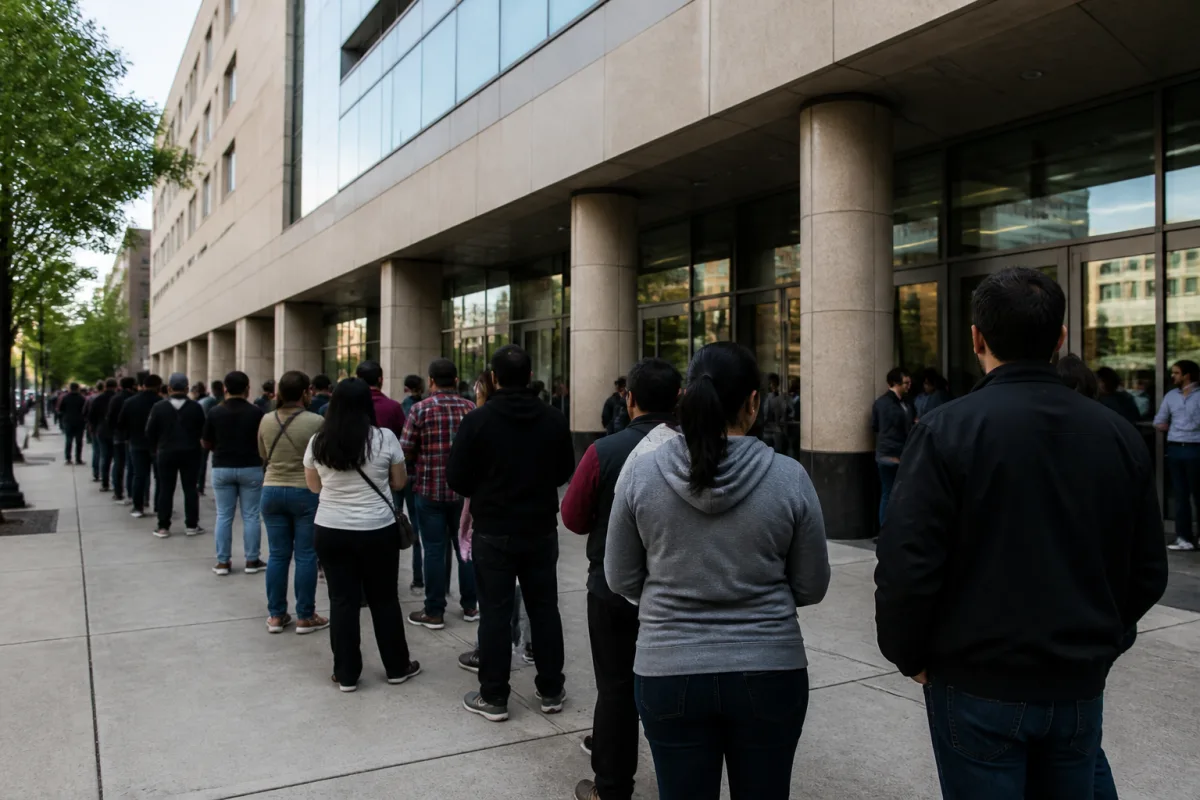
Appearing at the hearing is mandatory, even if there’s a risk of being detained right at the courthouse: the respondent is required to comply with immigration court requirements regardless of which state the case is in. The chance of detention at the courthouse is higher now than before, and that applies to any state and any immigration court — but avoiding the hearing doesn’t remove the obligation to attend.
avoiding the hearing doesn’t remove the obligation to attend
The form of appearance is usually stated in the NTA itself: the document says whether you need to appear in person or can appear online. For remote hearings, immigration courts often use the Webex platform. If the NTA doesn’t specify the form of appearance, it’s worth appearing online together with an attorney — that satisfies the formal requirement to appear, even without being there in person.
It’s also worth checking the first hearing date against the calendar: sometimes it falls on a federal holiday or a day when courts are closed. That can become grounds to argue the charging document was issued incorrectly.
The chance of being detained right at the courthouse is higher now than before, but that’s not a reason to skip the hearing: the obligation to attend remains regardless.
Master calendar hearing: what it is and how it works
The master calendar hearing is the first, initial court date in the case — a kind of organizational session ahead of the main proceeding. You need to bring the NTA itself: it’s the document that shows why the respondent appeared in court on that particular day.
For in-person appearances, expect security screening similar to an airport: belt off, pockets emptied. For an online hearing, the respondent simply turns on the microphone and tells the judge they’re present. After that, the attorney speaks on their behalf — there’s no need to answer on your own unless the judge asks you a direct question.
These hearings usually move fast — minutes from the moment you’re called up — and the respondent isn’t alone in the room: other respondents are often present at the same time, frequently with family members, interpreters, a court clerk, and a bailiff. That’s normal, though the number of people in the room can be unsettling for someone in immigration court for the first time.
At the hearing, the judge reads out the pleadings — the charges from the NTA. The attorney responds to each point individually: they may fully agree (“we concede” — meaning the charge isn’t contested) or accept some points while contesting others. The judge then asks what relief the respondent is applying for — for example, an application already filed with USCIS, an asylum claim, or an SIJ petition for a minor. Usually the attorney states the specific type of relief on the respondent’s behalf.
After that, the judge sets a deadline for filing the application for the chosen relief — typically a few months — and sets a date for the individual hearing, where the case will be decided on its merits.
What happens at a master calendar hearing
The first organizational hearing follows a fixed sequence of steps.
- The respondent arrives with the NTA in hand
- In-person appearance: airport-style security screening
- The judge reads out the pleadings — the charges from the NTA
- The attorney agrees with the points or contests them
- The judge asks about the type of relief sought
- The judge sets a filing deadline and the individual hearing date
The individual hearing, and what happens to an I-485 filing during the case
After the master calendar hearing, the case is set for an individual hearing — this is the actual trial, where facts, testimony, and, if necessary, experts are presented. A significant amount of time usually passes between these two dates — court backlogs can stretch it out considerably.
A separate situation comes up for family-petition applicants who were denied, refiled Form I-485, and then received an NTA. USCIS and immigration court are separate bodies, and USCIS keeps reviewing the application on its own track regardless of the court case. If the refiled I-485 is still pending when the NTA is received — and that review can take a considerable amount of time — the applicant may tell the judge about the pending USCIS application as part of the relief being sought.
The judge may continue the case for a long time to wait for a USCIS decision. But the reverse can also happen: USCIS states it won’t decide until the judge rules, while the judge, in turn, is waiting on USCIS. In that case, the applicant ends up stuck between two agencies, each waiting on the other, and it’s hard to break that loop on your own.
USCIS states it won’t decide until the judge rules, while the judge, in turn, is waiting on USCIS
Can you leave the country after a denial without waiting for court
If all you have is a denial letter — a letter stating the denial — and no court date has been set yet, you can leave the country without notifying the authorities. A common reason for this choice is the cost of the process: filing fees and attorney services are expensive, and a person decides to stop fighting the case and leave on their own.
The denial letter itself gives a certain window to respond: during that time you can file a motion to reopen, a motion to reconsider — or plan to leave. If you choose to leave at this stage — before a court date is set — it doesn’t formally violate the process, but the decision should be checked with an attorney, since the status of the case with USCIS can change.
The situation changes as soon as the government points to the person’s immigration history in the country and sets a court date. From that point on, simply leaving is no longer an option: the hearing will happen regardless, the person’s name and alien number will be called in the courtroom, and if neither the applicant nor an attorney representing them is present, a deportation order will be issued in their absence.
the person’s name and alien number will be called in the courtroom, and if neither the applicant nor an attorney representing them is present, a deportation order will be issued in their absence
As long as no court date has been set, you can leave the country without notifying the authorities, but the decision should be checked with an attorney — the case status with USCIS can change.
What happens if you don’t show up after a court date is set
Leaving the country after a court date has already been set doesn’t cancel the hearing: it will happen regardless, and the respondent’s name along with their case number (alien number) will still be called in the courtroom. If neither the person nor an attorney stating representation is present on that date, the court issues a removal order in absentia — that is, without the respondent present.
No one will check whether the person actually left the country and got on a plane: the court simply records the fact of the no-show and issues a deportation decision on that basis. An in absentia removal order is dangerous beyond the decision itself: even years later, if the person wants to return to the country, challenging that kind of order is significantly harder than challenging one issued with the person present.
There’s a cleaner option — show up at least for the master calendar hearing and ask for voluntary departure. That’s not a removal order: voluntary departure is a separate legal status that records the respondent notifying the court of their own decision to leave the country, rather than simply failing to appear.
Failing to appear on the set date leads to a removal order in absentia — that kind of order is significantly harder to challenge years later than one issued with the person present.
In absentia removal order vs. voluntary departure
| Criterion | Removal order in absentia | Voluntary departure |
|---|---|---|
| How it arises | Failing to appear on the set court date | The respondent notifies the court of their own decision to leave |
| Is appearing in court required | No — it’s issued without the person present | Yes, at least at the master calendar hearing |
| Ability to challenge it later | Significantly harder than when issued with the person present | A separate legal status, not a removal order |
Frequently asked questions
What should I do if the NTA arrives while an asylum case is still pending with USCIS?
If another application — such as an asylum claim — is already filed and pending with USCIS when the NTA is received, the respondent can inform the judge about it as part of the relief being sought. The judge may continue the case to wait for a USCIS decision, though the reverse can also happen, with both agencies waiting on each other.
How much time does the judge give to file an application for relief?
After the respondent states they’re applying for a specific form of relief, the judge sets a deadline for filing the corresponding application — usually a few months — after which the individual hearing date is set.
What happens if voluntary departure isn’t completed on time?
Voluntary departure is a separate legal status recorded by the court as the respondent’s own decision to leave the country, not a removal order. If the conditions of voluntary departure aren’t met, that status stops applying, but the exact consequences in that case aren’t known.
Can a removal order issued after an individual hearing be appealed?
This question goes beyond what’s covered here regarding the master calendar hearing, the denial letter, and an in absentia removal order, so there’s no basis to answer it.


Comments
Reader experience is useful, but it is not advice: check the rules on the official site.
No account needed: click Sign in, type any name, and you are done.