
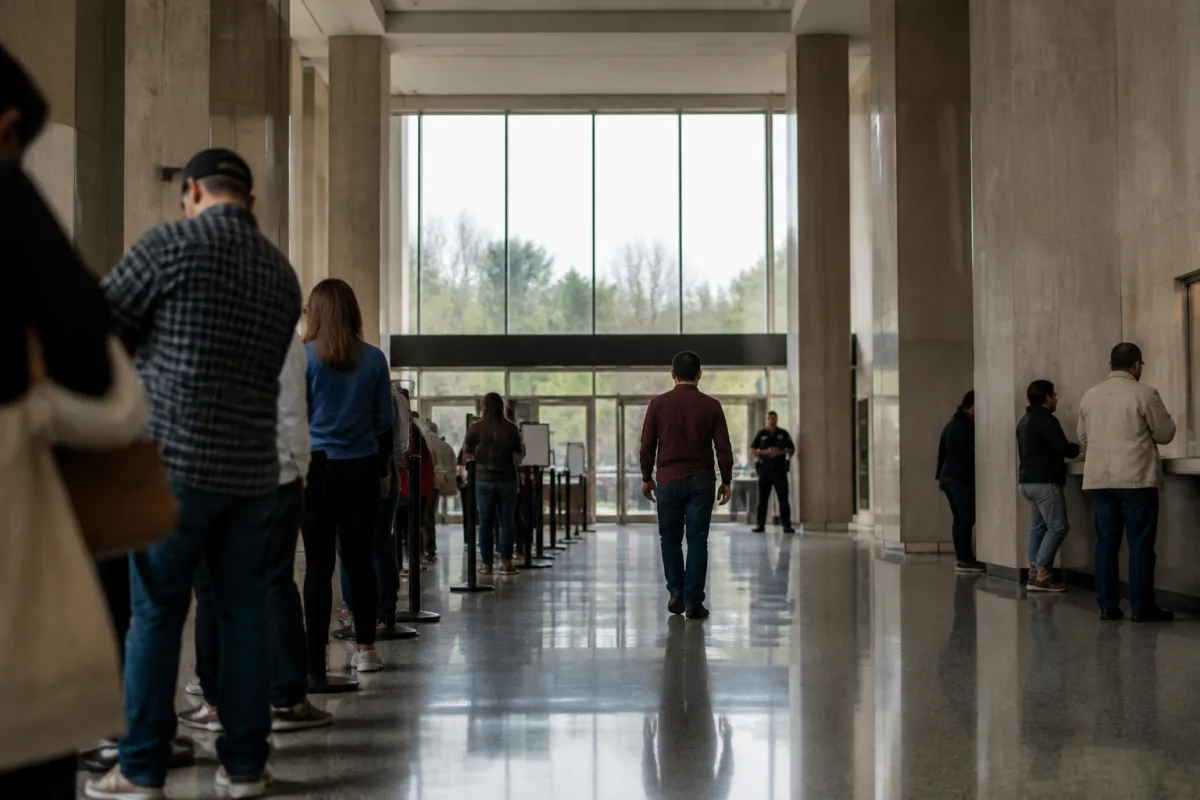

If your spouse fails to show up for a joint I-751 interview, the USCIS officer is effectively required to deny the petition and place you in removal proceedings — but you can switch the filing category to divorce, abuse, or extreme hardship and still get approved without a joint appearance.
In short
- A spouse’s no-show at a joint I-751 interview typically leads to denial and the start of removal proceedings.
- You can go through the interview on your own under three grounds: divorce, abuse, or extreme hardship.
- Switching to the divorce category requires the original divorce decree bearing the court’s seal — a copy won’t do.
- I-751 processing takes 1.5 to 3 years, while the conditional green card is only valid for 2 years.
- If the case reaches court, you can request de novo review of the original petition or file a new I-751 in parallel.
What happens if your spouse doesn’t show up for the I-751 interview
If an interview is scheduled for a jointly filed I-751 and your spouse doesn’t show up, the USCIS officer will typically deny the petition: a joint filing requires both spouses to be present. Denial is usually followed by the start of removal proceedings, and from that point you have to defend your case in immigration court.
If the interview is still some time away — say, around 30 days out — it’s worth asking USCIS for a reschedule. This usually requires proof of the reason: for a medical issue, that might be a doctor’s note. USCIS reviews these requests case by case, and there’s no way to predict in advance how soon the new date will be.
A postponement doesn’t solve the underlying problem on its own: if your spouse definitely won’t appear, the only real option is to switch the I-751 filing category before the interview so you can go through it on your own.
A postponement doesn’t solve the underlying problem on its own: if your spouse definitely won’t appear, the only real option is to switch the I-751 filing category before the interview so you can go through it on your own.
If your spouse doesn’t appear for a joint I-751 interview, the officer will typically deny the petition, and removal proceedings follow — meaning you’ll be defending your case in immigration court.
Option 1: Switch to a divorce-based waiver with proof of a good-faith marriage
You can file the I-751 on your own, without your spouse, by changing the petition category from a joint filing to a waiver of the joint filing requirement based on divorce. In some states, divorce can be finalized quickly — in Nevada, for example, the process moves fast enough that a petitioner can get a final court judgment before the interview date arrives.
To switch categories, you’ll need the original divorce decree bearing the court’s seal or stamp — a copy or an unsealed order won’t be accepted. This document is submitted along with the amended I-751 and evidence that the marriage was entered into in good faith in the first place, not to obtain a green card.
On top of the evidence you would have submitted for a joint filing, it’s worth adding a detailed written statement — USCIS doesn’t set a required page count, it asks for credible evidence, not a specific length. A useful approach is to walk through the relationship chronologically: how you met, how you started living together, what difficulties arose in the marriage, and what ultimately led to the divorce. The point of the statement is to close off any doubt the officer might have about whether the marriage was genuine.
At the interview itself, bring the final divorce decree, the amended I-751, and as complete a package of good-faith marriage evidence as possible — this improves the odds of approval without your ex-spouse’s participation.
You can file the I-751 on your own by switching to the divorce category: you’ll need the original divorce decree with the court’s seal plus evidence that the marriage was entered into in good faith.
What to bring to the interview when filing on divorce grounds
Option 2: Filing I-751 based on abuse
If the marriage involved abuse or extreme cruelty, the I-751 category can be changed to the abuse-based waiver — a separate ground for waiving the joint filing requirement. In this case your spouse isn’t needed at the interview at all.
At the interview, bring the amended I-751 and strong evidence that you were subjected to abuse during the marriage. That evidence — not your spouse’s presence — is what the approval hinges on.
If you’re claiming both abuse and extreme hardship at the same time, bring evidence for both grounds together, along with the amended I-751 — this improves your chances of approval.

Option 3: The extreme hardship category
The third ground for a joint filing waiver is proving extreme hardship: showing that removal to your home country would cause you extreme hardship. The source doesn’t specify whose hardship exactly needs to be proven — the law refers to extreme hardship in general terms. In practice, this usually means hardship to the immigrant who stands to lose status, but it can also rest on hardship to other people in the US — for example, the petitioner’s children.
Proven extreme hardship from removal is, on its own, a valid ground for approving the I-751 without your spouse appearing at the interview in person. If you’re filing on this ground together with the abuse ground, bring evidence for both categories at once along with the amended I-751 — that combination improves the odds of approval.
Three grounds for an I-751 joint filing waiver
The evidence required to get approved without your spouse
- DivorceOriginal divorce decree bearing the court’s seal
- AbuseEvidence of abuse during the marriage
- Extreme hardshipEvidence of extreme hardship from removal
Divorcing but not divorced yet: why being ‘in between’ is dangerous
If, at the time of the interview, you’re still formally married — even if the divorce has already been filed and is pending — the USCIS officer will deny the petition if both spouses fail to appear for a joint interview. There’s no recognized in-between status: legally, a petitioner is either married or divorced, and USCIS doesn’t recognize a third option.
There’s no recognized in-between status: legally, a petitioner is either married or divorced, and USCIS doesn’t recognize a third option.
I-751 processing after filing takes roughly 1.5 to 3 years, so it’s better to decide the fate of the marriage early — you have about a year from the time the petition is filed to do that. The worst-case scenario is waiting until the last minute and ending up ‘almost’ divorced a few months before the interview: the divorce process itself can drag on for six months or longer depending on the jurisdiction.
The rule is simple: by the time the I-751 is filed, the petitioner should be either fully divorced or fully married — with no in-between state. Filing as a still-married couple, or with a finalized divorce plus good-faith marriage evidence, are the most reliable grounds; abuse and extreme hardship are better treated as fallback options.

If the marriage isn’t formally dissolved by the interview date, the officer will deny the petition if the spouse doesn’t appear — USCIS doesn’t recognize an in-between status.
If the I-751 has already been denied: filing a new petition and review in court
After an I-751 denial and the start of removal proceedings, there are two paths forward.
-
File a new I-751 under a different category right away. The hope is that USCIS processes it quickly enough that the case doesn’t reach a notice to appear and immigration court. In practice, though, the case is often referred to court anyway.
-
If the case is already in court, ask the judge to review the I-751 directly. This is a second chance at approval for the same petition. If the original denial was specifically due to the joint filing requirement, and the petitioner and spouse have since reconciled and are living together again without divorcing, you can request de novo review — a review ‘from scratch.’ The judge schedules a hearing, accepts new evidence, hears testimony from both spouses and witnesses, and issues a ruling: if the judge finds the marriage genuine and ongoing, the I-751 can be approved right there as a defense against removal.
if the judge finds the marriage genuine and ongoing, the I-751 can be approved right there as a defense against removal
- At the same time, you can file a new I-751 under a different category even while already in removal proceedings. Under the rules, the court must give USCIS time to review this new petition. To do that, you submit proof of filing — the receipt notice — along with an explanation to the judge, and then request a continuance until USCIS decides.
If the new petition is approved, conditional status is removed, and you can seek to terminate the removal proceedings. If it’s denied, your remaining options are a de novo review of the earlier I-751 or another ground of relief from removal.
What to do after an I-751 denial
Three courses of action once removal proceedings have started
- File a new I-751 under a different categoryHoping USCIS processes it before the case reaches court
- Ask the judge for de novo review of the prior petitionIf the denial was solely due to the joint filing requirement and the spouses are back together
- File a new I-751 while already in removal proceedingsThe court must give USCIS time to review it
I-751 processing times and planning ahead
I-751 processing after filing takes 1.5 to 3 years in most cases. That’s worth keeping in mind if the marriage is going through a rough patch: conditional permanent residence lasts two years, and before that period runs out, you need to decide the marriage’s fate — stay together or divorce — before the deadline to file the petition to remove conditions arrives.
The worst-case scenario is putting off that decision until the last few months before filing or the interview. If spouses separate shortly before the I-751 is filed, the petitioner ends up in an ‘in-between’ status: the marriage isn’t officially over on paper, but it’s effectively already finished. The sooner the divorce-or-stay decision is made, the easier it is to prepare the petition under the right category before the conditional green card expires.
I-751 review takes 1.5–3 years against a 2-year conditional green card — the decision to stay married or divorce should be made well before filing.
Frequently asked questions
Can I file the I-751 early, before the marriage has fully ended, just to be safe?
No: at the time of filing, the petitioner must be either fully divorced or fully married — USCIS doesn’t recognize an in-between status. If the divorce isn’t finalized yet, the petition is filed jointly, and both spouses must appear at the interview, or the petition will be denied.


Comments
Reader experience is useful, but it is not advice: check the rules on the official site.
No account needed: click Sign in, type any name, and you are done.