
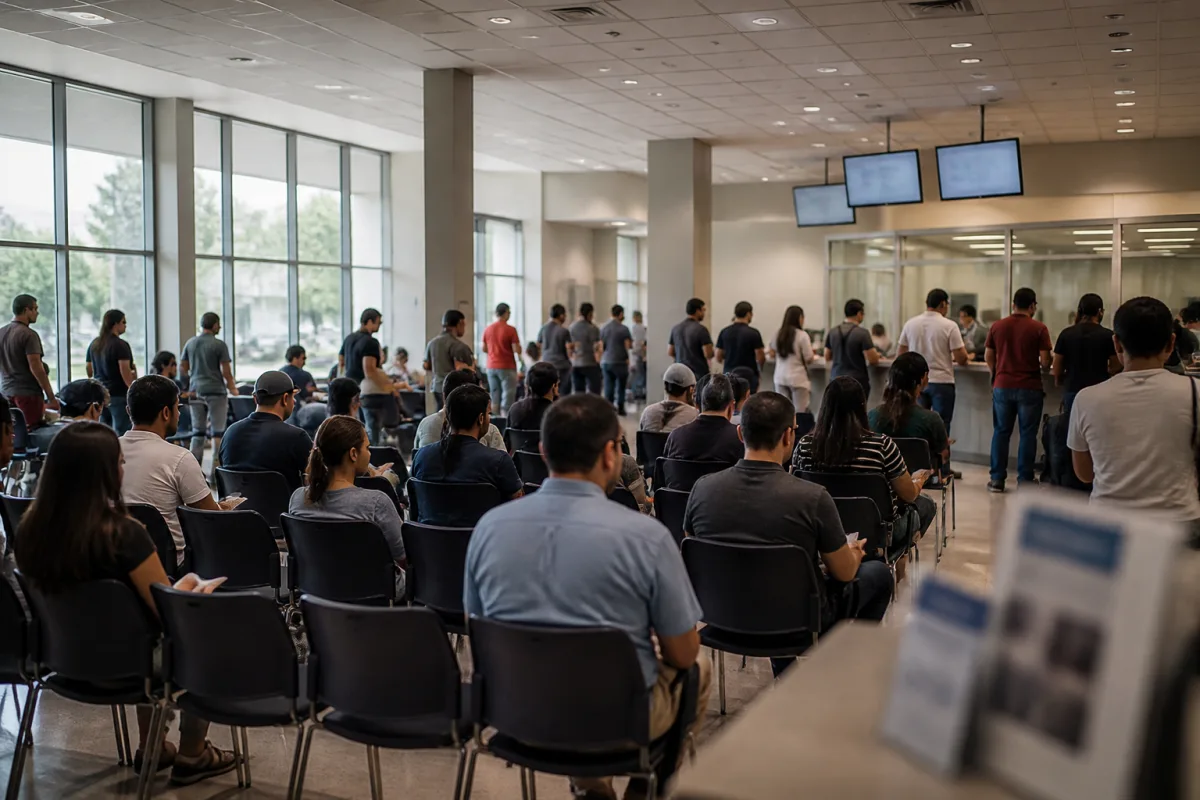

To check your place in line on the November 2026 Visa Bulletin, find the priority date on your I-130 or I-140 notice and compare it to the cutoff for your category and country of birth in the Dates for Filing chart.
In short
- Family categories F1, F2B, F3, and F4 advanced by a full 12 months in November on the Final Action Dates chart.
- EB-2 moved 3 months forward to April 1, 2025; EB-3 moved 1 month forward to June 15, 2024.
- The Dates for Filing cutoffs for EB-2 and EB-3 did not change in November compared with October.
- For category F2A (spouse of a green card holder), filing Form I-485 is open for every country with no date restriction — status Current.
- Clearing the priority date cutoff is not the same as approval: case readiness and USCIS or consulate workload decide separately.
How to find your priority date and compare it to the bulletin
-
Open the bulletin and determine which chart applies. The document contains two charts: Final Action Dates, which show how far the government has gotten in issuing visas or approving green cards, and Dates for Filing, which let applicants start the process earlier. For filing Form I-485 inside the United States, USCIS decides each month which of the two charts applicants may use. For November 2026, USCIS selected the Dates for Filing chart as the more favorable option for both family-based and employment-based applicants.
-
Find your priority date. Take your I-130 notice (family-based) or I-140 notice (employment-based) and locate the Priority Date line. This date determines the applicant’s place in line. In family cases, the priority date is usually the day USCIS received a properly filed family petition. In employment cases, the clock may start from the filing of the labor certification or from the filing of the immigrant petition, depending on the process. What matters is the filing date, not the date the petition was approved.
-
Select the right category and country in the chart. The relevant column depends on the applicant’s country of birth, not the citizenship on their current passport and not their actual place of residence.
-
Compare your date to the cutoff in the chart. The priority date must fall before the cutoff listed in the bulletin. An exact match — same day as the cutoff — does not meet the condition; that date is not yet considered current.
An exact match — same day as the cutoff — does not meet the condition; that date is not yet considered current.
USCIS decides each month which chart — Final Action or Dates for Filing — applies to I-485 filings. For November 2026, the more favorable Dates for Filing chart is in effect.
Family-based visas: which categories moved forward in November
In November, four family-based categories advanced by 12 months on the Final Action Dates chart.
| Category | Who it covers | New priority date cutoff |
|---|---|---|
| F1 | Unmarried sons and daughters of U.S. citizens, age 21+ | 01/22/2021 |
| F2B | Unmarried sons and daughters of green card holders, age 21+ | 08/22/2020 |
| F3 | Married children of U.S. citizens | 10/22/2015 |
| F4 | Siblings of U.S. citizens | 10/22/2012 |
Example: an applicant in the F1 category has a priority date of February 10, 2020. In October, that date fell after the cutoff and did not yet qualify for final approval. In November, the cutoff moved to January 22, 2021, placing the applicant’s date ahead of it — the queue restriction is lifted. From there, case readiness, visa number availability, and the rest of the requirements for that specific application take over. A cutoff advancing by a year does not mean every applicant’s wait shrinks by exactly a year: the bulletin shows the state of the queue, not a personal visa issuance date.
Family categories: how far the cutoff moved in November
All four categories moved 12 months forward on the Final Action Dates chart.
- F1 (children of U.S. citizens, 21+)
- F2B (children of green card holders, 21+)
- F3 (married children of U.S. citizens)
- F4 (siblings of U.S. citizens)
A cutoff moving forward by a year doesn’t mean a specific applicant’s wait shrinks by exactly a year: the bulletin shows the state of the queue, not a personal visa issuance date.
Employment-based visas EB-2 and EB-3: new cutoffs for November
On the Final Action Dates chart, EB-2 advanced by 3 months, to April 1, 2025. EB-3 for skilled workers and professionals advanced by 1 month, to June 15, 2024. Other workers under EB-3 have a separate line with its own dates.
For those still preparing to file their green card application, the following priority date cutoffs apply in November:
| Category | Chart | November cutoff |
|---|---|---|
| EB-2 | Final Action Date | April 1, 2025 |
| EB-2 | Dates for Filing | March 15, 2026 |
| EB-3 (main line) | Final Action Date | June 15, 2024 |
| EB-3 (main line) | Dates for Filing | August 1, 2024 |
Compared with October, the Dates for Filing cutoffs did not change. The advance on the Final Action Dates chart did not widen the pool of people who can file in November.
The Dates for Filing cutoffs for EB-2 and EB-3 are unchanged from October — the Final Action advance didn’t widen the pool of people who can file in November.
Spouse of a green card holder: category F2A and filing Form I-485
A spouse of a green card holder falls under category F2A — which also includes unmarried children under 21. On the Dates for Filing chart, this category shows the letter C — Current — for every country. That means there is no priority date restriction at the filing stage; this was true in October and remains true in November.
Because of this, someone already in the United States who meets all other requirements may be able to file Form I-485 even on a very recently filed petition.
But the fact of marriage to a green card holder does not mean any immigration history can be fixed simply by filing paperwork. Eligibility to adjust status inside the country is reviewed separately from where things stand on the chart — in both family-based and employment-based cases. As a general rule, admission after inspection at the border or entry under parole matters, but even that is not enough: status compliance and possible violations also have to be assessed — for example, unauthorized employment or overstaying authorized presence. Both types of violations can complicate adjustment of status through a green-card-holder spouse, though the final outcome depends on the specific facts of the case.
For spouses of U.S. citizens, the rules in this area differ. It’s also worth noting: a pending asylum application does not by itself confer lawful immigration status — even when formal conditions are met, a separate favorable USCIS decision based on the facts of the case is still required.
A pending asylum application does not by itself confer lawful immigration status
One practical option is to request work authorization on Form I-765 at the same time as filing Form I-485. Absent another valid basis for employment, work is only permitted once that authorization is issued and its validity period begins.
Unauthorized employment or overstaying authorized presence can complicate a green card case through a spouse, even when the priority date is Current.
Filing from outside the U.S. — and why the bulletin is not a visa guarantee
For those waiting on a visa outside the United States, the process runs not through USCIS but through the National Visa Center (NVC) and the U.S. consulate where the case is filed. Instead of Form I-485, used for adjustment of status inside the country, applicants file Form DS-260, following the NVC’s instructions.
Having a priority date fall within the right chart does not mean an interview follows immediately. The interview date depends on case readiness and on whether the consulate can schedule an appointment — each post has its own workload. It’s the same principle as with the priority date itself: the cutoff moving forward doesn’t mean the process is complete — the interview is scheduled separately, based on case readiness and the consulate’s workload.
The cutoffs in these charts are not fixed: each month the government chooses anew which chart to use, and dates can move forward or retreat. So the benchmark for filing isn’t the month an applicant decides to act, but the month in which the agency actually receives the documents.
The cutoffs in these charts are not fixed: each month the government chooses anew which chart to use, and dates can move forward or retreat.
Frequently asked questions
What happens if my priority date is exactly the same as the cutoff date?
An exact match between your priority date and the chart’s cutoff does not meet the condition — that date is not yet considered current. You need to wait until the cutoff moves past your date, or until your priority date falls before the listed value.
What happens if the cutoff moves backward next month?
The cutoffs in these charts are not fixed: each month the government chooses anew which chart to use, and dates can move forward or retreat. If the cutoff drops below your priority date, your eligibility to file or receive final approval for that period disappears until the next advance.
Can I start working right after filing I-485 and I-765, without waiting for the work permit?
No: absent another valid basis for employment, you may only work once your Form I-765 work authorization is issued and its validity period begins. Filing that form alongside I-485 does not by itself grant work authorization.
Do I need to refile if the government switches charts the following month?
The benchmark for filing isn’t the month an applicant decides to act, but the month in which the agency actually receives the documents. If one chart was in effect when you filed but the cutoff is assessed as of the date the package is received, it’s that receipt date that determines which rules apply.



Comments
Reader experience is useful, but it is not advice: check the rules on the official site.
No account needed: click Sign in, type any name, and you are done.