
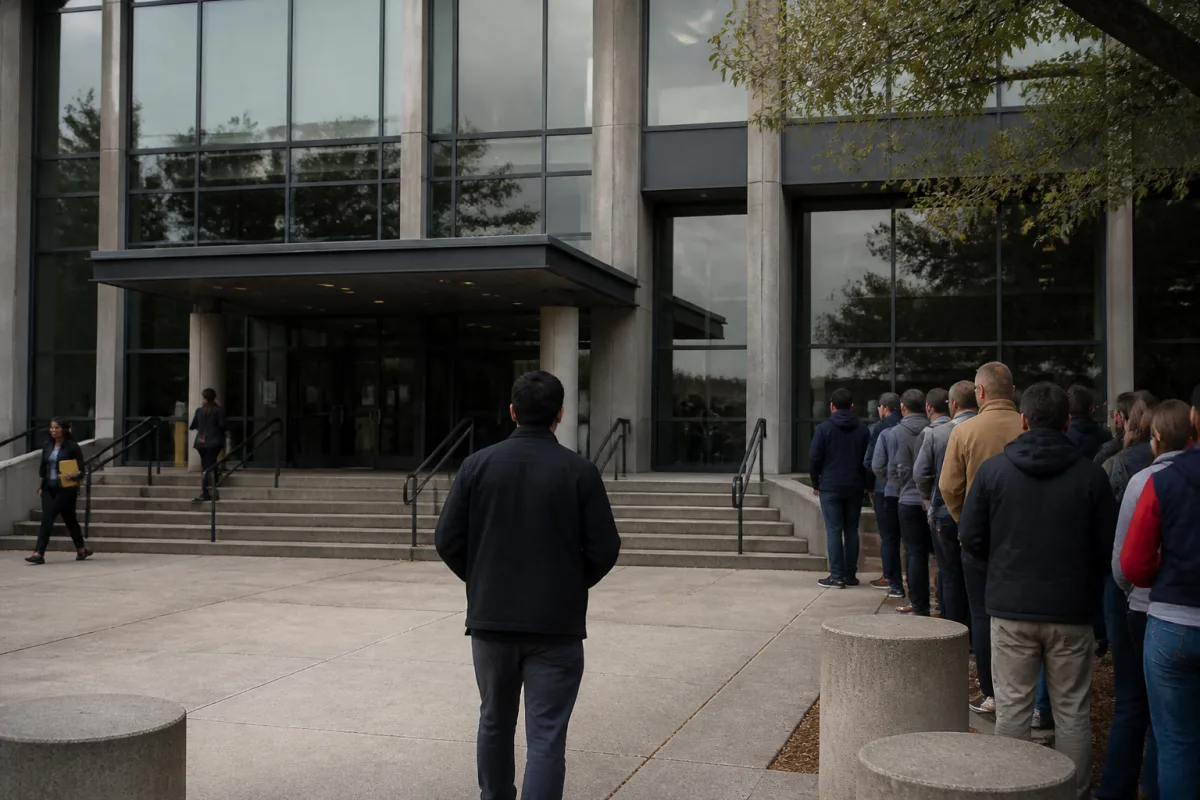

In 2026, USCIS introduced six new screening measures for applicants: the end of mandatory requests for additional evidence, a wet-ink signature requirement, a new Public Charge test, a memo expanding officers’ discretionary authority, broader data-sharing between agencies, and the use of artificial intelligence in case review.
In short
- A USCIS officer can deny a case without issuing an RFE or NOID right at filing if initial evidence is missing — there may be no second chance.
- Since July 10, 2026, documents must be signed by hand only: an e-signature like DocuSign leads to denial with no fee refund.
- Since September 18, 2026, Public Charge review weighs five factors, and in some cases applicants are offered a bond covering five years ahead.
- Since May 21, 2026, adjustment-of-status interviews include four new questions about why that path was chosen over consular processing.
- USCIS now shares data with banks, the IRS, and the TSA — an old tourist visa application can contradict the career history described in a case.
No more guaranteed RFEs: USCIS can now deny without asking for evidence
The rule applies to any petition or application filed with USCIS — green cards, work permits, status changes, parole renewals — and it covers both new filings and cases that have already been pending for years.
Under the old rules, an officer who found a gap or missing document was required to first issue a Request for Evidence (RFE) or, in more serious cases, a Notice of Intent to Deny (NOID) — essentially a last chance to fix the problem. That standard dated back to 2021, when officers were instructed to issue an RFE or NOID whenever additional evidence could plausibly establish eligibility.
RFEs and NOIDs haven’t been formally eliminated, but whether to issue one is now entirely up to the officer. There are three possible paths: deny outright if the required initial evidence is missing from the filing; deny outright if it’s clear the applicant doesn’t meet the requirements for the specific benefit sought; or still issue an RFE.
Initial evidence means the documents and proof that the statute, regulations, and USCIS instructions require to accompany a specific form from the outset. The list is published on each form’s official page, under a dedicated tab for required evidence. The burden of proof rests on the applicant: it’s up to them to check that list and establish eligibility at the time of filing — and to keep meeting that eligibility all the way through to the final decision.
If an RFE is issued, the response deadline depends on the form type and can run up to 12 weeks — the exact deadline is stated in the request itself, and there’s no extension. NOID response windows are shorter, typically 30 days. That makes a complete, properly assembled document package at initial filing more critical than ever: there may simply be no second chance to fix a mistake.
there may simply be no second chance to fix a mistake
What a USCIS officer does now instead of requesting evidence
Since 2026, the officer chooses one of three paths at their own discretion.
- Deny outrightif required initial evidence is missing
- Deny outrightif it’s clear the applicant doesn’t meet the benefit requirements
- Issue an RFEup to 12 weeksthe response deadline is stated in the request itself, with no extension
An officer can deny a case outright, without an RFE or NOID, if required initial evidence is missing at filing or if it’s clear the applicant doesn’t meet the eligibility requirements.
Wet-ink signature requirement in effect since July 10, 2026
The second change took effect on July 10, 2026, and governs how applicants sign documents submitted to USCIS. It applies in full to any new filing submitted after that date; filings submitted before July 10 are not affected. The rule covers every form and petition regardless of filing method — by mail or online.
The rule requires a personal, handwritten signature from the applicant or whoever is required to sign a given document. Two methods are allowed: sign by hand and mail the original, or sign by hand and submit a scan — but in that case the original must be kept on file.
E-signature tools like DocuSign are not allowed, nor is cutting a signature from an old document or copy-pasting the same signature across every document in the case. The one exception is filing through an official USCIS online account: that system has its own built-in e-signature mechanism, which works inside a secured account and is treated differently from a signature inserted via third-party software.
Violating the signature rule results in a denial — not a rejected, returned package. The case is accepted for processing, the applicant waits for a decision, and only once an officer actually reaches the file and spots a noncompliant signature does the denial come down. All filing fees paid are non-refundable: the applicant loses both the waiting time and the money.
Violating the signature rule results in a denial — not a rejected, returned package
DocuSign, a copy-pasted signature, or a signature cut from an old document all lead to denial — with no refund of filing fees.
The new Public Charge test: five factors and a bond, effective September 18, 2026
The third change took effect on September 18, 2026, and concerns Public Charge status — the likelihood that an immigrant will become a financial burden on the government, requiring public funds for support or medical care.
When reviewing a case, the officer weighs five statutory factors: age, health, assets, financial status, education and skills, and family status. Beyond these, the officer may also consider any other circumstances relevant to the decision.
Not every public benefit counts toward this test. The rule is simple: if a benefit requires proof of income below a certain threshold, it counts against the applicant. If the benefit amount doesn’t depend on income level, it isn’t counted.
The test applies to nearly all family- and employment-based immigration categories, including Form I-485 adjustment of status filed inside the US. It also applies to applicants going through consular processing — though a separate set of State Department and consular instructions governs that track, distinct from USCIS rules. At the consular interview, officers ask about planned residence, job offers, expected salary, insurance arrangements, and savings. Immigrant visas are still issued after this review.
If an officer concludes that an applicant may become a public burden in the future but otherwise qualifies for a green card, the applicant may be offered the chance to post a bond. The bond guarantees that the government won’t have to cover the immigrant’s support or medical care out of pocket. If the bond is posted correctly and on time, the green card may be approved — but posting a bond doesn’t guarantee approval, and not every applicant is offered one. The bond amount is calculated based on the public assistance the applicant could potentially claim over the following five years.
The new rules apply to applications filed on or after September 18, 2026: cases already pending are not reopened under the new standard. But even for applications filed before that date, officers may still ask — and in practice do ask — interview questions about receiving public benefits. Any history of benefits received should be something the applicant can explain. If a benefit can be declined without serious consequences, declining it is advisable; if the applicant genuinely needs it, the decision is theirs to make. The rule itself is currently being challenged in court, but its enforcement hasn’t been blocked or paused. The test applies to those seeking to obtain a green card while inside the United States.
If a benefit can be declined without serious consequences, declining it is the safer move — but any past benefit received should be something you can explain at the interview.
The discretion memo: new interview questions for adjustment of status
The fourth change affects applicants seeking a green card through adjustment of status inside the United States. It stems from a memo issued on May 21, 2026, that gives officers broad discretionary authority to approve or deny a case. There’s no evidence of an overall spike in denials tied to the memo so far, but the interview itself has changed: four new questions are now standard.
Four new interview questions
- Why did you file for adjustment of status instead of going through consular processing?
- Were there any factors that prevented you from pursuing consular processing?
- Do you have relatives living in your country of origin?
- Why didn’t you return home once your authorized period of stay expired?
There’s no single “correct” answer — every applicant has their own reason for seeking a green card inside the US rather than through a consulate, and the answer should reflect actual individual circumstances.
There’s no single “correct” answer
Those who entered the US on a tourist visa should be especially careful: if it turns out that immigrant intent already existed at the time the visa was issued or at entry, that can be treated as misrepresentation — misleading a government agency to obtain an immigration benefit. The consequences are serious: visa revocation, green card denial, referral to court, removal, and a reentry bar. For that reason, immigration strategy should be mapped out before documents are prepared, not adjusted after the fact, and should be updated if circumstances or rules change. The memo is already being challenged in court, but it remains in effect, and a reversal looks unlikely.
For applicants outside the US applying for a nonimmigrant visa, consular interviews now probe not just the absence of immigrant intent but also whether the applicant plans to apply for asylum after entry — a question that is especially relevant for those who later end up in F-1 or TPS status. In some cases the question is presented in writing rather than asked aloud — likely doubling as an English-proficiency check. The safest approach is to answer honestly and consistently: in one documented case, a person who entered on a tourist visa and filed only to extend their tourist status — with no asylum application at all — still received a visa revocation notice.
Separately, enforcement against so-called birth tourism is intensifying: if an officer suspects the real purpose of a trip is to give birth in the US, the case gets extra scrutiny. The basis for this is Executive Order 14419, Ending Birth Tourism, which allows for measures ranging from visa denial or revocation to a reentry bar. A dedicated unit has been set up to handle this area.
Four new interview questions for adjustment of status
These are asked following the discretionary-authority memo issued May 21, 2026.
- Why did you file for adjustment of status instead of consular processing
- Were there factors that prevented consular processing
- Do you have relatives in your country of origin
- Why didn’t you return home after your stay expired
Data-sharing between USCIS, banks, the IRS, and the TSA
The fifth change affects every filing without exception: the agencies sharing data with immigration authorities are no longer limited to USCIS’s internal circle. In the past, pulling information from another agency meant sending a formal request and waiting — slow and inefficient. Now information moves much faster, and new participants keep joining the network — banks, the IRS, and the TSA among them.
Records of an applicant’s past filings and actions are stored across multiple agencies at once, and an officer can pull them up instantly. That includes tourist visa application data — down to why earlier applications were denied before one was finally approved, even if that happened years ago. Officers can check entry and exit dates, the stated purpose of each trip, and whether the authorized period of stay noted on the application was actually respected. Every previously filed petition and application is also visible.
One overlooked risk is withdrawing a petition. In the past, that left no negative mark on a case. Now, if an officer determines that a withdrawn petition contained false information, it can affect how the same applicant’s future petitions are reviewed.
Consistency matters most for employment-based applicants. When a case describes a career path and professional background, the officer can pull up an old tourist visa application and cross-check it against dates and periods — for example, against who the applicant actually worked for at that time. If the two accounts don’t match, the officer has to decide which version to believe, and that’s a direct risk to the outcome of the case.
The only real protection is keeping track of your own history of answers. Copies of everything ever filed with USCIS should be kept permanently: set up a dedicated folder in cloud storage and save every document sent to USCIS there. That makes it possible to quickly check exactly what was stated, and when, if the question ever comes up again.

Set up a dedicated cloud folder and keep copies of everything filed with USCIS — an officer can cross-check it against applications from years ago.
Artificial intelligence in USCIS case review
The sixth change is the use of artificial intelligence by USCIS in reviewing cases, applicant profiles, and cross-agency data checks. The AI doesn’t make approval or denial decisions — it flags parts of a petition for an officer’s attention.
This is especially relevant in evidence-heavy cases: EB-1, EB-2, and National Interest Waiver filings can run from 500 to 1,500 pages of documentation. Cross-referencing that volume and catching contradictions is nearly impossible for a human to do manually, but takes an AI system only minutes. If the AI flags inconsistencies, the officer can use them as grounds to conclude the applicant failed to convincingly establish extraordinary ability or the significance of their work.
Another flagged pattern is copy-paste content. This shows up often in asylum cases, but isn’t limited to them: the system flags a case if it relies on boilerplate language and generic narratives. That includes responses to Requests for Evidence — using ready-made templates from the open internet is a bad idea, since the officer needs to see the specific applicant’s actual circumstances, not someone else’s text.
There’s also the reverse scenario — an applicant using AI to prepare their own case. That carries three risks. First, AI companies increasingly say they will mark generated text as such. Second, such text is often recognizable to the naked eye anyway — including to USCIS officers. Third, without careful review and a real understanding of how the immigration system works, relying on AI can backfire: generated text can include fabricated facts, events, precedents, and citations.
If an applicant doesn’t actually meet the requirements of a category — for example, falls short of the extraordinary-ability bar for EB-1A — polished AI-generated language won’t fix a weak case. The safest approach is not to embellish the facts but to present the real circumstances as clearly as possible: the clearer the officer can see the substance of the case, the better the chances of approval — and that holds true across every category of filing.

USCIS’s AI system doesn’t make decisions — it flags contradictions and boilerplate language for an officer’s attention, including in 500- to 1,500-page cases.
Frequently asked questions
Is there any way to know in advance whether a case will be denied outright or get an RFE?
There’s no way to know in advance — the decision is entirely up to the officer. But if required initial evidence is missing at filing, or if it’s clear the applicant doesn’t meet the category’s requirements, the chance of an immediate denial is higher. The only real protection is filing a complete package that matches the initial evidence checklist for that specific form.
I already filed before July 10, 2026 — does the new signature rule apply to me?
No. If your application was filed before July 10, 2026, the wet-ink signature requirement doesn’t apply to it. The rule only covers filings submitted after that date, regardless of whether they were filed by mail or online.
How can I find out the exact Public Charge bond amount in my case?
The exact amount depends on the public assistance you could potentially claim over the following five years — that assessment is made individually for each case. There’s no single fixed rate, and a bond isn’t offered to every applicant, even if the officer considers them a potential public burden.
Comments
Reader experience is useful, but it is not advice: check the rules on the official site.
No account needed: click Sign in, type any name, and you are done.