
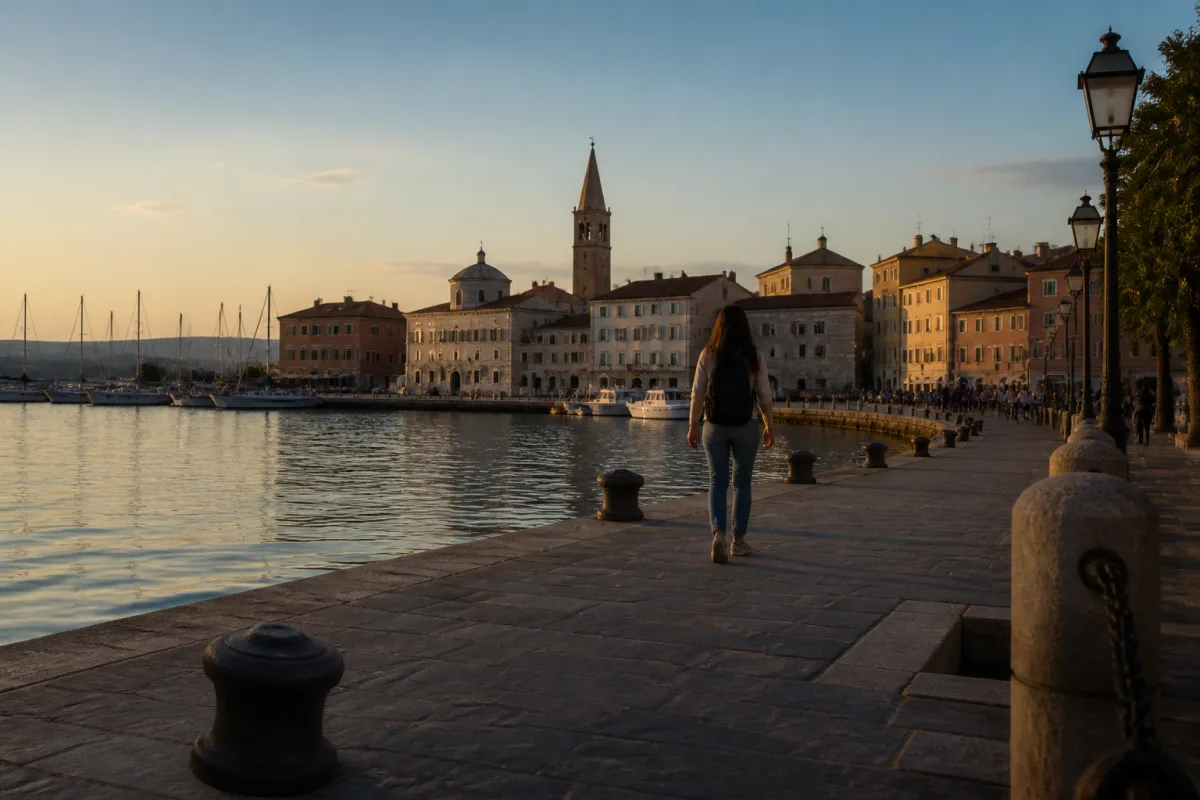

An English-taught bachelor’s program in bioinformatics exists in only two places in Europe — Rome and the Slovenian city of Koper, where tuition for citizens of most countries runs €3,150 a year.
In short
- The only alternative to an English-taught bioinformatics bachelor’s in Europe is a program in Rome, but it requires 12 years of school versus Slovenia’s 11.
- Tuition costs €3,150/year, except for citizens of former Yugoslav countries (free under agreement) and Ukraine (free under temporary protection status).
- No IELTS or TOEFL certificate is required for admission — English proficiency can be self-verified.
- Getting into a Slovenian dormitory as a foreign student is nearly impossible — priority goes to Slovenian, EU, and former Yugoslav citizens.
- The program provides enough ECTS credits for admission to almost any master’s program, except narrowly specialized ones like aerospace engineering.
What the Bioinformatics Program in Koper Is and Why It’s So Rare
The program is a bachelor’s degree offered at the University of Primorska (Koper, Slovenia) taught entirely in English. Bioinformatics itself is more commonly a master’s-level subject — bachelor’s programs in the field are rare, and English-taught options in Europe number exactly two: Rome and Koper.
The Italian option is off the table for many applicants for a formal reason: admission to Italian universities requires 12 years of school education, while most school systems abroad provide only 11. Closing that one-year gap usually means either paying for a Foundation program or spending an extra year at another institution just to catch up. Koper removes this obstacle entirely — admission is possible without any workaround.
Koper removes this obstacle entirely — admission is possible without any workaround.
The program runs over several years of study: the student whose experience forms the basis of this material had, by the time of the interview, completed three years on the program while living in Koper for the same three years.
Admission Requirements: The School-System Gap and How to Close It
Admission to Italy requires 12 years of school education, while many school systems abroad provide only 11 — and that one-year difference is enough for an Italian university to reject an application outright. This exact barrier is what pushed the choice toward Koper instead of Rome: the same English-taught bioinformatics program exists there, but without the 12-year requirement.
There are two common ways to close a one-year gap. The first is a Foundation program, which tends to be notably expensive. The second is spending a year at any other university just to formally accumulate the missing year of education. Slovenia requires neither — the country accepts graduates of 11-year school systems without an extra year.
For admission based on school documents, applicants need results of final school exams confirming graduation, along with grades from the 3rd and 4th years of schooling — in the competitive selection, these are weighted roughly 70% to 30% in favor of the final exam. The exact list of required documents should be confirmed directly with the faculty. Any national school-leaving test used domestically for university admission at home was not required for Slovenia — a final school certificate based on exam results was sufficient.
A separate step is apostilling the school diploma: without it, the education document isn’t recognized abroad. At the time documents were submitted (around three years ago), the apostille process went smoothly, but current recognition rules should be checked separately, since domestic systems change over time. Also worth keeping in mind: recognition of foreign education in Slovenia (through ENIC-NARIC) isn’t a separate step after enrollment — it’s part of the application process itself, submitted through the eVŠ portal, so these documents need to be prepared in advance rather than left for later.
Italy requires 12 years of school, while an 11-year system means outright rejection. Slovenia accepts applicants without an extra year and without a Foundation program.
Documents needed for admission based on foreign school records
Tuition Cost: Who Studies for Free and Who Pays
The bioinformatics program in Koper costs €3,150 a year — but not every student pays it; the cost depends on citizenship.
| Citizenship | Payment terms |
|---|---|
| Former Yugoslav countries | Free — under a bilateral agreement with Slovenia |
| Ukraine | Free — under temporary protection status (valid as long as that status holds) |
| Belarus, Russia | Paid, €3,150/year |
| Other European countries (e.g. Spain, Italy) | Paid, €3,150/year |
Free tuition for citizens of former Yugoslav countries comes from a bilateral agreement between those countries and Slovenia: it’s fixed in place and unrelated to current political circumstances. The situation for Ukrainian students is different — at the time of study, they weren’t charged tuition under temporary protection status, but this isn’t backed by the same kind of long-term agreement, so the condition could change.
For Belarusian, Russian, and other European students who don’t fall under any exempt category, the annual program fee is fixed at €3,150.
Important: even with a full tuition waiver, an annual registration fee for enrollment still applies, and health insurance is paid separately — it’s included in neither the tuition fee nor the registration fee.
Even with free tuition, an annual registration fee for enrollment still applies, and health insurance is paid separately — it isn’t included anywhere.
Other English-Taught Programs in Slovenia: Koper vs. Ljubljana
- In Ljubljana, there are practically no bachelor’s-level programs taught in English — instruction is in Slovenian. Even computer science, one of the most in-demand programs among applicants, is taught there only in Slovenian.
- In Koper, at the Faculty of Mathematics, Natural Sciences and Information Technologies, four programs are available in English: computer science, mathematics, bioinformatics, and one more, new program introduced only this academic year.
- Another English-taught program exists at the Faculty of Management of the same university — so the choice of English-taught bachelor’s degrees in Slovenia isn’t limited to one field.
- Plenty of Russian-speaking students also study on the Slovenian-language programs in Koper, but the pattern of transfers is telling: among those who applied to both Slovenian and English programs three or four years ago, everyone who was able to transfer to the English-language track eventually did — Slovenian turned out harder than expected.
Do You Need an English Certificate, and How Hard Is It to Study in English
No official IELTS or TOEFL certificate was required for admission: the student on the program didn’t take any official English test and submitted her application without a certificate. Her language level was assessed only through free online tests, which put her at roughly B2+C1.
By her account, studying in English caused no difficulties from the start. Switching to another language does take some adjustment, but the same issue would arise studying in one’s native language too: years of school condition a person to specific terminology and sentence structures, and all of that has to be relearned in a new language.
There was no dedicated language preparation before starting — with an already solid level of English, she considers it unnecessary.
What Bioinformatics Actually Teaches: Curriculum and Difficulty
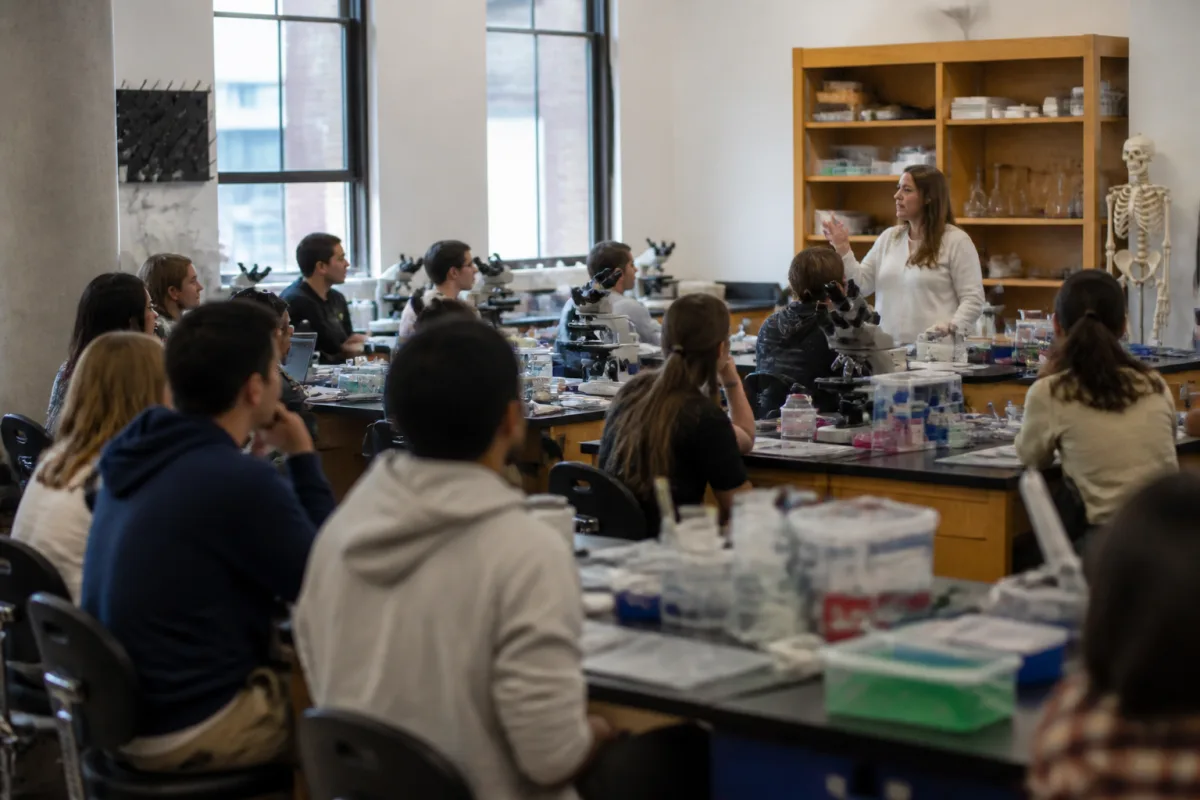
Students and faculty unofficially consider the bioinformatics program in Koper the hardest one at the faculty: it essentially merges three separate programs — mathematics, computer science, and natural sciences. The subjects barely overlap in content, which makes the workload feel heavier than on single-track programs.
it essentially merges three separate programs — mathematics, computer science, and natural sciences
The curriculum includes:
- mathematics — Algebra 1 and 2, Calculus 1, 2 and 3, discrete mathematics (also known as theoretical computer science), mathematical modeling;
- chemistry and biology — genetics, organic chemistry, biochemistry, physical chemistry, chemoinformatics, biophysics with foundations of physics;
- bioinformatics itself — introduction to bioinformatics, algorithms in bioinformatics, nucleotide sequence analysis;
- computer science and programming — Programming 1 and 2, statistics, machine learning, data mining, full stack development, Data Structures and Algorithms — one of the most foundational courses in computer science.
In terms of the European credit system, the program provides enough of a base for admission to almost any master’s program — the exception being narrowly specialized fields like aerospace engineering. That’s a direct result of the same volume of math, programming, and natural sciences that makes the program the hardest one around.
Teaching quality gets mixed reviews: around 80% of instructors are “decent or genuinely good,” while the rest draw complaints. A lot depends on a student’s own motivation and willingness to find the strong points even in a difficult instructor, rather than shifting the blame for a result onto the examiner.
Housing in Koper: Dorms, Rentals, and What to Choose
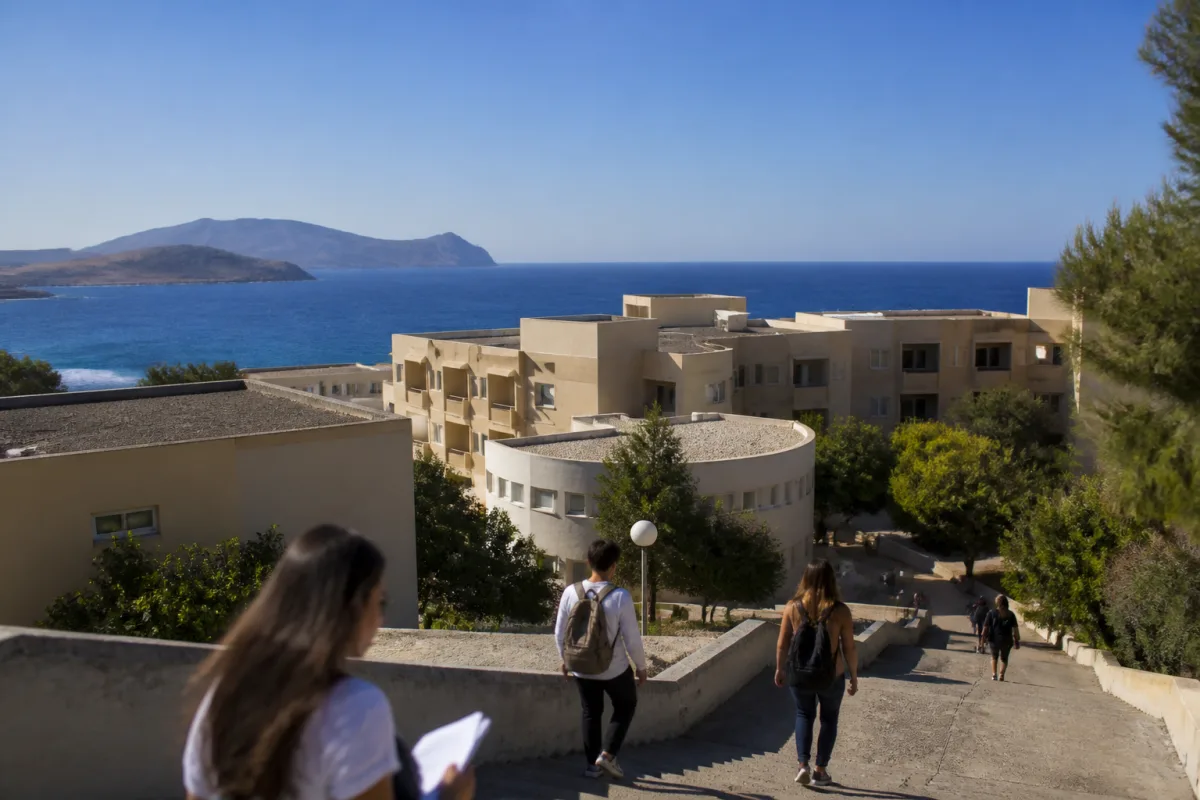
Getting a spot in a student dormitory in Slovenia is difficult: allocation priority goes to Slovenian citizens first, then EU citizens, then citizens of former Yugoslav countries, and only after that everyone else. Counting on a dorm as the main option isn’t realistic — in practice, most students end up searching on their own, renting a room in a house converted to host several students at once.
The first year of such a rental cost €280 a month, utilities already included — in Slovenia these are called “stroški.” The price rose over time: by the time of the interview, a room rental cost €300 a month without utilities, while utilities in a house shared by four people ran €50–70 a month. Combined, that’s up to €370 at the most.
Over the years of study, housing changed four times, and every move except the first was her own choice. The reasons for moving are typical of shared rentals: poor room conditions, conflicts with housemates, or personal safety concerns around questionable roommates. In one dormitory housing 10 people, there were only two bathrooms, one of which was broken almost the entire time — effectively one toilet and one shower for ten people. Cockroaches showed up there that same spring. Housemates in such houses are usually a mix of nationalities, with a noticeable share from Balkan countries, which adds a layer of cultural difference to everyday matters.
effectively one toilet and one shower for ten people
Staying in Koper for the summer is possible, but not every place allows it: the city is a resort town, and some landlords arrange in advance either to evict tenants for the summer season or to charge extra for the right to stay. Starting from the second year, she deliberately chose housing with the option to stay through summer — it costs more, but it means not having to move back to her parents’ for the break. Only in the first year did she have to return home for summer. Finding a summer-friendly place is easier in Izola or Piran than in Koper itself — but options exist there too if you move away from the city center. There’s almost always some tradeoff: price, distance from the university, or the comfort of the housing and housemates.
Renting in Koper: how the price changed over time
Room rent rose over the years of study; utilities are billed separately.
- First year of renting€280/monthutilities included (“stroški”)
- Later rental (utilities excluded)€300/month
- Utilities (house shared by four)€50–70/month
- Maximum combinedup to €370/month
Some landlords in resort-town Koper evict students for summer or raise the price for the right to stay — it’s worth choosing housing with this in mind ahead of time, not just for the first year.
Careers After Bioinformatics: Jobs and Student Work During Studies
Bioinformatics is a flexible, broad field, so career paths after graduation aren’t limited to one industry. Slovenia is home to pharmaceutical companies NovaIS and Lek (part of the Sandoz group) — the main target employers for bioinformaticians in the country. Beyond pharma, graduates find work in medicine: in research centers or private medical companies connected to genetics and reproductive medicine. Another path is academia: positions as a lecturer, professor, or researcher, including at the large Jožef Stefan Institute.
Career options don’t stop there — the skills gained on the program transfer into adjacent fields. Working with data, processing large datasets, and visualization are transferable skills that open doors into data science and software development, whether or not it’s connected to biology. Modern biology is increasingly converging with bioinformatics: working with big data and machine learning is becoming part of the discipline itself. A separate track is R&D (research and development), present at most biotech companies.
Students in Slovenia can take on part-time work through the student employment service — an official option that lets students take jobs without dealing with paperwork and tax hassles themselves, since the service handles most of the formalities. One typical case: before moving to Slovenia, the student already worked for a European company in programming, and now works through the student service in an academic setting — in bioinformatics-related research, where English remains the working language.
Among classmates, simpler part-time jobs are common too — waiting tables or working as a hostess, the fastest and most accessible way to find work. But some also work in their field of study or in beauty services. The difference is that service-industry jobs usually require knowledge of Slovenian, while the academic environment is international and English is enough there.
The student employment service in Slovenia handles most of the paperwork and tax formalities — an official way to work part-time without extra hassle.
Life in Koper: Climate, Safety, and the Downsides of a Small Town
The student names Koper’s climate as one of the biggest upsides of living there, alongside the variety and quality of local produce. Slovenian belongs to the Slavic language family, so for people already used to being bilingual in a Slavic language, picking it up tends to be easier than for someone starting from a non-Slavic native language — though this varies by individual.
Koper is a small town that feels more like a large village: you tend to know in advance who you’ll run into on the street and what you’ll talk about. Some people enjoy that predictability; others would rather move to a bigger city as soon as possible.
As for safety in Slovenia, in her personal experience there are no issues: she walks home from the library at three or four in the morning without concern. The exceptions are certain neighborhoods in Ljubljana and the tourist season, when cruise ships bring large crowds of visitors into Koper’s port — that’s when it pays to stay alert.
The main downside of a small town is limited prospects: everyone knows everyone, and there aren’t many opportunities for growth. The local mentality is a mixed bag too — Slovenians on the coast are considered fairly reserved and not especially open to foreigners. This impression isn’t universal, though: she studies on an English-taught program where there are no Slovenian classmates at all — on the Slovenian-language programs, local students make up a much bigger share.
Frequently asked questions
What happens to free tuition for Ukrainian students if temporary protection status ends
Tuition will stop being free if temporary protection status for Ukrainian citizens is revoked: the exemption is tied directly to that status, not to a separate long-term agreement like the one covering former Yugoslav countries. As long as the status remains in place, no fee is charged, but the condition could change at any point along with the status itself.
What to do if you end up with a problematic roommate or bad housing during studies
Waiting out the lease term isn’t required — moving remains a workable option: housing changed four times over the years of study, specifically because of poor room conditions, conflicts with housemates, and personal safety concerns. Every new place involves some tradeoff — price, location, or comfort — but there’s no need to delay a move because of that.
Is it worth learning Slovenian if you’re enrolling in an English-taught program
Formally, Slovenian isn’t needed to study on the English program — instruction and communication with classmates happen in English. But the language comes in handy outside of class: part-time service jobs (waiting tables, hostess work) usually require Slovenian, while the academic environment is international, where English is enough.
What’s needed to have a foreign diploma recognized when applying to Slovenia
Recognition of foreign education through ENIC-NARIC isn’t a separate procedure after enrollment — it’s part of the application itself, submitted through the eVŠ portal, so these documents need to be prepared in advance. An apostille on the school diploma is required separately — without it, the education document isn’t recognized abroad. Current recognition rules in a specific country should be checked separately, since they change over time.
Are there bioinformatics master’s programs in Slovenia
This isn’t covered in the article: it focuses on the bachelor’s program in Koper, where an English-taught bioinformatics bachelor’s is a rarity, with only two options in all of Europe. Neither the article nor the source material contains information on master’s programs in this field.
Comments
Reader experience is useful, but it is not advice: check the rules on the official site.
No account needed: click Sign in, type any name, and you are done.