
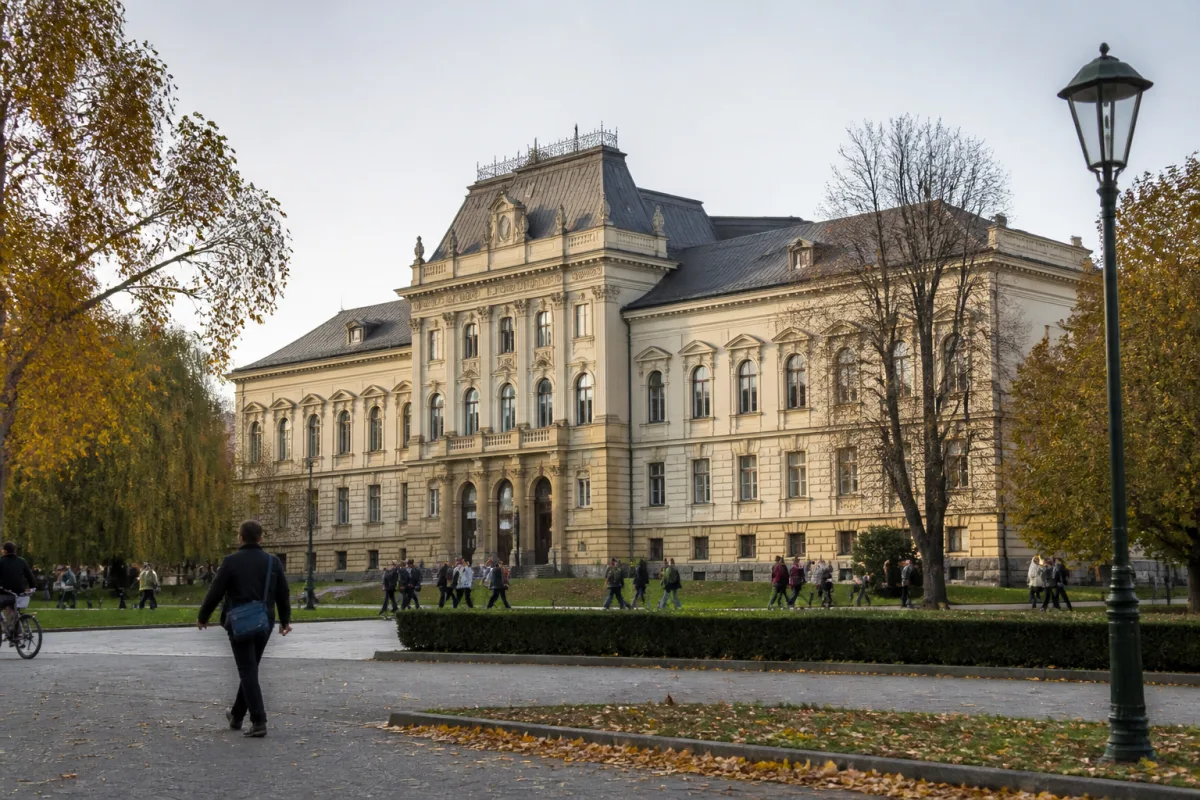

Studying at the University of Maribor without any Slovenian is possible: a student arrived in Slovenia with zero knowledge of the language, entered the country through Hungary after her Spanish visa was refused, and only started learning Slovenian on the ground with a private tutor while already attending classes at the economics faculty.
In short
- A Hungarian visa came through quickly after a Spanish visa refusal — the route ran through Istanbul and Budapest, with one overnight stay in Budapest
- A 30 m² studio in Maribor rents for €340 a month, plus a two-month deposit and a one-month agent’s commission
- Classes are split half online — the student chooses the format for each session, which removes the language barrier from the very start
- The first year at the economics faculty requires 11 exams and coursework assessments, with the first session in December
- Slovenian lessons at €30 an hour brought the language level up to A2–B1 within a few months of regular practice
A Schengen Visa Refusal and Entry Into Slovenia Through Hungary
After a Spanish visa was refused, the paperwork went in for a Hungarian one instead — it came through quickly, and within a short time the student was flying out of Novosibirsk. The route ran through two connections: Novosibirsk to Istanbul, then Istanbul to Budapest, with the final leg from Budapest to Slovenia covered by a FlexBus coach.
One question that comes up often is whether you’re required to spend a set number of days in the first Schengen country you enter. At the application stage, the Hungarian consulate asked for proof of accommodation bookings and a travel itinerary in Budapest — hotel reservations and a sightseeing plan were submitted as evidence of the purpose of the trip, and some of those bookings were cancelled once the visa was issued. In practice, only one night was actually spent in a Budapest hotel — and that didn’t cause any problems at the border.
At the Hungary–Slovenia border there was a passport check: the passport was taken away for roughly half an hour, along with those of several other passengers. No explanation was given, and it was simply returned without comment afterward. Based on this experience, it appears this checkpoint screens non-EU citizens for possible legal issues or violations.
No explanation was given, and it was simply returned without comment afterward.
Entry into the country didn’t end in Maribor itself: the first stop was Ljubljana, where documents needed for university enrollment had to be picked up. The night was spent there, the paperwork was collected the next day, and only then did the trip continue on to Maribor, where an apartment had already been arranged.
After the Spanish visa was refused, the Hungarian one came through quickly. The route went through Istanbul and Budapest, and at the Slovenian border the passport was pulled aside for a check — with no explanation and no consequences.
Housing in Maribor: Rent and Utility Costs
The apartment in Maribor was found before the move, with help from a real estate agent who also assisted with moving belongings and explained a few things about life in the city. Renting a roughly 30 m² studio apartment cost €340 a month.
Utility bills shifted with the season: winter averaged around €120, and in the coldest month the heating bill climbed to €150. In warmer months, utilities dropped to €90–100 — heating was clearly the main winter expense.
Moving in also required a deposit equal to two months’ rent, around €680, plus a separate agent’s commission of about €340 — equal to one month’s rent.
Why the Price Stayed Low
The apartment wasn’t in central Maribor but in an outlying district — with decent infrastructure nearby, though a longer commute to the center. The building dated from the 1970s and had heating issues, a result of its low energy efficiency rating. The small size also kept the price down: the sleeping area, dining space, and kitchen were all combined into a single room.
According to the student, similar money can still get you a room in Maribor today — somewhat cheaper than a full apartment, though it takes time to find through rental listing sites.
Housing Costs in Maribor
Rent, utilities, and one-time move-in costs for a 30 m² studio apartment
- Monthly rent340 euros
- Winter utilities~120 eurosup to 150 euros in the coldest month
- Summer utilities90–100 euros
- Move-in deposit~680 eurosequal to two months’ rent
- Agent’s commission~340 eurosequal to one month’s rent
An outlying location, an older building with a low energy rating, and a small floor plan — three factors that kept the rent down in Maribor.
How Classes Work at the Economics Faculty Without Slovenian
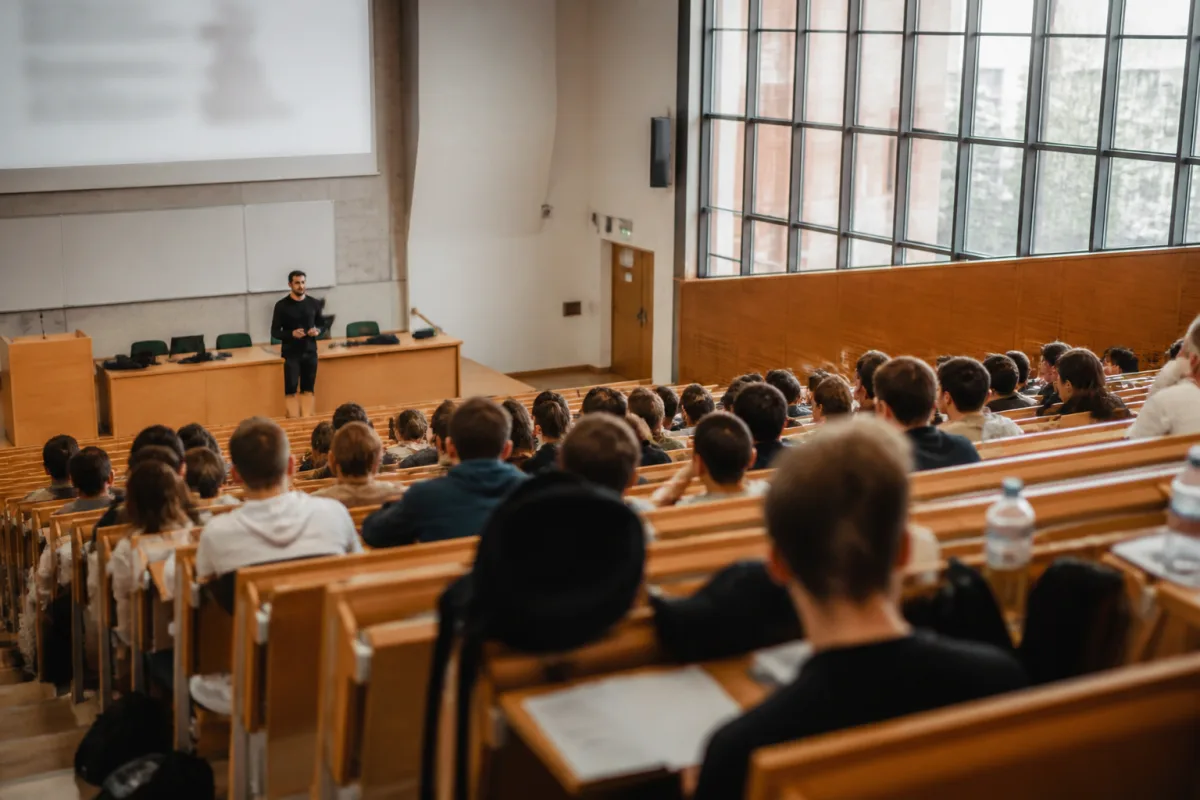
The program is split half online, half in-person: for every class, the student chooses whether to show up in the lecture hall or log in remotely through the university portal. Every lecture and every class is available this way, so not knowing Slovenian from day one doesn’t shut a student out of coursework.
At first, the choice of format came down to language, not scheduling. English classes were attended in person from the start — instruction was in English, and much of the material made sense right away. Sociology, taught in Slovenian, was followed remotely from the very beginning: sitting in the lecture hall and risking a question that couldn’t be answered felt worse than just watching the stream from home.
sitting in the lecture hall and risking a question that couldn’t be answered felt worse than just watching the stream from home
The technical side of the online format is simple: every lecture hall has a camera that streams what’s happening — the board and the audio — to anyone connected through the portal. When needed, the instructor can also enable two-way communication so a student joining online can answer through a microphone.
The schedule isn’t daily: lectures run a few times a week rather than every day, but each session runs longer than usual. A class that meets once a week doesn’t last an hour and a half — it runs four hours straight. At first, an entire lecture like that would pass without much understanding; the material got revisited later with a translator, with a chat AI tool, or with friends who had a better grasp of Slovenian — lectures without slides sometimes never got translated at all.
Despite the language barrier, making connections happened fast: within the first month in the dorm, there were already friends around, and the move, in her own words, turned out easier than expected given the complete lack of the language going in. None of this rules out working part-time either: taking on tutoring in one’s native language alongside coursework is a workable option even without any Slovenian at the start.
University Bureaucracy: The Dean’s Office, the Student Card, and Discounts
The dean’s office refused to issue a student card without giving a reason and insisted on communicating only in one of the Slavic languages — English wasn’t accepted. Sorting this out took some self-navigation, with help from Russian-speaking students in the same faculty who already knew how the local system worked.
The card itself turned out to be unnecessary: the enrollment confirmation letter worked just as well in its place. That document was enough to prove student status at museums offering student discounts, and it was also used to apply for student meal vouchers. The card was never actually required.
The dean’s office wouldn’t communicate in English and insisted on a Slavic language — a student card couldn’t be obtained without an enrollment letter, but the letter turned out to work just as well on its own.
The First Exam Session: How Many Exams and How Retakes Work
The first year at the economics faculty requires passing 11 exams and coursework assessments, with the first exam session held in December. In her first session, the student took three exams: English, sociology, and commercial law.
English wasn’t passed on the first try — only on the retake, once the exam format became clear. For sociology, the instructor made an accommodation: she allowed a presentation defended in Slovenian instead of an oral exam. The student practiced her pronunciation in advance and read the text without stumbling — the exam was passed.
Commercial law turned out to be more complicated. The instructor allowed the exam to be taken in English, the paper was written and submitted, but a few months later it turned out the grade had never made it into the system. The instructor suggested resolving this through a retake in Slovenian — either oral questions or a short written assignment to confirm the exam already completed. At the actual retake, he didn’t ask anything at all and simply entered a pass.
At the actual retake, he didn’t ask anything at all and simply entered a pass
The first session’s exams stretched across the entire winter. English and commercial law required serious preparation, while the sociology material only needed a few rereads. Help with the sociology presentation came from a Slovenian classmate: given a choice of topics, she offered to put the whole presentation together herself, entirely for free — just out of goodwill.
Learning Slovenian From Scratch: Tutor, Format, and Cost
Slovenian lessons started in December — three times a week, an hour each, one-on-one, and they’re still ongoing. The format is fully conversational: the tutor and student communicate only in Slovenian the entire time, without switching to English or Russian.
Classes take place online, taught by a Russian-speaking woman who has lived in Slovenia for about 10 years and works from her own program, with her own textbooks and methods. The one-on-one format turned out to be more the exception than the rule: most people learning Slovenian study in pairs or groups, and finding a private tutor for individual lessons is difficult.
One lesson costs €30. In the student’s own estimation, that’s roughly the average market rate, though she has no exact figures to compare it against — this is her impression, not a confirmed fact.
Over the course of these lessons, her Slovenian rose to somewhere between A2 and B1. Meanwhile, the English she arrived in Slovenia with was practically lost — pushed out by the intense immersion in the new language.
She credits her progress in Slovenian specifically to the tutor and the conversational format: even though, by her own admission, languages don’t come easily to her, and years of English lessons with different tutors never produced this kind of progress, here she can feel it — the ability to form complex sentences and understand slang.
Cost of Slovenian Lessons
One-on-one online lessons, three times a week, an hour each
- One lesson30 eurosby the student’s own estimate — roughly the market average
One-on-one lessons without switching to English or Russian produced more progress in a few months than years of English lessons with different tutors.
Life in Maribor: Social Circles and the Russian-Speaking Community
There were no other Russian-speaking students in the economics faculty group — only Slovenians and one Serbian classmate. Out of the whole group, she managed to build a rapport with just three girls: first in English, and once her Slovenian improved, in Slovenian. It never grew into real friendship — things stayed at a friendly “hi, how are you” level. Her English level when she left Russia was A2 — simple phrases came easily, but following fast, fluent speech was difficult.
Compared to Ljubljana, Maribor is quieter and cheaper. Part of the student experience came not from the language environment but from university-organized trips: one excursion lasted four days and covered Belgium and Germany. The itinerary included the Deutsches Museum’s transport wing in Munich, the European Parliament, and visits to two IT companies.
Students abroad tend to find company outside of class through apps and Telegram bots rather than classmates. One such outlet was a Russian-speaking social scene: in December, a project called “Sneg” (Snow) launched with Russian-language music, drawing people from across Slovenia and even from Italy. A few months later, turnout dropped off and the project shut down — a new one has since taken its place, though so far it’s only managed to hold one event, at a pool.
Frequently asked questions
What happens if a retake exam also fails to register in the university’s system
The material describes a case where, after a successful retake, the instructor simply entered a pass without asking any further questions — a technical glitch with the system was resolved by retaking the exam rather than filing a complaint or going through an administrative process. This suggests that in a similar situation, it makes sense to first ask the instructor to arrange a retake confirming the work already completed.
Can you enroll in a faculty where exams are in Slovenian if you don’t know the language at all
Yes: an exam can sometimes be adapted to the student’s level — for example, arranging to defend a presentation in Slovenian instead of answering orally, provided the text is prepared and practiced in advance. Some exams can also be taken in English by arrangement with the instructor.
How long does it take to bring Slovenian from zero to a conversational level
Over the course of lessons starting in December, the level rose to somewhere between A2 and B1 with three one-hour one-on-one lessons a week. No exact timeframe is given, but the progress is credited specifically to the conversational format and consistent practice.
Comments
Reader experience is useful, but it is not advice: check the rules on the official site.
No account needed: click Sign in, type any name, and you are done.