
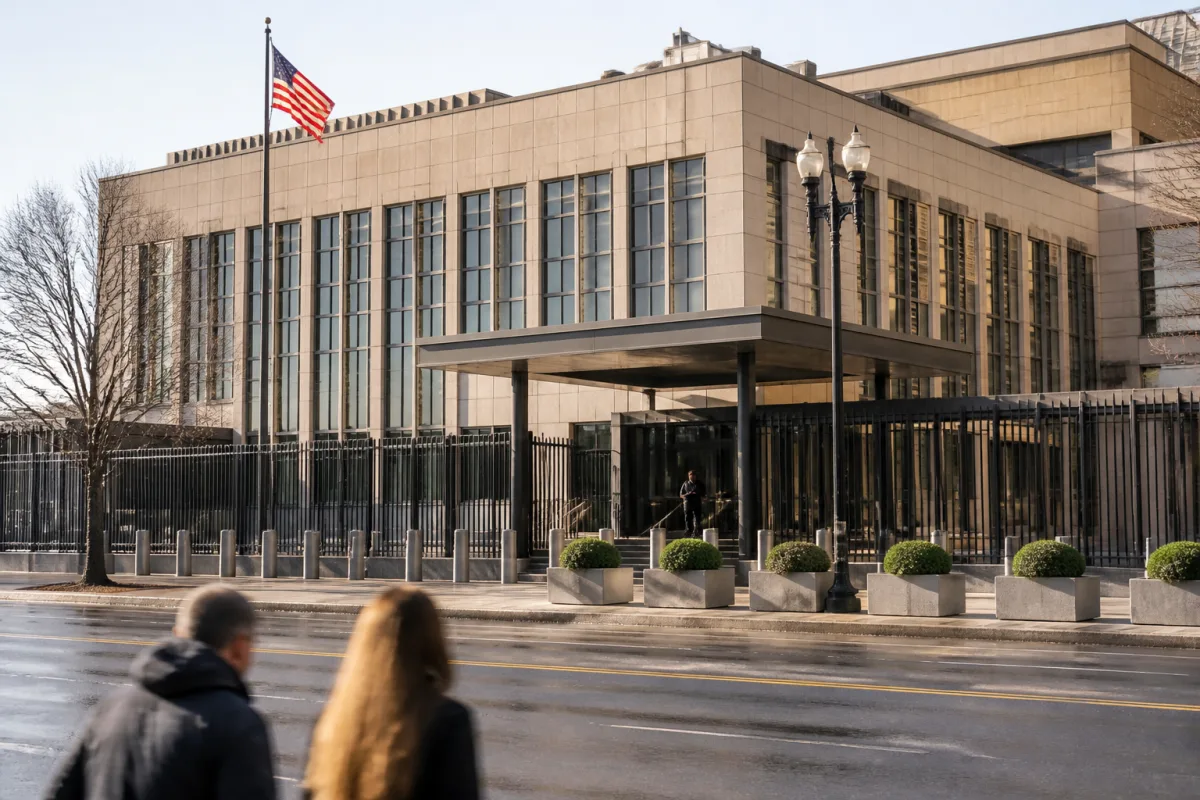

DV-2024 lottery winners stopped receiving visas after consulates suspended immigrant visa interviews earlier this year without any clear legal basis, and even though courts have since ruled the freeze unlawful, applicants now face a far harsher round of financial screening.
In short
- Visa issuance for DV-2024 lottery winners stopped in mid-January; interviews continued, but instead of a decision applicants received a notice about an “administrative review.”
- Courts in multiple states ruled the freeze unlawful and ordered the State Department to resume issuance — but quotas still expire September 30 regardless of the reason for delay.
- Since September 10, consular officers have resumed issuing decisions, but under new financial vetting: tax records, property, a sponsor with a letter of guarantee, a job offer.
- According to unofficial figures, since mid-September only 27–28 out of 290 interviewed applicants got a visa — under 10%.
- The DV-2027 lottery is effectively on hold with no announced timeline for reviewing the rules, while DV-2028 is set to launch unchanged.
What happened to DV-2024 lottery winners’ visas
Winners of the DV-2024 lottery, drawn two years ago, suddenly stopped receiving visas and green cards at some point this year. From last October, the consulate had been holding interviews and issuing visas as usual — that was supposed to continue until roughly August or September of this year, nearly a full year.
But in mid-January, right after the New Year, issuance of visas and green cards to immigrant visa applicants — including lottery winners — was halted. Interviews kept happening, but instead of a decision, applicants were handed a notice about a supposed administrative review. The State Department framed the pause as a “public charge” screening — a check on the risk that an applicant might rely on government benefits, a standard written into US immigration law — but it’s precisely the application of that standard to lottery winners that applicants are now challenging in court as unjustified. Applicants were told that once visa issuance resumed, they’d be contacted, invited back for another interview, and given a final decision.
instead of a decision, applicants were handed a notice about a supposed administrative review
Who was affected: 74 countries and which visas
The freeze applied to nationals of 74 countries, including Russia — flagged as higher-risk on the assumption that their citizens apply for public benefits more often than others. The suspension wasn’t limited to lottery winners: the same list included the O-1 talent visa, the EB-2 national interest waiver, and other visa categories issued together with a green card.
Nonimmigrant visas were untouched altogether: tourist visas, student visas (except in cases involving language-school programs), and fiancé(e) visas were all issued as normal, with no delays or disruptions.
The problem is that preparing for an immigrant visa interview runs in parallel with getting a Schengen visa, gathering documents, and completing a medical exam — all scheduled around a specific interview date. A Schengen visa issued for such a trip typically covers only the exact travel window, with no buffer. If the interview ends in a pause instead of a decision, the applicant has to renew documents, get them re-translated, and apply for a new Schengen visa all over again — repeating the entire preparation process and paying for it twice.
Is the freeze legal: lawsuits and court rulings
Consulates formally pointed to the “public charge” standard written into immigration law — but it was precisely the legality of applying that standard to lottery winners that courts were asked to weigh in on, since the “administrative review” procedure itself isn’t described anywhere in the law. In practice, applicants were handed a note about such a review after their interview and told they’d be contacted later — no actual review appears to have taken place.
Almost immediately after the freeze began, lottery winners started filing lawsuits against the State Department. Some of these were organized through law firms recruiting applicants into class actions for $500–1,000 per person. The first lawsuits challenging the freeze’s legality appeared around March–April, hearings began in June, and starting in late August, courts began issuing rulings one after another.
Cases were heard in different states before different judges, but the outcome was nearly uniform: courts found the freeze on visas for winners of the past lottery unlawful — unlike the separate pause on running a new lottery, which no one challenged. The rare rulings that went against applicants involved people who sued individually rather than as part of a class action.
Courts named the State Department, and its head Marco Rubio personally, as responsible for the unlawful suspension. The rulings ordered the State Department to resume issuing visas and green cards immediately — with only about a month left before the lottery quotas expired.
Courts in multiple states almost unanimously ruled the visa freeze unlawful, naming the State Department and Marco Rubio personally as responsible. The rulings ordered the process to resume immediately.
Why September 30 is the critical deadline for winners
Lottery visa quotas expire at the end of each fiscal year — September 30. If a winner hasn’t received their visa by that date, they lose the right to it regardless of the reason for the delay: it doesn’t matter whether it was an administrative review, a canceled interview, or the consulate simply running out of time. It works the same way as a gift card with an expiration date — if you don’t use it, it’s gone, with no extension and no way to get it back.
That exact deadline is what pushed courts to move fast. By late August, judges were ruling one after another that the freeze on visas and green cards was unlawful and ordering the State Department to resume the process immediately — the clock was running in weeks, since roughly a month remained before the visas expired. What happens next is really a question of whether the agency can physically get through interviews with winners in the time that’s left.

If a winner hasn’t received their visa by September 30, the right to it is lost regardless of the reason for the delay — an administrative review, a canceled interview, or the consulate running out of time all count the same.
Canceled interviews and consular training: what it looked like in practice
After the string of court rulings, the State Department instructed all consulates to cancel upcoming immigrant visa interviews and required consular officers to complete a certain training program — and while that training was underway, no interviews were held at all.
In practice, it played out like this: an applicant with an interview scheduled for, say, August 29 at the consulate in Astana would get a cancellation notice the day before, on August 28, saying it was postponed “until further notice,” with no new date and no explanation. Some applicants didn’t even get a notice and found out about the cancellation from security guards at the consulate doors.
For about a week to ten days after the cancellations, consulates were officially “in training”: the windows handling immigrant visas were closed, while tourist visas and other nonimmigrant categories were processed as usual.
Attorneys handling the lawsuits started complaining to judges about the delays. Judges scheduled additional hearings and warned State Department representatives that continued stalling would be treated as contempt of court — which can carry consequences for officials up to and including criminal liability. In one case, the judge ordered the State Department to report to the court three times a week on the number of interviews completed and the outcomes.
A court can order the process to resume and keep moving, but it can’t order approval of any specific visa or green card — that decision remains with the individual consular officer.
The new financial vetting: what consulates ask for now
Starting September 10, consular officers resumed issuing decisions on lottery winners’ visas, but under a new instruction from the State Department: screen applicants for financial risk to confirm they won’t immediately turn to government benefits. Interviews now include dozens of questions, most of them about the applicant’s finances and everything tied to them.
What’s now being asked for, with documentation required:
- tax records for the past three years;
- property documents — both currently owned and previously sold;
- a financial sponsor in the US who could provide support if the applicant doesn’t find work;
- a letter of guarantee from that sponsor;
- travel medical insurance;
- a job offer from a US employer;
- a US housing lease.
Sponsor letters come with an extra requirement: the sponsor’s own tax return must be attached, to confirm they actually have enough money to support the applicant. Few sponsors agree to share that — it’s private financial information.
Some of these requirements are physically impossible to meet given the timeline of the process itself. A job offer, insurance, or a lease can’t be arranged in advance — an employer won’t discuss a position with someone who doesn’t have a visa yet, and insurance or a lease logically needs travel dates that don’t exist yet either.
On top of that, the consulate gives applicants just three to four days after the interview to assemble the whole package — going home, gathering the documents, translating them, and coming back in that window simply isn’t realistic. Some banks don’t issue account balance letters instantly; ordering one can itself take up to three days. Previously, lottery winners were barely asked for any of this — at most an account balance statement and proof of property.
the consulate gives applicants just three to four days after the interview to assemble the whole package

Some required documents — a job offer, insurance, a lease — physically can’t be arranged before the visa is issued, and everything else has to be assembled within just 3–4 days after the interview. Prepare as much as possible in advance.
What consulates now require from lottery winners
How much money in the bank is now enough to satisfy the consulate
A balance of $20,000–30,000 no longer impresses a consular officer: applicants now try to show up with $100,000–200,000, and some sell an apartment specifically to deposit the proceeds before applying.
Producing a statement showing the right amount isn’t enough on its own — the consulate can reach out to the applicant’s bank directly to verify the money is actually there. There used to be a common workaround: borrow, say, the equivalent of a few thousand dollars from friends, deposit it, get a bank letter, and withdraw it the next day. With banks now being contacted directly, that workaround is at risk of failing.
According to information circulating among applicants, a consulate may send a request to the bank — by email or directly by phone — asking whether a given client’s account actually holds the stated amount, or whether the balance is currently zero. Whether the bank is obligated to respond to such a request, and on what legal basis, isn’t established — this practice hasn’t been officially confirmed.
Consulates can verify directly with a bank whether the stated balance is actually there, so briefly borrowing money just to get a statement is a risky move now.
How many applicants are actually getting a visa right now
According to unofficial figures found in open sources, since mid-September 290 interviews have been held with lottery winners, and only 27–28 visas were issued — under 10% of everyone who was interviewed. How reliable these numbers are is unclear; the consulate hasn’t published any official confirmation.
The people who got visas were those who came in with a complete document package prepared in advance — including the optional paperwork — and showed a large bank deposit. Another common factor was a US sponsor willing to vouch for the applicant, or a US employer with a job offer. By the same source’s estimate, about 90% of applicants can’t meet even half of these conditions — most simply don’t have friends or relatives in the US willing to act as sponsors.
about 90% of applicants can’t meet even half of these conditions
Which means the 10% of applicants who did get approved could have just as easily pursued an employment-based visa like the O-1 talent visa: putting together the case and hiring a good immigration attorney for that path costs $30,000–50,000, and people who already have a job offer, a sponsor, and a solid deposit generally have that kind of money. For applicants without those resources, the lottery isn’t doing them any favors right now — getting an O-1 has become harder and more expensive over the past two years, and the lottery visa is now effectively demanding requirements just as strict.
Who actually gets a lottery winner’s visa now
Share of successful applicants among those interviewed since the new financial vetting began.
- Interviews held since mid-September290unofficial figures
- Visas issued27–28under 10% of those interviewed
- Applicants unable to meet even half the requirements90%per source estimate
Is it still worth counting on the green card lottery
The DV-2027 lottery was put on hold, supposedly to review the rules of the program — those rules were never actually revised, even though the DV-2028 lottery is about to launch. Officially it’s described as a pause, but in practice it looks like a cancellation: if there were even a rough timeline for the review, this could be called a temporary delay rather than the end of the program. Among the changes reportedly under discussion are a possible one-dollar entry fee and vetting of entrants both when they apply and again if they win — but neither has ever been formally adopted.
Even if a new drawing does launch, there’s not much point in it: the financial vetting winners now go through requires showing the consul a sponsor, a job offer from a US company, and proof of a successful career — essentially the same package required for other employment-based visas. Forcing a consulate to actually issue decisions on visas is a manageable task for courts, but overturning hidden financial discrimination justified by “national interest” through litigation is practically impossible — the concept is too vague to pin down. On top of that, winners’ visa quotas expire every single year, and a years-long court battle isn’t something applicants can afford to wait out — the visa simply expires before the case is resolved.
A change of administration is unlikely to shift this quickly. Even if Democrats take office, they typically have plenty of other domestic priorities early on and may not turn their attention to immigration issues for a few years — and a predecessor’s decisions being fully reversed is the exception, not the rule; usually something carries over. So there’s a strong chance the lottery will keep operating roughly as it does now, with all the same problems.
Counting on the DV Lottery isn’t a sound strategy anymore — it used to come down to plain luck, but luck alone isn’t enough now. Much like language-school shortcuts, the lottery in its current form is turning into a dead end — a way to burn time and money that would be better spent on other paths to immigrating to the US or elsewhere.
Frequently asked questions
What happens if a visa expires because of the September 30 freeze — can it be restored the next year?
No, an expired visa can’t be restored: quotas are allocated for a single fiscal year and don’t carry over. The winner permanently loses the right to that visa regardless of the reason for the delay, and the only way back in is winning a future lottery — if one is even held.
Can the new financial paperwork be submitted remotely, without a second trip to the consulate?
Based on how the process has been described, no: the document package is assembled after the interview, on-site, within just three to four days — meaning the applicant has to physically stay near the consulate during that window rather than handling it remotely from home.
What happens if a bank refuses to respond to a consulate’s inquiry about an applicant’s account balance?
It’s not clear: no official rule confirms a bank’s obligation to respond to such requests, and the practice of consulates contacting banks directly isn’t documented anywhere formal. That means there’s no way to reliably predict how this kind of check will play out.
Is it worth suing individually instead of joining a class action?
Based on the outcomes so far, the odds look worse: the rare rulings that went against applicants involved people who sued individually rather than as part of a class action — nearly every class action was granted.
Can an applicant pass the financial vetting without a sponsor or a job offer in the US?
In practice, that sharply lowers the chances: visas mostly went to applicants who had a sponsor with a letter of guarantee or an employer with a job offer on top of a large deposit, and roughly 90% of applicants can’t meet even half of these conditions simply because they lack those US contacts.
Does the new financial vetting affect the fiancé(e) visa or the tourist visa?
No, the freeze and the financial vetting that followed apply only to immigrant visas issued together with a green card — the lottery visa, the O-1 talent visa, the national interest waiver. Nonimmigrant visas, including the tourist visa and the fiancé(e) visa, were issued the entire time without disruption.


Comments
Reader experience is useful, but it is not advice: check the rules on the official site.
No account needed: click Sign in, type any name, and you are done.