


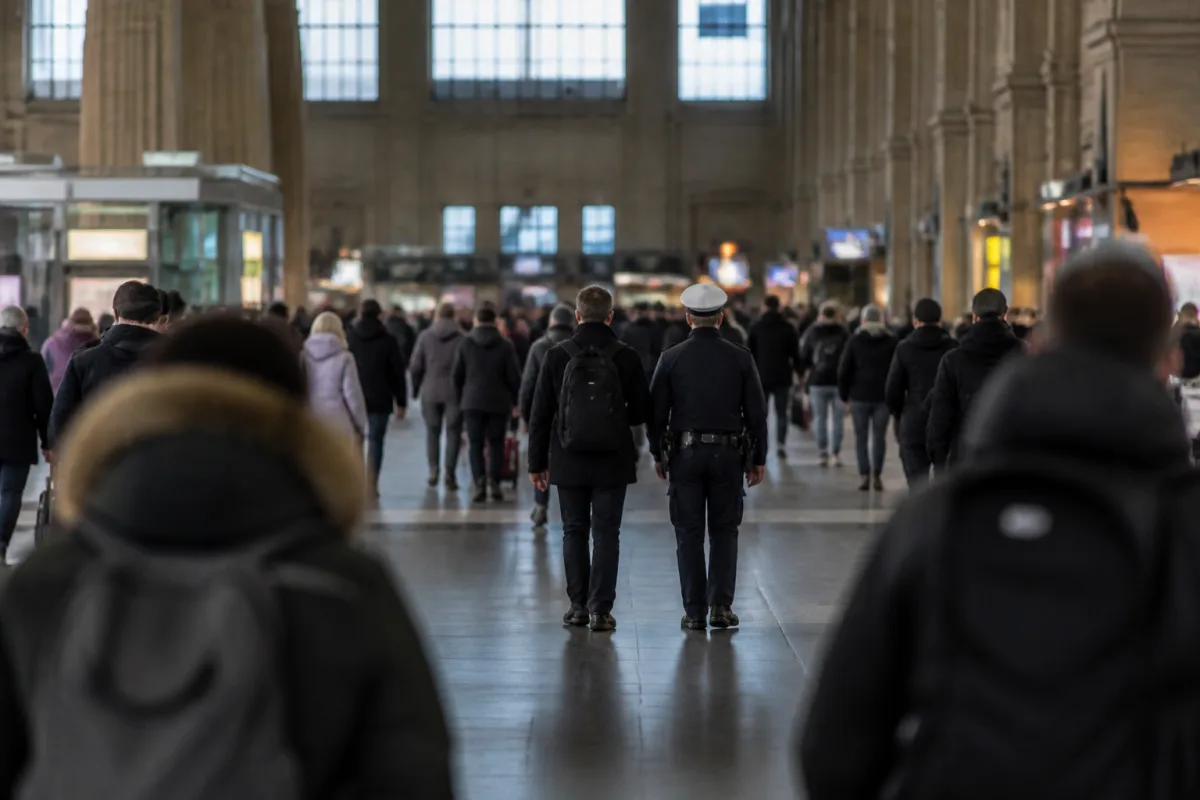
From 28 October 2026, a new federal police law has come into force in Germany that allows people to be stopped at railway stations and on long-distance trains without individual suspicion. Officers may check documents and identity and inspect the contents of a bag, backpack or suitcase — to monitor compliance with the ban on carrying weapons and knives. The rule also applies to citizens of Ukraine travelling through German stations or in transit.
What exactly has changed
Previously, for stopping and searching people, federal police needed individual suspicion — concrete grounds to believe a person was breaking the law, for example by carrying a prohibited item. The new Federal Police Act (Bundespolizeigesetz) removes this requirement for checks on compliance with the ban on carrying weapons and knives. Now an officer may approach, ask for documents, check identity and inspect the contents of a bag without any prior grounds.
Where such checks apply
The law defines specific places where checks without suspicion are possible:
- on long-distance passenger trains, including ICE and IC — the ban on carrying weapons and knives on long-distance transport is set by section 42b, paragraph 1, of the Weapons Act;
- in station buildings and at fenced-off stops of long-distance services — such areas are defined by the same section 42b;
- on open platforms or station squares — if they fall within the boundaries of a separately established prohibition zone;
- in special weapon and knife prohibition zones at federal railway facilities — the boundaries of such a zone are set by the relevant regulation.
In addition, the federal police may, by a separate order, ban the carrying of weapons and dangerous objects in a defined station area for a specific period.
Why this matters for those travelling through Germany
In practice, some visitors do not know that carrying knives is prohibited at German stations and may find themselves in an unpleasant situation during an ordinary check. If a person did not know about the ban and an officer finds a prohibited item, this may result not only in a fine but also in criminal proceedings. This applies not only to those arriving in Germany but also to those who simply pass through it in transit and use railway stations.
What to do if you consider a check to be discrimination
German lawyers already disagree about the new law: some consider it an effective security tool, while others warn of the risk of abuse by individual officers. If a person believes they have been subjected to discrimination during a check, they can contact a German lawyer, bodies that protect against discrimination, or file a service complaint with the police for an internal investigation. The most effective option is to consult a German attorney, who can bring a lawsuit over an unlawful search. During the check itself, it is best to follow the officer’s instructions and avoid conflict, and to address the legality of police actions afterwards, through a lawyer.


Comments
Reader experience is useful, but it is not advice: check the rules on the official site.
No account needed: click Sign in, type any name, and you are done.