
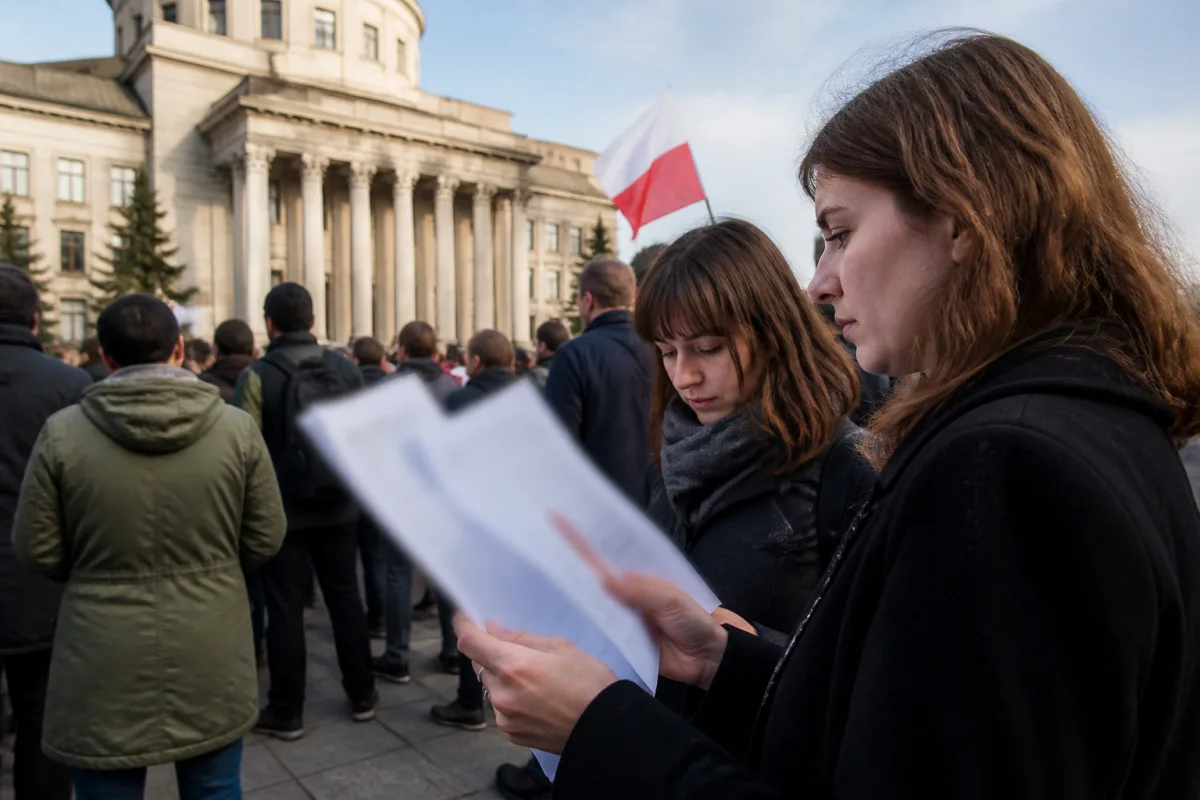

In 22 Polish cities, residents took to the streets demanding protection for Ukrainians from attacks and insults. The wave of protests reflects rising tensions in Polish society, where the Ukrainian issue is increasingly used as a tool in political struggle.
Protests for Ukrainians’ Rights
Over recent weeks, Polish cities have seen a rise in conflicts and attacks against Ukrainian citizens. In response, Poles organized a series of demonstrations demanding that authorities not only condemn attacks on Ukrainians but also strengthen protection for people targeted by hatred because of their origin or language.
These protests show that a group has formed within Polish society that openly opposes discrimination against Ukrainians. They demand that the state more actively prevent and stop acts of violence and persecution against Ukrainian citizens.
Shifting Attitudes in Polish Society
Just a few years ago, Poland was seen as one of the main supporters of Ukrainians. Today the picture has changed. Tension is growing in Polish society around the Ukrainian issue and Ukrainians themselves.
Surveys show that Poles’ opinions differ. Some claim they haven’t noticed any particular change in attitudes. Others say attitudes have genuinely worsened. Still, the scale of this phenomenon shouldn’t be exaggerated — one cannot say all of Poland has turned against Ukrainians, but the changes that have occurred cannot be ignored either.
Ukrainians as a Political Tool
The Ukrainian issue is increasingly becoming part of high politics and a tool of political struggle in Poland, especially ahead of elections. Politicians are more actively discussing questions of refugees from Ukraine, social assistance and benefits, competition from Ukrainian business, and the threats posed to Poland by Ukraine’s potential accession to the European Union.
A common practice is to portray Ukrainians as the main culprits behind various problems in society. One Polish politician stated that if the “Law and Justice” party comes to power, Poland will deport Ukrainian men of conscription age who are not working legally in the country. The problem, however, is that political rhetoric doesn’t stay at the level of statements alone — ordinary Poles hear such remarks daily, and this spills over into the streets in the form of conflicts.
The Paradox of Ukrainian Success
Political scientist Kulpa points to an interesting paradox: some Poles may feel envy toward Ukrainians who have successfully integrated into Polish society, opened their own businesses, and now compete in the Polish market.
Data show that the overwhelming majority of Ukrainian migrants (73% women and children) have found work and are actively engaged in the economy. Ukrainians in Poland often appear not as cleaners or construction workers, but as entrepreneurs and specialists. This fact can stir mixed feelings in a society where a significant portion of the population looks for the causes of its own problems in external factors.
Questioning the Reality of European Support for Ukraine
Alongside events in Poland, Petro Kuzyk, commander of the “Svoboda” battalion of Ukraine’s National Guard, made a sharp statement about the priorities of European countries. According to him, if Ukraine’s main partners truly wanted its victory, they would have supplied enough weapons that the war would long ago have become hopeless for the aggressor.
In this context, a logical question arises: how genuinely interested is Europe in a swift end to the war in Ukraine? On one hand, the threat of a Russian victory is obvious to European countries. For nations bordering Russia or located in its geographic vicinity, such a scenario would mean serious security problems. By supporting Ukraine, Europe is trying to prevent an even greater threat to itself in the future.
But there’s another side to the coin. The war has created enormous demand for weapons. European countries are increasing military budgets, signing multibillion-dollar contracts, and expanding production of ammunition, missiles, drones, and other weaponry. The European Union has openly stated the need to develop its own defense industry and increase production capacity. 300 million euros has been allocated to support Ukraine’s defense industry.
Even more telling is the European Union’s new loan to Ukraine worth 90 billion euros for 2026–2027. Of this sum, approximately 60 billion euros are earmarked specifically for defense, developing defense capabilities, and purchasing military equipment. EU documents explicitly state that military products must be purchased from producers in Ukraine, the European Union, and a number of European countries. Thus, the funds go toward supporting Ukraine, but a significant portion of this money simultaneously creates demand for the European defense industry.
Two Strategies of Assistance
There are two fundamentally different strategies for helping Ukraine. The first is to provide just enough resources for the country to keep resisting. The second is to provide enough funds for Ukraine to gain a decisive advantage and end the war significantly faster. The words of Ukrainian servicemen about the level of support should not simply be dismissed — they point to a fundamentally important question about the nature of European policy regarding the war.


Comments
Reader experience is useful, but it is not advice: check the rules on the official site.
No account needed: click Sign in, type any name, and you are done.