
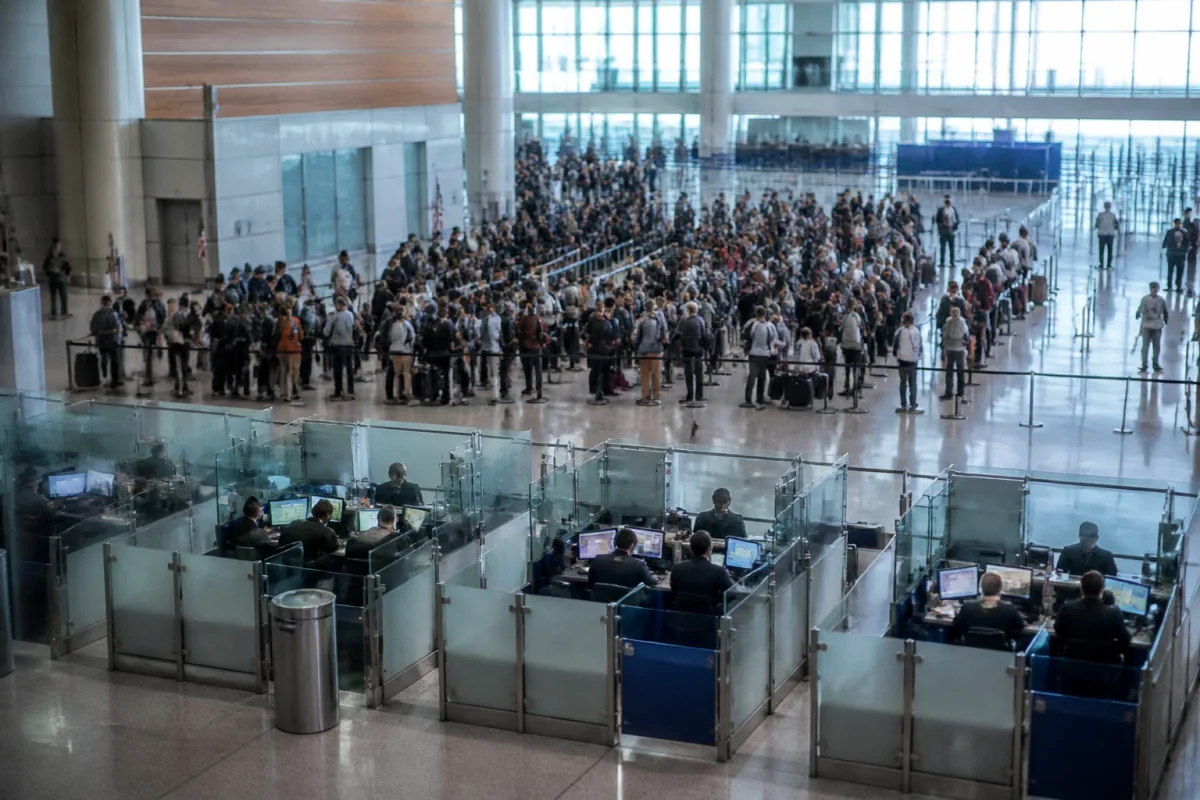

The US has no general visa-free transit program: a connection to another flight, or even staying on the same aircraft, still requires a visa or an approved ESTA. The exceptions are Visa Waiver Program participants with an approved ESTA, as well as Canadian citizens and, in part, holders of Bermudian passports, who usually do not need a visa. In any case, the final admission decision is made on the spot by U.S. Customs and Border Protection (CBP).
Why “visa-free transit” through the US doesn’t work like it does in other countries
The Transit Without Visa program, which allowed travelers to pass through the US without a document, was suspended back in 2003. Since then, a traveler continuing to a third country via the US must either obtain a visa or travel under the Visa Waiver Program (VWP) with an approved ESTA.
ESTA is not a visa. VWP participants must obtain ESTA approval before boarding a flight, even if they are only in transit. On the form, the question of whether the trip is a transit to another country must be answered “Yes.” The ESTA application fee as of October 16, 2026, is $40.62.
An approved ESTA or a valid visa allows you to arrive at a US port of entry, but does not guarantee admission — that decision is made by CBP on the spot. If you plan to see sights or make another visit during the connection, it is no longer “pure transit,” and you need a different permitted basis for the trip.
Who is affected by transit without a visa
Canadian citizens usually do not need a non-immigrant visa for transit, but Canadian permanent residents are not automatically excluded from this rule — third-country citizenship or resident status does not exempt you from the requirement. Bermudian passport holders usually also do not need a visa, except for categories E, K, S and V.
For other travelers, the main option is the C-1 visa, designed specifically for continuous transit to another country. Another valid US visa that matches the purpose of the trip, such as a B visitor visa, will also work. For crew members of ships or airlines, there is a combined C-1/D category.
How the connection works and how long you may stay
If the departure takes place from a preclearance location, the check is done there, and no repeat inspection by CBP or TSA is needed after arriving in the US. In other cases, the sequence is as follows:
- complete CBP inspection at the first US airport;
- collect your baggage and take it through customs, re-checking it if needed for the next flight;
- confirm the procedure for the onward flight with the airline.
The length of stay is determined by CBP at admission, not by the visa’s validity period — these two periods are different. A stay on a C-1 or C-1/D visa may not exceed 29 days, except for certain categories for ship crews (lightering). VWP participants may stay no more than 90 days and must depart by the date indicated on the entry stamp; this period cannot be extended or changed to another status in the US.
How to apply: ESTA and C-1
For ESTA, you must be a citizen of a participating country and hold your own passport with an electronic chip (e-passport), submit an online application on the official ESTA website, indicate the purpose of travel as transit, and wait for a decision — usually within 72 hours. Possible results are “Authorization Approved,” “Authorization Pending,” and “Travel Not Authorized.” If travel is refused, you must apply for a visa at a US embassy or consulate.
For a C-1 visa, you need to complete Form DS-160, print the confirmation page, book an interview at the embassy or consulate, pay the non-refundable fee of $185 (an additional issuance fee may apply depending on citizenship), and prepare your passport, photo and supporting documents required by the mission.

What this means for Ukrainians and Russians flying through the US in transit
The rule applies to everyone planning a connection at a US airport, regardless of their final destination — so Ukrainians and Russians flying, for example, to Latin America or Canada via the US are affected just like anyone else. Neither temporary protection nor refugee status in another country exempts you from the requirement to hold a visa or ESTA — what matters is the passport’s citizenship program, not the current residence status.
Before the trip: check whether your passport and citizenship entitle you to VWP, apply for ESTA in advance — at least a few days before buying tickets — and be sure to indicate the purpose of travel as transit. If ESTA is not suitable or has been refused, the only route is a C-1 visa, and it is worth applying with time to spare, given the interview scheduling times at the specific consulate.
The risk is that a connection in the US is often seen as a formality, whereas in fact it is a full entry with CBP inspection and separate document requirements for each family member, including children. An expired or non-matching ESTA, lack of a return ticket, or a mismatch between the trip purpose and the C-1 category can lead to denial of boarding before departure.
Frequently asked questions
Do I need a visa if I’m only connecting to another flight in the US?
Yes, in most cases you need a visa or an approved ESTA, even if you don’t leave the airport and the transit lasts only a few hours. The exceptions are Canadian citizens and some holders of Bermudian passports.
Does an approved ESTA guarantee admission to the US?
No. ESTA only allows you to arrive at a port of entry, and the final admission decision is always made by CBP on the spot.
How much do an ESTA application and a C-1 visa cost?
As of October 16, 2026, the ESTA application costs $40.62, and the non-refundable fee for C-1 or C-1/D visas is $185, with a possible additional issuance fee depending on citizenship.

Comments
Reader experience is useful, but it is not advice: check the rules on the official site.
No account needed: click Sign in, type any name, and you are done.